
Whitehot Magazine
October 2026
"The Best Art In The World"
"The Best Art In The World"
October 2026
Chelsea Exhibition Reviews: New York Society of Women Artists, Berry Campbell, Rosebud Contemporary and GoCA
 Pamela Casper, Telluric Forces, 2024, oil and acrylic on canvas. 40 x 30 in.
By LIAM OTERO August 1, 2025
Into the NOW - The Time of Our Lives: Centennial Exhibition of The New York Society of Women Artists at Ceres Gallery (June 24 - July 19, 2025)
New York Society of Women Artists Website Link
100 years ago, a coterie of female painters & sculptors from New York assembled to establish an organization committed to promoting voting rights and artistic opportunities for women, the New York Society of Women Artists (NYSWA). This historic moment was cemented by its founding members who comprised artists that exhibited with the Armory Show, Whitney Studio Club, and the Society of Independent Artists. 100 years later, this group has grown in membership and recognition with its artists ranging in age from 28 to 98. Into the NOW is a monumental exhibition both for its milestone celebration of the NYSWA’s centenary and for its boundary-pushing, outside-the-box, novel artworks that are intrinsically responsive to our contemporary moment, to which I will highlight the works of several of the participating artists to delineate this significance.
 Lori Horowtiz, Growing Up, 2024, mixed media relief: aluminum sculpted photo, fabric, wood fungus, fiber, and encaustic wax. 72 x 32 x 20 in.
 Maureen Renahan-Krinsley, Beyond Here, 2022, oil paint, cold wax paint, graphite, handmade papers, oil sticks, plastic particles on canvas. 72 x 24 in.
Artist and President of NYSWA Lori Horowitz’s hanging mixed media sculpture Growing Up (2024) responds to the deleterious effects of extreme deforestation and land redevelopment in Upstate New York. The warped, distressed, and contorted form of the work is intended to recall a segment of woodland comprising an aged tree, fungi, and other flora as represented here with sculpted photos from the site, wood fungus, and encaustic wax. Pamela Casper, too, deals with the environment through her heroicized depictions of fungi and the role they wield in the natural cycle through a mystically idealized nocturnal landscape situated under a magnificent Aurora Borealis.
Lauren Gohara’s mostly abstract painting of a massively tilted golden yellow square over a white backdrop alongside a realistic leaf seems to have brought the aesthetics of Russian Suprematism to the climate change discourse as this work alludes to the 2023 Canadian wildfires and their impact on the New York air quality. Maureen Renahan-Krinsley’s panoramic abstract mixed media paintings similarly engage with nature, albeit in a more ethereal format that gets at the heart of moods or energies that arise and the emotional effects they leave upon / within us.
 Bruna d'Alessandro, Breast Book, 2019, steel, stainless and copper. 17.5 x 14.5 x 5 in.
 Sarah Katz, Woman Screaming in the Shower, 2018, glazed stoneware. 15 x 6 x 5 in.
The celebration of female anatomy as metaphor for the inherent strength of womanhood is further explored by Italian-born Bruna d’Alessandro’s sculptural Breast Book, a representation of a book with a woman’s breast on its cover as a statement on the beauty, power, and symbolism ascribed to its existence. Sarah Katz’s Woman Screaming in the Shower delves more into the private sphere, as noted in its literal title, an artistic commiseration to the personal, professional, and social pressures foisted onto women and the subsequent need to vent as self-care.
The centenary of NYSWA inspired certain artists to consider their own landmark creative moments. Take veteran sculptor Leah Poller’s Bedlam(b), the 100th iteration of her long-running bed sculpture series in which she materializes a concept into a bed-centric subject infused with art historical iconography and clever wordplay, such as her riff on the rhyming connection of bedlam / lamb.
88-year old Barbara Arum’s freestanding An Accord View is an older work from 2005 that was physically delivered to the gallery by the artist on the basis of her prolonged engagement with addressing both the sanctity of nature and reproductive rights. A different kind of bodily autonomy was addressed in Siena Gilliann Porta’s Ambiguous Selfie, Buddhist Nun, Chemo Patient …. that displays an upfront portrait of a woman without hair which leaves some room for interpretation as to why she appears this way while also alluding to the artist’s experience of living with cancer; this work came as a surprise as I seldom see a work so explicitly deal with cancer, a subject all too familiar following the passing of my mother in 2023.
 Leah Poller, Bedlam(b), 2023, bronze. 6.5 x 12 x 12 in.
The visual representation of subjects historically excluded from the fine arts space was another crucial theme, from Kelynn Z. Alder’s portraits of a Mexican mother & daughter who were forcibly separated by border control security or Lindsay Blanchard’s Lemuel that serves as a “genuine portrait” in honoring the everyman subject.
It is tempting for me to go on and on about each and every artist in this exhibition as the narratives conveyed, stories documented, and ideas expressed forth are timely, thought-provoking, and pertinent. Though the show may have ended, NYSWA’s activities persist, which is why one need stay in touch with the organization and its members’ forthcoming projects!
Poetic Discourse: Summer Show at Rosebud Contemporary (on view through August 8, 2025)
 R.J. Calabrese (American, b. 1979), Bunker Room 13: Meat Chamber Assembly Space, 2025, water mixable oil, resin, polymer, clay, faux fur, human hair, thread on wood panel.8 1⁄2 x 8 x 2 in.
One of the best curatorial feats a gallery can achieve is to organize a group exhibition featuring works by artists that - on an aesthetic ground - are markedly different from one another but are conceptually in unison. Poetic Discourse emblematizes the idea that the grouping of artworks created by a unique hand inform one another’s existence. The artists in this exhibition comprise Stan Narten, Ebenezer Singh, RJ Calabrese, Larry Greenberg, and Claire HarnEnz (her first time exhibiting with Rosebud) and a core theme that bridges each painter’s work is their preoccupation with communicating thoughts, expressions, and metaphors in a poetic vein that emphasizes emotional resonance over clinical descriptiveness, visceral allusions over literal pictorialism.
RJ Calabrese’s cacophonously sardonic paintings of disembodied human and animal figures engaged in carnal acts of Boschian debauchery has made me time again remark that these images are, as I described his 2024 solo show with Rosebud, “Freudian psychosexual manifestations of a game of MadLibs on crack” (I still hold true to that sentiment as his paintings keep getting better and better). For as chaotic and strange as these images appear, there is something uncannily normal about them - if I can even put those two words together - where they could be the painterly realization of a dream (or nightmare), vision, or metaphor.
Ebenezer Singh’s works are a powerful complement to Calabrese’s as his Expressionistic style of colorfully murky vignettes contain human and animal characters, such as a seated woman antagonized by a violently squawking crow. These have a dreamy atmosphere in which not all is at it seems, but that a deeper, possibly even spiritual resonance is present - similar to the cinematic styles of European auteurs Andrei Tarkovsky or Roy Andersson.
 Ebenezer Singh (Indian-American, b. 1967), Jonathan, oil on linen. 12 x 10 in.
 Claire HarnEnz (American, b. 1994), Greenlight, oil on canvas wrapped panel. 12 x 24 in.
Turning to Claire HarnEnz, her predominantly blue canvases of a single animal - a horse in one, and a big horned ram in the other - take place in nondescript yet familiar landscapes. But these animals are not quite physically present in the way that Calabrese’s or Singh’s appear, as they are in separate windows. For the ram, this is contained within its own boxed space that almost seems as if it were superimposed over the Montana night scene depicted. Meanwhile, the horse’s vertically positioned head is bisected down the middle which opens up to a sliver of a road scene at dusk. These juxtaposed elements - much like Singh’s and Calabrese’s - are more than ordinary scenes, and in this case, veer into Magical Realism. Another commonality to underscore between Singh and HarnEnz is the filmic style to their work, which for HarnEnz seem like frozen scene transitions.
 Stan Narten (American, b. 1979), Ultraviolet, oil on linen. 9 x 12 in.
Stan Narten’s still lifes challenge our perception of traditional floral still life paintings. These smaller scaled works are a departure from Narten’s typically grand-scaled interior architectural scenes depicted in a partially abstract, partially shattered effect; interestingly, the floral paintings here are actually scenic details taken straight from those enlarged works. Your eye will register these as flower subjects based on the colorful patina of bloomed bulbs, knotted tendrils, and reflective glass vases. Simultaneously, there is something not so recognizable about them when seen for an extended period as the colors bleed into one another, thereby producing a haziness somewhat obfuscating our viewpoint.
Larry Greenberg, too, experiments with perception through a series of all-black paintings that depict a transparent rectangular box in an illusionistic, isometric fashion whose painterly-sculptural trompe l’oeil effect is amplified by the shadows cast from the edges of the projecting shaped wood. He limited his palette to about three or four shades of the darkest forms of black (any assumed sightings of gray is a trick on the eye from seeing the groupings of black).
 Larry Greenberg (American, b. 1956), Meditation in Geometry (detail), oil on boards. Size variable.
Though each artist has their own stylistic approaches and conceptual methodologies, prolonged looking reveals that the five painters in Poetic Discourse have enriched and built upon one another’s practices with tremendous aplomb.
Eric Dever: Points of Interest at Berry Campbell Gallery (on view through August 15, 2025)
 Installation view of Eric Dever: Points of Interest at Berry Campbell Gallery, Chelsea
From my perspective, a great on-site introduction to an artist comes when stepping into a solo show that really sweeps you off your feet, for that is precisely what Eric Dever (American, b. 1962) accomplished as soon as I entered Berry Campbell. The amount of times I kept my index finger to my mouth whilst making enthusiastic “Hmm!” and “Mmm!” sounds is a strong indicator of my infatuation with Dever’s paintings along with the gallery’s presentation of them. Dever is a contemporary landscape and still life painter whose compositions swell with a pulsating energy and rhythmic flow as demonstrated in his mastery of color, umbrage, perspective, and materiality.
Having seen so many types of paintings in my life, I learned that the representation of shadows is not exclusively done in shades of black, for darker purples get the job done in a far more poetic way (I became acutely aware of this with Danish painter Vilhelm Hammershøi’s interiors and self-portraits). So, too, does Dever showcase a nuanced understanding of the power of umbrage to endow a subject with a vivaciousness not confined to only illuminated subjects. Stone Pine, Villa Borghese (2025) is a terrific example of this as the tall, swaying trees in a bucolic Italian landscape almost seem like enlarged flowers bursting from the soil and allowing their leafy bulbs to embrace the open skies.
 Eric Dever (American, b. 1962), (left) Stone Pine, Villa Borghese, 2025, oil on linen. 72 x 60in. (182.9 x 152.4cm.). (right) Willow, Mecox Bay, 2025, oil on linen. 60 x 72in. (152.4 x 182.9cm)
The paintings are quite gigantic in scale - the longitudinal Corwith Pond, Summer Afternoon - measures at 72 x 144in. across a whole wall, but the physical magnitude does not overwhelm, for you get immersed in the pleasantries of Dever’s subjects. Spending time with Corwith Pond was an experience that most closely recalls my ritualistic visits to Monet’s Water Lilies at MoMA - time split taking in the work as a whole and then fragmented moments studying Dever’s painterly idiosyncrasies: a duck here, a catfish there, the reflective ripples of overhead fluffy clouds, the gentle intersections of lily pads, etc.
Dever’s affinity for French Impressionism, Japanese ukiyo-e woodblocks, and Vienna Secessionist painters are among the influences that inspired his creative tact. The Japanese connection is worth noting as the philosophical concept of ma (negative space) is a fitting description of Dever’s proclivity for utilizing empty spaces, often the unexposed brown sections of his Belgian linen canvases.
Yes, Dever is a most excellent painter, but he is also excellent for his decisiveness in knowing when to just let the surface’s unpaintedness become a key player in the composition. Willow, Mecox Bay (2025) provides a perspectival view of a lone tree on a thin strip of land surrounded by broad waters and skies. But there is also the barrenness of the lower right quadrant whose exposed brown linen immediately evokes the topsoil of the earth or the sand of a beach. These details must not be overlooked, for they are just as invaluable as that of the painted sections.
 Eric Dever (American, b. 1962), (left) Via Sacra, Roman Spring, 2025, oil on linen. 60 x 72in. (152.4 x 182.9cm). (right) Corwith Pond, Summer Afternoon, 2024, oil on linen. 72 x 144in. (182.9 x 365.8cm.)
Art historian Dr. Giovanni Aloi’s essay for the exhibition catalogue (with a quote incorporated into the wall didactics) is a beautifully worded commentary on Dever’s natural subjects as “time made form” with further discussions on gardens - an important subject for Dever - and how they function in the greater scheme of life. Aloi’s points were absolutely spot-on as Dever’s paintings are not an artist’s attempts at visually mastering or conquering the subject to be presented in a way that is infallibly perceptible in the human eye, but instead to blur the distinctions between aesthetic truthfulness and subjective expression, which really is how nature operates on its own terms.
Eric Dever is probably one of the most democratic painters of the natural world I have ever encountered for he brings our attention to all aspects of the outdoors, large and small, but with no hierarchical notions. Prepare to lose yourself in the most gorgeously alluring scenes of nature’s wonders as magnified within the tranquil, well-lit spaces of Berry Campbell.
Stand Clear of the Closing Doors, Please at GoCA (Gallery of Contemporary Art) (on view through August 27, 2025)
 Installation view of Stand Clear of the Closing Doors, Please at GoCA (Gallery of Contemporary Art), Chelsea
GoCA (Gallery of Contemporary Art) is making headway as one of Chelsea’s newest and most prolific galleries. With an emphasis on Japanese and other East Asian artists, GoCA’s 2,400 square foot gallery on W. 23rd St. possesses a Metabolic-meets-Brutalist architectural charisma that will make you think you have been transported to a Tadao Ando structure in Tokyo’s Roppongi Hills neighborhood. The current exhibition at GoCA presents three young New York-based Japanese artists whose individualized works assess the tensions between global fluidity - the transference of goods, peoples, and ideas from one place to another - and its polar opposite of closed-off insularity, especially as it relates to the cultural melting pot of a place like New York.
Hiroshi Masuda’s tonally muted portraits rendered in shades of white, black, and gray get down to the material and emotional complexities of the human condition. His bust-length portraits present an interesting dichotomy in which the torsos are depicted with the utmost realism whereas the heads are almost molecular, formless containers whose faces are quite cartoonish.
These deliberate disparities of appearance are contextually nuanced in a series of philosophical, spiritual, and political ideologies that Masuda has investigated, from the in-flux nature of our bodies as masses of atoms to Buddhist ethical principles. Even for those who are not versed in such belief systems and teachings, one can detect Masuda’s preoccupations with the multilayered, highly intricate corporeal and personal essences that make up our humanness. A more polychromatic series of paintings that comment on consumer culture continue these themes in a similar but, arguably, more allegorical manner.
 Hiroshi Masuda (Japanese, b. 1987), Evan M. Johnsonun, 2025, spray paint, acrylic, and oil pastel on canvas. 16 x 12 in. (40.6 x 30.5 cm.)
Yuya Saito’s works lean heavily into urban street culture as an inviting space for those seeking a space of community, a theme that is relevant to both the urban realities of Tokyo and New York. “Flow-architecture” is the term used here to describe Saito’s work in which the material and symbolic embodiment of the ramp becomes the creative vehicle for his practice. Since the ramp as a motif is synonymous with skate culture, it should be mentioned that ramps as a platform upon which one moves is intended to not only provide ease of access, but also a sense of agency and command over one’s actions and movements. Saito’s painted ramps are elaborately colorful surfaces that glow with bold shapes and gestures in direct homage to the vibrancy of urban street art graffiti.
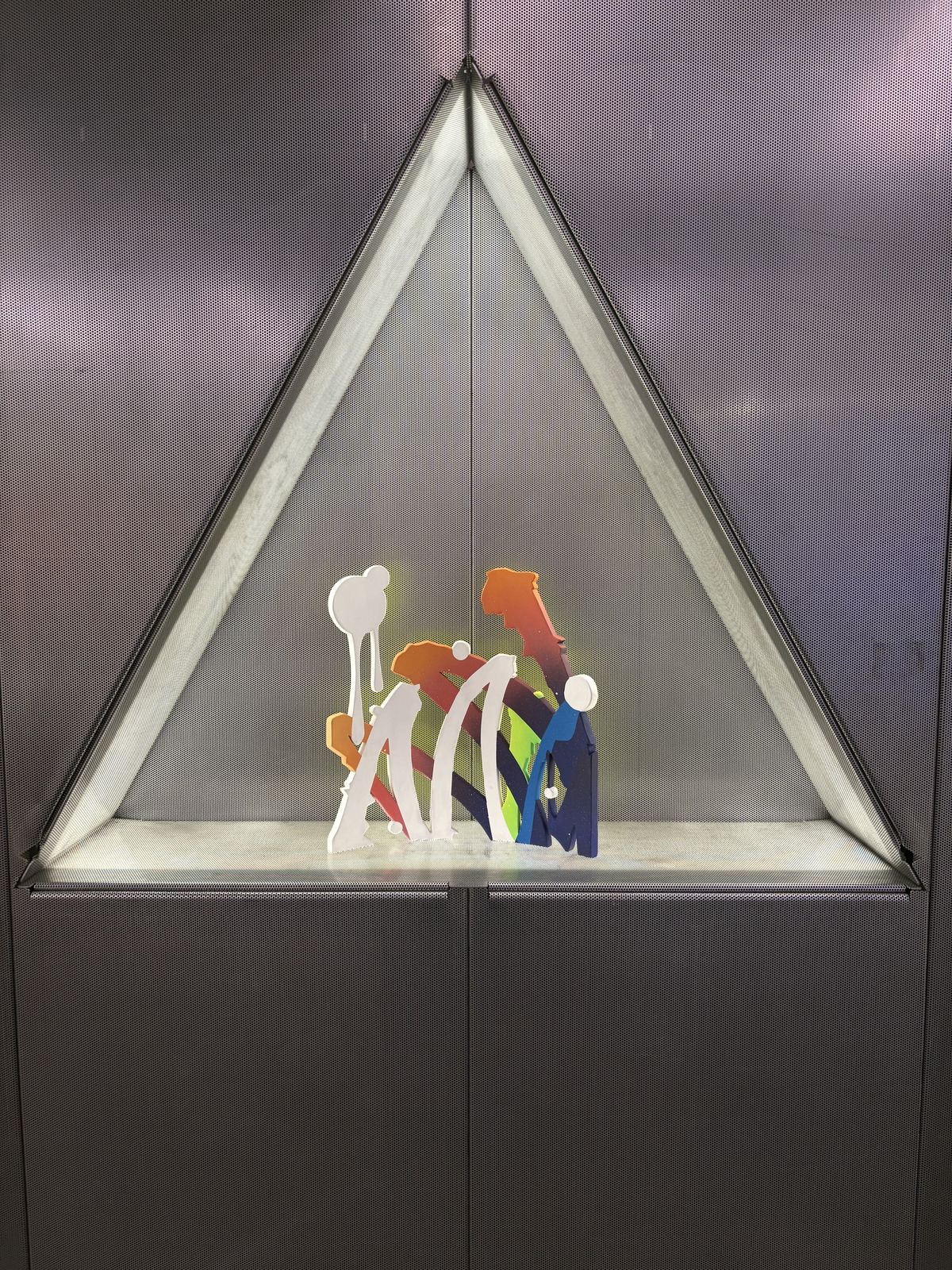 Yuya Saito (Japanese, b. 1982), FLOW_01, 2025, curved wood, acrylic. 24 x 24 x 6 in. (61 x 61 x 15.2 cm.)
Shinji Murakami, who coincidentally shares the same surname as Takashi Murakami, is a leading example of a younger generation Japanese artist whose work falls in line with Takashi Murakami’s Superflat, a Japanese style of art known for its literal flatness of aesthetics but also conceptual flattening of distinctions between Japanese and Western cultures. Murakami delves into the legacies of ukiyo-e, a form of woodblock art commonly associated with historic Japanese artistic conventions dating back to the 18th & 19th Centuries, by transferring its aesthetics into new media. LED matrix panel works showcasing an intricate network of electronic grids, switches, bulbs, and other technical features are moving image works in which colorfully abstract, atmospheric landscape scenes based on the traditional ukiyo-e style are saturated in garish shades that routinely shift positions or change colors across each screen.
The simplified, pared down distant trees are brought into three-dimensionality in small-scale monochromatic sculptures that evince a commercial kitschiness to them. But Murakami does not stop here as he brings these ideas into another dimension - that of video games via a converted retro Atari device in which users may switch the abstracted landscape scenes at their own pace with the aid of a joystick. The ukiyo-e landscape has been revered for its two-dimensional spatiality in the painted form, but Murakami’s work here demonstrates how its aesthetics have evolved into new media, particularly through methods most digestible and accessible for a wider audience: video games, commercial-esque sculptural simulacra, and moving image displays.
 Installation view of Shinji Murakami's "video game" display at GoCA

Liam Otero
Liam Otero is a freelance art writer in NYC. He was recently named New York Editor of Whitehot Magazine.
view all articles from this author



