Whitehot Magazine
October 2026
"The Best Art In The World"
"The Best Art In The World"
October 2026
Dynaton: Convocation of Radiant Beings at Château Shatto
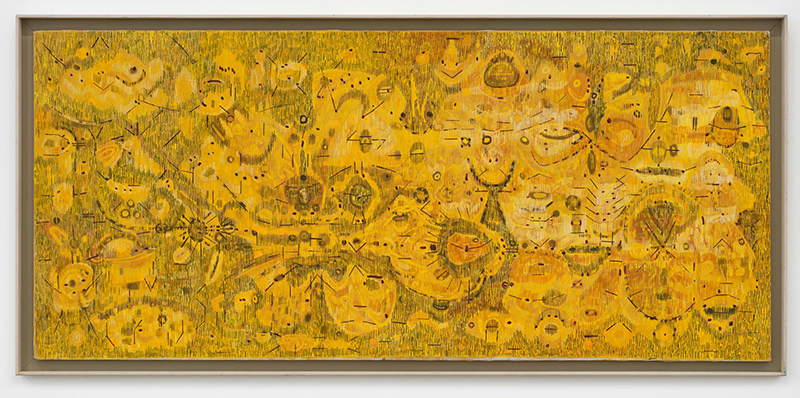 Lee Mullican, Tide of the Mud Sun, 32 x 72, 1950, photo courtesy of Château Shatto
“The West was a place where latent possibilities emerged like mutations …”
—Rebecca Solnit, A River of Shadows: Eadweard Muybridge and the
Technological Wild West
By GARY BREWER July 8th, 2026
California has been a seedbed for novel ideas and experiments in living since the beginning of the 20th century. The Bay Area in particular was a center for social experiments and rebellious spirit expressed in the Bohemian culture between WWI and WWII, then the Beatniks with Allen Ginsburg’s poem Howl and Lawrence Ferlingetti’s bookstore City Lights in the 1950s, to the Summer of Love in 1967. The openness of the atmosphere made San Francisco a perfect place for artists to express their aspiration for a spiritual dimension to painting and sculpture.
The 1951 exhibition Dynaton at the San Francisco Museum of Modern Art represented a group of artists who aspired to create a radical artistic fusion of spirituality, quantum mechanics and Indigenous beliefs. They expressed these ideas through rhythm, light and color in dynamic abstract paintings and sculptures. Many of these artists had found their spiritual origins in the experiments of Surrealism and the ideas of André Breton. The current exhibition at Château Shatto—including artists Wolfgang Paalen, Gordon Onslow Ford, Lee Mullican, Jeanne Reynal, Alice Rahon and Luchita Hurtado—is in part a re-creation of the 1951 exhibition, skillfully curated by Laura Whitcomb with support from the Lucid Art Foundation and the Hurtado Mullican Estate.
“Dynaton” is derived from the Greek word dyn, meaning “force” or “that which is possible.” Influenced by quantum mechanics, the 20th-century movement expressed a new understanding of a universal life force that was not a fixed and stable reality that we perceive, but one with infinite states of possibility. Wolfgang Paalen believed that human perception was deeply linked to a cosmic texture of latent possibilities.
Paalen was born in Vienna to a wealthy family. He was deeply educated in the intellectual traditions of European thought and philosophy. He studied archaeology and developed a fascination with ancient myths and archetypes. This would have a profound influence on his ideas about art and spirituality. He was close to, and worked with, some of the major artists of the early 20th century: Marcel Duchamp, Man Ray, Salvador Dalí and André Breton. His theories, writings and lectures would have an important influence on the Abstract Expressionist painters of the New York School. Paalen was in many ways the main architect of the ideas that shaped the Dynaton group. He was married to Alice Rahon, a poet and painter, and later to Luchita Hurtado, both artists part of Dynaton.
While living in Mexico he met the British-American artist Gordon Onslow Ford, whose affiliation with Surrealism, relationship with André Breton and interest in the spiritual dimension of art brought them together in a creative union. Paalen moved to the Bay Area, where Onslow Ford introduced him to the painter Lee Mullican. Their shared ideas and influences inspired the three artists to form the short-lived Dynaton group. During this time they all lived together in a home in Mill Valley, California.
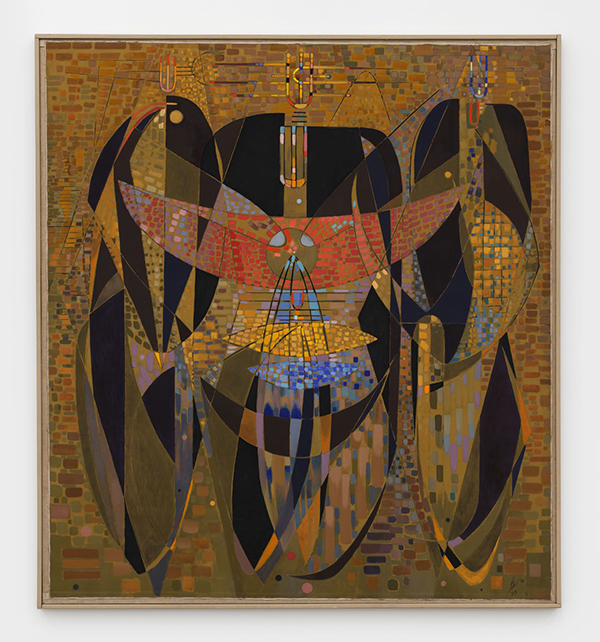 Wolfgang Paalen, Messenger from the Three Poles, 1949, 90 x 81.5 inches, Photo courtesy Château Shatto
Paalen’s large-scale painting Messenger from the Three Poles (90x81.5 in., 1949) is a powerful work, suggesting a totemic figure that holds one in its grip. The artist’s study of pre-Columbian art as well as European abstraction feel integrated into the painting’s design, all of its parts forming a singular gestalt. One can sense his belief that art could be a form of ecstatic ritual connecting our psyche to a genetic memory. For Paalen, art was a form of ancestor worship.
In Les Cosmogones (96x93 in., 1944), another painting by Paalen, rhythmic patterns animate the surface, its Dionysian energy softened by the subdued earthy palette. In it one feels the artist as conjurer, seeking to awaken all spirits and beings. The concept of quantum mechanics that the reality we perceive is not fixed and stable, but one of many possible states, is beautifully expressed in this painting’s metamorphic fluidity. Paalen was a seeker who believed that art could open consciousness to higher states of awareness. For him, myths and symbols were living, animate presences; his was not art for its own sake, but art as way to connect us to a spiritual world.
Gordon Onslow Ford and his wife, the writer Jacqueline Johnson, lived in a small village in Mexico for six years. During that time they met Paalen and his wife, Luchita Hurtado. They had an immediate connection, as Onslow Ford had been the last member invited into the Surrealists by André Breton. All four shared an interest in science, spirituality and Indigenous art as well as a desire to forge a new synthesis of the possibilities that Surrealism had opened up.
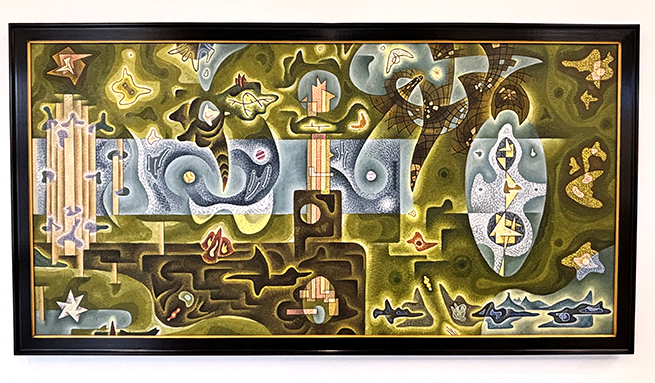 Gordon Onslow Ford, Luminous Land 41 x 83 inches, 1943, Photo credit Gary Brewer
The dynamic painting Luminous Land (41x83 in., 1943) manifests the influence of the Mexican muralists and pre-Columbian art. Onslow Ford’s sensitivity as a colorist is beautifully on display, something he would shift away from in his late black-and-white paintings. Gradients of moss green, sky blue and earthy brown traverse the surface in individual dabs of paint, creating a scintillating field of energy. In this ambitious work we see many of the elements at play in his imagination: abstraction, cosmic galactic swirls, biomorphic forms suggesting microscopic life, and totemic pre-Columbian shapes drawn from architecture and sculpture. It is a primordial code of the myriad forces that have shaped consciousness through time. Onslow Ford’s wife, Jacqueline Johnson, was an integral part the Dynaton group as a writer, articulating their ideas and philosophy in numerous essays and catalogues.
Lee Mullican met Gordon Onslow Ford through a serendipitous—perhaps fated—path. Onslow Ford had a solo exhibition at the SFMOMA, and his catalogue was created in a print shop where Mullican worked. One of Mullican’s paintings was on the wall, and Onslow Ford asked who the artist was. He later went to Mullican’s studio, and a spiritual kinship became apparent. He introduced Mullican and Paalen, and an artistic alliance was formed.
After graduating from the Kansas City Art Institute, Lee Mullican enlisted in the military during WWII. While stationed in Hawaii he found a copy of Paalen’s magazine DYN at the library in the Honolulu Academy of Art and found himself influenced by his ideas.
In the military Mullican was assigned to learn topography and was trained as a mapmaker; this language would shape the direction of his work. Later, while working at a print shop, he came in contact with a tool of the trade, a printer’s-ink knife for spreading ink on a plate. The way that a thick line of the physical color could be applied and accumulate in rhythmic striations and patterns would guide his painterly technique and become the signature mark of his work.
In the painting Tide of the Mud Sun (32x72 in., 1950) Mullican’s poetic power is on full display. The field is filled with radiant cadmium yellow, applied with the edge of a palette knife or a printer’s-ink knife, achieving a textural surface that activates a somatic as well as a visual response. The surface pulsates with energy. Small black lines punctuate and animate the design, suggestions of beings peering back at the viewer from within the field. He creates a chiaroscuro effect from a darker undercoat of paint that has been laid down first, creating barely discernible patterns. The darkness of the under painting generates luminosity in the strident yellow lines. One can feel Mullican’s interest in the Indigenous art of various cultures. There is an animistic spirit in his paintings, and a fearless expression of spiritual optimism.
Luchita Hurtado was born in Venezuela. When the group first formed, she was married to Wolfgang Paalen, whom she would later divorce, then marrying Lee Mullican. This would fatefully lead to her recognition late in life and her work appearing in major museums and galleries.
In 2015, during research to organize Lee Mullican’s archives, researchers came upon many paintings, stored along with his, bearing the initials “L.H.” The strength of these artworks led to renewed appreciation of Hurtado’s work: At 95 she became an art star and had the good fortune to live another five years to enjoy it.
Though Hurtado’s work was not included in the 1951 Dynaton exhibition, curator Laura Whitcomb chose to champion the work of several women who were involved as artists with the philosophy and ideas of the Dynaton group, including Hurtado, Alice Rahon and Jeanne Reynal.
Untitled (9x40.5 in., 1947) by Luchita Hurtado is one of her small works on paper. Using bold patterns reminiscent of Northwest Coast art she has created a handsome long, horizontal abstract work that captures the group’s interest in the power of form, pattern and energy to affect consciousness. She used crayons, wax resist and ink to activate the surface with a method that yields unexpected results. Though humble in scale and technique, it is a strong expression of her journey as an artist exploring different paths in her long career.
Alice Rahon was a Surrealist poet born in France. In 1939, she moved to Mexico with her then husband, Wolfgang Paalen, became close friends with Frida Kahlo and Diego Rivera, and began her career as a painter there.
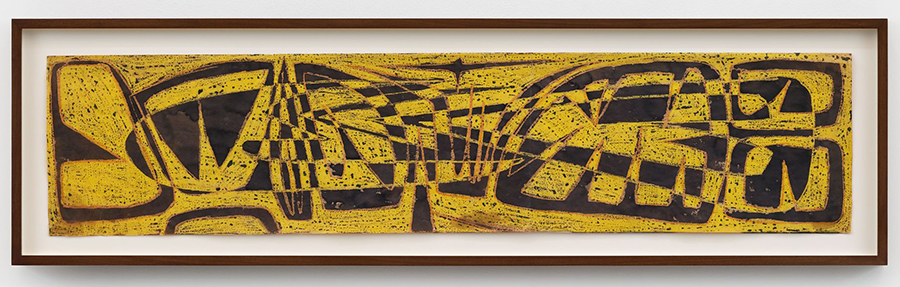 Luchita Hurtado, Untitled, 9 x 40.5 inches, 1947, Photo courtesy of Château Shatto
Untitled (17x22 in., 1950) has an intimate scale, a deep red field with softly scumbled black passages that create a billowing effect or a sense of undulating energy. Within this space, three black circles of varying sizes hover planet-like. It conveys both a feeling of celestial bodies afloat in dark matter, and a subjective state of consciousness; one can sense Rahon’s desire to reveal something that is hidden.
Jeanne Reynal, influenced by the Abstract Expressionist painters, reinvigorated the ancient art of mosaic, innovating new techniques and bringing a deep sense of mythic totemic forms to her mosaic art.
A small piece by Reynal gives us just a glimpse of the artist’s powerful works. Untitled (11x12 in., n.d.) suggests a bird-like entity, maybe a firebird held in the physical materiality of this mosaic, glass and leather icon. The abstract image also alludes to the shape of larger physical sculptures that Reynal created and covered in mosaic.
Works by several other artists who were connected through friendship or a spiritual/aesthetic alliance are included in this illuminating exhibition: Harry Partch’s unique handmade instrument, a drawing by Roberto Matta, and a beautiful work on paper by Leonora Carrington.
This exhibition offers an opportunity to embrace the origins of many early 20th-century artists whose work was influenced by spirituality. Painters such as Mondrian, Kandinsky and Malevich were all informed by ideas from theosophy, P.D. Ouspensky and other sources. Their art was reduced to a formalist interpretation where the novel forms within a work’s objective structure were the critical achievement. Art critics and theorists such as Theodor Adorno, Clement Greenberg and Rosalind Krauss espoused the idea of “art for art’s sake.” Krauss once wrote that it would be “embarrassing to mention art and spirit in the same sentence.”
As we currently reach the boundaries of understanding in science—from the complexities of quantum mechanics questioning the nature of reality and challenging our once-firm belief in the veracity of our five senses, to the mind-boggling attempt to understand our universe with its incomprehensible scale and forces of dark matter—the dominance of a purely rational, mechanistic interpretation of our reality has become more porous.
The popularity of recent exhibitions of Agnes Pelton and Hilma af Klint reveal how hungry viewers are to be engaged with art that delves into the mystery of consciousness and the shadowy nature of reality. Curator Laura Whitcomb is a scholar and researcher into these currents of thought. This exhibition would not have been possible without her commitment and passion that have brought together this convocation of radiant beings.

Gary Brewer
Gary Brewer is a painter, writer and curator working in Los Angeles. His articles have appeared in Hyperallergic, Art and Cake, and ART NOWLA.
Email: garywinstonbrewer@gmail.com
Website: http://www.garybrewerart.com
view all articles from this author