Whitehot Magazine
September 2026
"The Best Art In The World"
"The Best Art In The World"
September 2026
“It’s A Totally Artificial World:” Kathleen Beausoleil and the Possibilities of her Fairgrounds
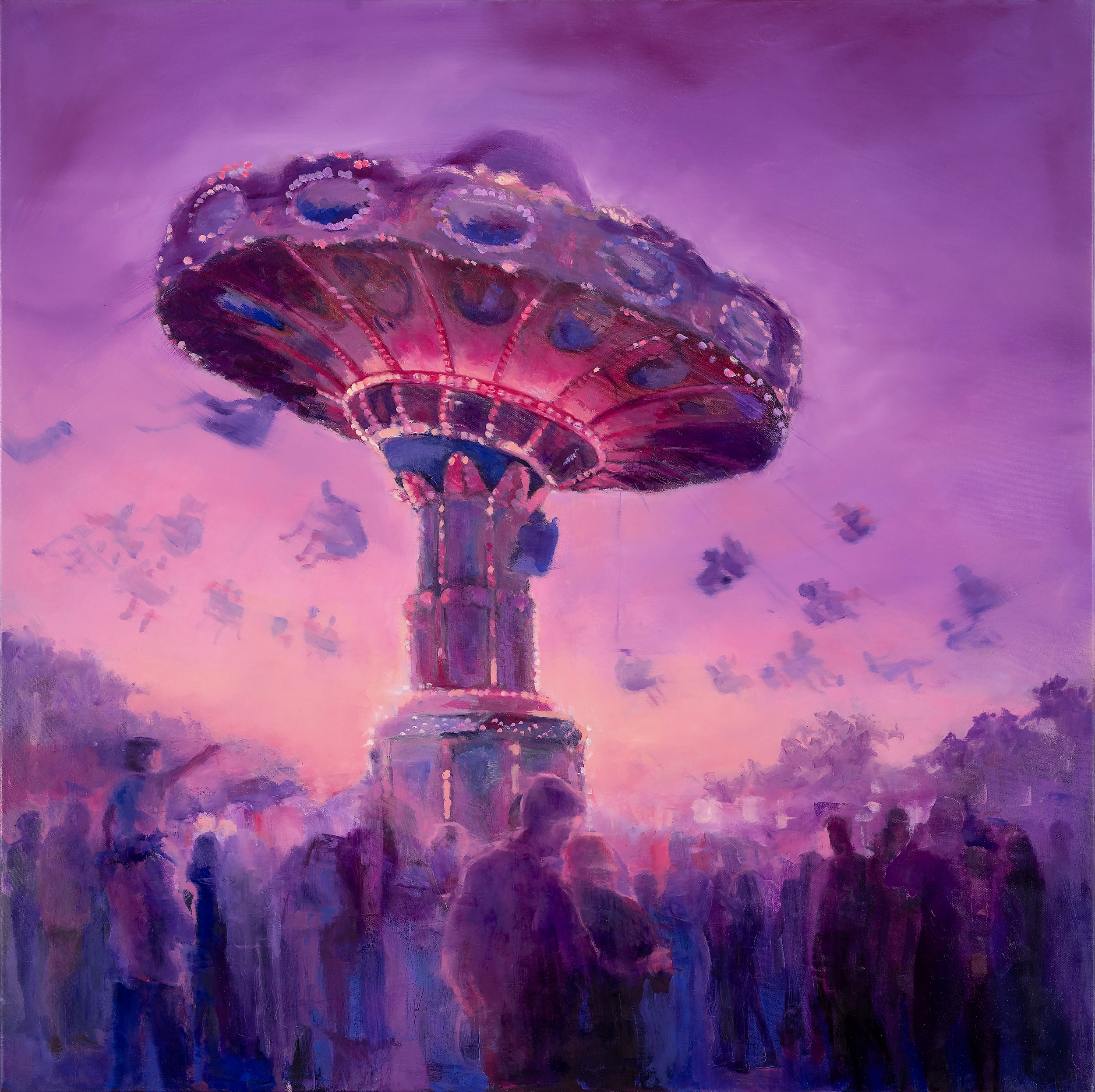
Kathleen Beausoleil. Turning Towards Light, 2026. 36 x 36. Oil on Canvas. All images courtesy of the artist and The Painting Center.
By Anna Mikaela Ekstrand, September 24, 2026 at 2:02pm EST
“This season, I made it to three fairs,” Kathleen Beausoleil tells me over Zoom, “last year I went to at least seven,” she clocks her head, continuing to count silently, “actually nine.” Beausoleil has spent all her life on the Jersey Shore and has for the past two decades painted its vibrant fair ground culture. She has developed a relationship with a couple fair operators—the family run Majestic Midways is one of them—and arrives with her easel to paint plein air at the fairs each year. The works combine vignettes, life and photos, collaged together, resulting in observations where the speed of a ride, the smell of salt water, and the intimacy of people shines through. Often with an aerial perspective her pieces offer a glimpse into the magical, light-filled, world of the fair.
The fair ground is deep seated in the folklore of the United States, a staple of Americana. In the nineteenth century, P.T. Barnum popularized public museums and large spectacles, setting up tents around the country, one which he called The Greatest Show on Earth. The Wisconsin brothers Ringling soon followed, starting their own traveling circus. These shows were predecessors to the traveling fairs centered around a midway of temporary rides and games. In 1906, the hamlet of New Jersey Fair Haven organized its first fireman’s fair, to raise money for the local fire house. “Our Fair Haven fair has a bit of a record,” Beausoleil chuckles, it has run nearly every year since, pausing only during World War I, World War II, and due to the restriction on gathering during the COVID-19.
In the early days, there were tight rope walkers “and all of that,” Beausoleil explains. Referencing some archival photographs currently at the firehouse. Her plein-air painting sessions at the fairs are motivated by a will to record and archive contemporary experiences capturing something that is usually word-of-mouth and in the local public imagination and memory.
“By painting them, I elevate the simple everyday moments that shape our lives,” she explains. Recalling that she gets commissions and calls from collectors in Nevada and Colorado who have heard of ‘the lady who paints the fair.’ Some have been put up in homes, others in bars, most people, she explains, connect to their sense of nostalgia and appreciate the gesture of honoring little moments of joy. In Midway Moment, Beausoleil has captured the Midway area of Fair Haven Fireman’s fair at night; lights from the rides reflect and spill into the dark blue sky, and it is hard to place a perspective. Semi-bird’s eye, we are not together with the figures who stand around casually in the frame, but not wholly separated from them either.
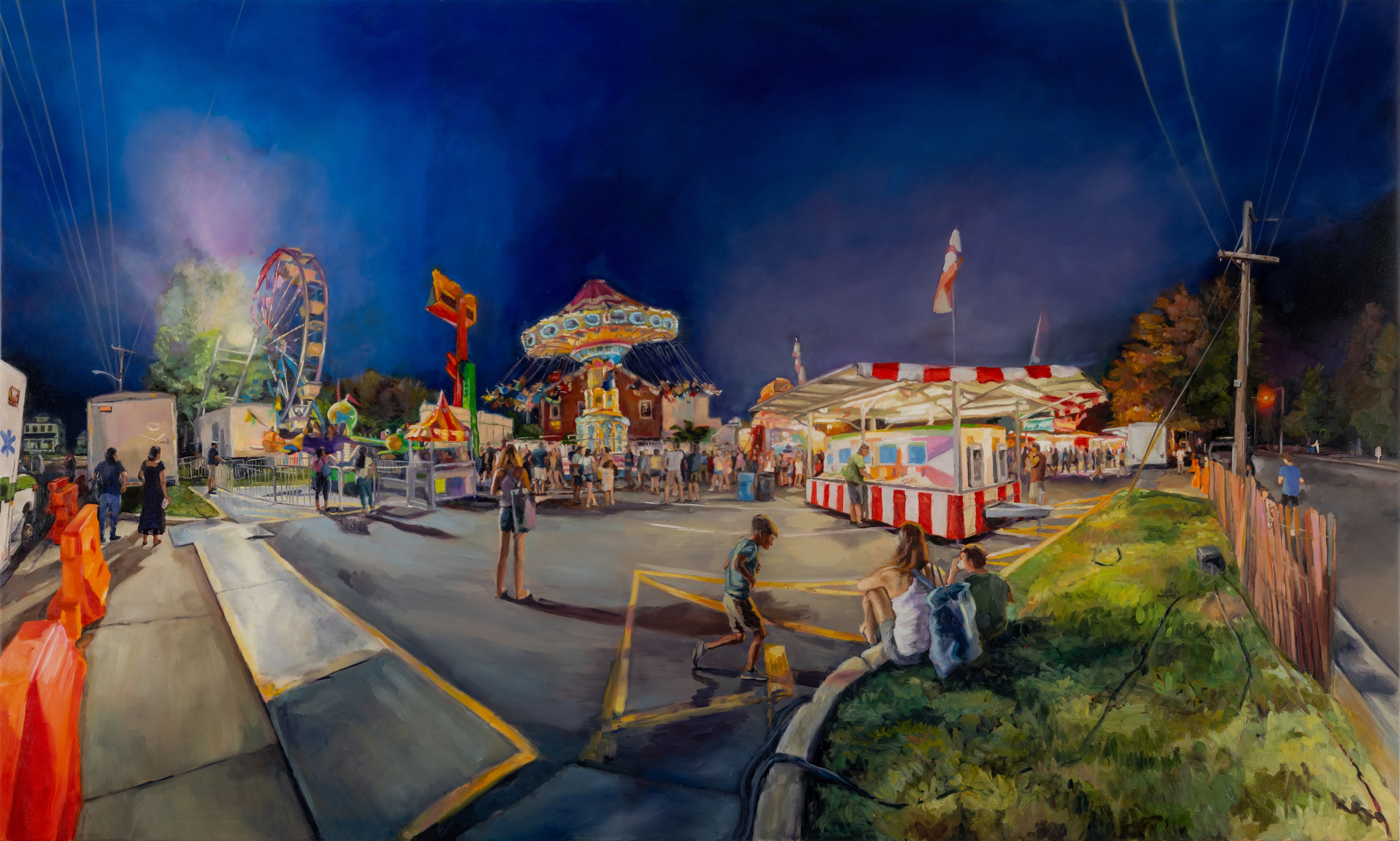 Kathleen Beausoleil. Midway Meeting, 2026. 36 x 60. Oil on Canvas.
“There’s a kind of specific unspecificity that I’m interested in—you can see people, relationships, and little stories unfolding, but I deliberately don’t give the viewer too much detail,” she explains leaving room for viewers to bring their own memories and experiences to the work. This ambiguity is also present in Beausoleil’s depiction of light, especially the transition from day into night. “The sky often establishes the time and mood, while the artificial, saturated lights of the rides begin to take over as daylight disappears,” she continues. The result is a tension between natural and artificial, encouraging viewers to ponder time as fleeting.
Now the Fair Haven fair is run by the Fair Haven Fire Company with rides provided by Majestic Midways, in addition to rides, games, and food, it boasts a car auction and a 50/50, to raise money for the firehouse. Teenagers in the community volunteer to work in the restaurant. Important work experience for their future employments and studies and a great way for parents to see their kids at work, Beausoleil adds. The teachers for the incoming school class are announced on the first day of the fair and students meet their teachers who volunteer in the ticket booths. “I love the fact that in a world that is divided, the fairground brings people together across generations, cultural values, and traditions. You convene with your neighbors who might have different political views, and share in the fun together,” She explains. Continuing to share that there is much science that backs up the importance of community gathering to benefit mental health.
The exploitation of fairs and circuses from yesteryears have been replaced by more intentional local community building and international exchange. Most paid staff at these fairs are young guest workers from abroad. They spend around three months on the beach to work and party, some make a little money to bring home, others spend it all, coming only for the experience. I met one on a flight from Belgrade this summer, he was excited to take a break from his engineering studies to work on the shore.
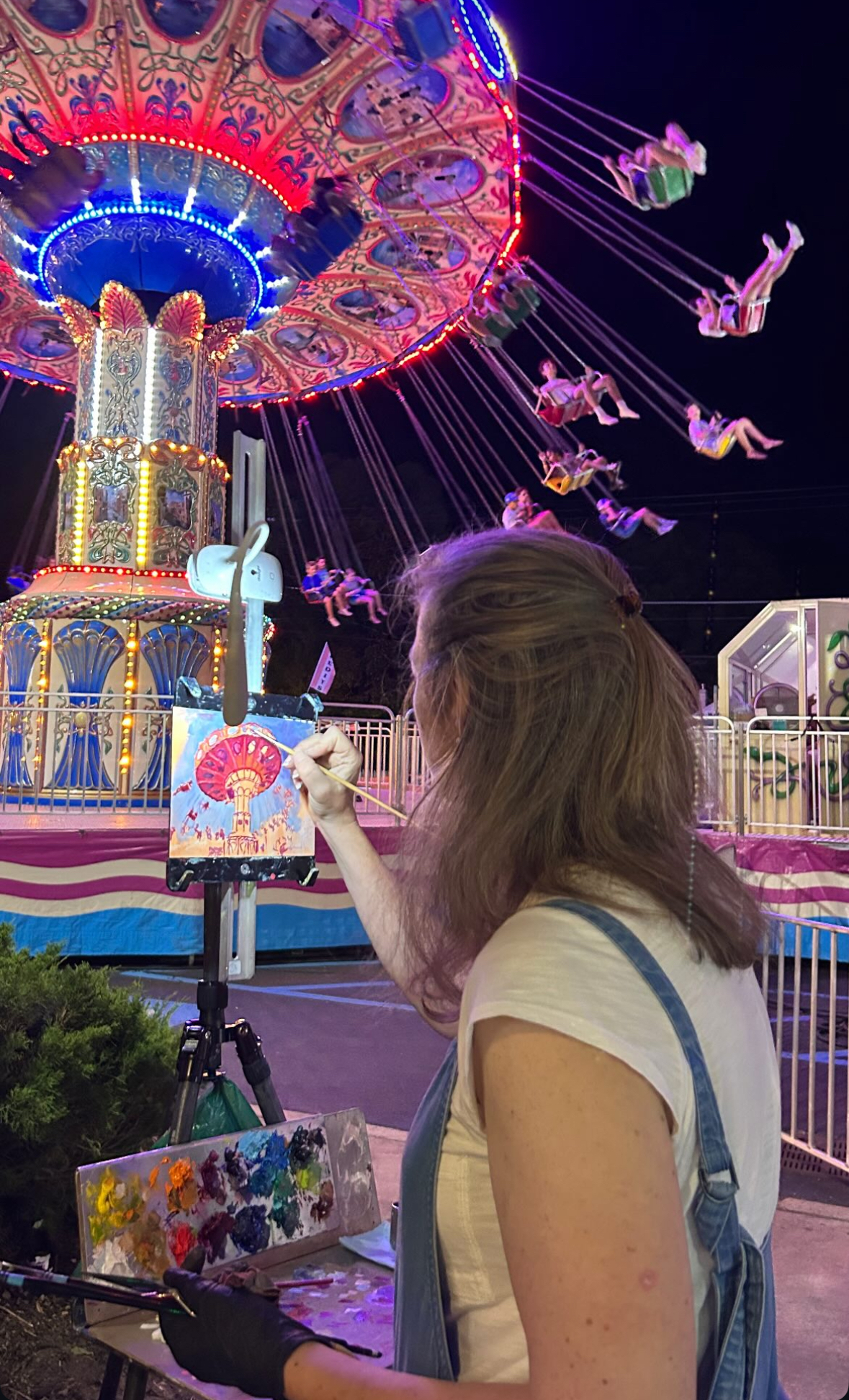 Kathleen Beausoleil, 2025.
“It is totally an artificial world,” Beausoleil muses.
The reason she only visited three fairs this year is a broken shoulder. She beams at me pointing the camera down and turning her wrist happily on camera. Her right arm is in a sling, her shoulder immobile from a mishap when her dog sprinted during a walk—”I might have to let them out in a bit,” she chirps—but her wrist is fine. Many artists would despair with their most prized tool, their painting arm, out of commission, but Beausoleil has found the silver lining. Specifically she cannot move the shoulder of her painting arm, so she is now painting smaller works at hand level, a couple which will be on view in her next solo show Meet at the Ferris Wheel at The Painting Center.
“I am a firm believer in community and together we raise each other up,” she says. The Painting Center is a non-profit membership based gallery, strongly rooted in building community within the arts. In Orbit of Adolescence (2026) a rollercoaster vrooms by, a child reaches out their arms, their face obfuscated due to the speed. In her show Beausoleil will exhibit that and twenty some other works, from the magic of the fair ground. Begging viewers to use her oil paintings as a portal to reflect on the rituals of gathering, places they might return to year after year, and to reignite memory and recognition.
It’s weird, after living in New York for over a decade, this summer marked the first time I visited the fairs on the Jersey Shore. Interviewing Beausoleil felt like kismet—fitting the magical aura of the fairs themselves. Overall, Beausoleil is interested in group dynamics and capturing places where intimate and public collapse. Beaches are another motif she has dug into. Recently, during football season, Beausoleil has attended games and painted cheerleaders and football players. Last season, she painted a player whose numbered Jersey was visible: “The number had been in the family for three generations, they were delighted and it was incredible to capture this moment for the family.” Internal family dynamics and joy are displayed on the sidelines, for all to see. Am I in a Taylor Swift song? I think to myself.
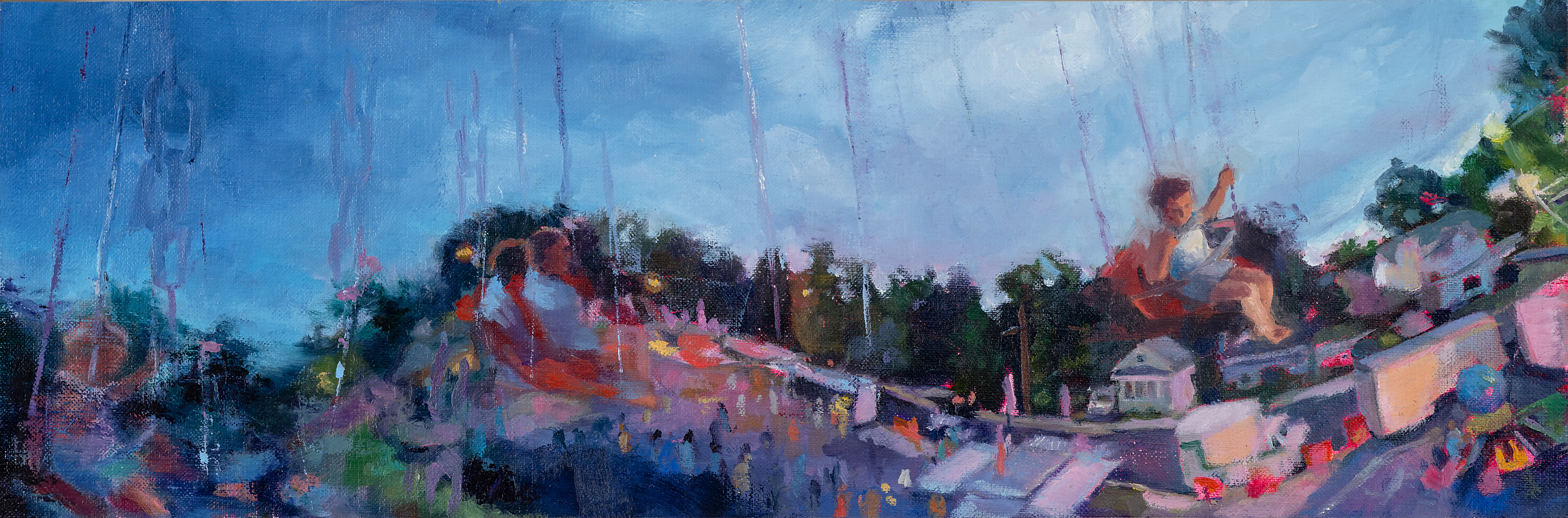 Kathleen Beausoleil. Orbit of Adolescence, 2026. 6 x 18. Oil on Linen.
This winter, she is considering painting local ice boat racing. Where residents put skates on boats. They will harken back to the seventeenth century Dutch painter Hendrick Avercamp who painted winter scenes from his second story bedroom. Beausoleil is drawn to his works of “silly vignettes, where you see connections in the crowd, people looking at each other.” The five different types of crowd dynamics interest her, and its counterpart, isolation, and she has explored them all in natural, beach scenes, and protests, on view at Monmouth Museum in 2022, Galerie Lucida, and The Cornelius Low House Museum respectively. Avercamp’s Colf Players on the Ice (c. 1625) opens at the Stedelijk Museum on October 3 (opinions differing if it shows an early version of golf) and is expected to draw both national and international crowds. Through vibrant color and blurred movement Beausoleil's work capture that fiery energy that fairgrounds and sports bring out of both participants and onlookers.
Beausoleil tells me about a group of professional artists that she meets with every two weeks over Zoom and twice a year for in-person paint outs at the farms of two participants. ”We keep each other accountable. If we miss a goal we set for ourselves, a round of beer is on us when we meet next—but no one really keeps count.” It sounds like a warm and supportive group to meet with. For the paint-outs they hire models and cook together. “None of my work related to this,” she admonishes cooly. After we both log-off, I think that actually all of her themes are represented in this artists group and their work of gathering: building community, meeting, sustaining, having fun, being real, letting go, and holding on, all at once, while painting plein-air.
Kathleen Beausoleil "Meet at the Ferris Wheel" is on view October 1-24, 2026 with an opening reception on October 8, at The Painting Center, 547 W 27th Street, New York, New York, 10001,

Anna Mikaela Ekstrand
Anna Mikaela Ekstrand mediates art through writing, curating, and lecturing. Her art criticism is published in Cultbytes, BOMB, Artspiel, and Artefuse, among others. Her latest books are Assuming Asymmetries: Conversations on Curating Public Art Projects of the 1980s and 1990s and Curating Beyond the Mainstream both published by Sternberg Press in 2022. She is co-curator of The Immigrant Artist Biennial 2023: Contact Zone and the organization's Associate Director.
view all articles from this author