Whitehot Magazine
October 2026
"The Best Art In The World"
"The Best Art In The World"
October 2026
Rose Wylie’s Henri, Egypt…Bette, Bear at David Zwirner Paris
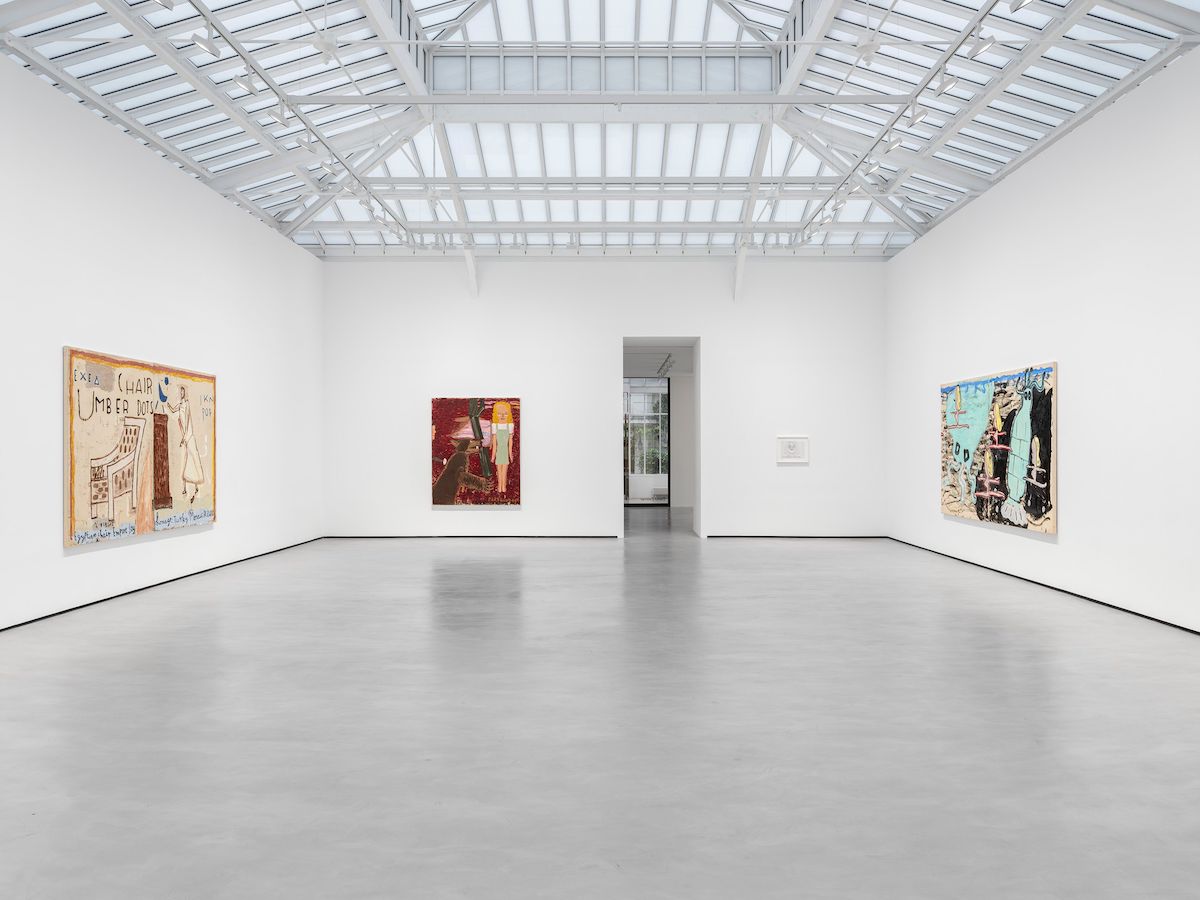 Installation view, Rose Wylie: Henri, Egypt…Bette, Bear, David Zwirner, Paris, 2026. Courtesy of the artist and David Zwirner.
By ISABELLE BERGMANN May 20th 2026
Saturday marks the finissage of Henri, Egypt…Bette, Bear by Rose Wylie at David Zwirner Paris. Her eighth solo exhibition with the gallery—and first in Paris—the presentation gathers recent works across monumental multi-paneled canvases, their sprawling surfaces unfolding alongside more intimate works on paper tucked into the final room. I wonder whether they are private remnants of her studio, where stacks of newspapers rise toward the windows, doubling as palettes for oil paint before being swept into trash bags once they creep too close to the ceiling.
The exhibition unfolds across two temporalities at once. One belongs to historical narration, including an homage to Henri Rousseau’s Unpleasant Surprise (Mauvaise surprise) (1899–1901), refracted through the figure of Bette Davis. Elsewhere, references to foreign travel drift through memories suspended somewhere between archaeology and fantasy. Yet beneath these references runs another temporality entirely: that of immediacy and nomadic intimacy. Suddenly, I imagine myself standing in a pond where splashes of paint creep beneath my soles. Wylie’s paintings seem to absorb thought before it fully hardens into language, arriving instead as guttural, instinctive totems. Perhaps this is where the sublime emerges, not as spectacle, but as painting’s capacity to contain impulse itself, restoring to the image its ability to hold raw psychic energy.
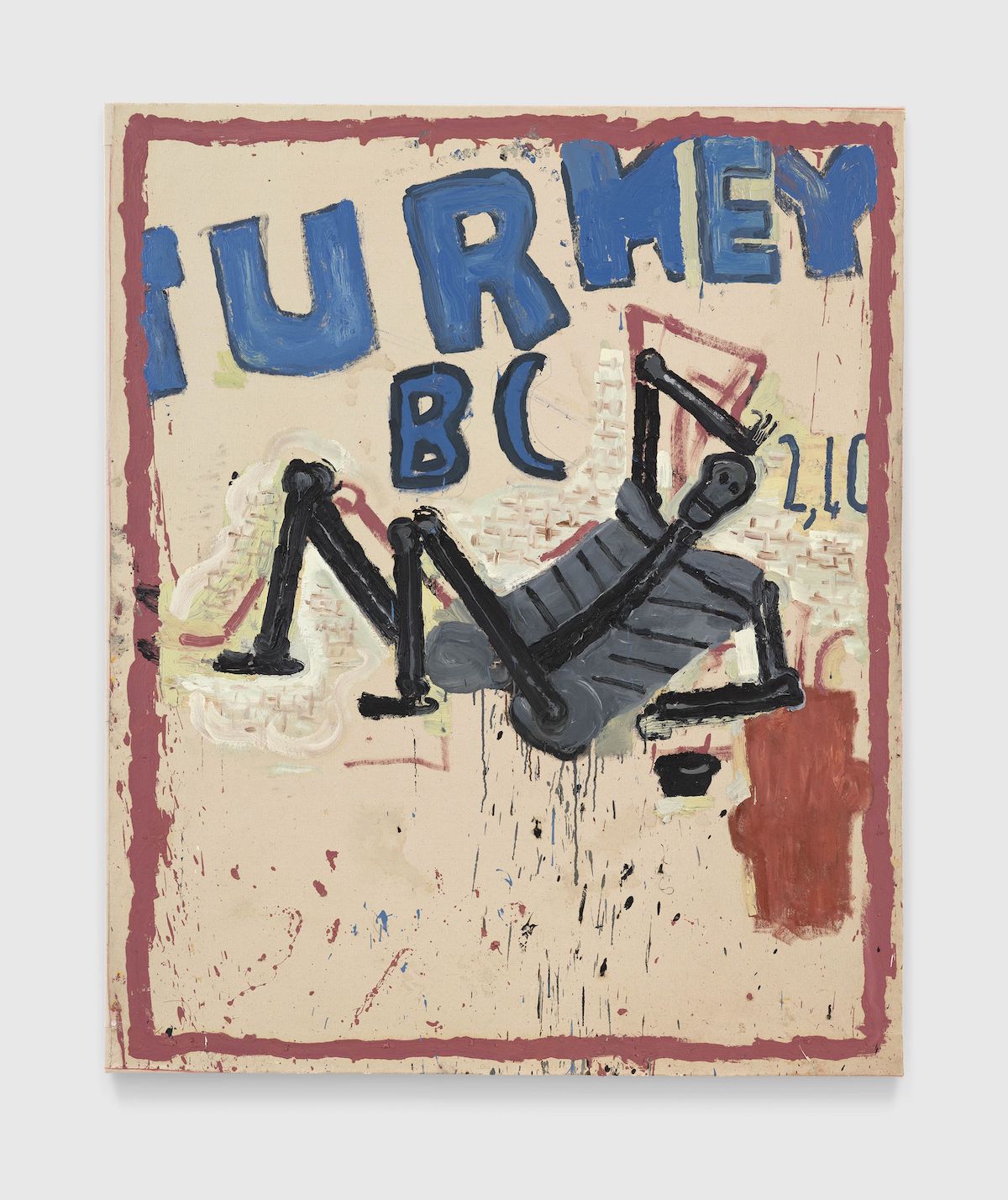 Rose Wylie, Black Skeleton, 2025. Courtesy of the artist and David Zwirner, Paris.
Painting distinguishes itself here as a medium uniquely capable of honoring the instability of perception. Memory, in Wylie’s hands, never appears fixed; it arrives fragmented, layered, constantly renegotiated through gesture. One mark produces the next. A canvas feels complete only when this chain of gestures resolves into its own internal necessity, as though the painting had uncovered a logic independent from the artist who began it. I imagine Wylie herself disappearing in her studio. The painting becomes the conductor of its own material. Standing before these monumental surfaces, I feel seven times smaller than them.
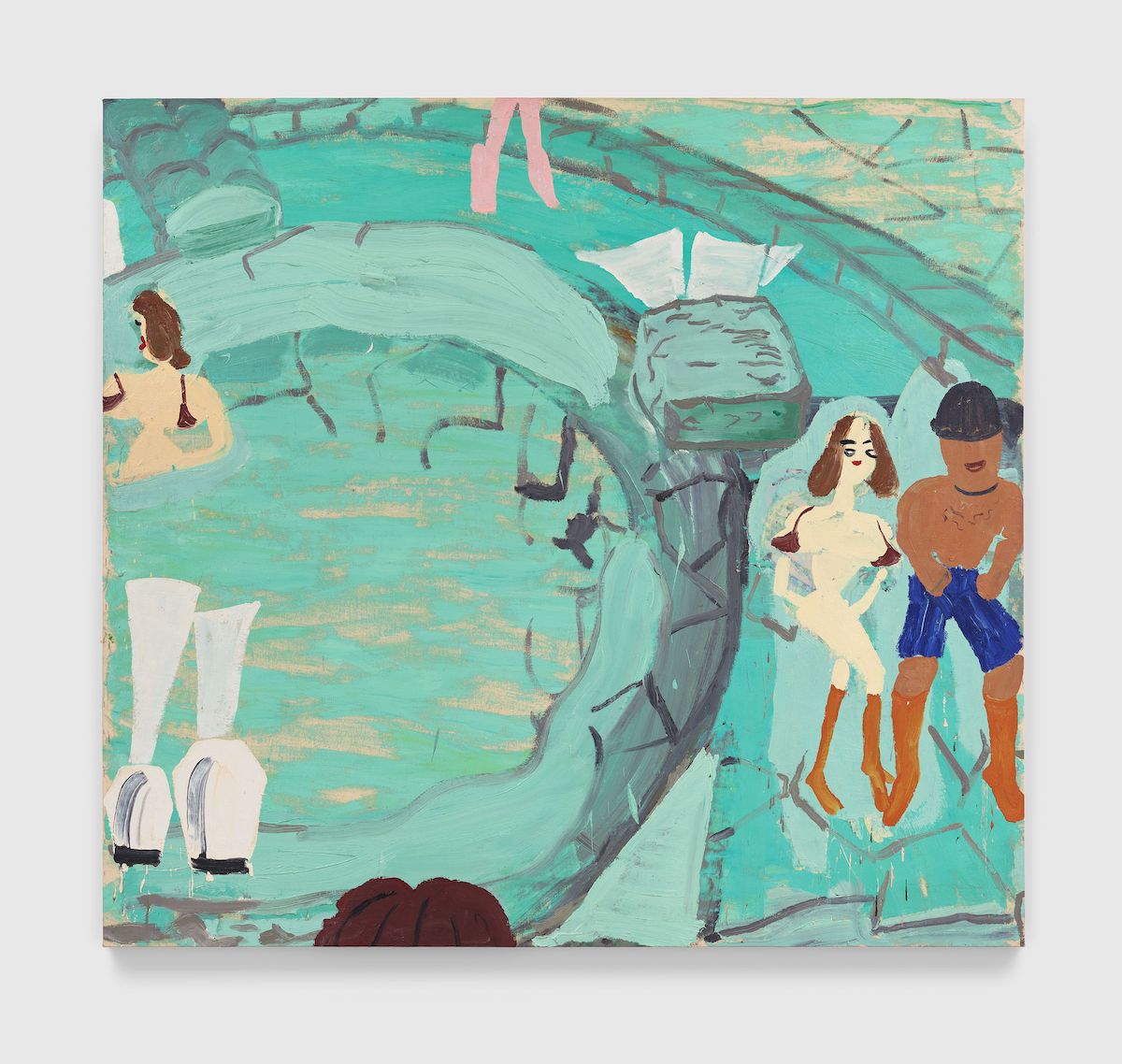 Rose Wylie, Manor, 2004. Courtesy of the artist and David Zwirner, Paris.
Sweeping my shoes across the gallery floor—hoping not to stain them with imaginary traces of paint—I found myself electrified by her visual punctuations pressing outward from the canvas like a body itself. Looking at these works, I had the strange sensation that Wylie had collapsed time into one continuous present. Each painting appears executed in a single inevitable movement, immediate in the purest sense. A rare event in painting—a medium that so often reveals its layered durations through oil, scale, and accumulation. The encounter returned me to a kind of beatitude, leaving me with a question that lingered long after I left the exhibition: what does it mean for an artist to absorb the essence of an environment with such immediacy that perception itself becomes indistinguishable from instinct?
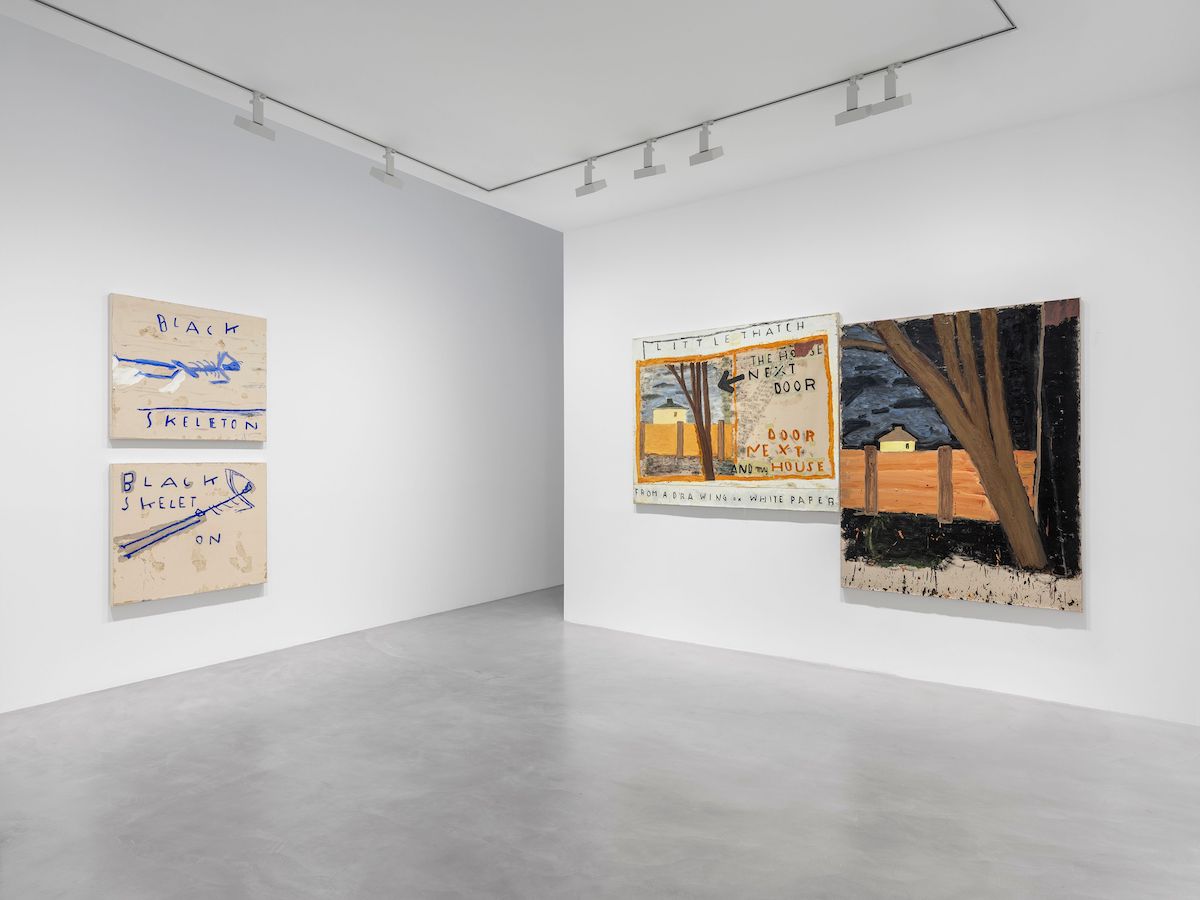 Installation view, Rose Wylie: Henri, Egypt…Bette, Bear, David Zwirner, Paris, 2026. Courtesy of the artist and David Zwirner.
From palettes recalling the surreal chromatic tensions of Dana Schutz to depictions of domestic objects—chairs, doors belonging to her neighbor, fragments of everyday life rendered almost mythic—Wylie’s exhibition leaves one with the persistent desire to return before it closes on Saturday. I finally found work that defends romance.
Rose Wylie’s Henri, Egypt…Bette, Bear remains on view at David Zwirner Paris, 108 Rue Vieille du Temple, through May 23.

Isabelle Ada Bergmann
Isabelle Ada Bergmann is a writer and former student of the Cooper Union, currently based in Paris.
|
view all articles from this author