Whitehot Magazine
October 2026
"The Best Art In The World"
"The Best Art In The World"
October 2026
Before Jeff Koons, Takashi Murakami and Damien Hirst got a lot of attention, there was Mark Kostabi
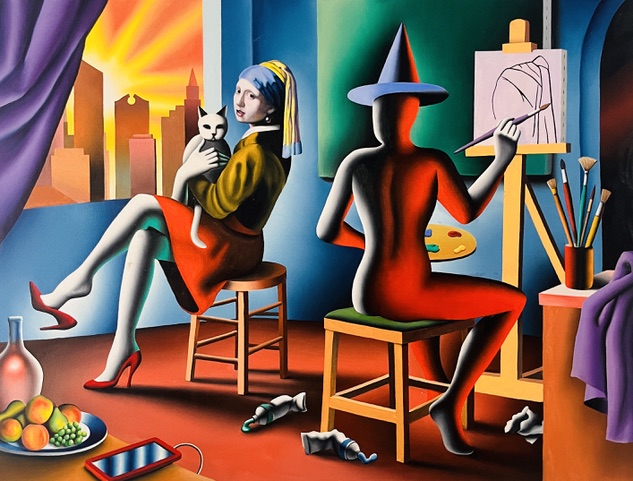 Mark Kostabi, Embracing Beauty and Light, 2024, Oil on Canvas, 100 x 130
By ANTHONY HADEN-GUEST July 13th, 2026
Mark Kostabi’s paintings almost invariably center around one or several figures, each with a featureless egg-like head, creatures which writers often call Kostabiman. This work has given him a double life but hardly in the secretive sense. In Rome, his longtime base, Kostabi is a pillar of the art world. Vittorio Sgarbi, a hefty Italian critic and art historian, has titled a book Kostabi from Giotto to Warhol. He has just had a substantial show at La Vaccheria, a museum space, has been made an honorary citizen of the neighboring town, Trevi, and he was recently commissioned to execute a bronze statue, a medum to which he was introduced by his late friend, the artist, Dennis Oppenheim, which is to be installed in a Roman plaza.
In New York though, where Kostabi launched his career and still shows regularly, it has been another story. This was where he created Kostabi World, in the 1980s, patterning it on Warhol’s Factory, and he also became known as as a columnist in art newspapers and an attention-getting provocateur, as when he wore a suit stitched with $100 bills to a People magazine party in 1988. He also got attention when he gleefully publicized his use of assistants, 29 at one point, through Name This Painting get togethers, and explained in his gossip columns, saying “With my assistants doing all of my work - I need something to do with my time”.
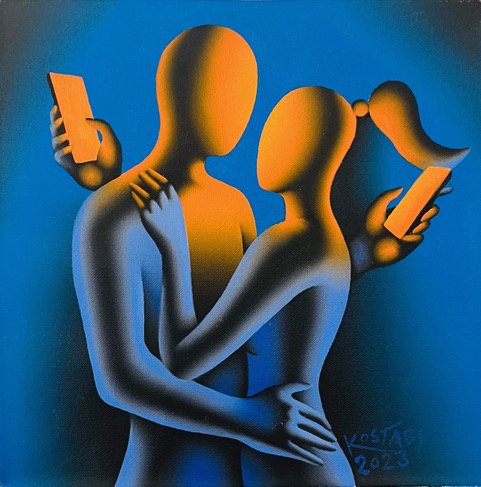 Mark Kostabi, Hold On, 30 x 30 cm, 2023
Had assistants truly played such a part in the actual painting, I asked?
“Totally,” Kostabi said. “I’ve made over thirty thousand paintings. And I painted a lot of those myself. But most of them were executed by assistants according to my instructions. So I use studio assistants in a big way and as you know, I got a lot off attention for that back in 1986/87/88. Before Jeff Koons, Takashi Murakami and Damien Hirst got a lot of attention for doing the same sort of thing”. This being true.
Another such jaunty provocation got Kostabi accused of being anti-gay. This though was untrue... I know Kostabi and he ain’t no homophobe, indeed believes, like most reasonable folk, that what consenting adults do with their bodies is their own business. But nothing, I think, will curb Kostabi’s tongue, nor prevent his provocations from bubbling. It’s as if they are a part of his work process. Which brings us directly to the art.
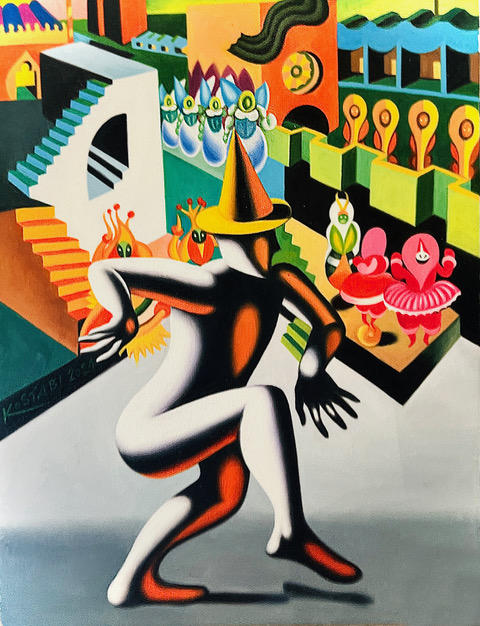 Mark Kostabi, The Soul of Via Poerio, 2024, Oil on canvas, 41 x 31 cm
We’ll begin with the heads. Giorgio de Chirico, the great proto-Surrealist, had sometimes painted such blank heads and I wondered whether this had been a source. Not so. “I developed the character on my own when I was an art student in the late 1970s,” Kostabi said, adding that he had discovered de Chirico’s work after moving from California to New York. “Since then I have made a lot of paintings inspired by de Chirico,” he says. “He is a big part of my visual vocabulary.”
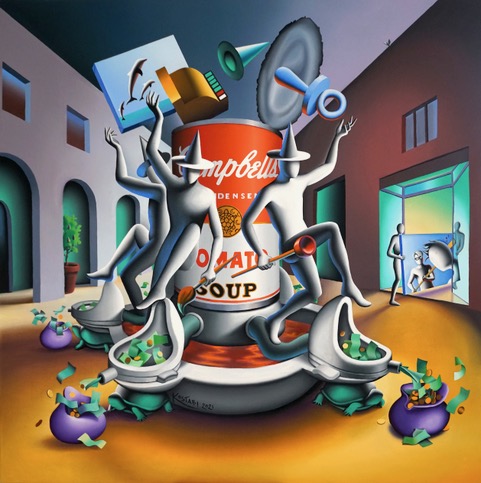 Mark Kostabi, Ideas are Drips from a Melting Brain, 2021, oil on canvas, 120 x 120 cm.
Indeed for Kostabi the art world as a whole has been a fruitful source of material for his own work. His Warholesque touches include painted Brillo pads, a Marilyn head, a Campbell’s soup can and he has referenced entire paintings, such as Velasquez’ Las Meninas and Edward Hopper’s Nighthawks. He also sometimes paints artlsts, painting, himself included, bnt not taking himself over seriously, as in Secrets of the Studio, in which he depicts himself painting four canvases by using of both hands and feet, attended by a young woman with a glass of red wine on a tray,
Kostabi has built other paintings around two characters, who are clearly offshoots.of Kostabiman, Migraine Man, and Pensive Girl and he makes frequent use of what he has developed as a pictorial vocabulary in his work. What, I asked, was the significance of the pointy witch hats frequently worn by his characters?
“The pointy hats have different meanings, depending on the context,” he said., “It could be a party hat or a witch hat and it can suggest wisdom. I love the basic shape. The basics of painting is all about shapes - tubes and cylinders and spheres. Geometric icons, I am attracted to that. But they do have meanings.”
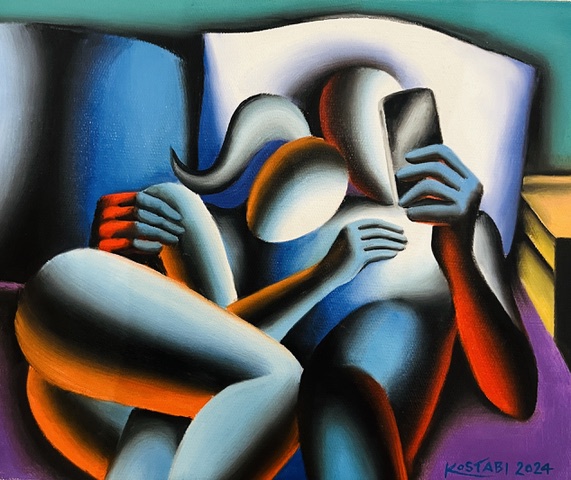 Mark Kostabi, Mutual Dreaming, 2024, Oil on canvas, 26 x 31,5 cm
What of the tech devices he clearly also loves to paint? Like the laptop in Mark My Words and The Writers Revolution. On another canvas, upon which a hand is holding an iPhone. “I started that when I was six years old,” he said. “I made drawings of computers. In 1982 I was painting Walkman radios and beat boxes, I was keeping up with technology back then, then going forwards to iPhones and AI.”
Kostabi also frequetly paints buildings, I observed. Very different buildings.
“I’ve always been drawn to buildings” he said. “I was a little kid in Southern California where all the houses were one storey, two storey, so when I moved to New York I was overwhelmed by these tall buildings and they became a major part of my visual vocabulary.”
Invariably though the dominant figure or figures in each painting will be Kostabiman or Kostabiwoman, humanoid presences, which brings me to what I consider an explanatiion for the strkingly different responses to his work in Rome and New York. When one looks at art in Italy the human figure is almost always a presence, and usually a dominant one. In New York though, abstraction largely rules, and this is the aesthetic which Mark Kostabi’s clusters of capering figures wholly disrupt.
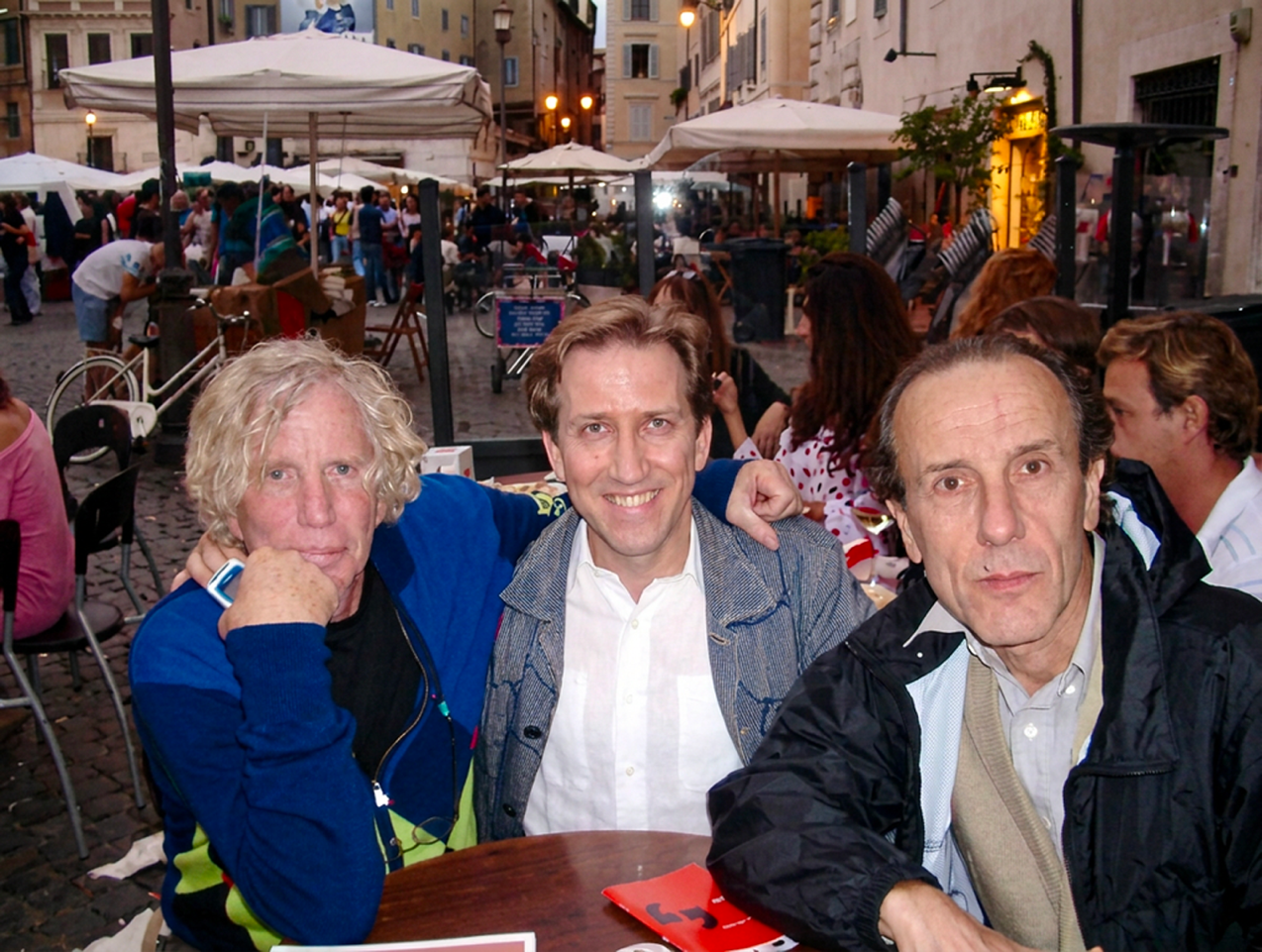 Dennis Oppenheim, Mark Kostai and Enzo Cucchi
So to a couple of singular elements in Kostabi’s work, the first being this. I have described the characters he paints as featureless. So do all writers on his work. The late Walter Robinson in his excellent book Mark Kostabi in the 21st Century, described them as “faceless automatons, human clones with no real identities of their own.”. Which is both true and not so. Mark Kostabi’s painterly skills are such that he can express what’s going on behind those blank faces through the use of shadow and a suggestive title but mostly by indicating emotion through his positiioning of the head, the arms, the torso, so these blank faces almost always communicate specific meaningg, such as bafflement in Lost In Translation and Under The Influence , expectancy in Breaking Free. and affection, heating up into desire in a slew of canvases such as Kaleidoscopic Reverie.
What I consider the most singular things about Kostab’s art though, an element I find unusual to the point of startling, is that his composition of each canvas is radically different. This was true of past artists, especially those with s story to tell, like the 16th century Brit, William Hogarth, but it’s rare in a time when an artist will develop a way of making work which works for them, and also for their dealers, their collectors, and will stick with it, until maybe moving on into something new.
This is not Kostabi’s way. One work may be dominated by an individual featureless Kostabiman - featureless that is, apart from an occasional nose - or by an entire cast of capering Kostabimen but the composition of each and every convulsive canvas will be different. And this is something one does too often see in art.
Anthony Haden-Guest
Anthony Haden-Guest (born 2 February 1937) is a British writer, reporter, cartoonist, art critic, poet, and socialite who lives in New York City and London. He is a frequent contributor to major magazines and has had several books published including TRUE COLORS: The Real Life of the Art World and The Last Party, Studio 54, Disco and the Culture of the Night.
view all articles from this author