Whitehot Magazine
September 2026
"The Best Art In The World"
"The Best Art In The World"
September 2026
Starting at the End: Roy Lichtenstein: 1997 at the Whitney Museum of American Art
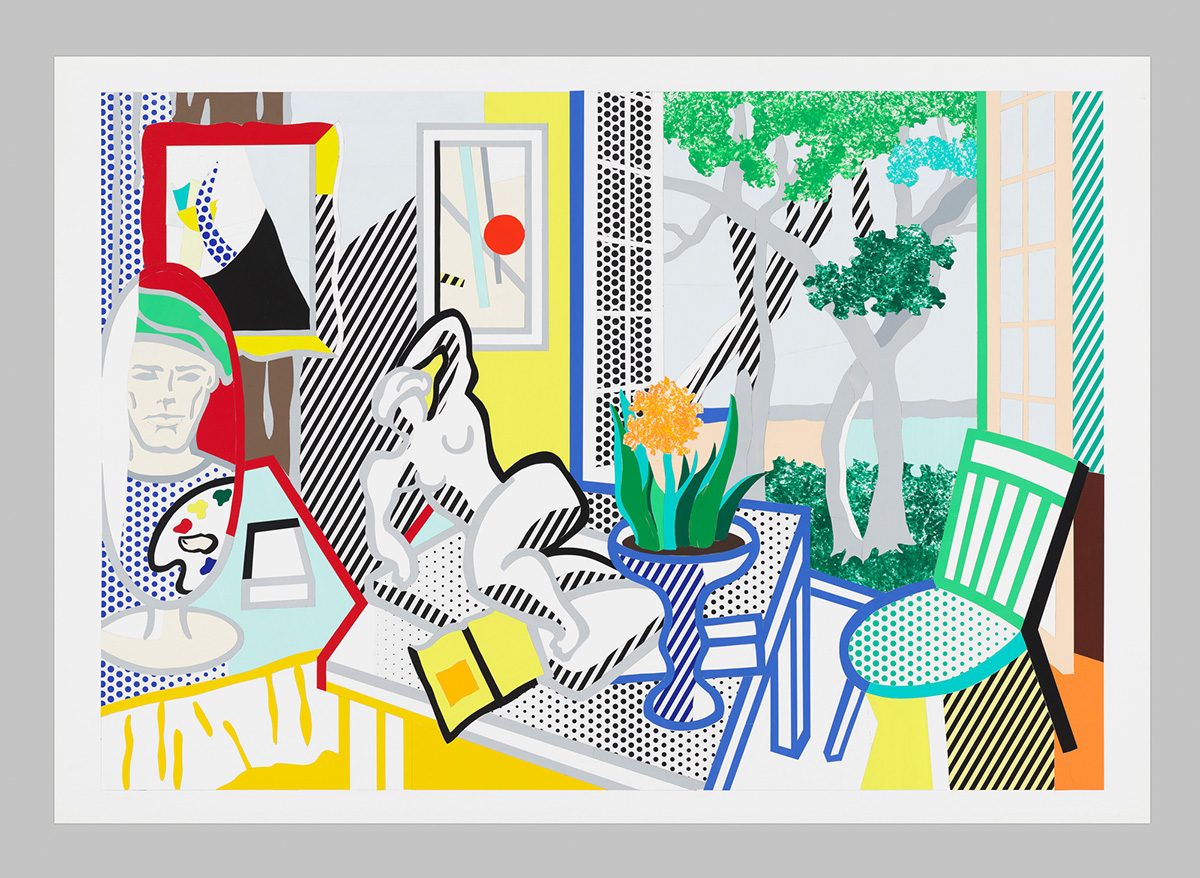
Roy Lichtenstein, Bellagio Hotel Mural: Still Life with Reclining Nude (Study), 1997. Collage and graphite pencil on board: sheet, 38 5/8 × 54 5/16 in. (98.1 × 138 cm); image, 36 1/2 × 52 3/16 in. (92.7 × 132.6 cm). Whitney Museum of American Art, New York; The Roy Lichtenstein Study Collection, gift of the Roy Lichtenstein Foundation 2019.79. © Estate of Roy Lichtenstein/DACS 2026
By KURT COLE EIDSVIG September 14th, 2026
In anticipation of Roy Lichtenstein: Like New, the much-hyped retrospective starting in October, the Whitney Museum unveiled Roy Lichtenstein: 1997 in early September. Planned to run alongside the retrospective, the exhibition in the 3rd-floor galleries features drawings, models, sketches and unfinished paintings from the last year of the artist’s life. Roy Lichtenstein: 1997 starts at the end.
Rather than a long, lingering illness that may have inspired meditations on mortality, Lichtenstein's death was somewhat sudden, occurring at 73, after a bout of pneumonia. Still, 1997 gives us a man considering impermanence, as well as his place in art history. As a precursor to the larger retrospective, the 1997 presentation is tantalizing. But make no mistake, Roy Lichtenstein: 1997 stands firm on its own legs, an exhibition to be seen and enjoyed.
The opening image, Brushstroke Still Life with Box is an unfinished painting with an accompanying study from 1996. The wall plate states, “In 1996 an idea came to Lichtenstein in a dream: an ‘obliterating brushstroke’ that obscured or effaced an image.” Decades earlier, Lichtenstein and his contemporaries all but lampooned the AbExers and their toxic masculinity when starting the Pop Art movement. While Pollock and de Kooning were double-fisted drinkers, brawlers, and unapologetic womanizers, the next wave of Johns, Rauschenberg, Warhol, and Lichtenstein were anything but. When Lichtenstein represented a brushstroke as a tongue-in-cheek attack, it was of course a de Kooning representation. Lichtenstein’s 1997 work is a similar reconsideration of animosities and relationships. Decades later, as de Kooning suffered cognitive decline, Lichtenstein's use of the de Kooning-style brushstroke becomes more intimate than adversarial.
Go way back past the start of “American” art. History buffs might remember the fabled arguments between John Adams and Thomas Jefferson, forefathers of the United States of America. The two were bitter rivals with very different ideas about America's formation and governance. So much so that at one point they didn't speak for over a decade. But the two men reconciled and exchanged letters for years before their deaths. In a twist of fate, they died on the same day, July 4, 1826—the 50th anniversary of the adoption of the Declaration of Independence. That's not just your Jeopardy prep trivia for the day. While not signers of the Declaration of Independence, de Kooning and Lichtenstein are forefathers of American art.
Just as Adams and Jefferson later reflected on their similarities rather than differences, Lichtenstein is in a similar mood here. With de Kooning’s looming presence literally erased by dementia, Lichtenstein’s epiphany can be seen as a reconsideration of those earlier aggressions as well. As we search the picture plane, we’re confronted with an empty vase and an empty box. Things aren’t just obliterated by time or reassessment; there are hollow spots Lichtenstein may have traditionally populated with ornamentation and representation. We’ve all seen numerous pictures where Lichtenstein presents flowers and layers of excess. In fact, others in the 1997 show layer pictures and present a smorgasbord of imagery. But here, the artist is cast as someone looking for things that are no longer there. Read this as the disappearance of former animosity or interpret the seeking as a contemplation on importance. All further highlighted by Lichtenstein’s having an affair with a muse forty years his junior in his late 60s. Not only was the art not so different after all, the blurry blending of life and art is central to this drive to blot out dots with brushtrokes in an effort to see what remains.
While de Kooning and Lichtenstein, two granddaddies of American art, didn't die on the same day, they both passed in 1997. Brushstroke Still Life with Box, with its unfinished quality, speaks to this kind of reconsideration of the past. From the wall text: “The white absence along the left edge of Brushstroke Still Life with Box is where Lichtenstein's hand-painted brushstroke was meant to be applied, had the artist not died before the work could be finished.” A question of what remains and what wasn’t achieved presides here. Exactly the lens required for a leap into the upcoming retrospective.
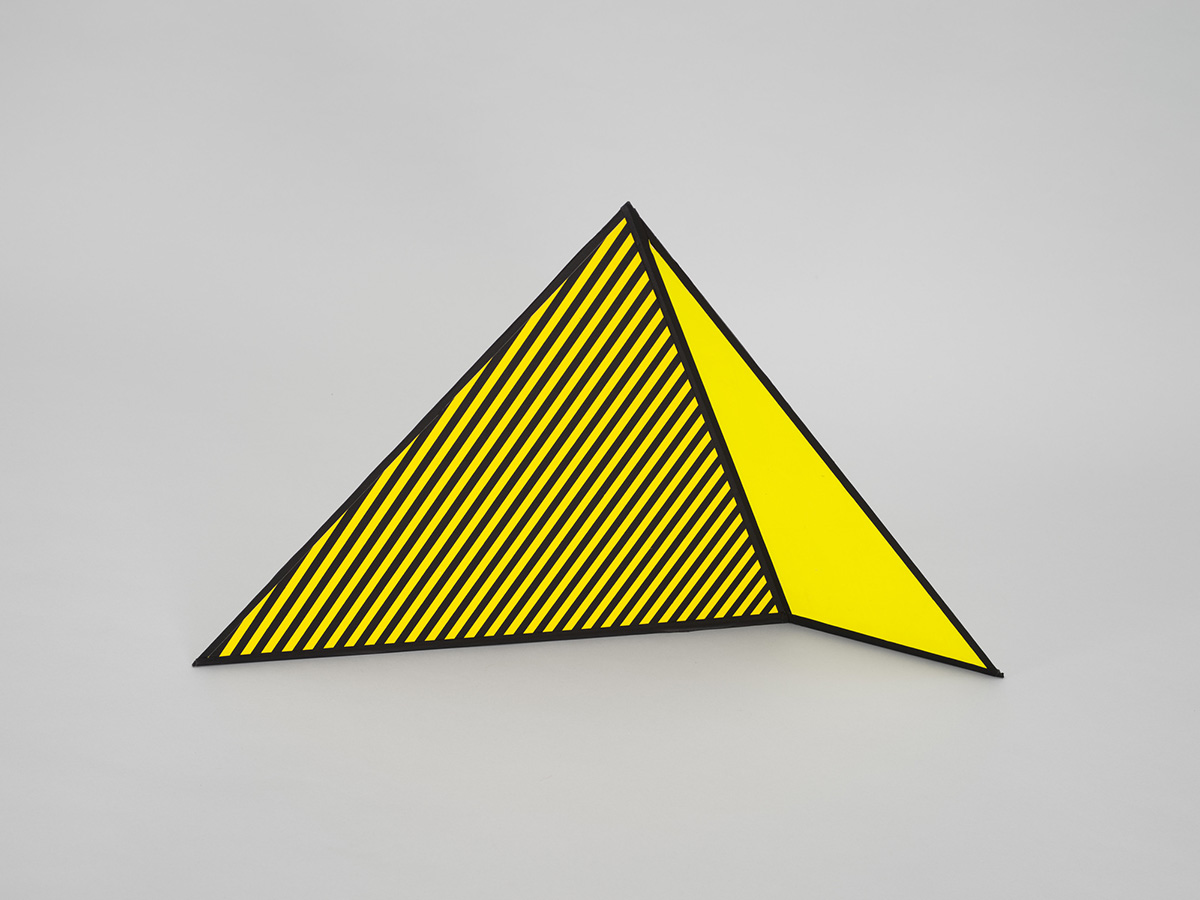 Roy Lichtenstein, Pyramid (Maquette), c. 1996. Collaged paper and tape on foamcore, 17 1/16 × 28 3/4 × 5 in. (43.3 × 73 × 12.7 cm). Whitney Museum of American Art, New York; The Roy Lichtenstein Study Collection, gift of the Roy Lichtenstein Foundation 2019.228. © Estate of Roy Lichtenstein/DACS 2026
These ideas of impermanence run through 1997. A study for a Lichtenstein house, almost as emblematic in his oeuvre as Ben-Day dots, is considered with two pyramid studies: Wall Pyramid (Model) and Pyramid (Maquette), both created with tape, cut painted paper, cut printed paper, and acrylic on foamcore. These pyramids, and the central question of what advances and what recedes in the picture plane, symbolize Lichtenstein facing his last stretch of life and wondering about the fates of time and immortality. Even without a lingering illness, we can sense the man being instrospective. What can be more important than a pyramid to convey mastery and majesty, an icon beheld and marveled at for all of human history? Lichtenstein makes his pyramids from folded surfaces, tenting away from us. Their solidity and presence are parlor tricks, illusions. Set against the Lichtenstein home, a post-war suburban tract house, the questions of what will actually last in American culture and what representations of Lichtenstein's willl endure for the ages are hard to ignore.
So too is the overall theme of reflection. While not included here, some of my favorite Lichtenstein paintings are his mirrors. Rendered with his signature Ben-Day dots and shimmering lines, the mirrors cast viewers as pop culture consumer vampires. We stare at the mirror but can't see ourselves in it.
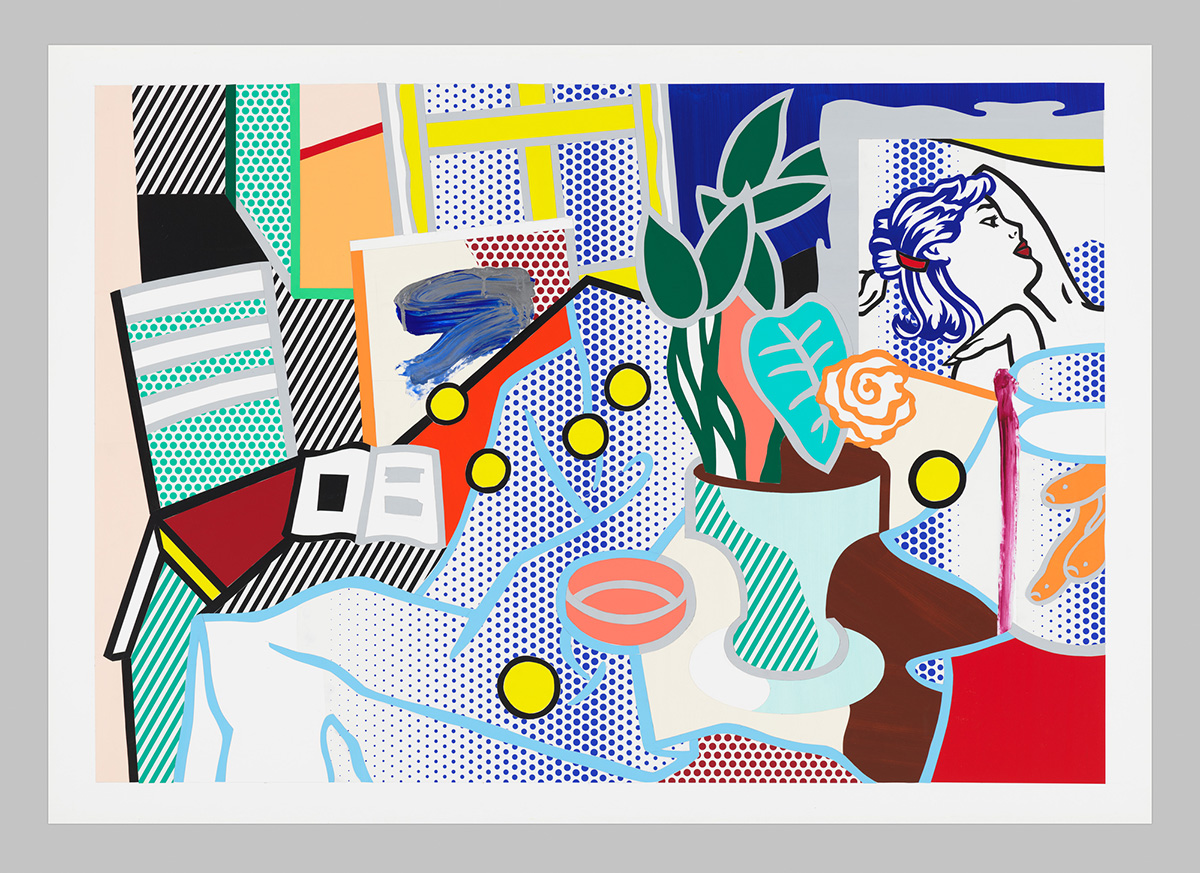 Roy Lichtenstein, Bellagio Hotel Mural: Interior with Painting of Reclining Nude (Study), 1997. Collage and graphite pencil on board: sheet, 36 × 51 3/4 in. (91.4 × 131.4 cm); mount, 38 × 52 7/8 in. (96.5 × 134.3 cm). Whitney Museum of American Art, New York; The Roy Lichtenstein Study Collection, gift of the Roy Lichtenstein Foundation 2019.78. © Estate of Roy Lichtenstein/DACS 2026
But in the studies for the Bellagio, all that is different. The Bellagio Hotel Mural: Still Life with Reclining Nude (Study) are a pair of pictures that reflect one another and raise important questions about art history. The pictures span Cézanne's drapes and fruits and a Matissian open window and goldfish. Adept at conversing with art history in his numerous riffs on Monet, Picasso, and van Gogh, Lichtenstein's career is very much marked by his advancing the larger conversation of art history. In 1997, as with the pyramids and the house, Lichtenstein is more obvious and explicit in meditating on his place in great art. On one panel, we have a typical comic book-style Lichtenstein reclining nude, while on the other the reflection aligns more with an ancient statue. Visual Echoes of: Will my figures be remembered to this extent? Do I belong here? Bounce back and forth between the panels. Further, we have the stand-in for Lichtenstein himself, the man in the mirror. Featuring those killer Lichtenstein cheekbones and holding an artist's palette, our eyes travel this near panorama of art history, scanning along with the artist himself, contemplating his place there. We may be undead vampires of one sort when looking in a Lichtenstein mirror. But when he looks, we wonder if he finds a more vibrant immortality in those expanses of forever.
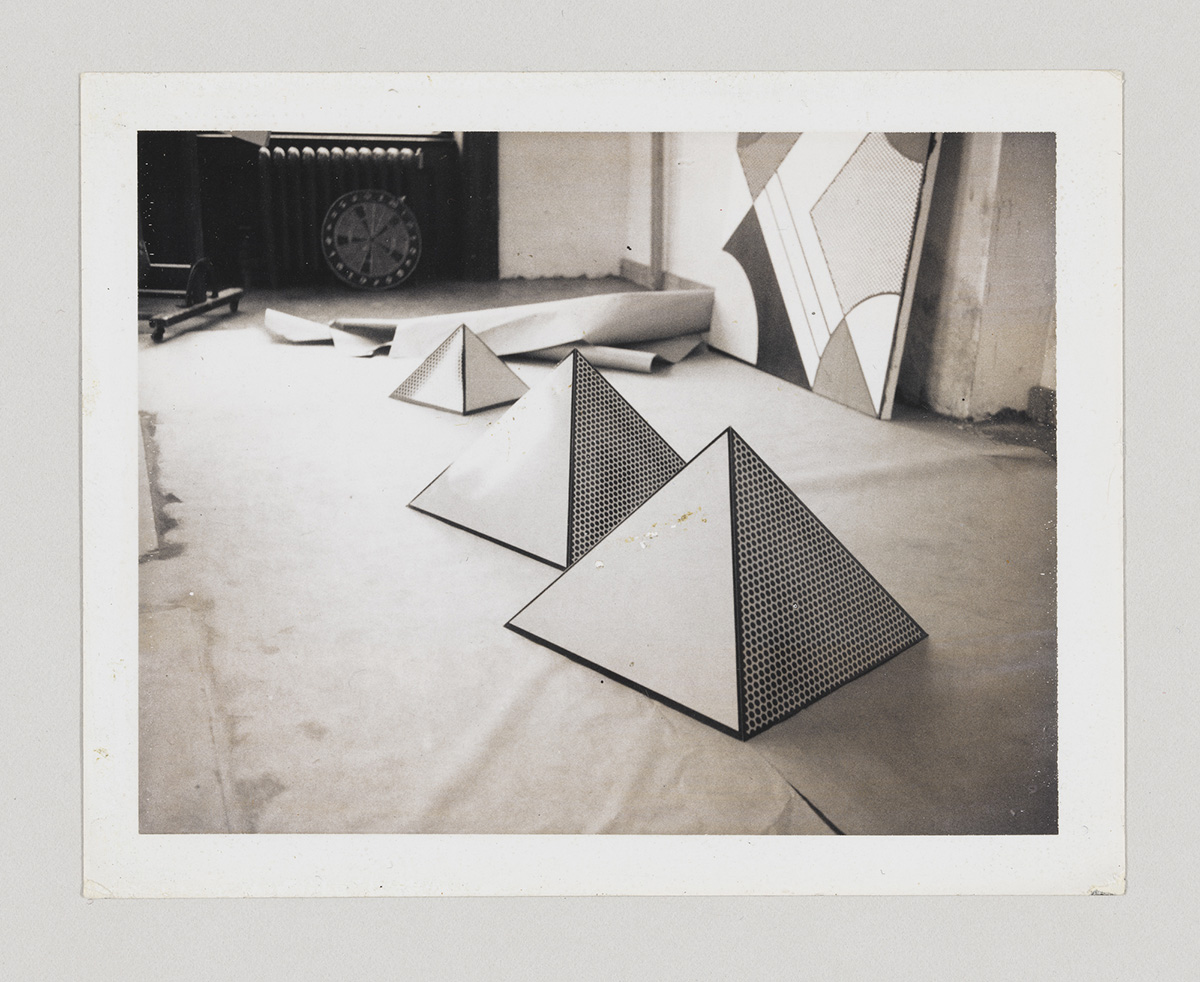
Roy Lichtenstein, Untitled [pyramid], c. 1970. Dye diffusion transfer print (Polaroid), 3 3/8 × 4 3/16 in. (8.5 × 10.7cm). Whitney Museum of American Art, New York; The Roy Lichtenstein Study Collection, gift of the Roy Lichtenstein Foundation 2019.234.15. © Estate of Roy Lichtenstein/DACS 2026
On eternity: While not known for religious painting, one of the gems in 1997 is the Chapel of the Eucharist Mural (Study). A rendering of the da Vinci Last Supper table, the study is devoid of figures. Instead, the Pop master renders a flash of light above the table. A visual POP. A sketch for an unrealized mural, Chapel of the Eucharist Mural (Study), presents the brevity of life alongside the power of epiphany and its lasting impact on humanity, when captured in the right moment. 1997 is the right moment to propel each of us into reflection on Lichtenstein, the artist and the myth, on the eve of the upcoming retrospective. Then we too can scan permanence, history, and accomplishment and decide for ourselves Lichtenstein's place among the pyramids of art history.
Roy Lichtenstein: 1997 will run alongside Roy Lichtenstein: Like New through May 10, 2027.
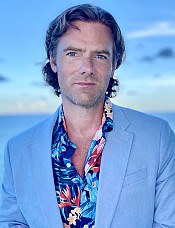
Kurt Cole Eidsvig
Kurt Cole Eidsvig is an artist, poet, and author. His most recent book, Drowning Girl, is a book-length novel-poem inspired by the Lichtenstein painting of the same name. He maintains a website at EidsvigArt.com.
view all articles from this author