Whitehot Magazine
October 2026
"The Best Art In The World"
"The Best Art In The World"
October 2026
Beyond Dark Flow at the Strother School of Radical Attention
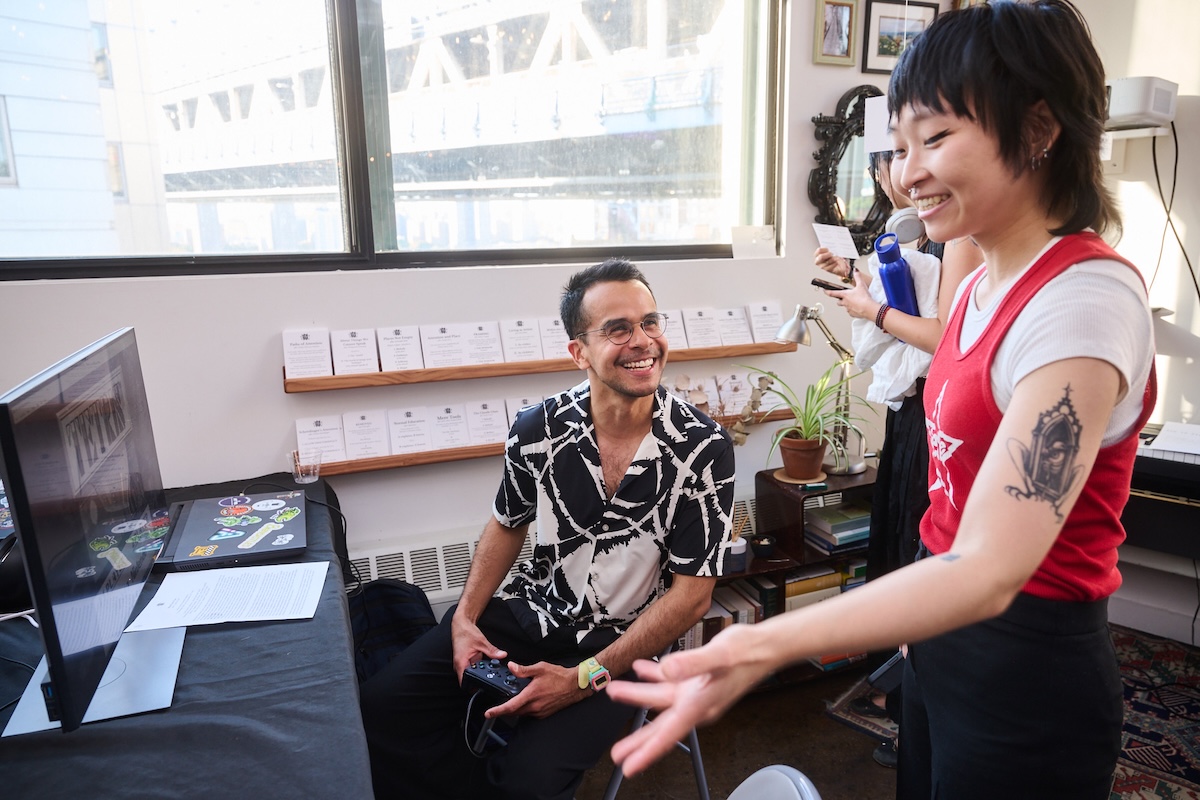 Photo by Caleb Bryant Miller
By KEN KRANTZ June 29th, 2026
It is increasingly difficult to find experiences that are not designed to trap the consciousness. Our digital landscape is a series of elegant cages: social media feeds that never end, streaming platforms that autoplay into oblivion, and video games engineered to dopamine-loop us into staying another five minutes, then another hour. Entire global industries now depend upon our systematic inability to look away.
What makes Beyond Dark Flow so quietly radical is that it approaches human attention from the exact opposite direction. The exhibition, organized by resident curator Haena Chu at the Strother School of Radical Attention (SoRA) in collaboration with collective boshi's place and Catherine L. Hansen, gathers independent game-makers and artists to showcase experimental gameplay as a site of collective praxis.
“We see SoRA's nontraditional exhibition format as an expansion in the sense of ‘world-building,’” Haena explains, “or making tangible the kind of culture we could build in a future beyond the current attention crisis.
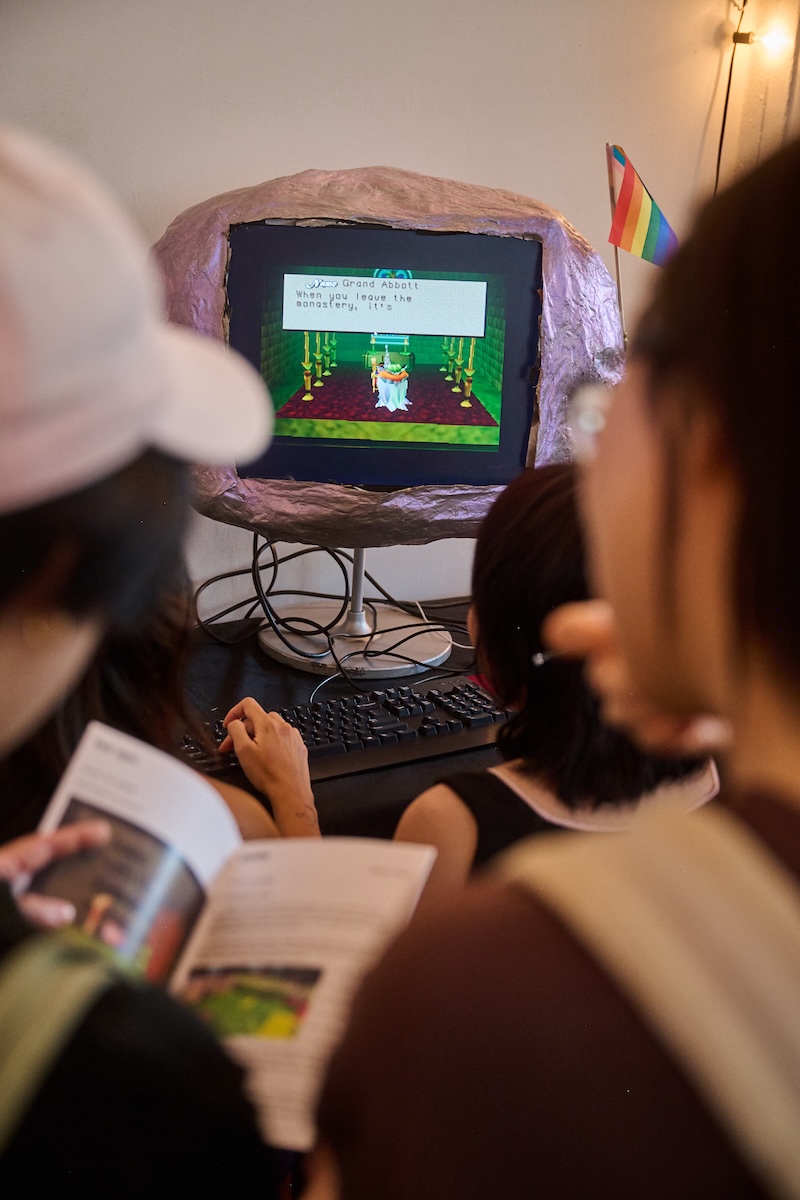
Photo by Caleb Bryant Miller
The opening of Beyond Dark Flow felt like stumbling into a chill house party which magically materialized inside SoRA's sunlit DUMBO headquarters. Couches, chairs, and colorful rugs were arranged to facilitate gameplay. Screens blinked from every corner, integrated seamlessly into environments meant for lounging. “Sometimes, the white cube format is a little clunky," Chu notes dryly. By shedding that institutional skin, the exhibition frames the computer monitor as a communal hearth.
As a noob whose gaming experience begins and ends at Go Fish, I tapped into the boshi’s place community to learn how to use a controller. The rhizomatic experimental game development collective was kind enough to show me the ropes. According to Fiona, one of my gaming mentors, "boshi's place is a big mix of members with art, film, design, and tech backgrounds."
Fiona introduced me to a digital companion game, Pomodotchi. They helped me feed it a banana to regain an 8-bit heart. "I use the pomodoro timer a lot," they share. "It's for myself." At the final stage, after two hours of successful care, the Pomodotchi creature evolves.
Around the table, Fiona’s co-boshi Jonny, walked me through a version of Tetris that creates simultaneous, distracting windows, refracting the game. Literally called Tetris All At Once, the overwhelming popups constitute a “plunderludics,” a school of development sampling existing games to make new play. This concept derives from situationist détournement, the radical, avant-garde practice of turning capitalist media imagery against itself. As I saw defeat across the windows, they explained, "When you lose one, the games are all lost."
Despite losing the Tetrises, I was having fun. Being in community, trying something new, and meeting new people all pointed to the importance of play.
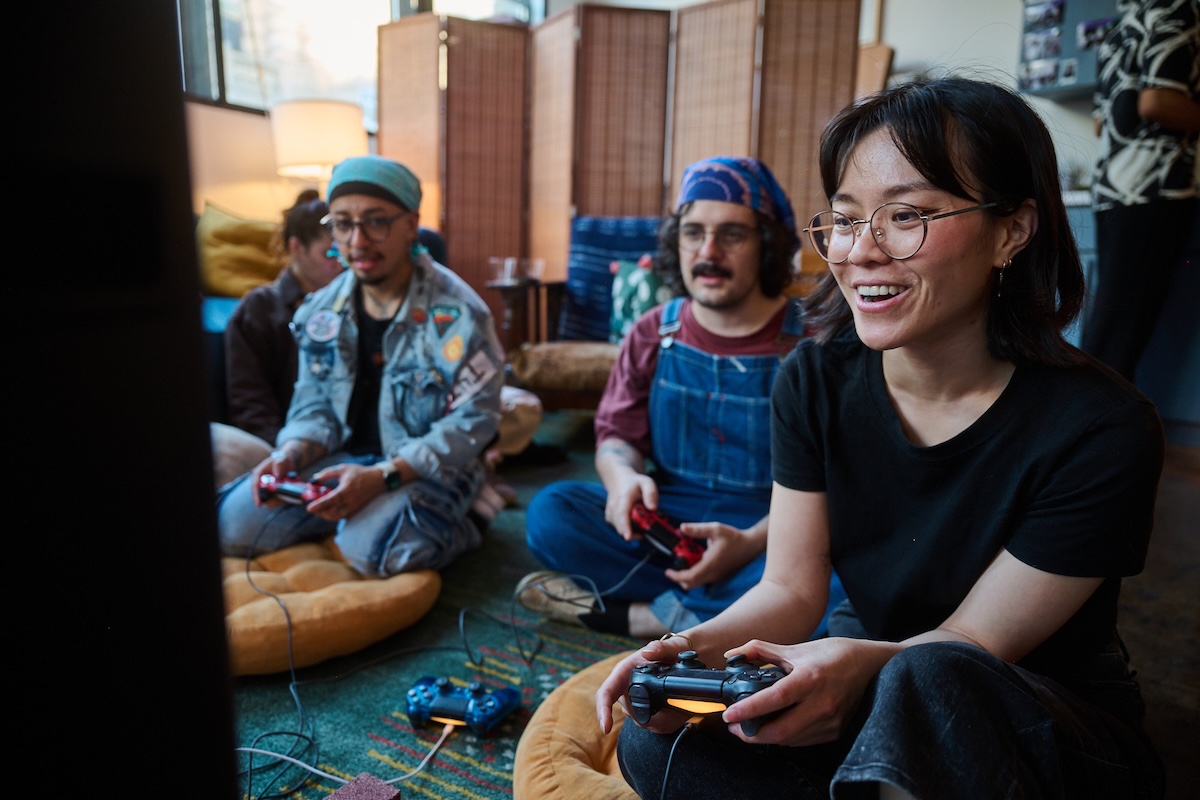
Photo by Caleb Bryant Miller
“Play has always been around and fundamental to our humanity,” co-boshi Ali said, guiding me around a large desktop computer flipping through landscapes. “Contrary to belief about play being an escape from the world, play is a way of gathering our attention and attendance to the world.” It is a nod to the legacy of avant-garde spaces like Babycastles, asserting that alternative, third spaces must remain alive to experiment with what a game can structurally achieve.
The most physically arresting work in the exhibition anchored the opposite side of the room. A teetering, sculptural assemblage of colorful ping-pong balls, solo cups, and cardboard took on a deeply moving form courtesy of Aging in Play, a design trio consisting of Hao Jie Sim, Xiaolan Fu, and Kelsey Zhang. Using social design principles rooted in Bourriaud’s relational aesthetics, the work answers an overlooked question: How do we create community conditions wherein folks can continue to play?
“This project is about rethinking aging, community, and participation,” shared Hao Jie. “At the SoRA exhibition, I want visitors to try the games we co-created with the community, imagine new ways to play, and ask where play is missing in the lives of older adults around them. What conditions can we create together to make room for play again?”
 Photo by Caleb Bryant Miller
Hao Jie tells me how he looked at NYC Open Data and realized that recreational activities for older adults in the city's senior centers are almost entirely segregated into a predictable, repetitive loop of ping-pong, mahjong, and bingo. The set currently includes cards for open game innovation, but initially, Hao Jie and his team led a group of older adults in the Open Door Older Adult Center through a collaborative design process. They curated a set of accessible objects and prompts into a Playbox to help the group test, adapt, and create new games together.
The games also serve a critical purpose, as described by Hao Jie: "We considered functional assessments like the Sit-to-Stand test by asking how it can be playful, fun, and engaging. We worked with Dr. Parth Naik, a physical therapist, to develop games that are fun and also benefit the body."
The group also worked with a partner (Alzheimer’s & Aging Public Health Initiative (AAPHI)) in New Haven to facilitate a session with older adults with dementia in a senior home. A volunteer reported back that “residents were more engaged than in a previous craft session. One resident had some trouble speaking at first, but after playing, she could speak clearer.”
Hao Jie explains that Aging in Play is self-sustaining: "We trained facilitators and staff to activate social energy, so play could continue beyond our involvement."
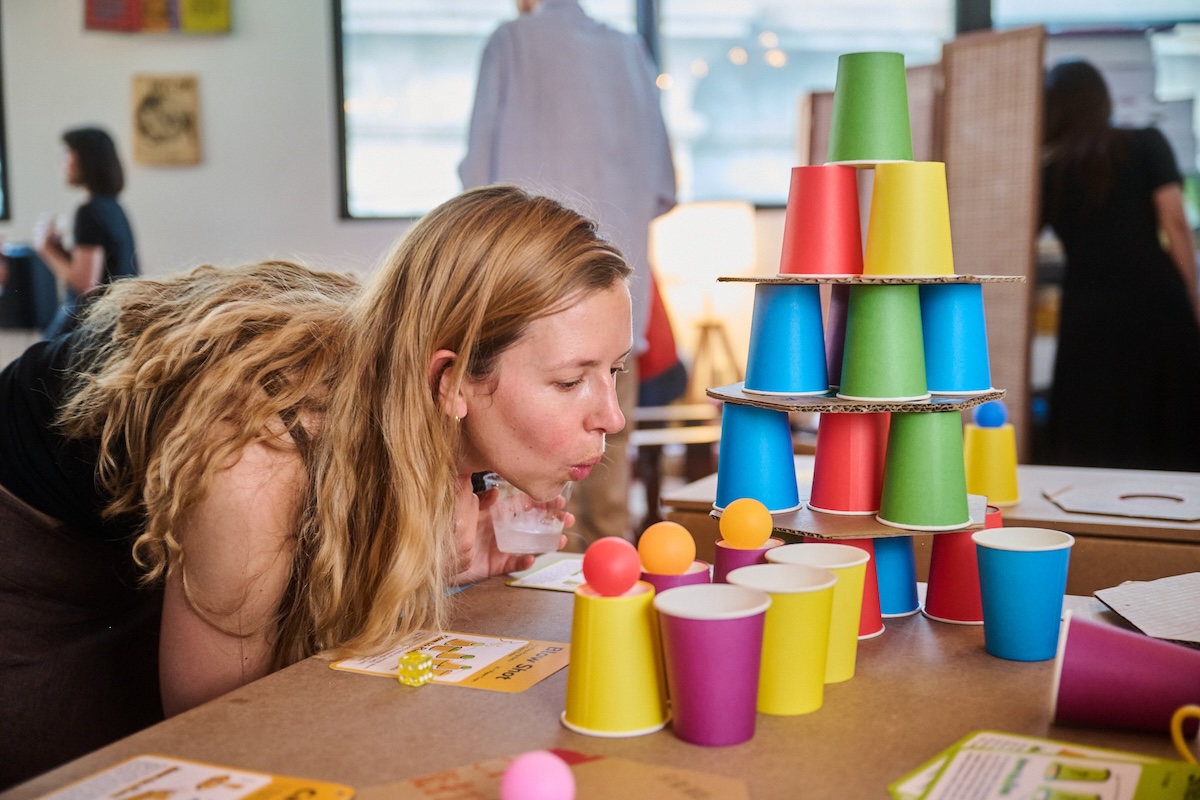 Photo by Caleb Bryant Miller
The games’ continuity is significant in the context of SoRA’s greater project of “Attention Activism.” As Hanea explains, rather than centering problematic visibility, SoRA focuses on "what we are going to do about it with the tools that we have."
The works gathered here seem more interested in a vision of gaming as a social practice; victories and failures mattered less than playing with an open heart (especially in Tetris All at Once). In a cultural moment defined by digital containment, Beyond Dark Flow opens a door.

Ken Krantz
Ken Krantz is interested in the intersection of business, culture, and bravery where great artwork emerges. He can be found on Instagram as @G00dkenergy or online at goodkenergy.com.
view all articles from this author