Whitehot Magazine
November 2026
"The Best Art In The World"
"The Best Art In The World"
November 2026
Marching Through the Mist: Review of Recovecos, a Solo Exhibition by Luis Alfonso Villalobos, Presented by PALMA Galeria at Pipeline Contemporary, London.
BY RUI JIANG, November 11, 2026
Overlapping mountain ranges, undulating white massifs. You feel the shadows of trees wavering.
Why don't you speak?
You finally pose the question to a range of towering mountains, stacked and erected by artificial objects. You are compelled to accept, unguarded, the substitution of objects for nature. Already disoriented by the dizzying spectacle of overlapping mountain shadows, you stare blankly at these white “wall-towers,” straining your eyes to see through them. The undulations of the mountains become, almost seamlessly, the contours of vessels; the contours of vessels, in turn, suddenly lend the forest a quivering sense of order. Amid this derangement of the woods, you sense a helplessness that does not originate solely within yourself. The forest's echoes struggle to wander. You lean in to listen, only to hear a crisp sound, only to hear the sound of something disappearing.
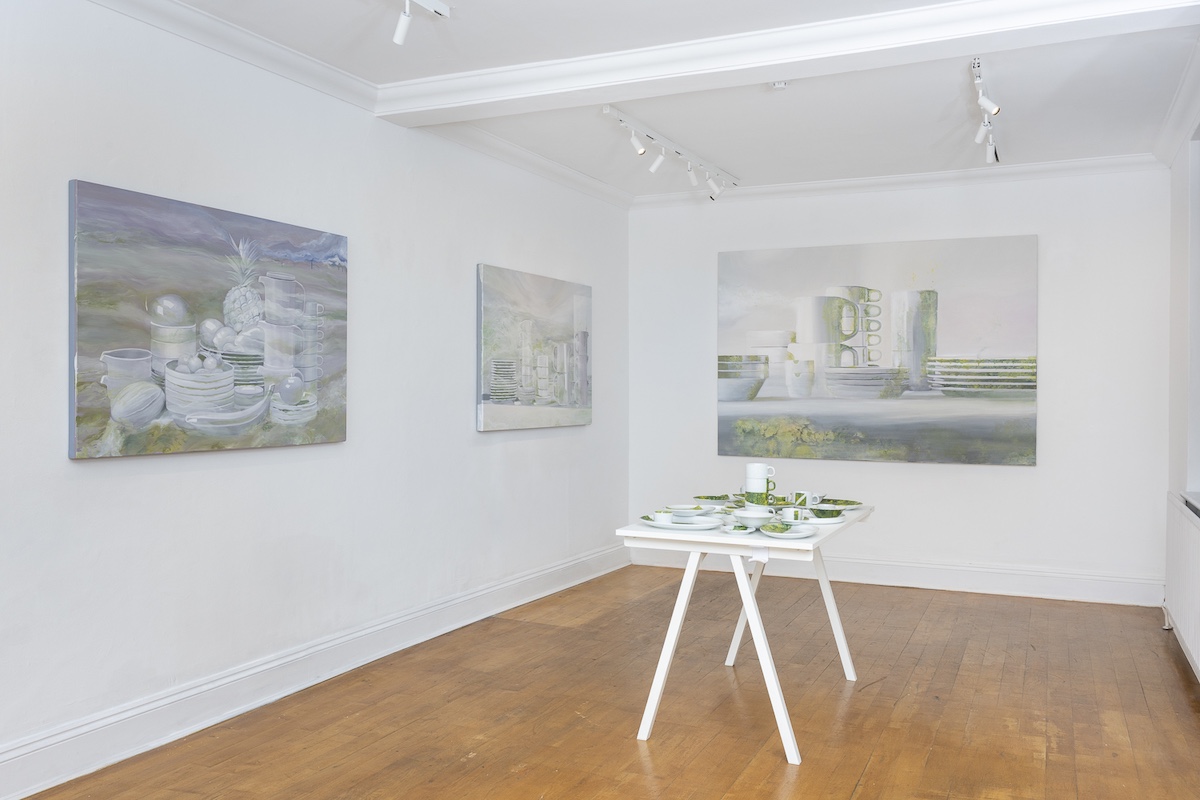
Exhibition installation view of Recovecos by Luis Alfonso Villalobos. Photo: Damian Griffiths. Pipeline Contemporary, London UK
Presented by PALMA Galeria and hosted at Pipeline Contemporary in London, Luis Alfonso Villalobos's solo exhibition Recovecos makes no grand declarations. The resemblance between nature and artificial objects assumes a lustrous, almost tender appearance, yet retains an air of unreliable intimacy. Taking satellite imagery of Mexico's cloud forests captured through Google Earth as his point of departure, the artist superimposes images of stackable tableware designed by Nick Roericht in 1959. Through this renewed digital encounter, vessels originally made for everyday use seem to transform into something immeasurable: smoke-like wisps, gauzy veils, spectral glimmers, and white cities suspended within a milky atmosphere.
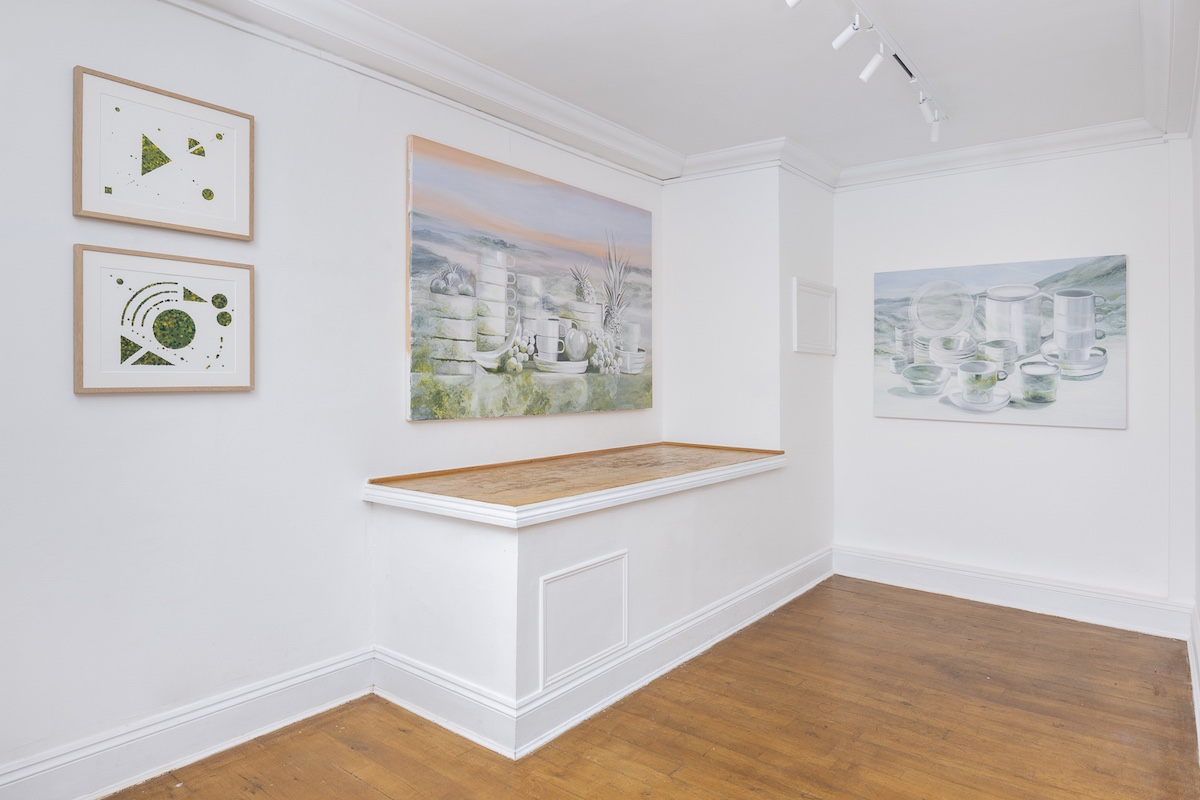
Exhibition installation view of Recovecos by Luis Alfonso Villalobos presented by PALMA Galeria; Pipeline Contemporaey, London UK. Photo: Damian Griffiths.
They resemble architecture growing from within the forest, or the visual remnants of a civilization left upon the surface of nature. The substitution of scale and measurement is the footnote Villalobos leaves behind. Daily functional objects become mountains; mountains, in turn, become architecture. What we call the life cycle now circles around the human scale with a darkly comic gait, beneath these softly shaded forms. Functional objects suddenly acquire the proportions of geological formations, immense and startling; the vastness of the forest is absorbed into a visual order of axes and alignments, making it almost greedily tangible. I can no longer ascertain whether I am looking at an industrial phantasmagoria borrowing the forms of nature, or at the lingering reverberations of a forest's dystopian retaliation.
Natural abundance is ordinarily recognized through growth, decay, moisture, and the ineffable. Industrial objects, by contrast, establish their own order through polished surfaces, controlled dimensions, and clearly defined functions. Yet here, the two material forms become entangled, exchanging flesh and bone, exchanging appearances. The succulent, juicy fruits gleam amidst the towering mountains… Through resemblance, they reveal a chilling lack of kinship.
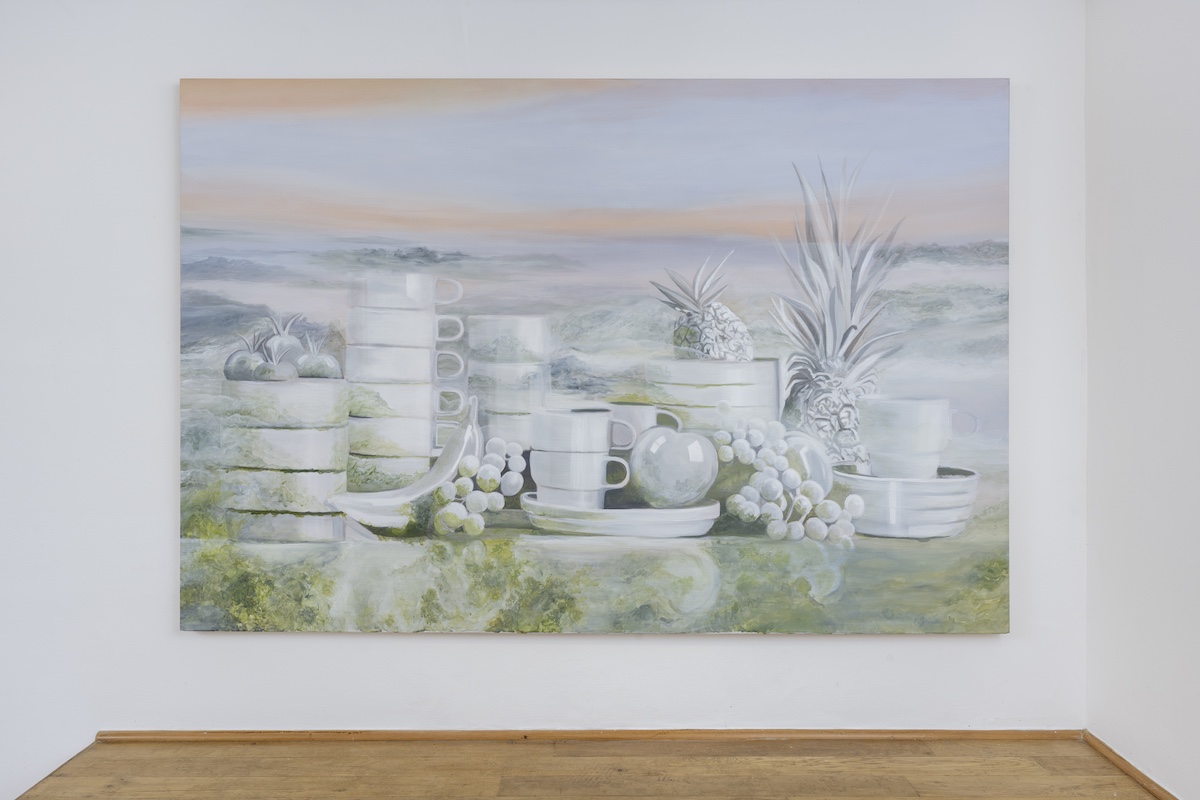
Luis Alfonso Villalobos, Petén, 2026, acrylic on canvas. 120 × 180 × 5 cm. Exhibition installation view of Recovecos. Pipeline Contemporary, London UK. Photo: Damian Griffiths.
Artist Luis Alfonso Villalobos and curator Alfonso Sanchez Herrera Lasso invite viewers to recognize that the maintained cloud forests of Latin America remain embedded within broader structures of resource extraction and historical exploitation. Thus, as you become enveloped by the winding mountain ranges obscured by mist throughout the space, you also descend into a vast, hallucinatory uncanny valley. Who, exactly, gets to determine what counts as unproductive? The system that binds forests to economic value has, by now, formed a weighty parent-child kinship. Surrounded by the paintings, we find ourselves equally unable to confront the material lives of milky-white domestic vessels and furnishings as they grow into their own existence among the clouds. The naked misalignment continues to unfold through Villalobos's painted tableware on the dining table. You cannot help but perceive, at the intimate scale of the body, the histories of production engendered by functionalism; nor can you sit comfortably at this table set within the reverberating woods.
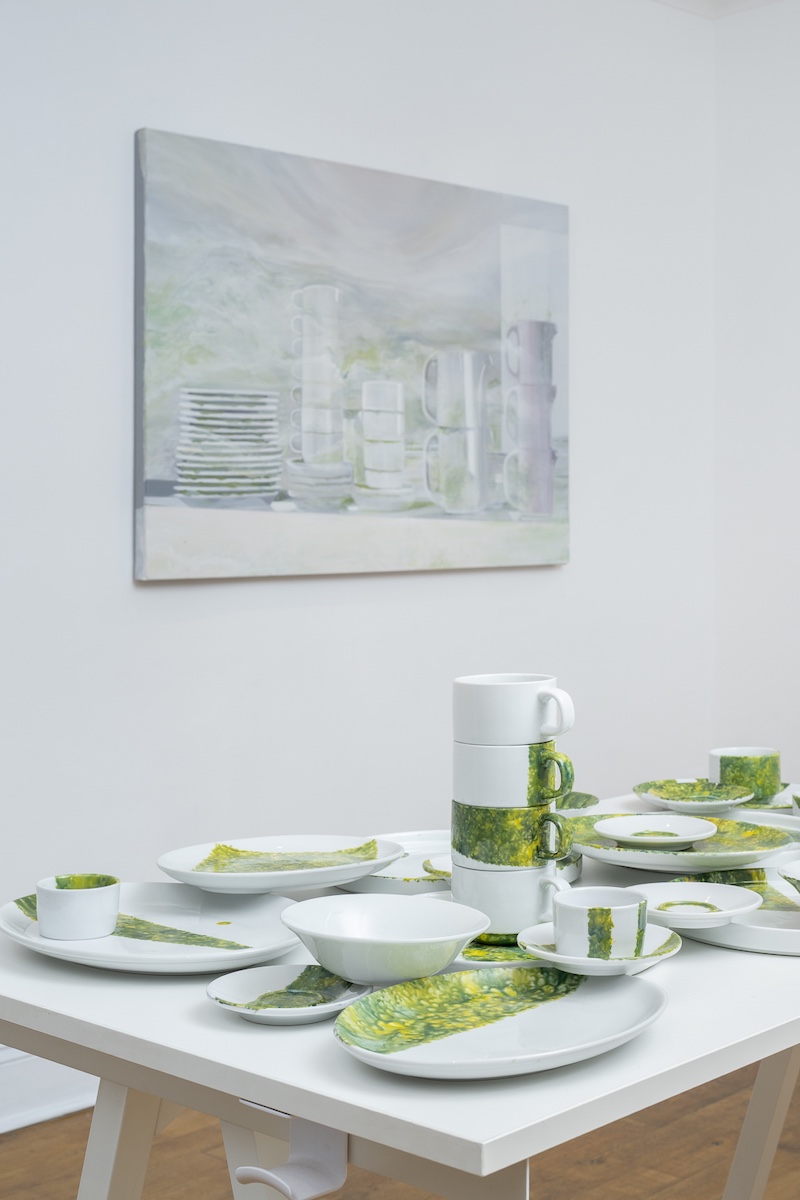
Exhibition installation view of Recovecos by Luis Alfonso Villalobos presented by PALMA Galeria; Pipeline Contemporaey, London UK. Photo: Damian Griffiths.
The translucent canvas seems, visually, to permit light to pass through, yet never truly relinquishes everything it holds. It seems to issue a call accompanied by a certain resistance. Yet the satellite aerial view originally promised a mode of observation that transcends the physical body, fulfilling the modern viewer’s desire to grasp the entire landscape from a safe distance. The curator, Alfonso, folds the exhibition into successive turns through its title, Recovecos. The word itself encompasses hidden recesses and unseen places; it also suggests convoluted turns, while referring to every single aspect of a thing. Tangible scale, the totality of a view, and its invisible twists all tumble and nestle against one another within this word, granting the veiled concessions and spectral violence in the work a broader perspective of haze and a witness to the act of seizure. Vessels and wilderness remain suspended in an uneasy coexistence, within the milky scales and halos of light. Their gaze dwells upon and lingers before the human eye. WM
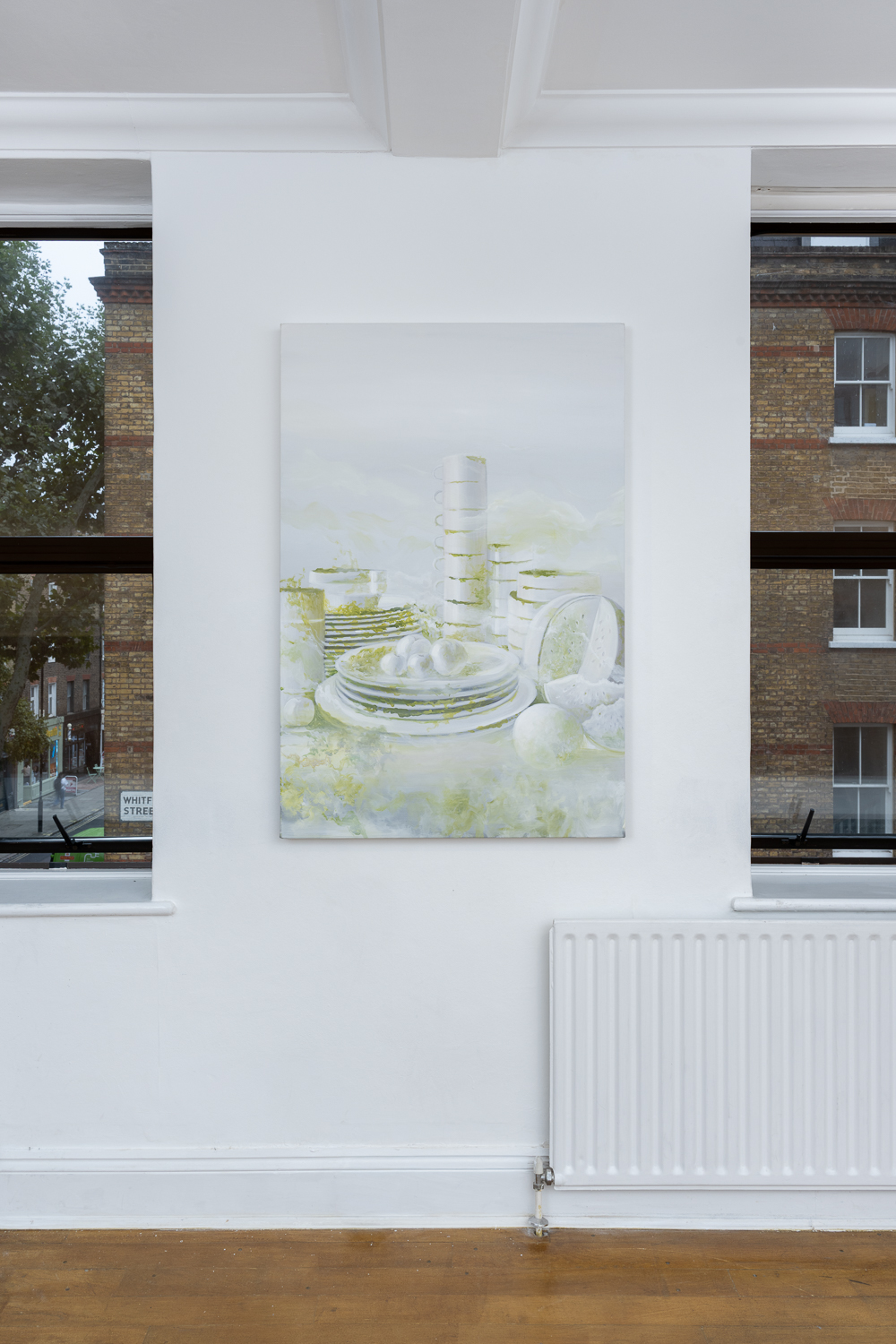
Luis Alfonso Villalobos, Xico, 2026, acrylic on canvas. 120 × 180 × 5 cm. Exhibition installation view of Recovecos. Pipeline Contemporary, London UK. Photo: Damian Griffiths.
Rui Jiang
Rui Jiang is a Baltimore-based independent curator and writer. She holds a Master's degree in Curatorial Practice from Maryland Institute College of Art. Her research moves between semiotics, intimate gestures, and shifting dialogues, examining how art forms deconstruct and reconstruct within a polycentric field. She investigates the tensions embedded in exhibition-making—complicity, reflexivity, and the shifting power dynamics that shape artistic discourse. Through interdisciplinary approaches, she experiments with curatorial strategies that challenge linear narratives, embrace contradictions, and reimagine the relationships between artists, audiences, and institutions.
view all articles from this author