Whitehot Magazine
September 2026
"The Best Art In The World"
"The Best Art In The World"
September 2026
Exhibition Review: “Nancy Bowen, From A to Z and the Bodies in Between” at Nunu Fine Art, SoHo
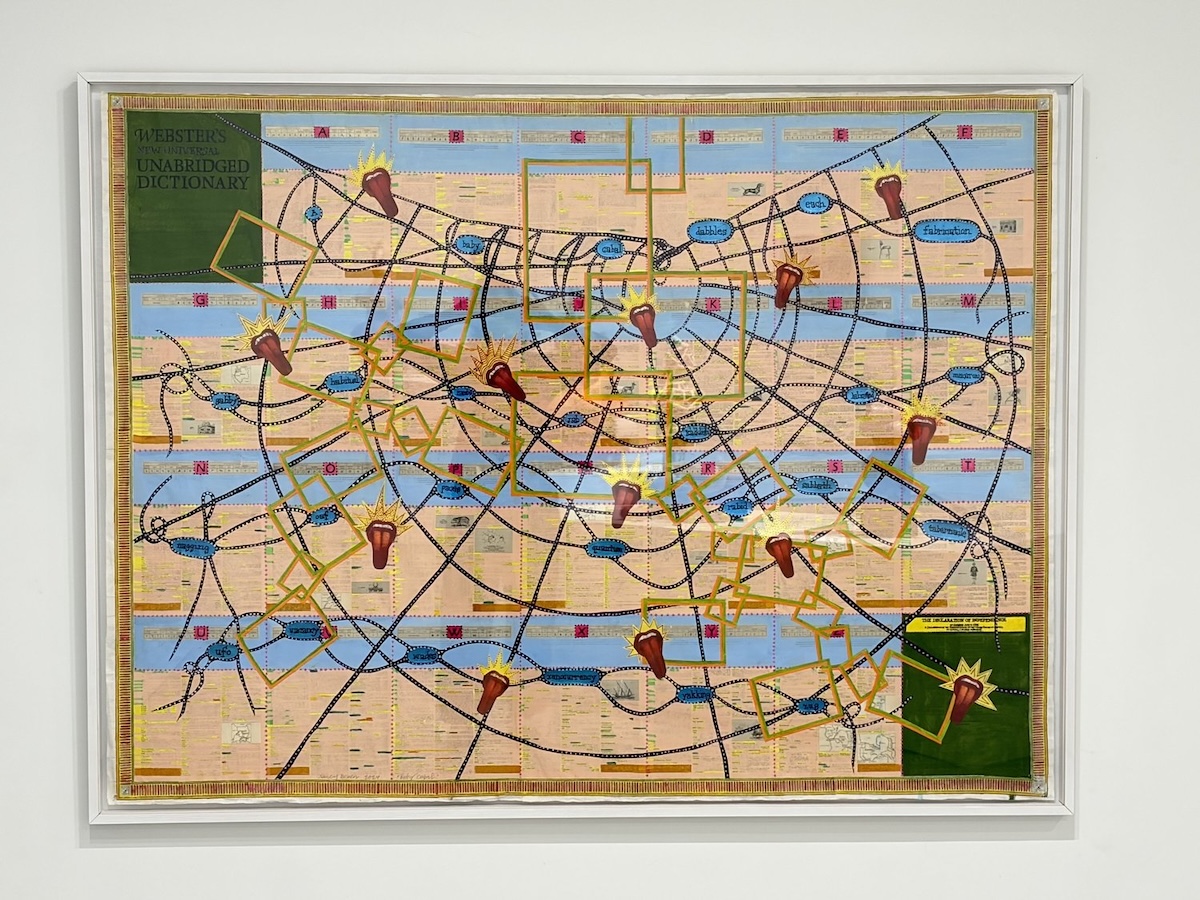 Nancy Bowen, Baby Cabal, 2025, 44 x 58.5 inches, collage, gouache, and found book pages on rice paper.
By SYDNEY SRNKA July 24th, 2026
“Weren’t you just here earlier?” asked artist Nancy Bowen when she recognized me from my earlier visit to her show of recent works, From A to Z and the Bodies In Between, at Nunu Fine Arts an hour earlier. She was right. I had been in a rush when I first passed through the gallery that day. Upon first glance, the show felt both historic and personal, as if the legacy of a feminist past was connecting to a living present, so I returned an hour later to fully grasp the show’s complexity.
Bowen, who came of age under the rise of second-wave feminism and the artistic revolution of the 1970s and 80s, describes herself as an “artistic archeologist.” Using materials such as old dictionaries and seashells from her late parents’ home for painting and sculpture, Bowen restructures dominant literary and visual rhetoric with her own logic. This process is both additive and reductive. She reanimates old materials, techniques, and conversations by reshaping and reorganizing their conduits, or vessels, in other words. Bowen cannibalized materials and coalesced them into her own taxonomy, in a way reclaiming her autonomy from these systems. In speaking with Bowen, I confirmed her suspicion of my prior visit, to which she responded by inviting me to join the private tour she was about to give to her friend and fellow artist, Kate Horsfield. I eagerly accepted.
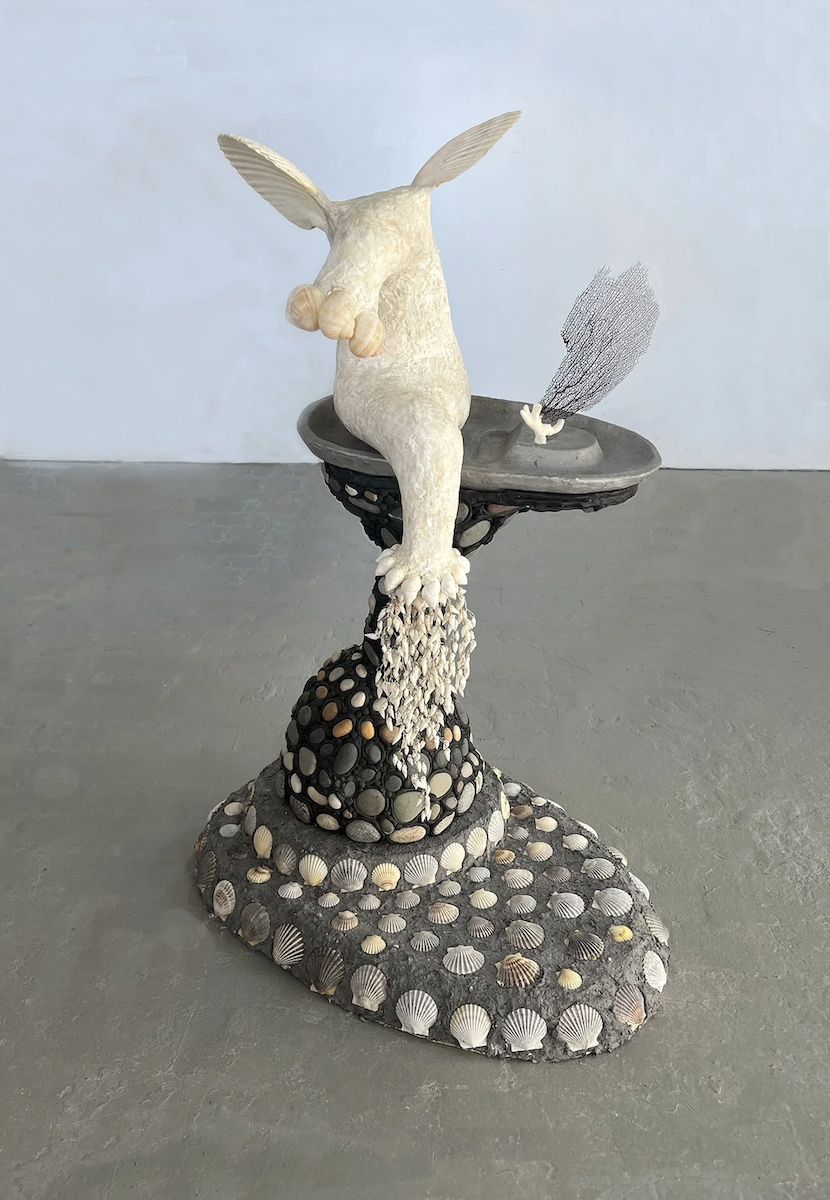 Nancy Bowen, From the Deep, 2024, 43 x 32 x 22 inches, ceramic, wax, pigmented paper pulp, coral, and shells
The tour began with two works at the front of the gallery, From the Deep (2024) and Lost at Sea 1 (2023). The entire show is guided by personal materials, but these works concretely lay the foundation. From the Deep is a sculpture of a ceramic figure seated upon a base made of foam, clay, paper, and her mother’s seashell collection. Bowen explained that the figure is a reference to portrayals of the Venus motif throughout art history, such as Boticelli’s famous Renaisannce painting, The Birth of Venus, and the Venus of Willendorf, an estimated 30,000-year-old sculpture from Paleolithic Europe. Unlike these idealized figures in history, Bowen’s Venus sits upon a public water fountain and lacks any sexual features. The figure instead more closely resembles a marine animal than a woman. Her positioning of the Venus as being born out of a water pipe to be thoughtlessly drunk by any passerby is a clever metaphor for the archetyping of female bodies, which are defined and then consumed by the public conscience.
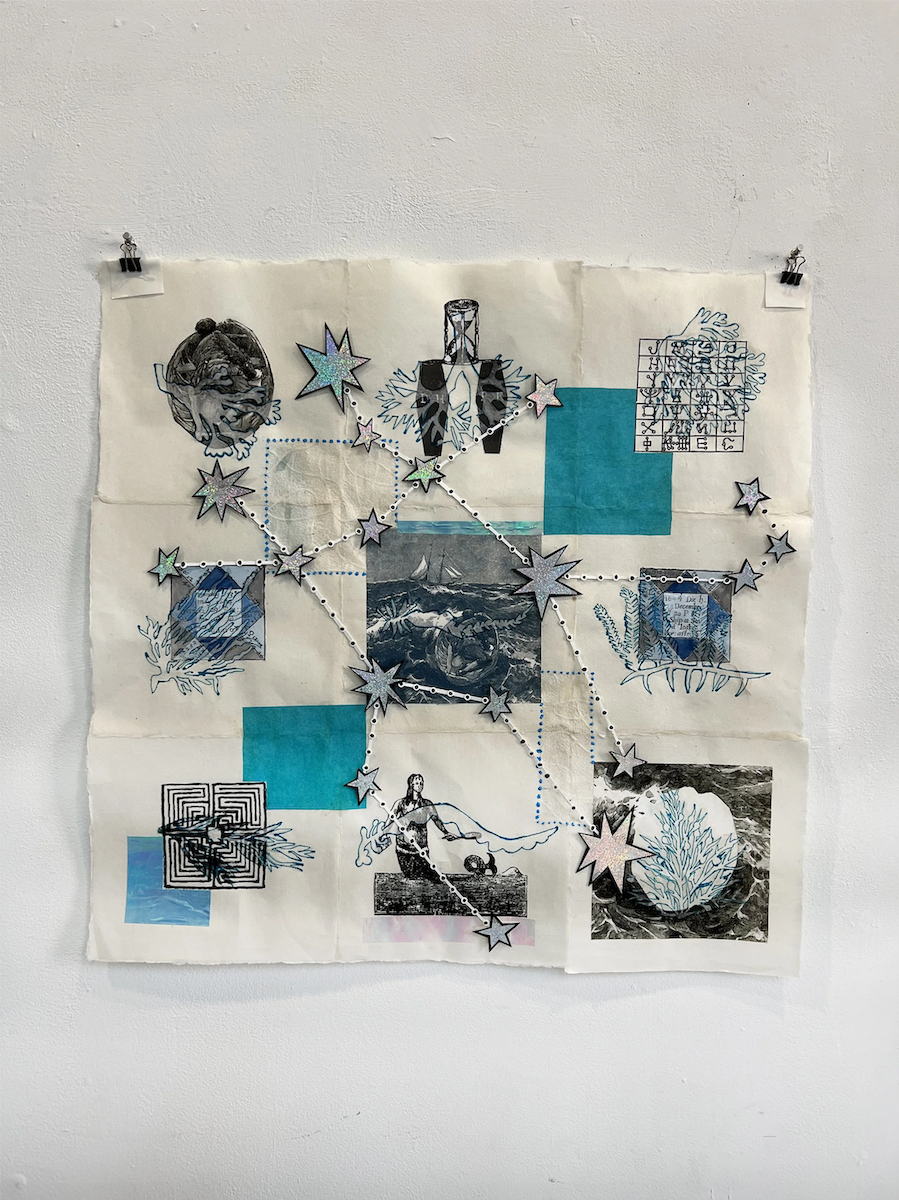 Nancy Bowen, Lost at Sea 1, 2023, 27 x 28 inches, collage and gouache
Accompanying this body is an illuminated collage of old Americana materials from her parents’ library entitled Lost at Sea 1. According to Bowen, the meaning of the images are far less important than the aesthetic viewing experience as a whole. The composition forms a self-mapping of her family history, including two coffins that symbolize her late parents. Because she grew up near the water in Rhode Island, the ocean is a theme that Bowen weaves throughout the exhibition, treating it as a place of origin and return, of guidance and oblivion, depending on the day. She paired the Americana images with drawings of labrynths, puzzles, and coral that are interchangeable in meaning. They are based on the concept of voyage and the attempts to map or control an entity that cannot truly be piloted.
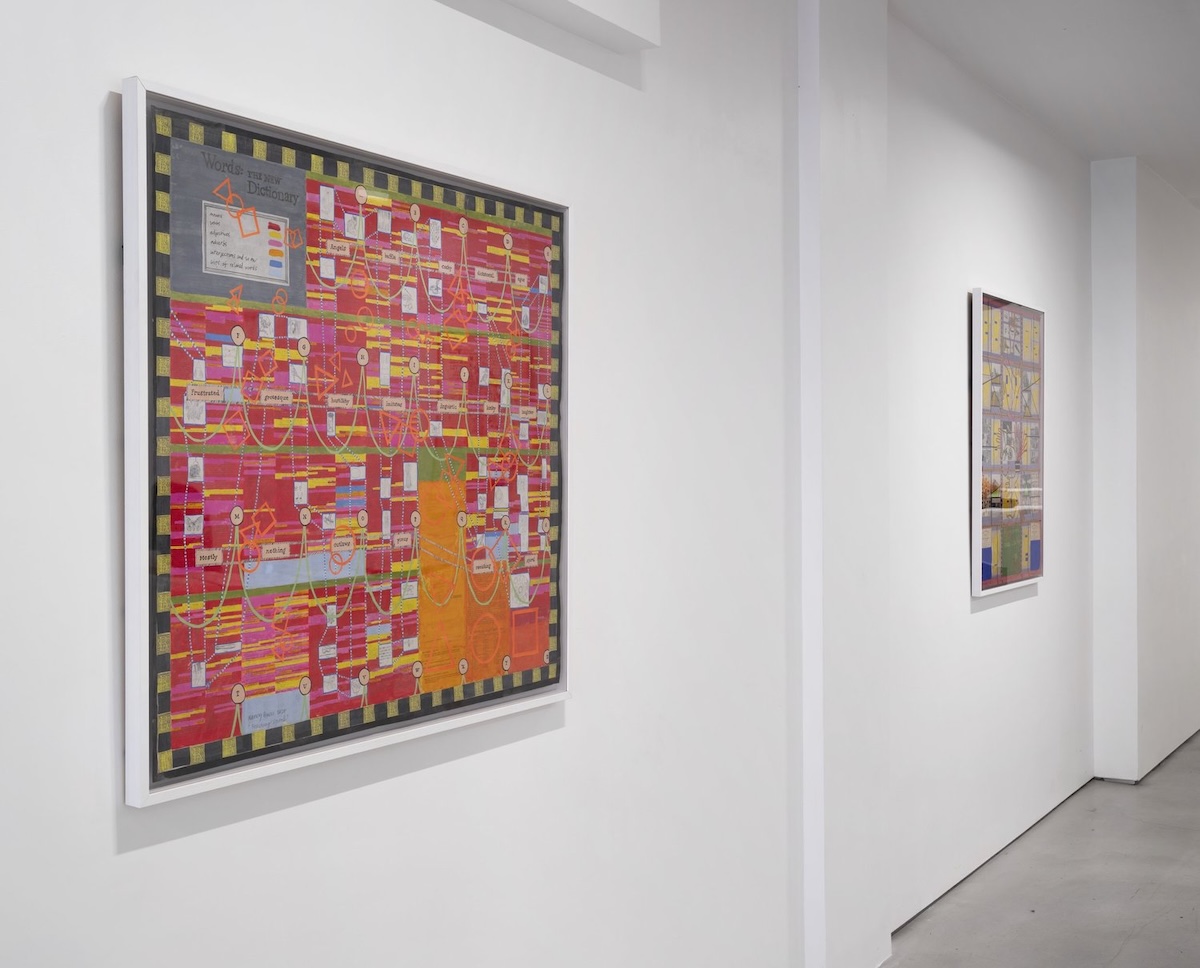 Nancy Bowen, Installation view of Ravishing Spiral, 35.5 x 40 inches, collage, gouache, and found book pages on rice paper
From the Deep and Lost at Sea 1 permeate throughout the rest of the exhibtion, setting the tone as Bowen’s most personal works. Bowen’s work is a reminder of the age-old tale that the private and public are entangled. The remainder of the show consists of collages and sculptures that the artist continues to oversaturate with aesthetic and literary meaning. Dictionary and typology pages fill the Gestalt of her collages, while curves and edges sculpt her figures. Bowen uses these elements like a double-edged sword, treating them as both subject and medium to construct her works and subsequently alter their use and meaning. With her selected dictionary pages, which she organized alphabetically, Bowen assigns a semi-objective set of rules to the work’s visual logic. In Ravishing Spiral (2024), for example, Bowen wanted to use a red composition, so she assigned the color red to any nouns. She then selected a word from each page to create a series of sentences such as, “angels baffle cocky dictatorial egos” and “grotesque hostility imitates jingoistic kinky laughter,” keeping the nation’s current state in mind. Teetering between playful and politically loaded, the materials Bowen used to build her systems collapse under the weight of their own meaning, becoming superseded by her exhibition’s greater visual aesthetic.
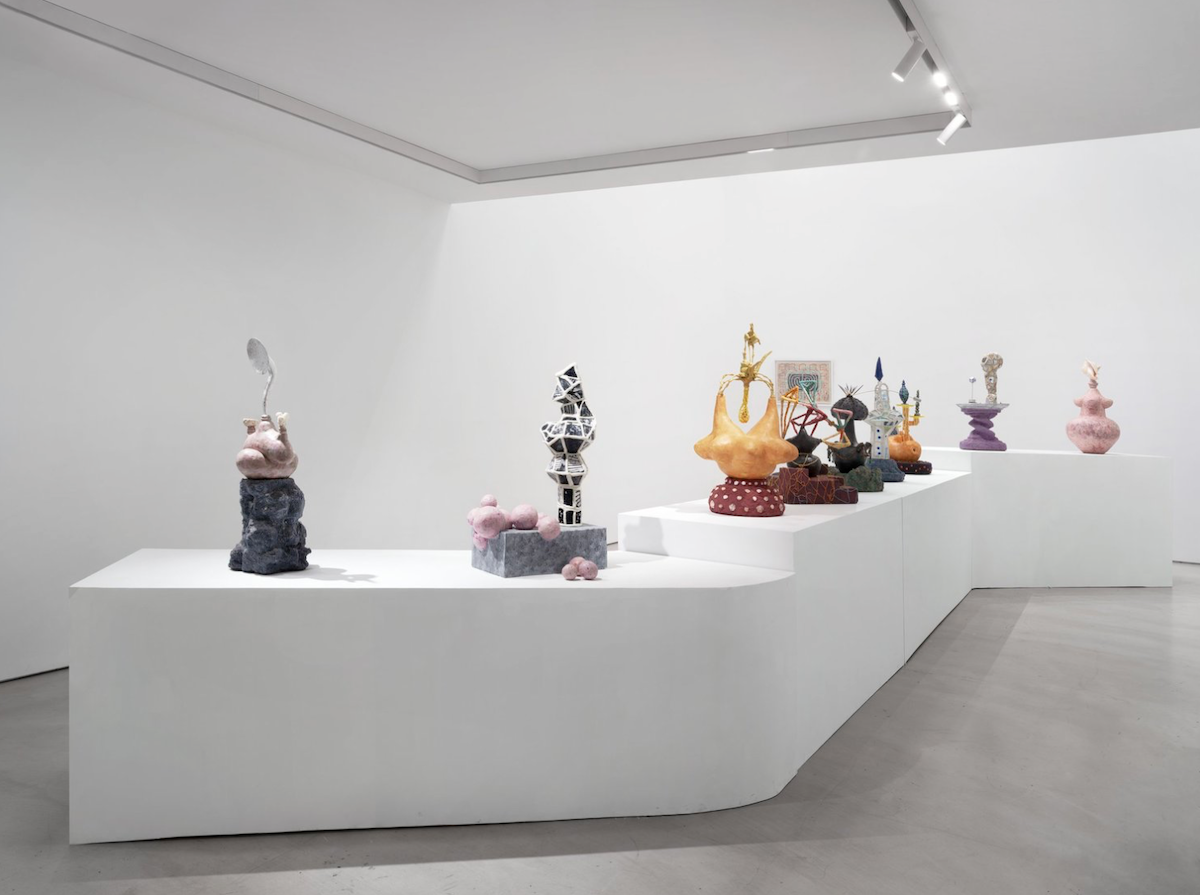 Nancy Bowen, Installation view
Bodies have always come before words or definition. Bowen stays true to this condition in her sculptural practice, explaining it as an intrinsic process where she begins her sculptures at the center and works outwardly from there. Once the core is made, she ponders where the figure lives and what they would be wearing. Each base, or “where they live,” was created from recycled foam which she then coated with dyed sand often used in crafts, another nod to the ocean. Bowen pointed to Sentinel (2024), a black and bulbous figure with porcupine quills protruding from the head, as the mean girl of the group. Looking at Holiday (2024), Bowen simply stated that she was thinking about the butt first, and went from there. Her practice is playful by nature, but many forms that emerge from this process connect to her dictionary collages, like in the mosaic geometric that holds together both her Beacon (2025) sculpture and Jolly Kismet (2024) collage. From these parallel structures, Bowen reenacts the intrinsic binding of bodies to American rhetoric. In binding them to her own structures, however, she also creates gateways for these bodies to escape this rhetoric’s containment, thus turning these systems against themselves.
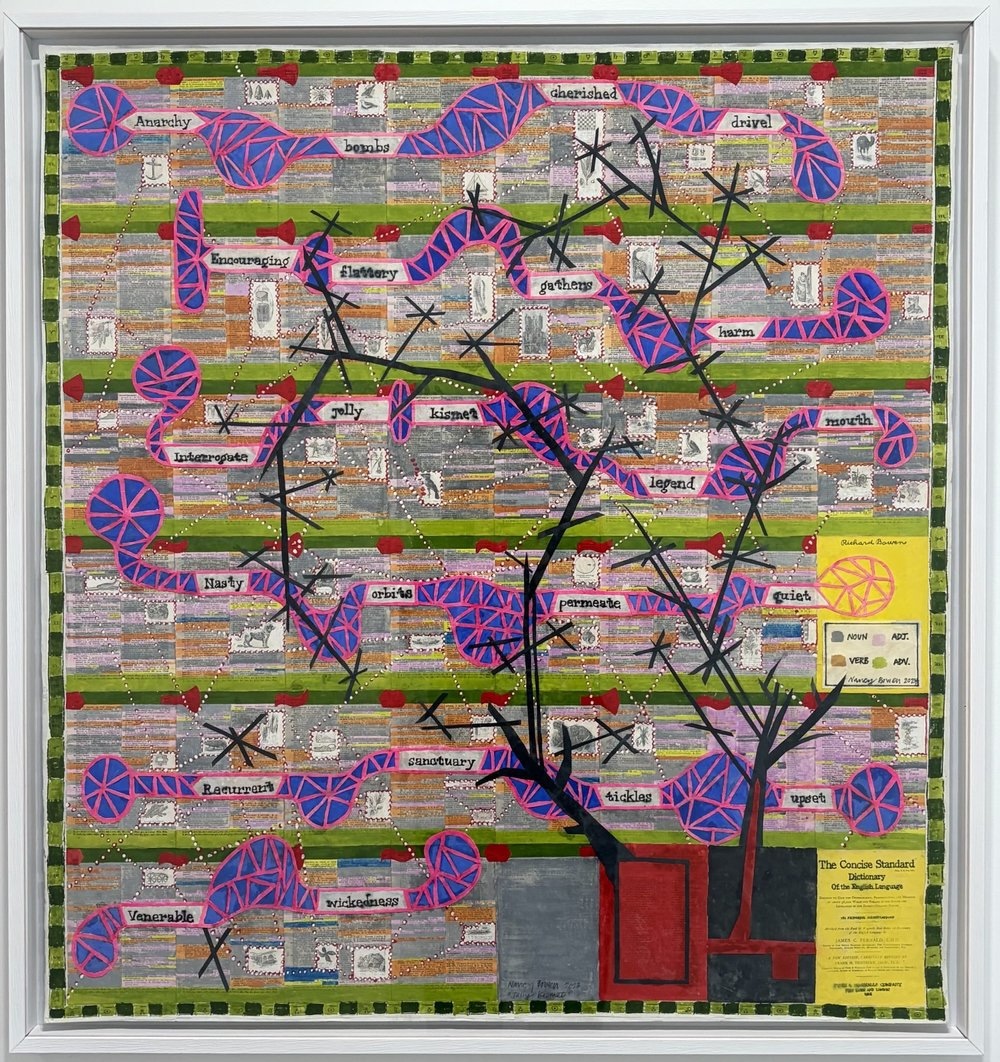 Nancy Bowen, installation view Beacon, 31 x 19 x 13 inches, glass, epoxy clay, gouache on ceramic, and wax
From A to Z and the Bodies In Between harbors deep histories of feminism, artistic experimentation, and the American identity, all of which Bowen anchors within her own history. The show breathes life into a feminist past that is coming to be solely understood through text and archives. She restores form to and demonstrates the power of this rhetoric, both constructive and containing, using a visual repertoire of symbols and patterns bound by historic American ephemera. As a long overlooked woman artist who witnessed the feminist movement’s birth and its deterioration firsthand, Bowen challenges the movement’s bookshelfing. History shouldn’t be treated as a past event, but rather as a lived experience. Bowen’s work is a reminder that the past can be repeated if we remove ourselves too far from it, and that the weight of our language will always be felt.
Nancy Bowen at Nunu Fine Art, New York June 5–July 25, 2026
Sydney Srnka
Sydney Srnka is a writer based in New York. She has a background in the gallery sphere and received her Master of Arts in art history at Hunter College.
view all articles from this author