Whitehot Magazine
August 2026
"The Best Art In The World"
"The Best Art In The World"
August 2026
Exhibition Review: “Bellmer, Nauman, Pondick: Material Desire” at Nunu Fine Art, Nolita
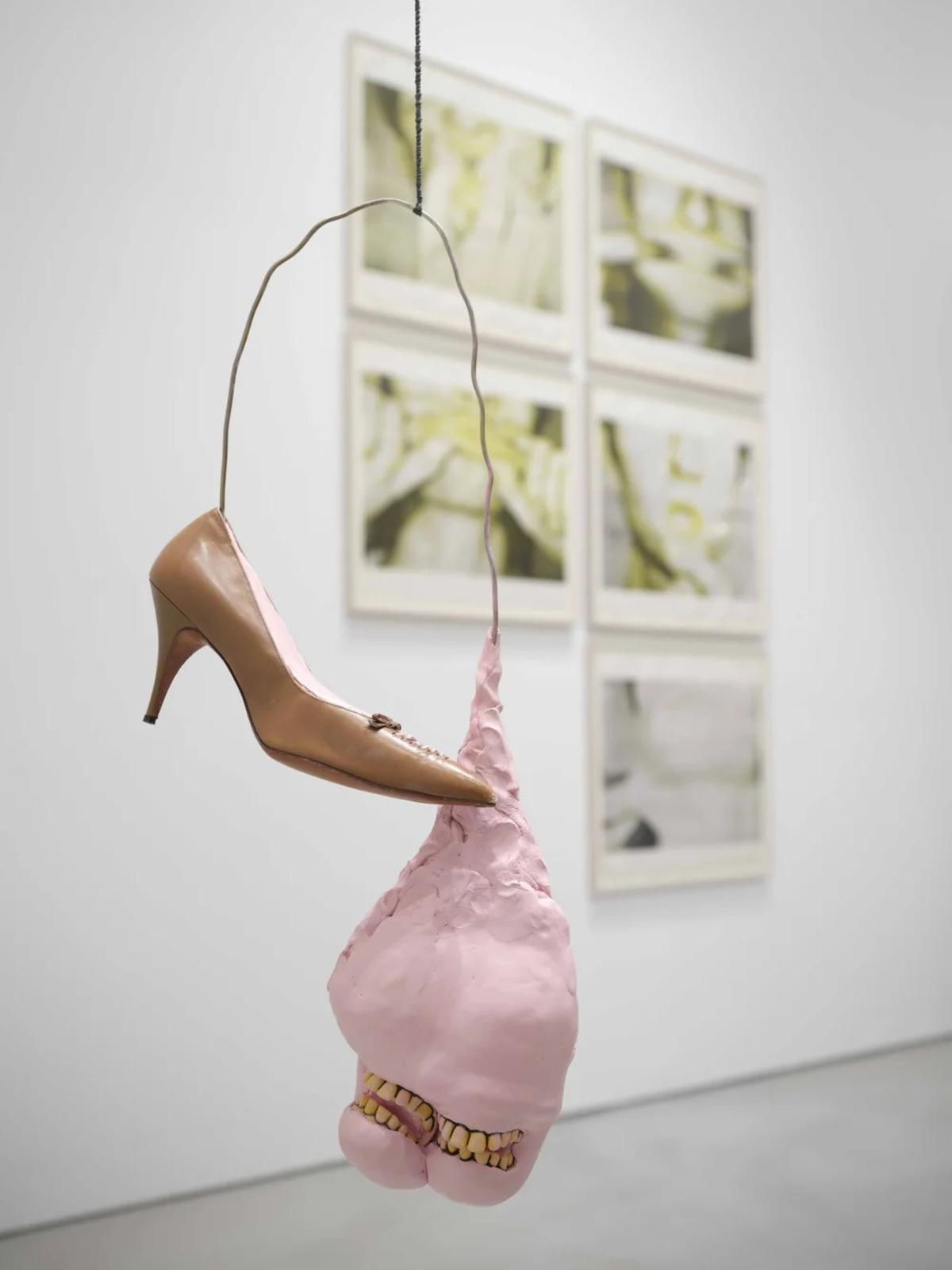 Installation view of Bellmer, Nauman, Pondick: Material Desire at Nunu Fine Art (March 6 - May 30, 2026). Photo by Martin Seck. Image courtesy of Nunu Fine Art.
By LIAM OTERO June 20th, 2026
There are gallery exhibitions, and then there are museum-quality gallery exhibitions. Nunu Fine Art’s Bellmer Nauman Pondick: Material Desire exceeded the expectations of what makes a great exhibition through its artist-driven / artist-insertion curatorial direction, spearheaded by the legendary sculptor Rona Pondick herself with the collaboration of Sonnabend, New York and Ubu Gallery, New York. Material Desire was - and remains - an active rumination on the human body as the mainframe for understanding the human condition (or at least, even beginning to comprehend it) as seen through a decisive selection of works by Hans Bellmer, Bruce Nauman, and Pondick. Given the rigorous research that went into the preparation for this exhibition, Pondick’s efforts are a testament to why curation should be appreciated as an art form. Material Desire succeeded in its sui generis positioning of three divergent artists in a cogent art historical dialogue coupled with an equally strong roster of stellar programming that enriched the totality of the exhibition’s scope.
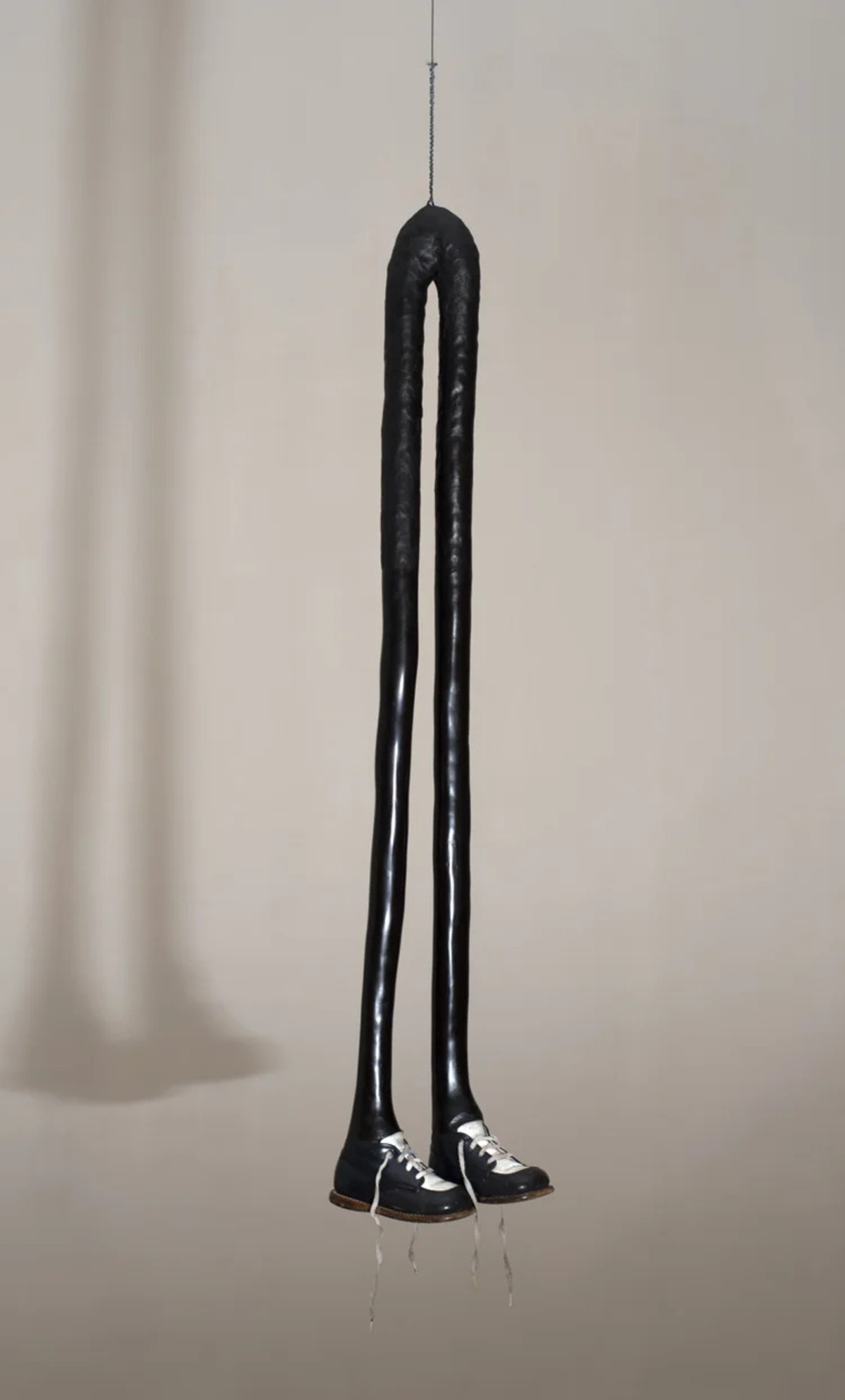 Rona Pondick (American, b. 1952), Baby Legs, 1990, shoes, wire, and epoxy modeling compound; wire variable for ceiling height. Sculpture: 39 x 5 ½ x 6 inches | 99.1 x 14 x 15.2 cm. Image courtesy of Nunu Fine Art.
Material Desire titillates one’s physical sensations, not from a position of comfort, but discomfort, pain, and anxiety. As soon as one enters the gallery, Pondick’s Baby Legs (1990), a pair of epoxy modeled legs whose feet wear untied sneakers, is an unsettling presence given the inhuman elongation of the legs absent of any bodily top-half as they dangle from the ceiling. Nearby, photographic prints documenting Bellmer’s La Poupée dolls are the artist’s reconfiguration of the female figure into bizarre physical forms comprising extra limbs, misaligned breasts, and headless bodies situated in varied interior and exterior settings. What makes these subjects so haunting beyond their disfigurement of the female body is that the images resemble crime scene photos, as if these are sites where a violent murder occurred based on the splayed positioning of the dolls with their decapitated appearances under ominous lighting and shadows.
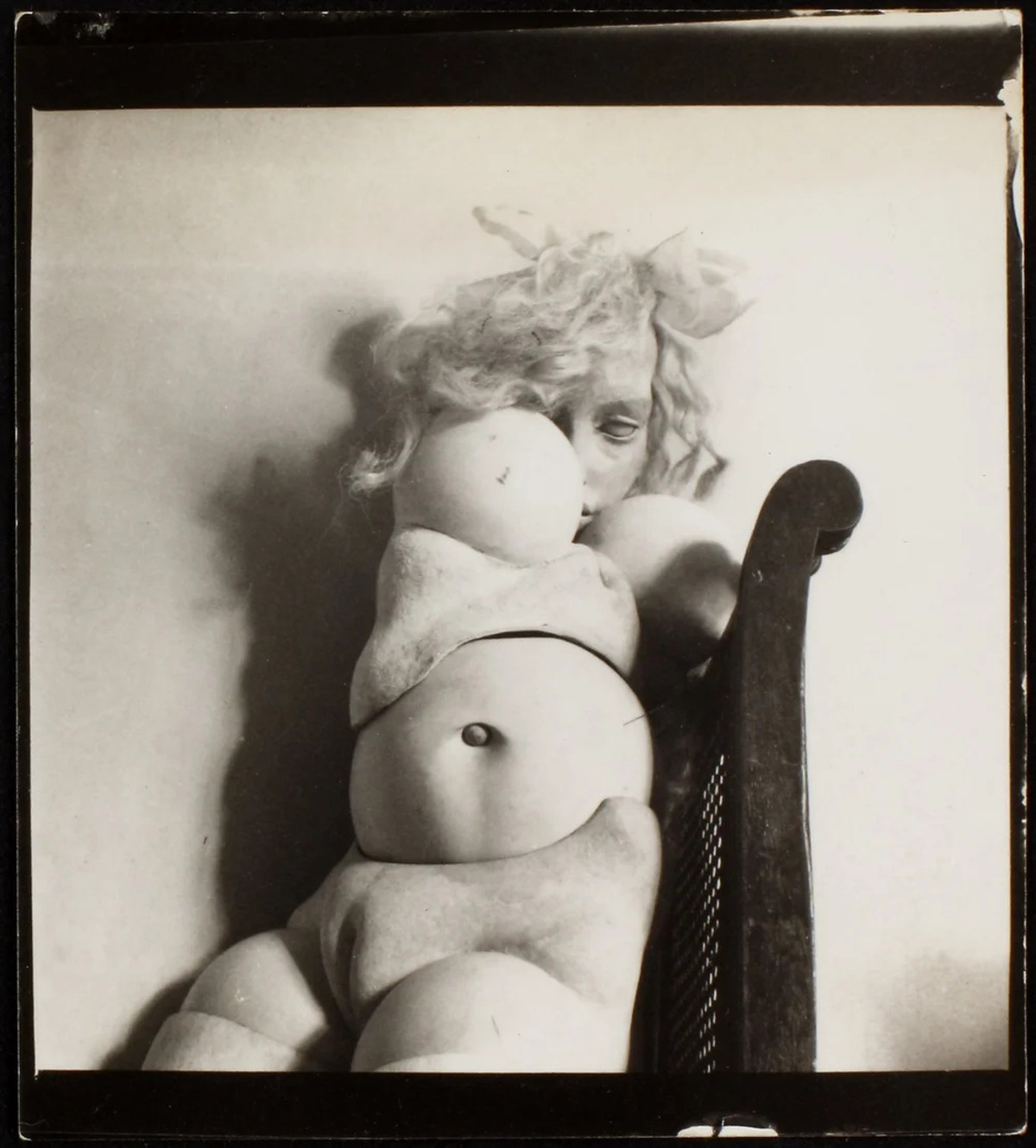 Hans Bellmer (German, 1902 - 1975), La Poupée (The Doll), 1935, vintage gelatin silver print. 2 ⅝ x 2 ⅜ inches | 6.7 x 6 cm. Image courtesy of Nunu Fine Art.
Stepping further into the body of the gallery, more of Pondick’s works - most of these dating from the 1990s - inundate the space alongside a few Nauman hologram studies from the early-1970s. Pondick’s sculptures are always about the selective parts of the body, never the complete corpus. The artist is present as Pondick frequently makes use of molds from parts of her body, which are reproduced in hordes, shrunken or enlarged sizes, or spliced together with other materials. Mouths detached from any head exist like chattering teeth toys, each distinguished in shades redolent of the gums of the mouth, while scattered along a base. Various permutations of legs, feet, or shoes - some of which hang singly by a wire that are attached to one of the strange teeth orbs while others stand silently in place conveying a surrealist bent with their hybridized formations of extra and absent limbs à la Bellmer’s La Poupée.
This comes from a personal squeamishness, but Nauman’s Studies for Holograms are uncomfortable to stare at for a long period as these close-ups of the artist’s face from the nose down to the neck capture the combined fleshiness and elasticity of skin. Actions like the squeezing together of lips that balloon to an inflated proportion or the pinched pull of the neck’s skin a few inches outwards triggers an association of touch, but to a level of intensity that feels like it is on the cusp of questioning “How much further can I extend this sensation?”. Perhaps these can be described as the conceptual preface to the borderline daredevilry of a body artist like Chris Burden and his injurious performances? In the downstairs space, Nauman’s fixation with the parts of his body are expressed through several screened video works from the 1970s where he caresses his thighs, genitals, and face in repetitively sensual gestures seen up-close and awash in an-all blue coloration (could the choice of color here be a tongue-in-cheek reference to "blue films", an informal term for pornographic cinema?).
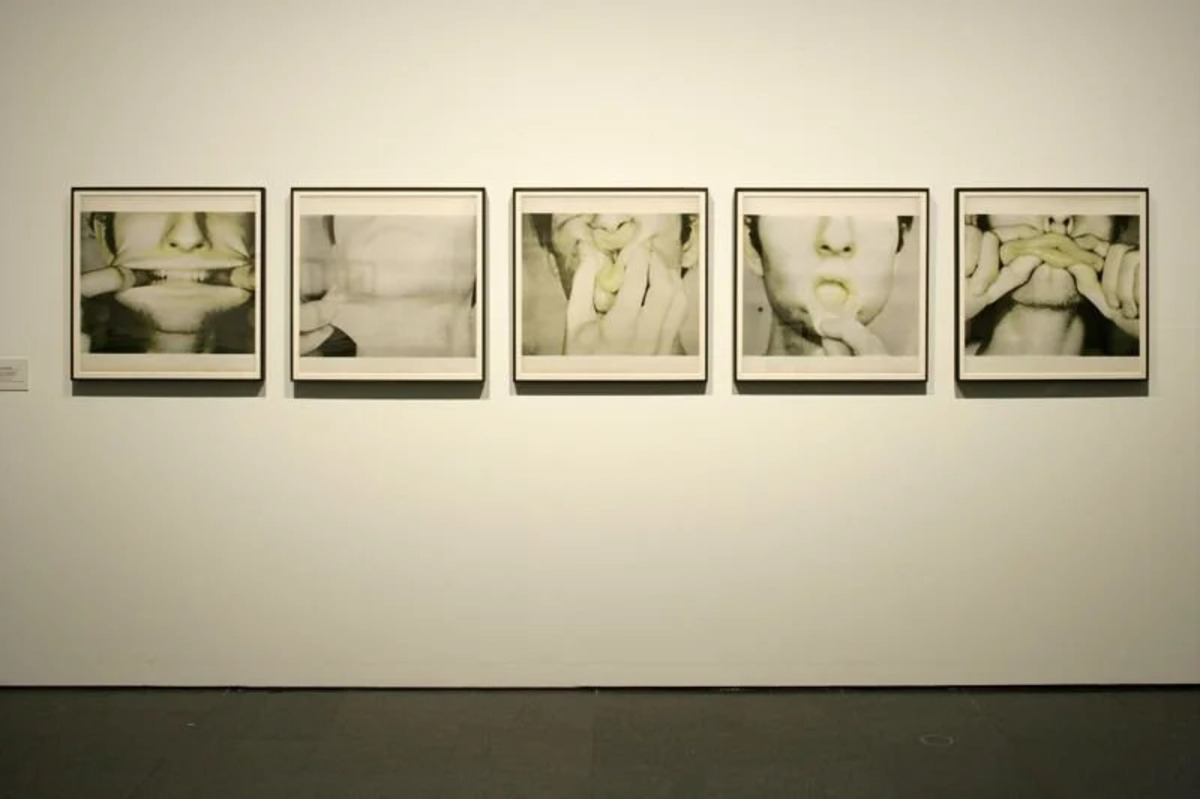 Bruce Nauman (American, b. 1941), Studies for Holograms (a - e), 1970, screenprinted in yellow-green. 26 x 26 inches | 66 x 66 cm. Image courtesy of Nunu Fine Art.
The art of Pondick, Nauman, and Bellmer are not only concerned with the body, but seem to be just as preoccupied with how far to push the limits of what the body is and what it can become. Bellmer’s La Poupée dolls were conceived in the 1930s, Germany’s Interwar years when fascism was on the rise and Aryan ideals on race and gender were enforced. Retroactively, Bellmer’s works have been criticized as antithetical to feminism for their distortions of the female body in ways that come across as grossly perverse (the feeling lingers for me), but given the context of when they were made, the La Poupée dolls were quite radical in their subversion of bodily representation and aesthetic standards, such that Bellmer was added to the list of deemed degenerate artists by the Nazis.
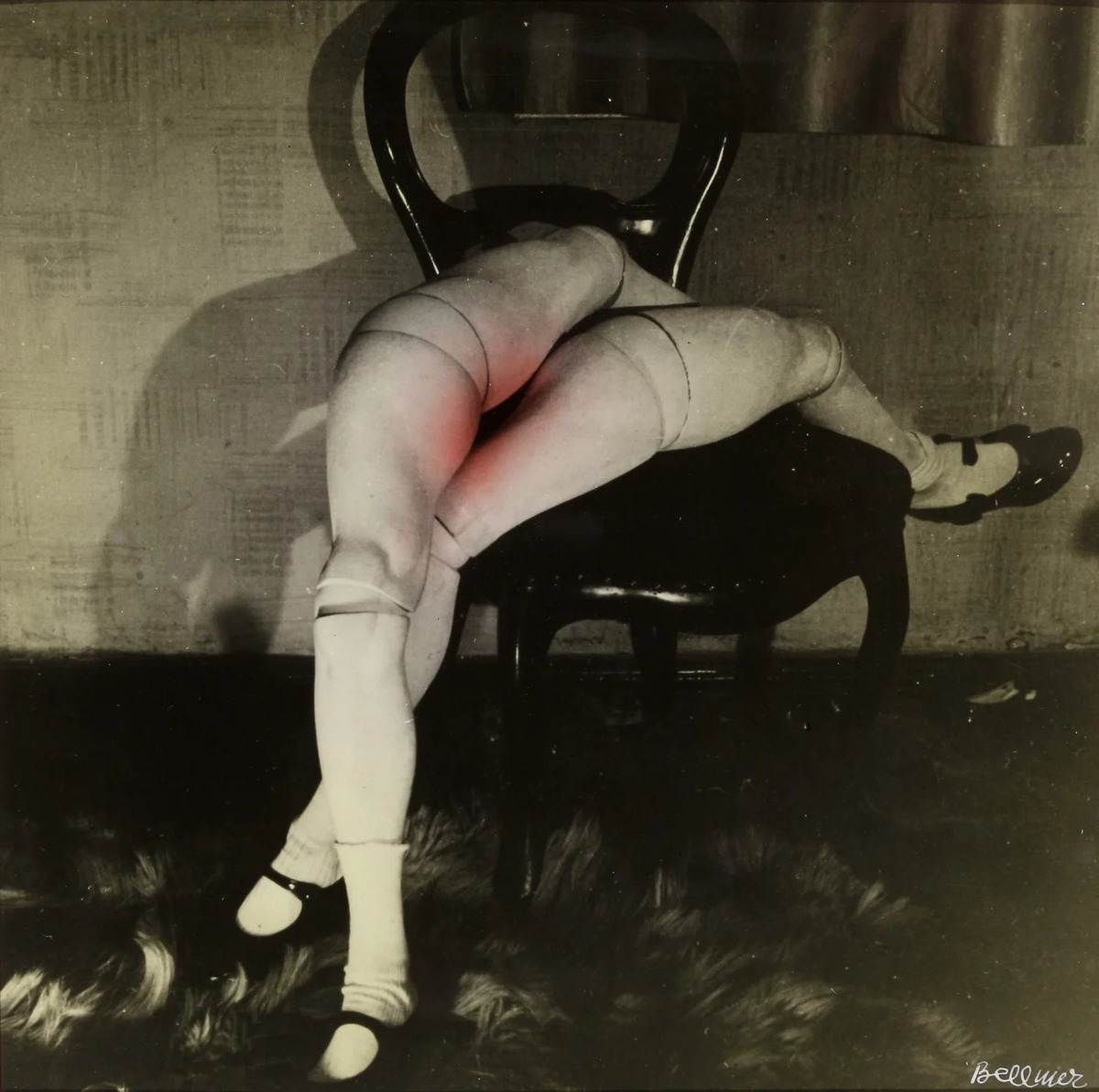 Hans Bellmer (German, 1902 - 1975), La Poupée (The Doll) or La Bouche (The Mouth), 1936 (Printed 1949 or earlier), hand-colored vintage gelatin silver print. 5 ⅝ x 5 ¾ inches | 14.2 x 14.5 cm. Image courtesy of Nunu Fine Art.
Nauman’s works are a transgression of a different era and geography as he arose at the height of the Sexual Revolution in the 1960s & 1970s. Concurrent with this socio-political sea change, the body as a site for artistic statement and tool for creative expression was an emerging idea, to which Nauman was at the helm while devising works like the exhibited hologram studies or documented video performances.
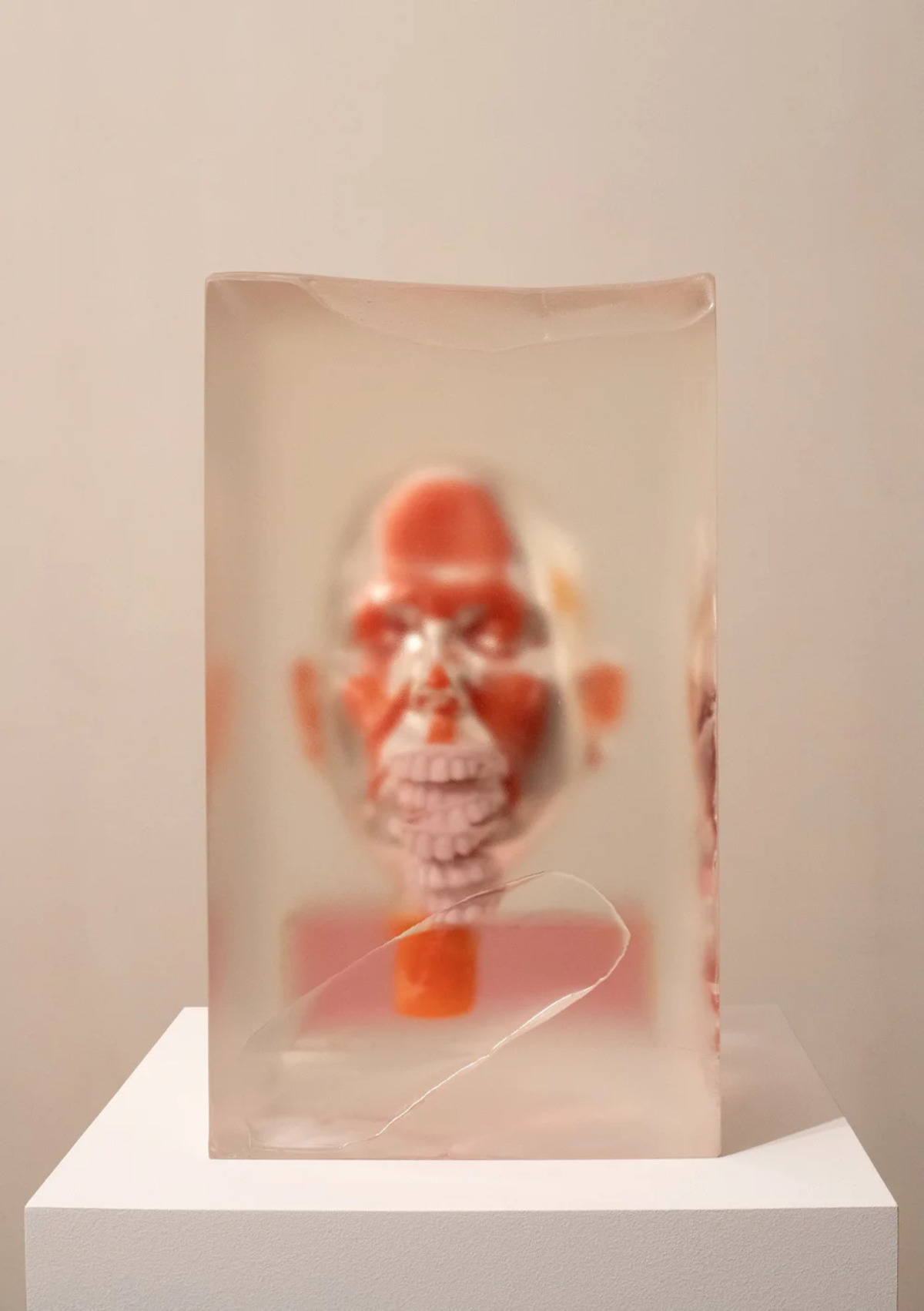 Rona Pondick (American, b. 1952), Encased Orange with Pink Teeth, 2019 - 2023, unique, pigmented resin, acrylic, and epoxy modeling compound. 18 ¼ x 10 ½ x 12 ½ inches | 46.4 x 26.7 x 31.8 cm. Image courtesy of Nunu Fine Art.
Pondick, the most contemporary of the three artists, taps into a post-figuration with her more future-oriented, visionary conceptions that imagine the body in a more-than-human fashion. For example, the encased head in the middle of the space feels eerily as though life is temporarily frozen in a manner congruous with the much speculated process of cryogenic freezing. The part-transparent, part-opaque resin resembling a block of ice that contains one of Pondick’s partially formed heads gives an anticipatory sense that the head could one day be liberated and still possess some living cells.
Accolades must also be given to the catalogue that accompanied the exhibition. The print quality of the text is such that, returning again to the museum-quality praise, institutions like The Metropolitan Museum of Art, MoMA, and The Whitney Museum would be remiss not to have at least one copy in their library holdings; as a matter of fact, The New Museum (which is practically a neighbor to Nunu Fine Art) would especially benefit in owning a copy or distributing them in their store considering the themes of the current New Humans: Memory of the Future exhibition along with their inclusion of a late-career Bellmer sculpture.
 Bellmer, Nauman, Pondick: Material Desire. English / Mandarin. Published: 2026
Even for those who were unable to see Material Desire, the catalogue excels in its ability to recapture the essence of the curatorial approach undertaken by Pondick while also functioning on its own as a great topic-focused art book elucidating further context on the themes and ideas expressed forth. Ample images grace the pages of the catalogue, some in reference to works directly included in the exhibition along with those not in the show serving a more ancillary value. Audiences have the benefit of recognizing Pondick’s voice by reading a wonderful interview between her and the gallerist Nunu Hung. Additionally, the art historian A.J. Godetzky contributed the catalogue’s excellent introductory essay, “Fleshing Out”.
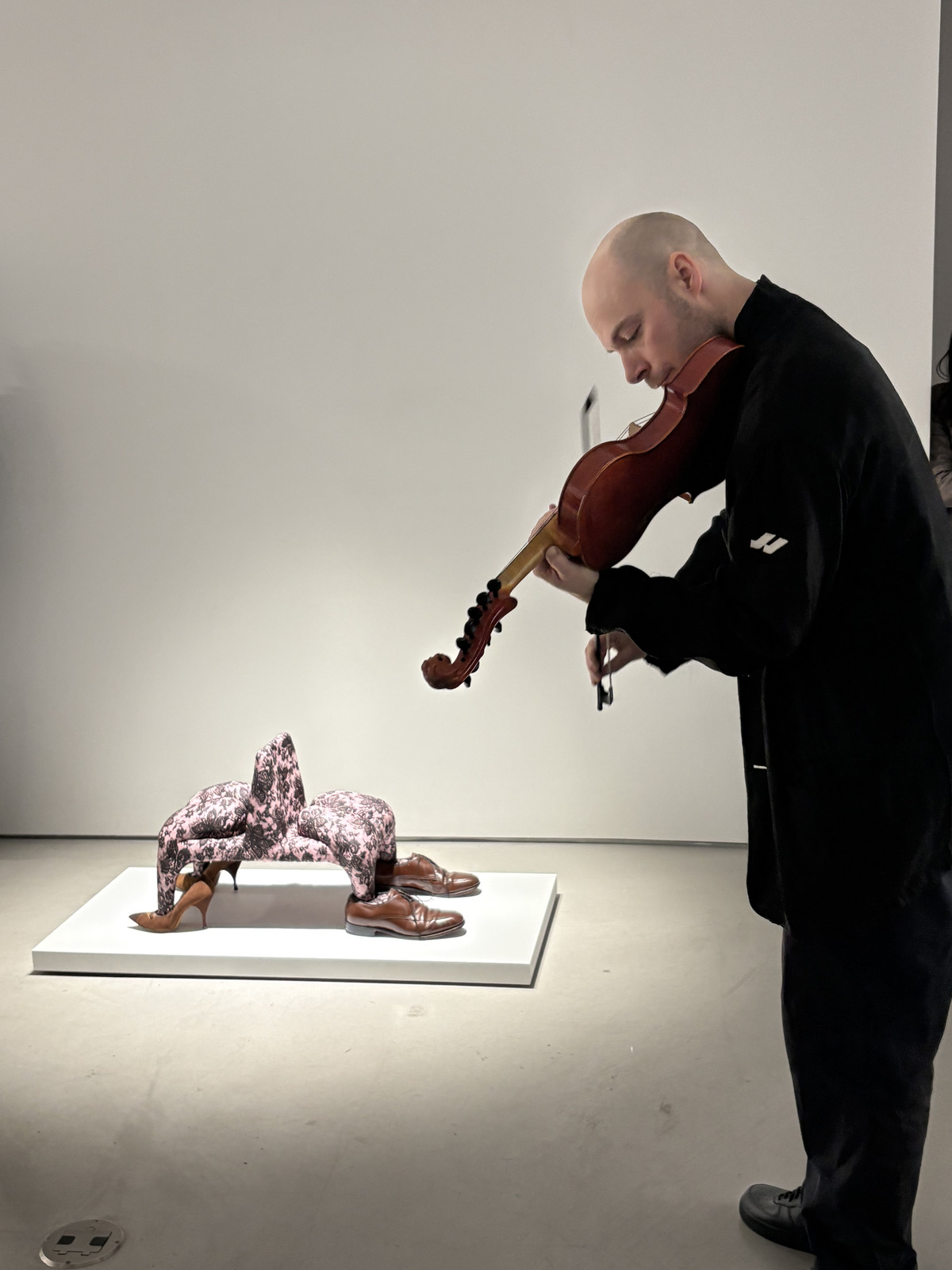 Experimental musician Cleek Schrey performing at Nunu Fine Art on March 18, 2026. Photo by Liam Otero.
Because of how much meaning there is to mine from this assortment of artists and works, Pondick and the gallery organized wonderfully diverse event programming. Experimental musician Cleek Schrey delivered a sonic response to the show that entailed a rule-breaking performance with a violin that emphasized silence rather than sound whilst slowly perambulating the gallery (perfect for those who are ardent John Cage enthusiasts). A more ekphrastic interpretation of the exhibition came through in a live poetry reading by the poets Abigail Child, William Lessard, Andrew Levy, and Susan Lewis. And lastly, a gallery talk was held between Pondick and the catalogue’s contributing writer Godetzky near the end of the exhibition’s run, which was extremely well-attended like the previous events.
When comparing museum or gallery-style curation, an argument can be made that museums may have a greater modicum of curatorial freedom than that of galleries. Let me clarify this is not an absolute statement given the reams of headlines that crop up about museum shows that close over financial cutbacks or are censored for political reasons, among a number of other examples. What I am getting at here is that academic rigor and non-commercial curation tends to be what holds sway in the museum setting over galleries. Again, not an absolute statement, but a general trend in galleries is for the show to garner sales, which is not necessarily terrible dependent on the ethics of that gallery.
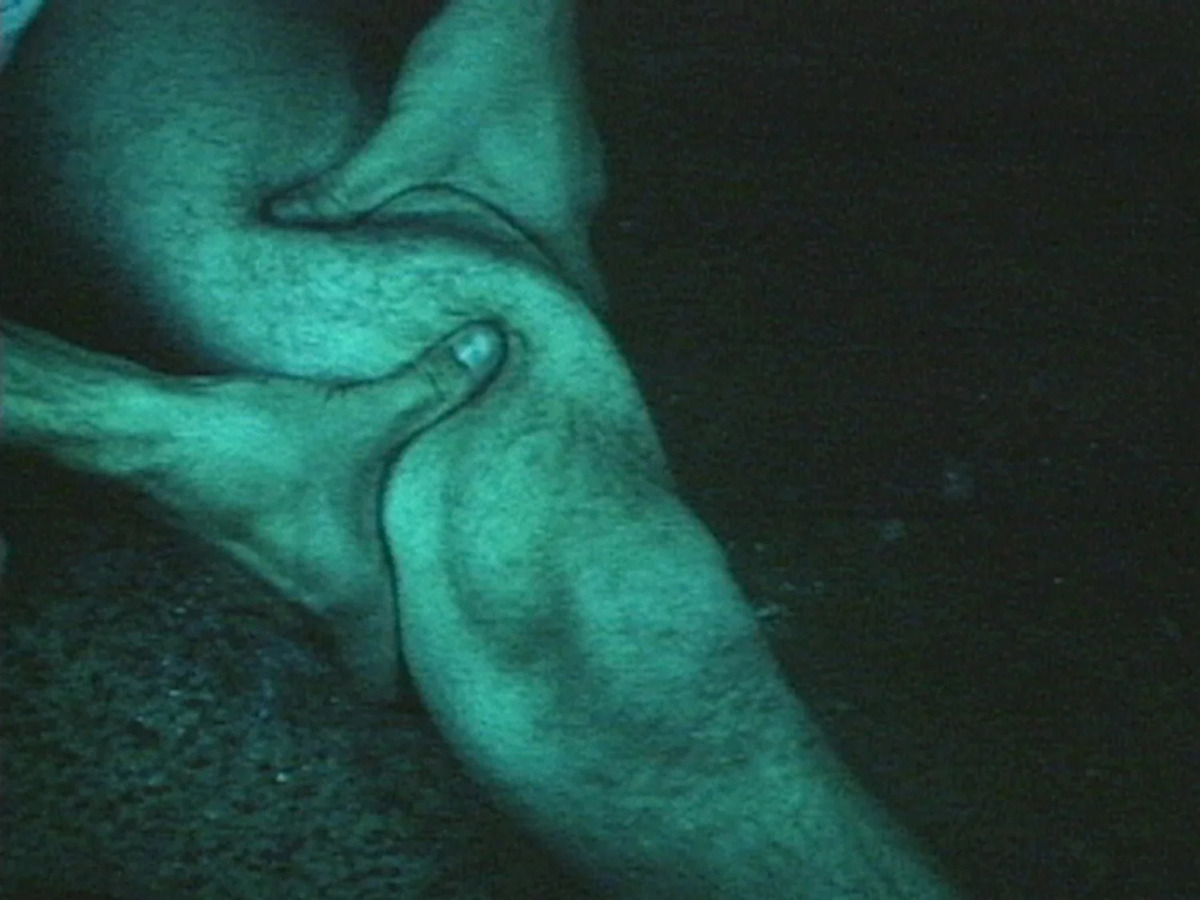 Bruce Nauman (American, b. 1941), Thighing (Blue), 1967, 4:36 minutes, color, sound, 16mm film on video. Image courtesy of Nunu Fine Art.
Nunu Fine Art’s acceptance and support of Pondick’s exhibition is a refreshing example of a contemporary art gallery that took a leap of faith by facilitating an exhibition that was all about thought-provoking ideas as explicated through a fascinating choice of artists and works that otherwise might not be pursued by most other galleries (and frankly, was an idea so original that it had not yet been pursued at the museum level). Rona Pondick’s ability to organize and execute such an exhibition is an inspiring demonstration that galleries like Nunu Fine Art are out there to stir engrossing discourse about art beyond just a consideration of aesthetic marketability. Another theme to be ascertained from these artists is their disavowal of simply making work to please the eye, but instead to dig further into the hard truths of life, to pull from a Nauman quote from the catalogue: “Sunsets, flowers, landscapes: these kinds of things don’t move me to do anything. My work comes of being frustrated about the human condition.”
The artist-driven curation of Pondick has opened up a wellspring of ideas on the human body as motivated by the artist’s interest in “juxtaposing Bellmers and Naumans with my own [Pondick’s] work [that] might make people scratch their heads”. And it is precisely this kind of authentic curatorial experimentation of bringing in artists that otherwise have seldom been connected which I respect and value as an art critic, art historian, and curator because it is only expanding the terrain of Art History. WM

Liam Otero
Liam Otero is a freelance art writer in NYC. He was recently named New York Editor of Whitehot Magazine.
view all articles from this author