Whitehot Magazine
October 2026
"The Best Art In The World"
"The Best Art In The World"
October 2026
Clouds and Traces: Chasing Clouds at the Metropolitan Museum of Art
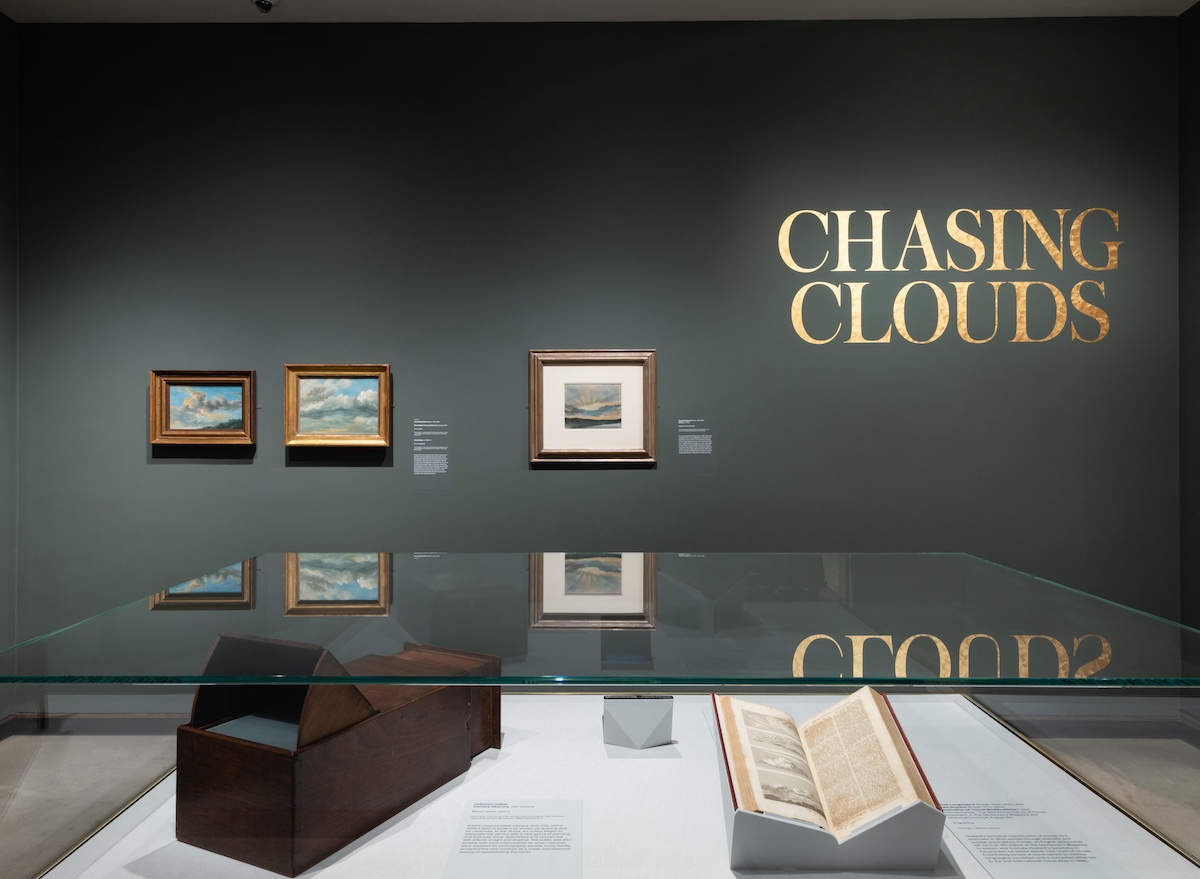 Installation view of Chasing Clouds, 2026. Photo: Hyla Skopitz. Courtesy of The Metropolitan Museum of Art.
By RAPHY SARKISSIAN | October 21, 2026
Chasing Clouds, installed at the Metropolitan Museum of Art in a dimly lit gallery with dark slate walls, gathers works from four of the museum’s departments around the motif of the cloud. Oil sketches made under the open sky in the early nineteenth century hang alongside watercolors, drawings, and photographs from the first decades of the medium to the 1930s. Among the works on view in a display case are a Claude mirror and a camera obscura, two optical instruments of the kind artists once carried into the field. The earliest photograph in the show is a daguerreotype that Marie-Charles-Isidore Choiselat and Stanislas Ratel made in 1844 on a journey through eastern France, at a time when portraiture dominated the trade. The plate shows a cottage and a row of poplars at the edge of still water. The water gives both back: before the camera recorded anything, the pond had already produced an image of its own, without hand or apparatus, out of nothing more than light and a level surface. The daguerreotype preserves the cottage and the poplars upright and inverted at once, a moment in which architecture and nature regard themselves in a shared narcissism.
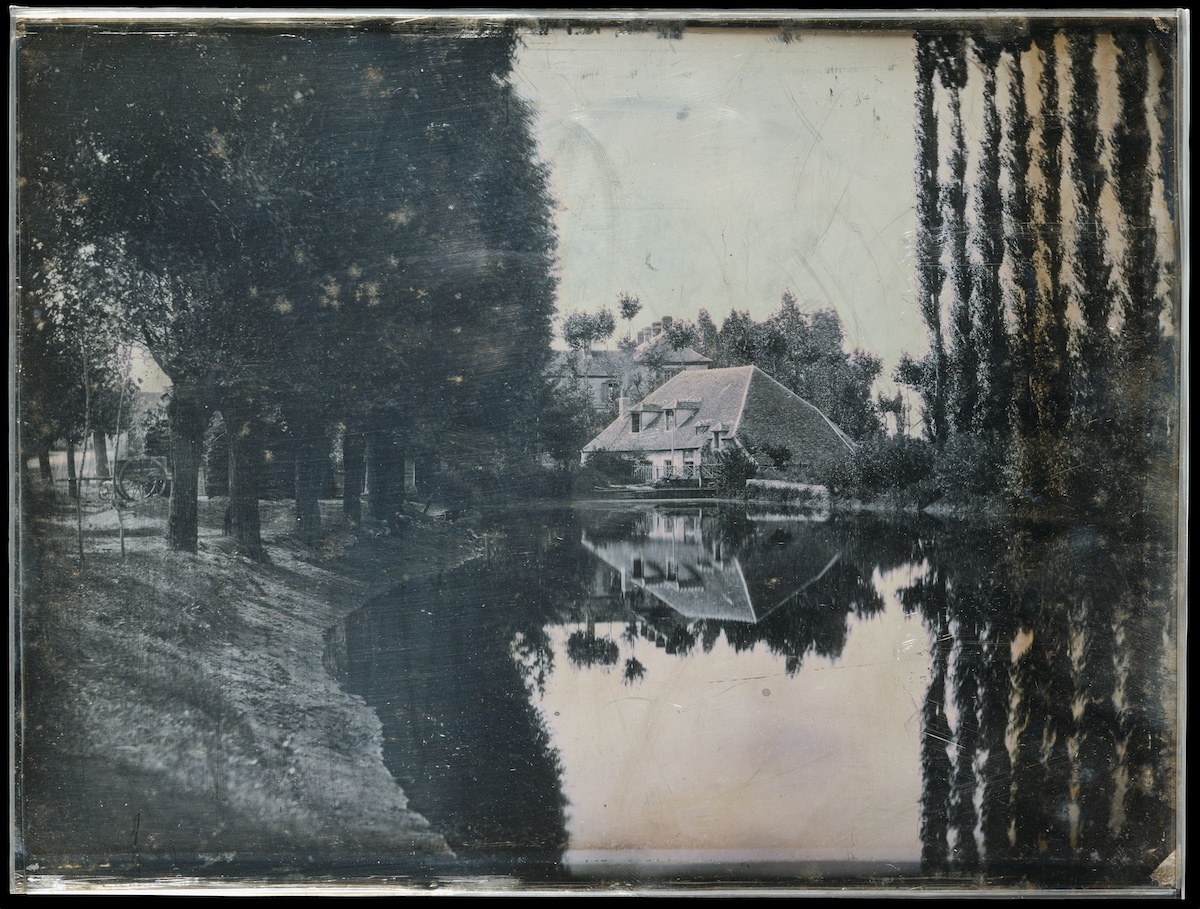 Marie-Charles-Isidore Choiselat and Stanislas Ratel, Landscape, 1844. Daguerreotype. 6 7/16 by 8 9/16 inches. Courtesy of The Metropolitan Museum of Art.
The Claude mirror, a device that predates photography by decades, reshapes a landscape in ways the unaided eye cannot. The example on view, a small glass in a leather case from the nineteenth century, lies open, the lid holding a rectangle of black glass above a lining of blue satin. Under the gallery lights, the glass shows almost nothing. This dark mirror remains a surface waiting for a world to be placed before it. Travelers and sketchers who carried such mirrors typically turned their backs on the view in order to observe the scene within the optical accessory. Darkened to subdue the glare of daylight, the glass returned the landscape smaller and drawn together in tone. In the mirror, sky and land, unequal in brightness, approached the even light of a canvas by Claude Lorrain, painted more than a century before the device that bore his name.
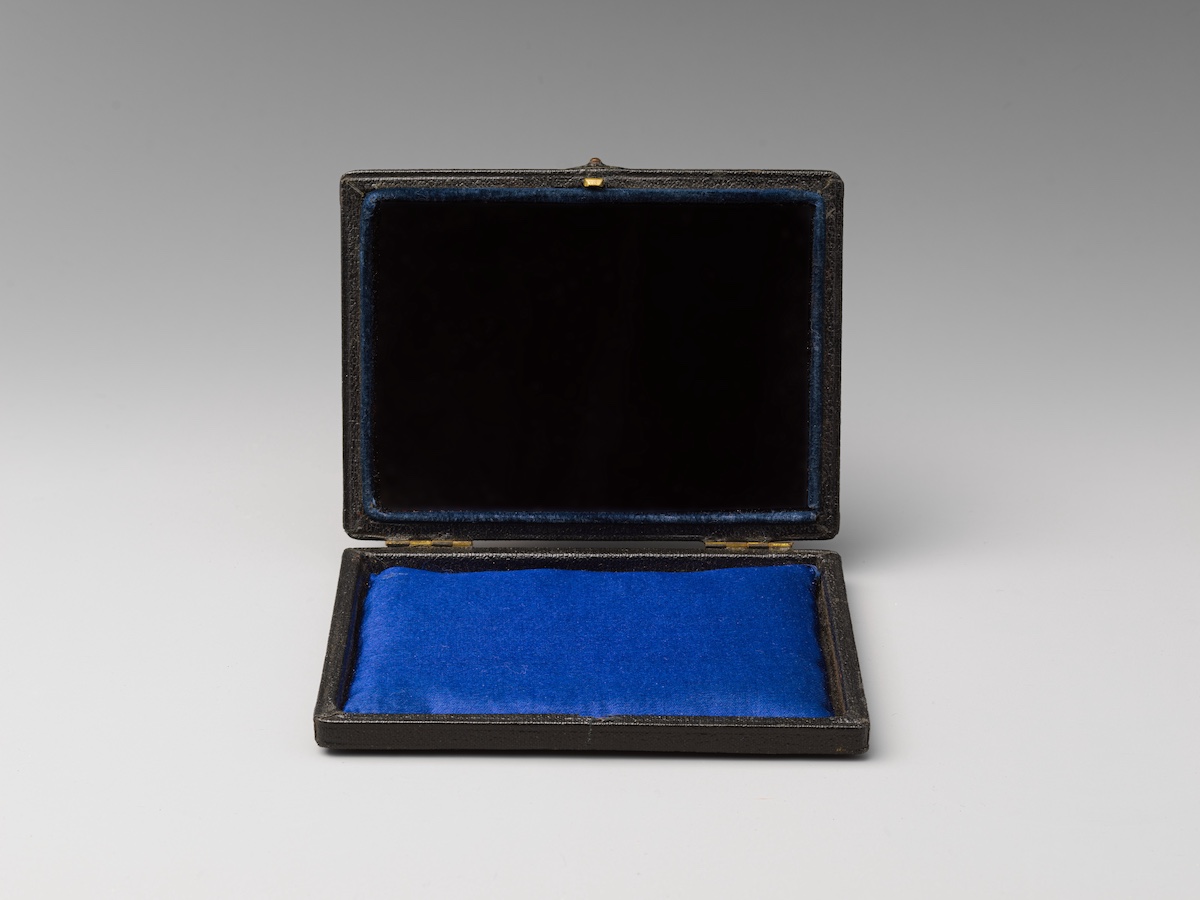 Unknown maker, Claude Mirror, 19th century. Glass, leather case. Glass: 4 5/16 by 3 1/16 inches. Courtesy of The Metropolitan Museum of Art.
The Claude mirror and Choiselat and Ratel’s daguerreotype of a pond answer comparable desires for a world re-presented, but they situate their images in different temporal frames. The image in the Claude mirror vanishes as soon as the glass is lowered, while the image in the daguerreotype photograph belongs to the moment of its exposure. That moment has long since passed, yet it survives on the plate as a trace: the silvered copper keeps the impression of light from the cottage, the poplars, and their reflection. Oliver Wendell Holmes, writing in 1859, called the daguerreotype “the mirror with a memory.” [1] And Roland Barthes, though he was thinking of people rather than landscapes, described the photograph as “literally an emanation of the referent.” [2] On this reading, light radiated by the edge of a pond in eastern France in 1844 still reaches the eye in the gallery’s electric light.
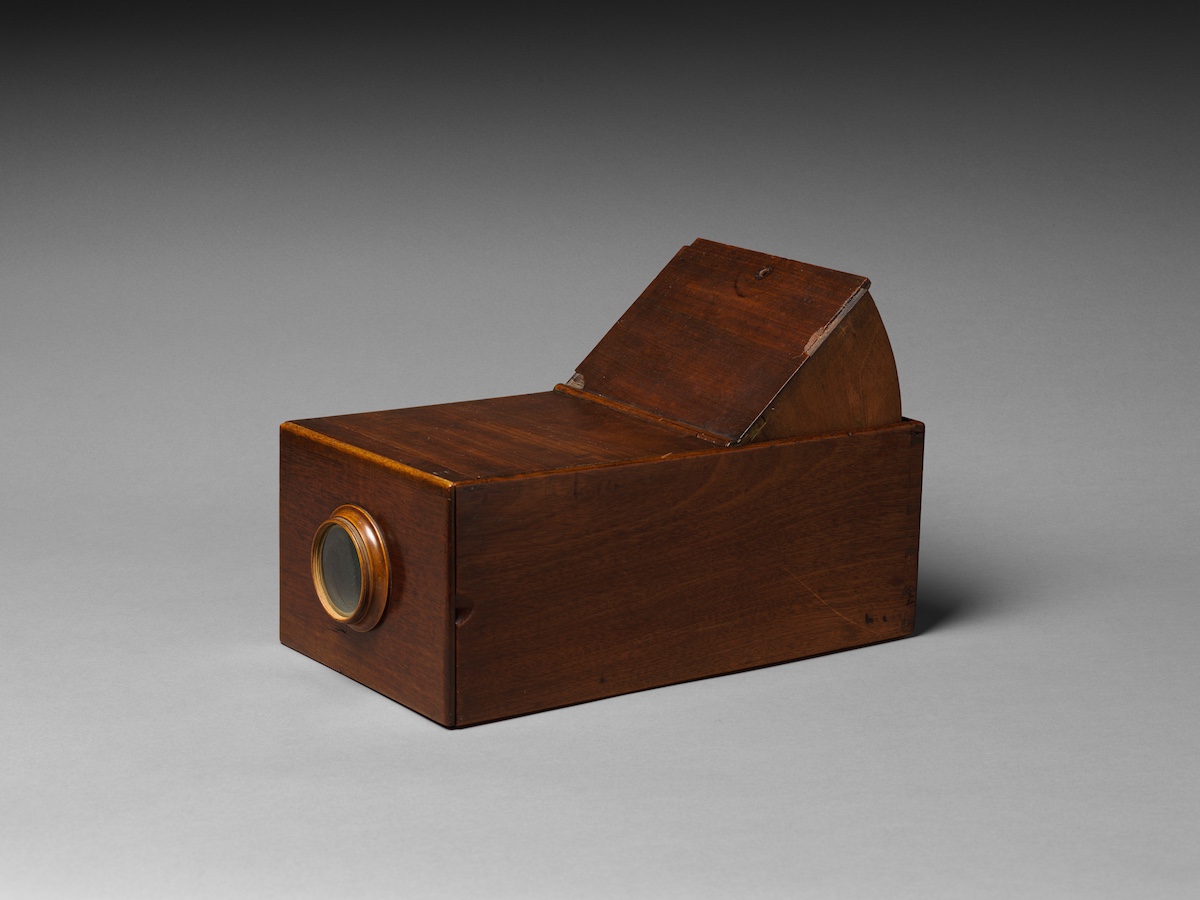 Unknown maker, Camera Obscura, 19th century. Wood, glass, optics. Courtesy of The Metropolitan Museum of Art.
The camera obscura on view, a wooden box with a lens at the front and a hinged hood on top, gathers light through the lens and sends it, by way of a small mirror inside, up onto a pane of glass beneath the hood, where an artist could trace the view at the scale of a drawing. The camera’s label explains that in the 1820s critics began to associate the device with a more descriptive kind of painting. The same text adds that a public already familiar with such instruments later accepted photography more readily as an objective record of the world. For centuries before such an image could be made permanent, the box had taught viewers to trust a likeness that no hand had made. That image, however faithful, bears no trace of whoever looks into the box, only the choice of where it was pointed, whereas a painted study is marked by its maker in every stroke.
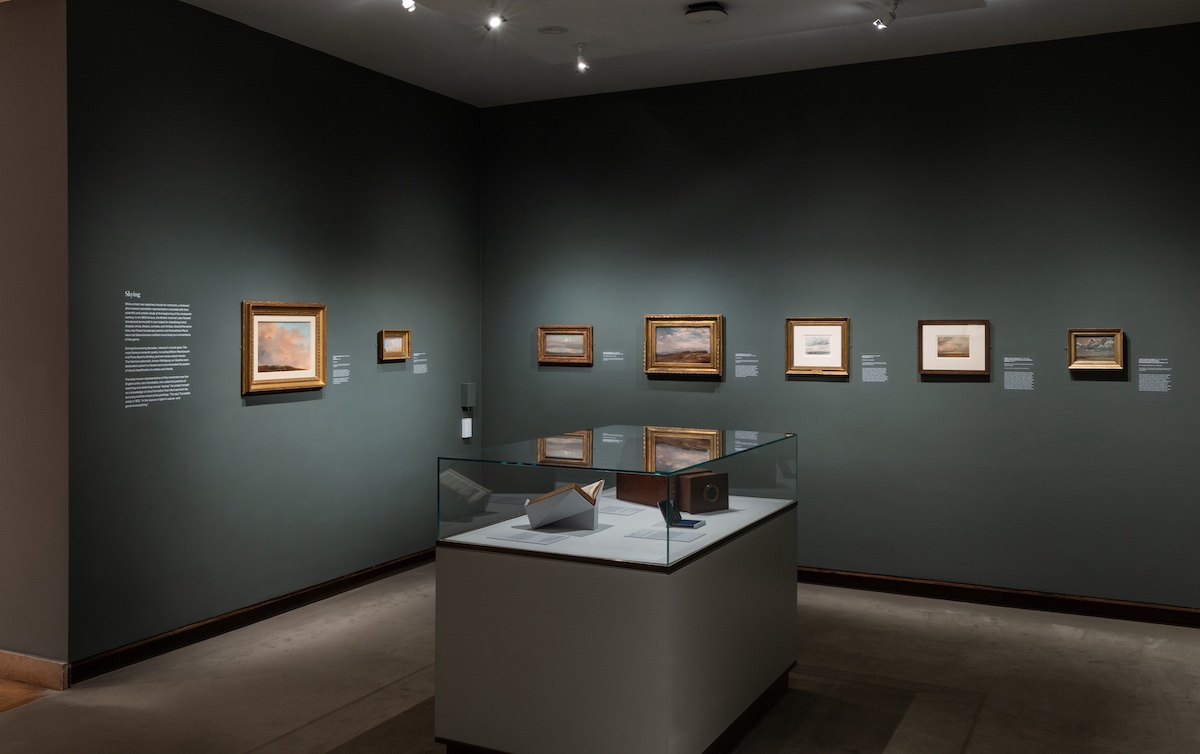 Installation view of Chasing Clouds, 2026. Photo: Hyla Skopitz. Courtesy of The Metropolitan Museum of Art.
In 1604, Johannes Kepler explained vision by treating the eye as a camera obscura: light from the world passes through the pupil and forms an inverted picture on the retina. Svetlana Alpers, who made Kepler’s account central to her study of Dutch painting, notes: “Neither the observer looking out into the world nor the process of perceiving the picture formed is Kepler’s concern.... He stands aside and speaks of the prior world picturing itself in light and color on the eye.” She continues: “The function of the mechanism of seeing is defined as making a representation: representation in the dual sense that it is an artifice—in the very making—and that it resolves the rays of light into a picture.” [3] The camera obscura places that mechanism outside the body. On the glass beneath its hood, the wooden device represents the scene before it from a single viewpoint, within a fixed frame, and at a scale set by its lens. What the nineteenth-century public took to be objective was a convention, and photography, when it arrived in 1839, inherited it along with the camera.
Alexandre Desgoffe’s Cloud Study with Distant Mountains keeps the land only along the lower edge of the sheet. The foliage forms a continuous green ridge whose irregular undulations repeat those of the blue mountains above it, and both are so summarily brushed that they read less as terrain than as tone, a silhouette against which the sky can still be reckoned. Above them, a broad band of gray cloud hangs nearer to us, darker and heavier than the mountains beneath, as if vapor could outweigh stone.
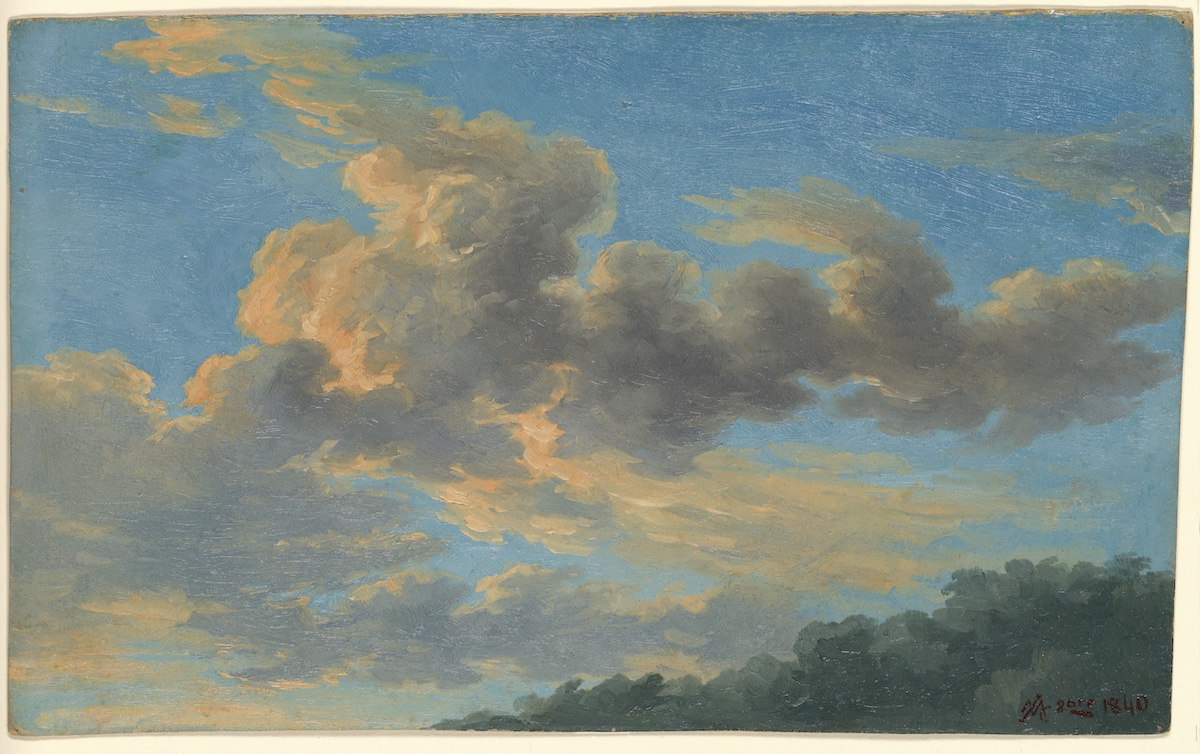 Jean-Michel Cels, Cloud Study in the Late Afternoon, 1840. Oil on paper. 8 1/8 by 13 1/4 inches. Courtesy of The Metropolitan Museum of Art.
In Jean-Michel Cels’ oil-on-paper Cloud Study in the Late Afternoon (1840), nothing of the earth is visible except a triangle of dark treetops in the lower right corner. The cumulus clouds above, scattered across the sheet, echo the rounded crowns of the trees on a larger scale and more freely, and wherever the low sun reaches them, it turns them into apparitions of gold and peach light. Beside this painting, his Cloud Study (ca. 1838–42) gives up even that corner of trees, leaving the clouds on their own. Here the oil turns the flatness of the cardboard into the formlessness of vapor and light. Trees, like land or architecture, can be measured against one another and against the ground they occupy. Yet clouds are immeasurable, and to arrest them at all, the paint must give them an outline and a skin they never possessed. This is Cels’ pictorial aporia.
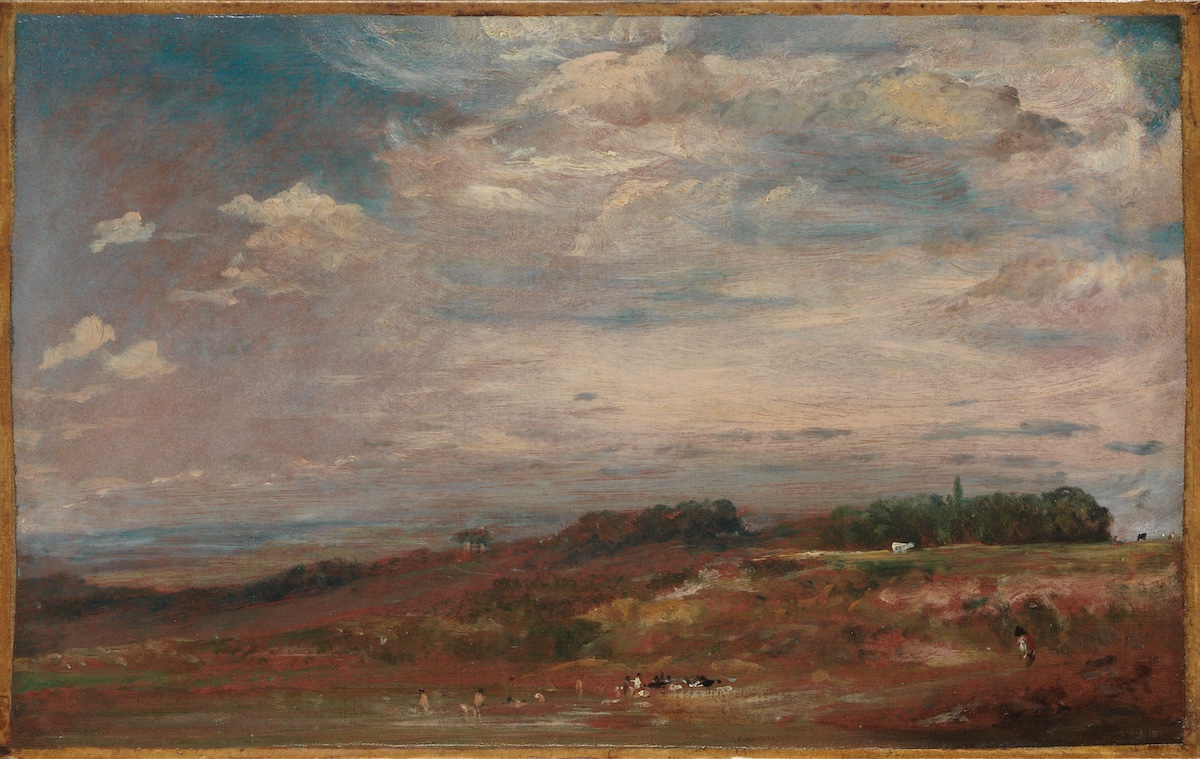 John Constable, Hampstead Heath with Bathers, ca. 1821–22. Oil on canvas. 9 5/8 by 15 3/8 inches. Courtesy of The Metropolitan Museum of Art.
In John Constable’s Hampstead Heath with Bathers (ca. 1821–22), a band of reddish heath fills about a third of the picture and gives the sky above it a measure. The bathers named in the title are rendered in a few loose strokes, nearly lost in a landscape that is itself close to abstraction. Sir Joshua Reynolds, whose Discourses Constable admired, had placed history painting at the summit of the art and left landscape well below it, to be elevated only by such figures from history or myth as it might admit. Here the figures survive as marks, no more solid than the clouds above them, while the sky, without contour, holds the field. Constable called his practice of studying clouds “skying,” a word that makes of the sky not a place but an activity, the looking itself. The weight of the picture has shifted from those who act within the landscape to the changing light and weather in which it is seen.
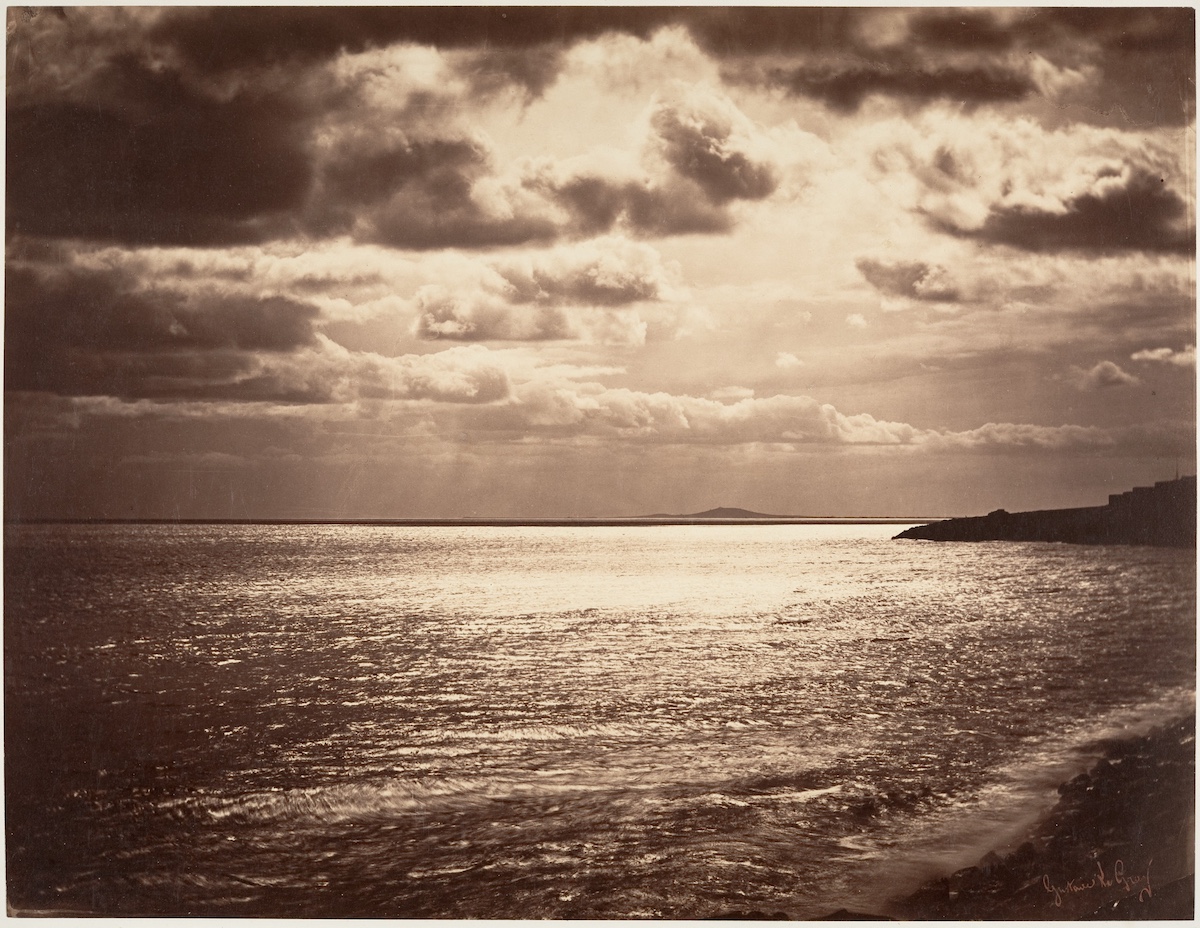 Gustave Le Gray, Mediterranean Sea – Sète, 1857. Albumen silver print from two glass negatives. 12 5/8 by 16 1/2 inches. Courtesy of The Metropolitan Museum of Art.
Gustave Le Gray’s Mediterranean Sea – Sète (1857) appears to record a single moment, wherein light breaks through the clouds and falls across the sea. Yet it joins two seascapes, taking the sky from one negative and the sea from the other. Each negative was exposed for what it had to hold, since a single exposure could seldom keep both the bright sky and the darker sea, and the two may have been made on different days or in different places. The unified light, as though the sun lit sky and sea at the same instant, was composed in the printing, and the photograph gives an arranged harmony the appearance of a single moment. Hubert Damisch, writing against the belief that a photograph is nature’s own image, reflected: “The photographic image does not belong to the natural world. It is a product of human labor, a cultural object whose being—in the phenomenological sense of the term—cannot be dissociated precisely from its historical meaning and from the necessarily datable project in which it originates.” [4] In Le Gray’s print, what appears to the eye as a unity found in nature was constructed, and constructed along the horizon, the line on which perspective builds its space. And vision itself is no less composite: the eye cannot see everything before it with equal clarity at once and must move from sky to sea. Le Gray’s joining of two exposures, which seems to betray vision, recalls the eye’s own restlessness. Here the line between “a cultural object” and “the natural world” grows harder to draw.
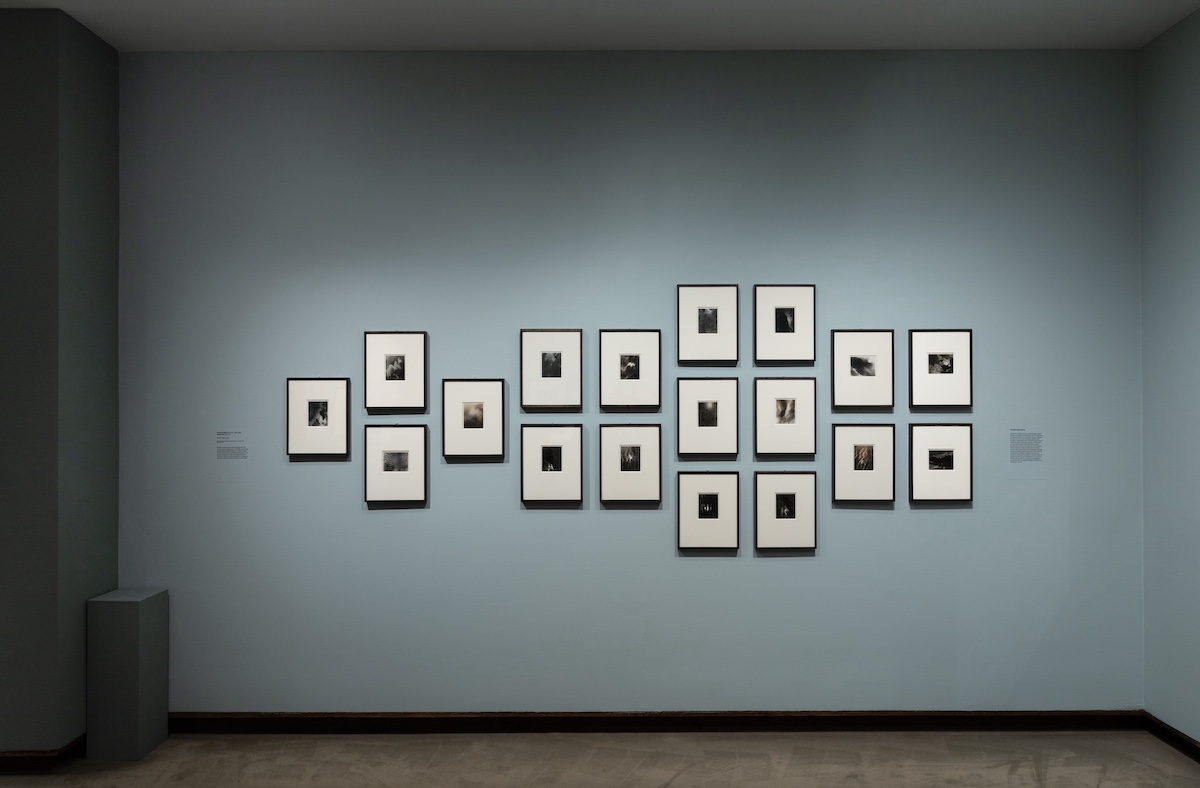 Installation view of Chasing Clouds, 2026, with Alfred Stieglitz’s Equivalents. Photo: Hyla Skopitz. Courtesy of The Metropolitan Museum of Art.
By the early twentieth century, plates sensitive enough to hold sky and land at once had made the earlier practice of joining two negatives largely unnecessary. Alfred Stieglitz, photographing at Lake George, New York, from 1922 onward, often left the land out altogether and turned the camera to the sky alone, in series he titled Music, Songs of the Sky, and Equivalents, as if their luminous skies lent themselves to the rhetoric of music. Stephen C. Pinson, the exhibition’s curator, working with Micayla Bransfield, has hung them as its culmination on the partial wall that divides the gallery, where they come into view only as one enters its second half. Prints a few inches across, each set deep within a wide pale mat, hang in columns that rise toward the center and fall away again, so that the wall becomes a constellation of openings, windows onto the sky or mirrors of it.
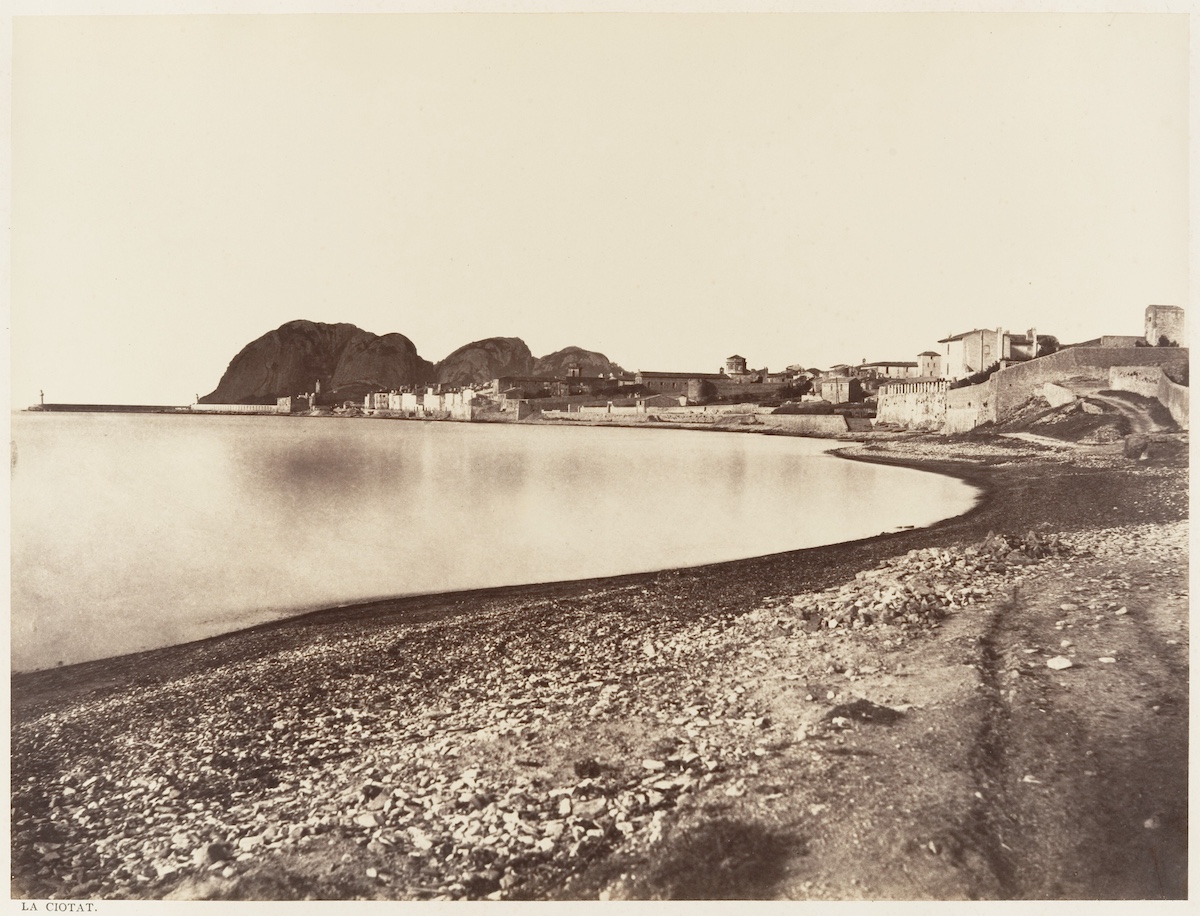 Édouard Baldus, La Ciotat, ca. 1860. Albumen silver print from paper negative. 12 3/4 by 16 15/16 inches. Courtesy of The Metropolitan Museum of Art.
Pinson observes that these works, seen together, reveal how changing ideas about nature, art, and technology shaped “not only how clouds were pictured but also what they could come to express.” One of those ideas, the single fixed viewpoint, is older than photography and built into the camera itself. In Édouard Baldus’ La Ciotat (ca. 1860), a view of the port on France’s Mediterranean coast, that viewpoint governs the ground and gives way, in the sky, to an even blankness. The print’s foreground shows pebbles in sharp detail and what appear to be the ruts of a cart, and the shore steadily swings up from the lower edge toward the town, holding the bay in an almost elliptical basin. Above it the sky is a single field of light, and the water nearly so. Neither field is invented. The sky is white because the exposure in the camera, long enough to record the darker beach, was far too long for the bright sky and erased whatever clouds may have been there. The sea is calm because the same exposure outlasted every wave. In the sky the photograph records only luminosity and in the sea a surface as still as glass. Unlike Le Gray, whose seascape hangs beside it and whose sky came from a second negative, Baldus added no clouds and let the trace of light become the picture. While Choiselat and Ratel, at the edge of their pond, framed a bright rectangle of sky and water between dark masses of trees, Baldus stood where the shore bends into a sweeping curve, letting the camera do the rest: an unbroken arc of shore beneath an open field of brightness, its poetics made equally of what the photographer chose and what the light itself determined. WM
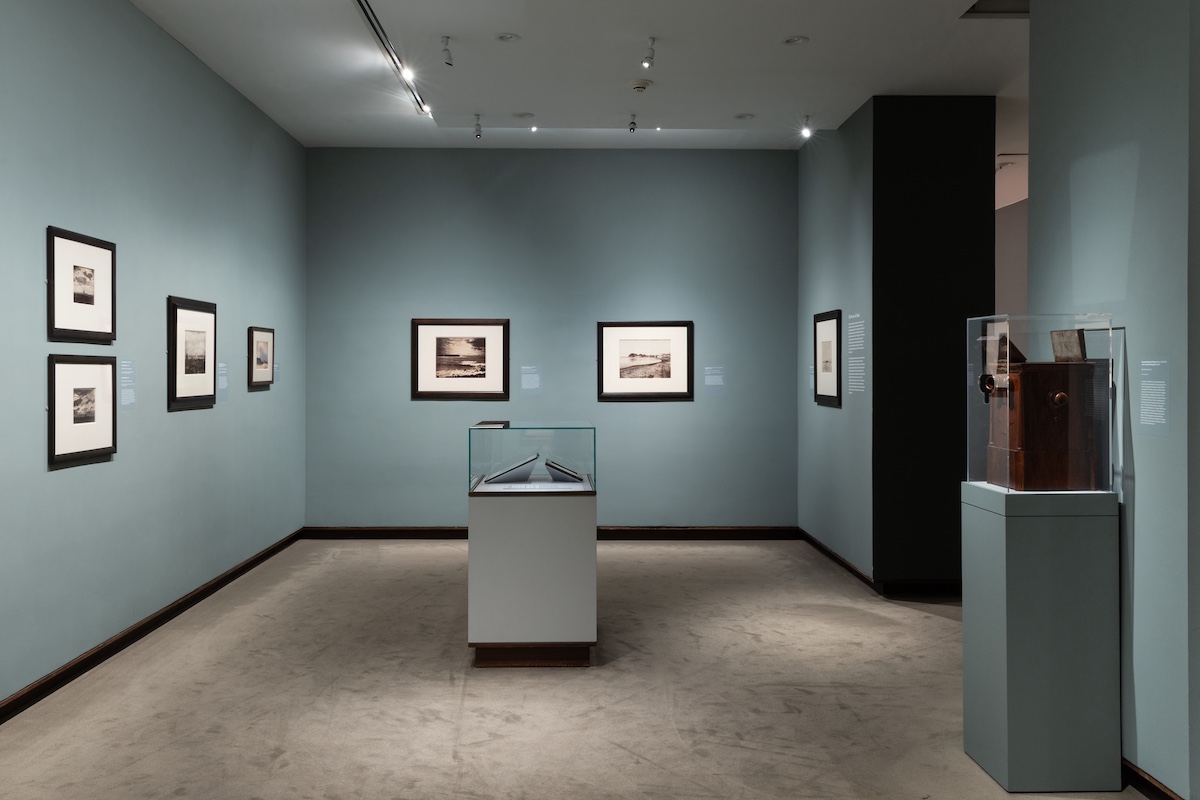 Installation view of Chasing Clouds, 2026, with works by Gustave Le Gray and Édouard Baldus. Photo: Hyla Skopitz. Courtesy of The Metropolitan Museum of Art.
Notes
1. Oliver Wendell Holmes, “The Stereoscope and the Stereograph,” Atlantic Monthly 3 (June 1859).
2. Roland Barthes, Camera Lucida: Reflections on Photography, trans. Richard Howard (New York: Hill and Wang, 1981), 80.
3. Svetlana Alpers, The Art of Describing: Dutch Art in the Seventeenth Century (Chicago: University of Chicago Press, 1983), 36.
4. Hubert Damisch, “Five Notes for a Phenomenology of the Photographic Image,” in The Photography Reader, ed. Liz Wells (London and New York: Routledge, 2003), 88.
The Metropolitan Museum of Art
September 14, 2026 – February 28, 2027
Raphy Sarkissian
Raphy Sarkissian received his masters in studio arts from New York University and is currently affiliated with the School of Visual Arts in New York. His recent writings on art include essays for exhibition catalogues, monographs and reviews. He has written on Rachel Lee Hovnanian, Anish Kapoor, KAWS, David Novros, Sean Scully, Liliane Tomasko, Dan Walsh and Jonas Wood. He can be reached through his website www.raphysarkissian.com.
view all articles from this author