Whitehot Magazine
August 2026
"The Best Art In The World"
"The Best Art In The World"
August 2026
The Material Matrix: Bio-morph at the Liu Shiming Art Foundation
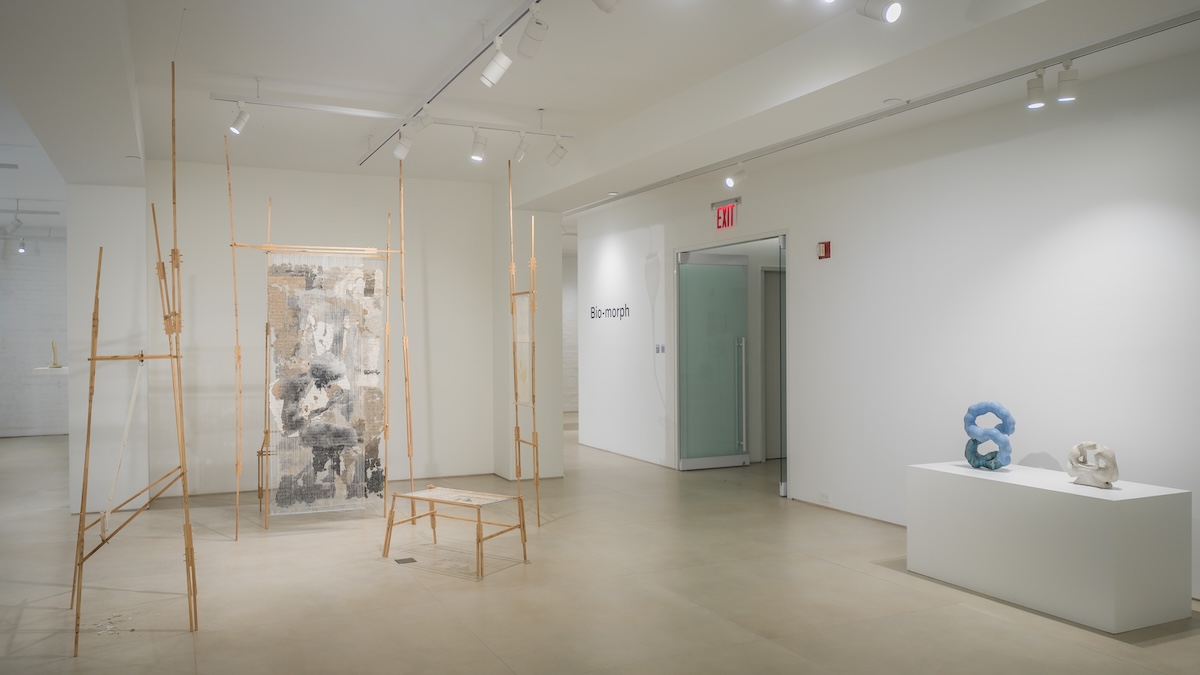 Installation view of Bio-morph, Liu Shiming Art Foundation, New York, 2026. Courtesy of Liu Shiming Art Foundation.
By EMANN ODUFU August 27th, 2026
Bio-morph, curated by Ashley Wu at the Liu Shiming Art Foundation, begins with the idea that the materials around us are never really inert. Material is life itself, the substance of the physical world we inhabit and of our own bodies within it. It arrives already charged, energetically, historically, or spiritually, and through the artist’s attention it is transformed. An onion can hold the memory of a funeral. A discarded object can become a question of value. Living ants challenge the idea that an artwork is an inanimate object at all.
The artists in Bio-morph work from this intuitive relationship with the material world, allowing ordinary things and familiar processes to become ways of locating ourselves within a reality that is always changing. There is a kind of magic in that transformation, not an escape from the everyday, but a deeper encounter with it. It is a sensibility that echoes Liu Shiming’s own attention to the meaning held within ordinary life.
Seen more broadly, the exhibition is as much about becoming as it is about material. Each artist has received a grant from the Liu Shiming Art Foundation, extending this idea of transformation beyond the objects on view and into the artists’ own evolving practices.
In the conversation that follows, a few of the artists reflect on their own relationships to material and transformation.
Emann Odufu: I’m interested in the fact that none of you really begin with neutral materials. You’re working with things that already have a life, a history, or a use. How does that affect what you make?
Sergei Zinchuk: A lot of my work comes from maintenance. I’ve worked with the restoration of modernist buildings, where you scrape away one layer of paint only to put another layer on top. You are trying to preserve something, but you are also changing it every time you touch it.
I grew up surrounded by the remains of the Soviet system, so I think a lot about what we inherit and continue to maintain without always asking why. That eventually led me to work with things that would normally be discarded. Throwing something away is already a decision about its value. I retrieve it because I want to look at that decision again.
Sangwoo Yoo: I think about that through archaeology. At excavation sites, we would find fragments, a broken object or worn surface, with no explanation or label. But looking at them, I could still feel something of the person who had once lived with them.
That was when I understood that form and material can communicate before language becomes involved. An object can carry time and human presence without explaining itself.
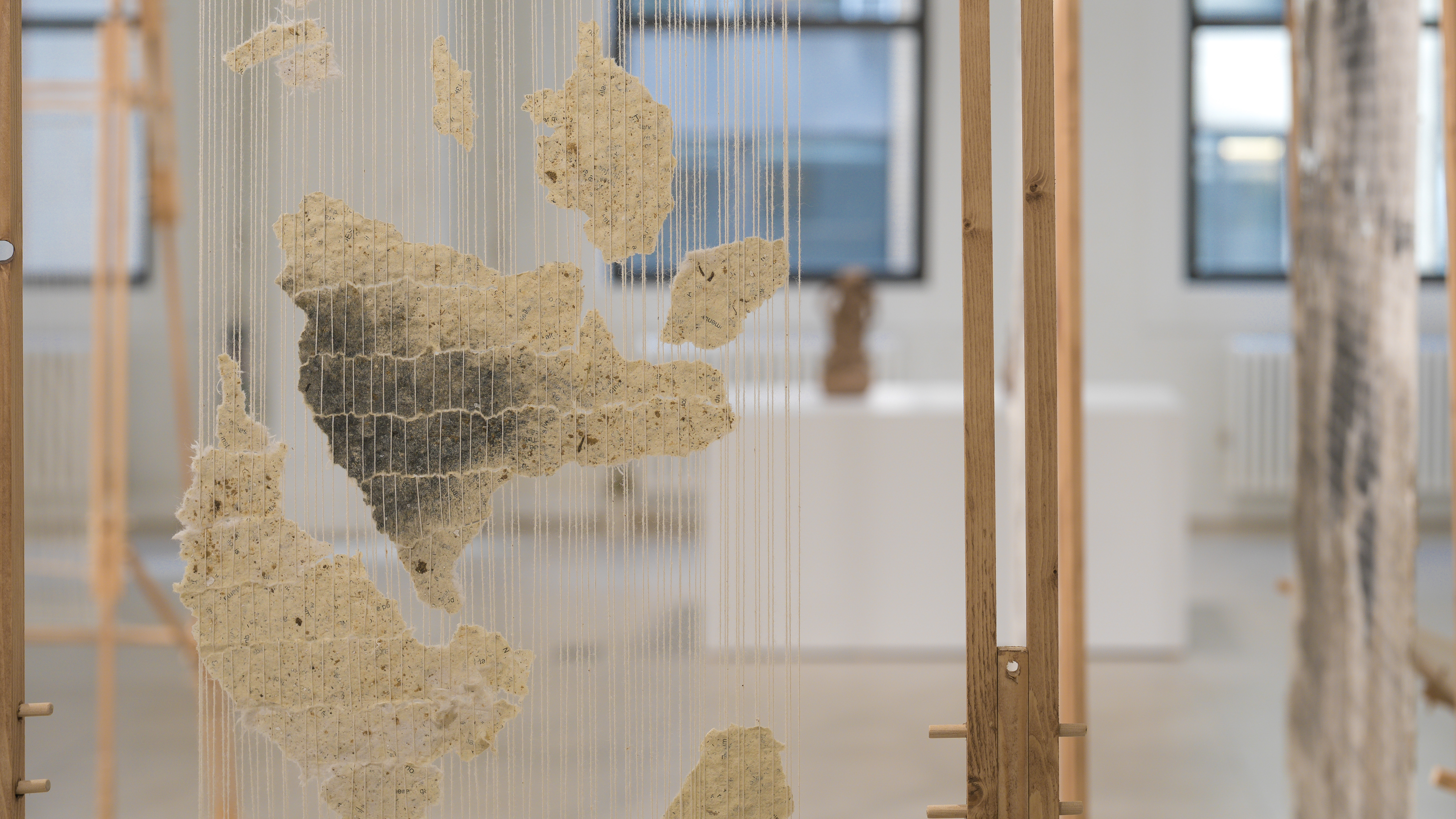 Installation view of Bio-Morph, Liu Shiming Art Foundation, New York, 2026. Courtesy of Liu Shiming Art Foundation.
Emann Odufu: And Manami, in the case of your work, what changes when the material itself is living?
Manami Ishimura: Becoming a mother changed how I thought about making art. At one point, art began to feel artificial to me. We were trying to represent life, but it wasn’t actually life. I felt that I needed to bring a living element into the work.
In One Breath came from bathing my son and from the experience of his birth. He was born with the umbilical cord around his neck and briefly stopped breathing. It made me very aware of how fragile life is.
That is part of why I used ants. They are living, but they are also dying. Some die during the installation while leaving behind the nest and traces of their activity. I wanted the work to hold life and decay at the same time.
Lulu Osnaya: My work also explores that relationship between life and death. I started working with ritual because of memories of funerals in my family. There was a tradition of placing a small dish with vinegar and onion under the coffin to protect the body and the mourners.
That memory stayed with me, and years later I began working with the onion itself. So far, I have peeled around three tons of onions. When I repeat the same action thousands of times, there is a point when it stops feeling mechanical. The body remembers the action, and the connection with the material becomes almost like a prayer. That is when it becomes ritual for me.
Emann Odufu: So how much of making is really about changing something, and how much is about trying to hold onto something?
Sergei Zinchuk: I don’t think the two can really be separated. Maintenance is an attempt to preserve the memory of something, but every time you maintain something, you also change it. You inherit something and try to hold it together, but each time you remake it, it changes slightly. Eventually, you begin to recognize your own authorship in it.
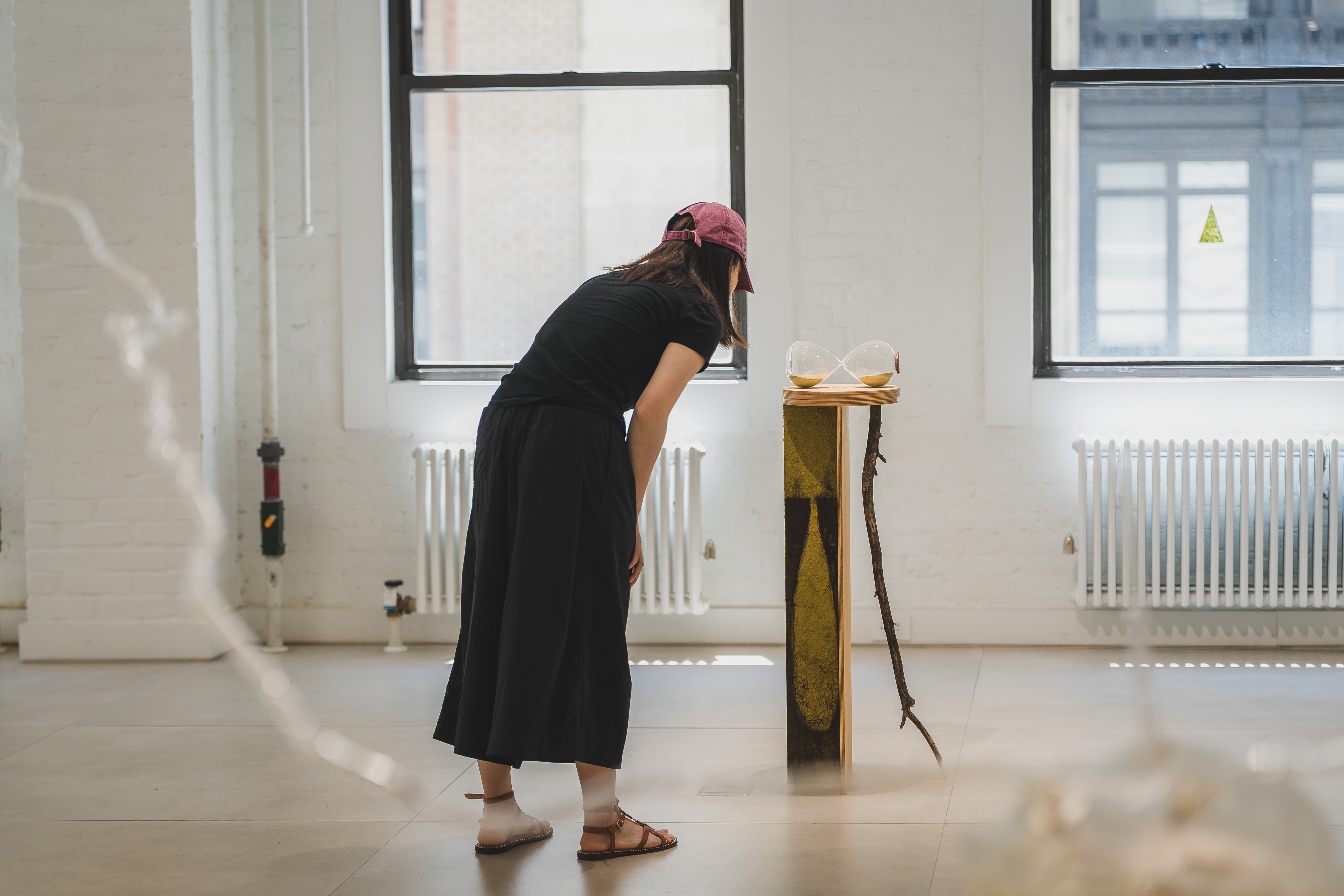 Installation view of Bio-morph, Liu Shiming Art Foundation, New York, 2026. Courtesy of Liu Shiming Art Foundation.
Sangwoo Yoo: My Christmas tree project began with something that had already been discarded. I found a tree after the holidays and brought it back to my studio. I spent time with it before I knew what I wanted to make.
Eventually, I began asking myself, “What does the sense of loss smell like?” I burned it, ground it, distilled its scent, and steeped it in water. I became less interested in preserving the original object than in allowing its presence to move into another form.
Lulu Osnaya: For me, repetition is also a way of holding onto something, but the action changes through repetition. At some point, it becomes part of the body. The material carries a trace of the action.
That is something I noticed in Liu Shiming’s sculptures. You can see the gestures on the surface and almost feel the movement of his hands. I’m interested in that relationship between human action and matter, and in the way an everyday action can become sacred.
Emann Odufu: Maybe that’s what I’m getting at. If the material keeps changing, what actually remains?
Sangwoo Yoo: For me, it is less about preserving the original object than preserving its presence. Something can change form and still carry something of what existed before.
Sergei Zinchuk: I think labor can remain too. The work can hold evidence of someone trying to maintain something, even if what they were maintaining has already changed.
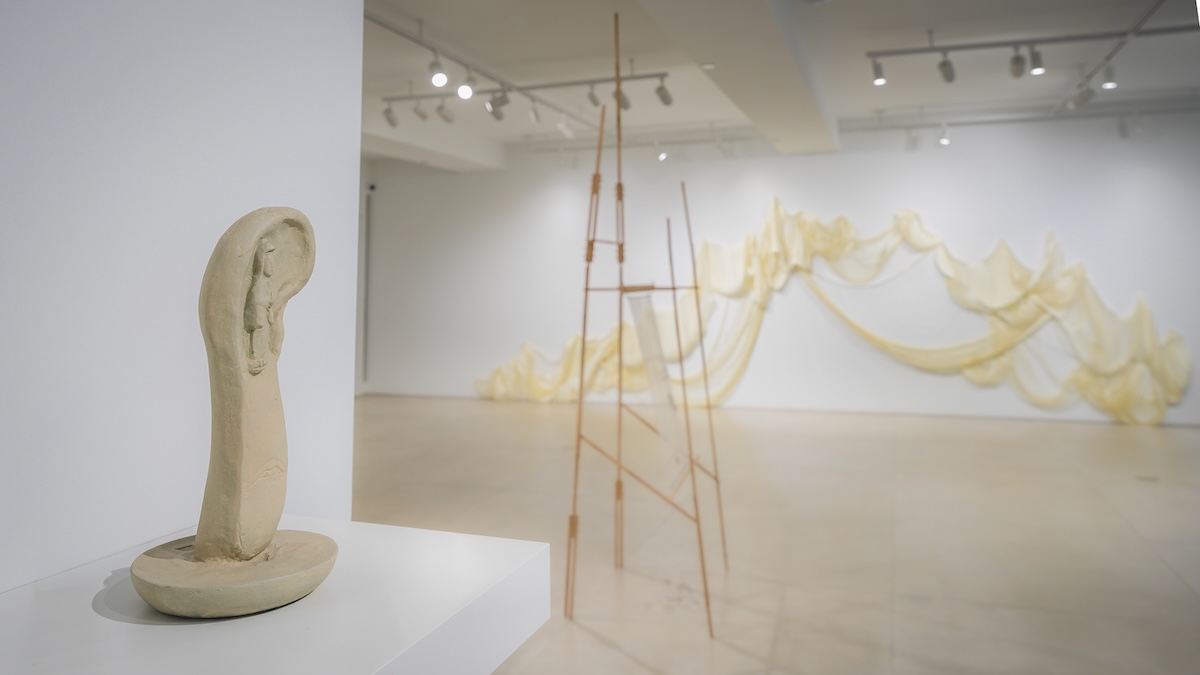 Installation view of Bio-morph, Liu Shiming Art Foundation, New York, 2026. Courtesy of Liu Shiming Art Foundation.

Emann Odufu
Emann Odufu is an independent art and culture critic, filmmaker, and curator from Newark, New Jersey, whose work explores contemporary art and Black visual culture through Afro-Futurism, narrative, and cultural memory. His writing and creative work has appeared and been featured in The New York Times, HuffPost, Paper Magazine, Office Magazine, and The Brooklyn Rail, and his curatorial practice includes exhibitions at the Liu Shiming Foundation, National Arts Club, MoCA Westport, Friedrichs Pontone Gallery, and Leila Heller Gallery. He has spoken at Harvard University, Yale University, the British Film Institute, and the National Academy of Design.
view all articles from this author