Whitehot Magazine
September 2026
"The Best Art In The World"
"The Best Art In The World"
September 2026
Preserving Functionality: Interview with Meekyoung Shin for ‘The Unclassified’ at the Korean Cultural Centre UK
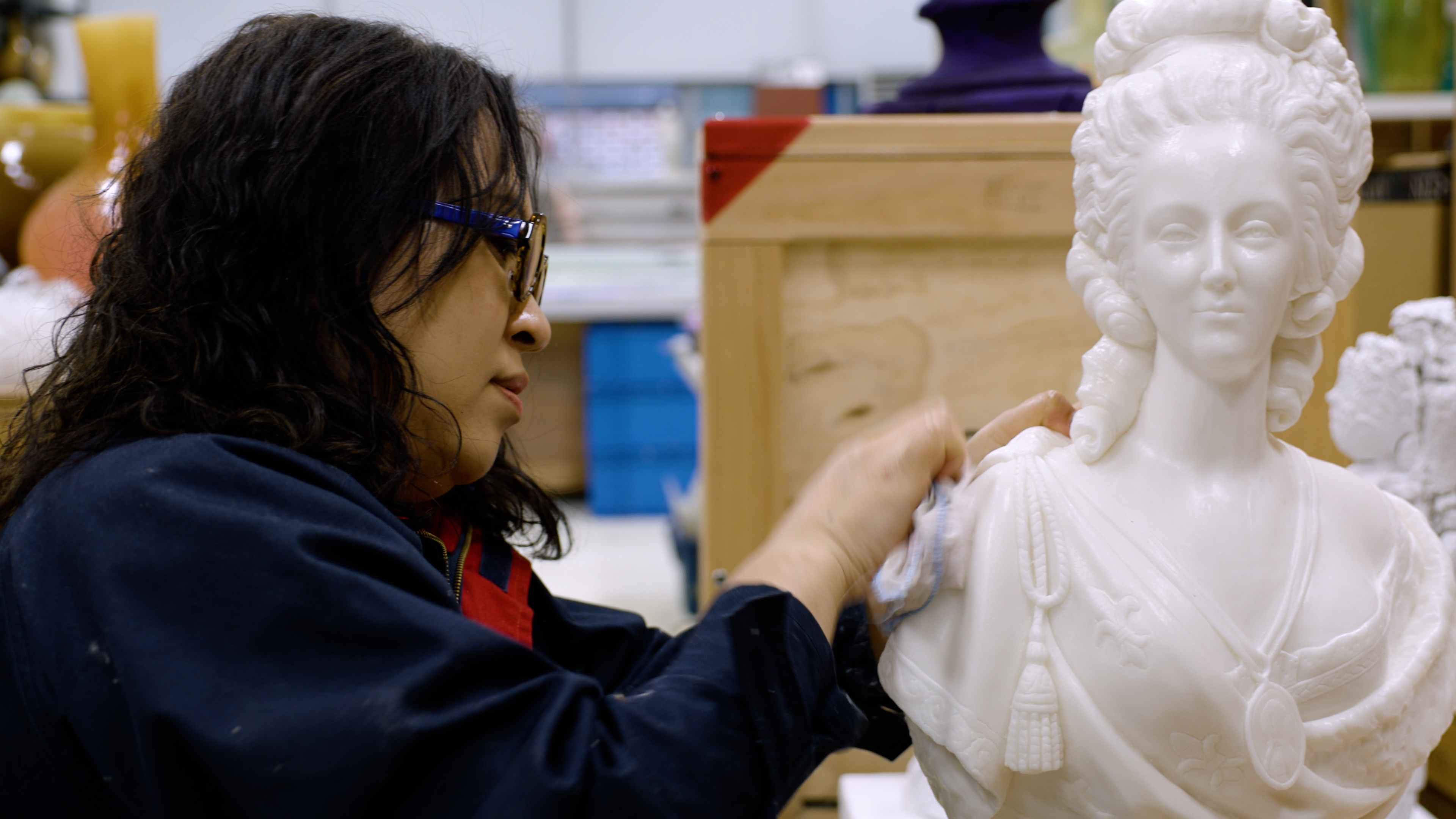 Meekyoung Shin Profile
By GRACE PALMER September 25, 2026
How do we assess cultural value? What, according to Stuart Hall, defines our “matter of belonging as well as [of] being?” Under what circumstances is preservation shaped, and what is lost in its limitations? Meekyoung Shin’s latest series, Korean Classic: In Use (2026), showcased at ‘The Unclassified’ at the Korean Cultural Centre UK, presents an alternative approach to cultural preservation and monumentality. Created in collaboration with LUSH, Shin’s Greco-Roman sculptural heads are crafted from soap and have been used, touched, moulded and reshaped in their various locations across the UK over recent months. From this transformational gradation emerges a diversity of objects. Upon entering the gallery, visitors encounter heads shaped by repeated contact, hollowed-out forms, and even a head ‘made-up’. Through engaging the audience in the process of creation, Shin incorporates their actions as integral to the work’s material, not external to it. Rather than answer the rhetorical questions of cultural legacy, value and heritage, she poses another: What if a functional material becomes an object of preservation? I discussed with Meekyoung Shin the development of the Toilet Project, the mutability of cultural history and the transformational power of functionality in creating artefacts.
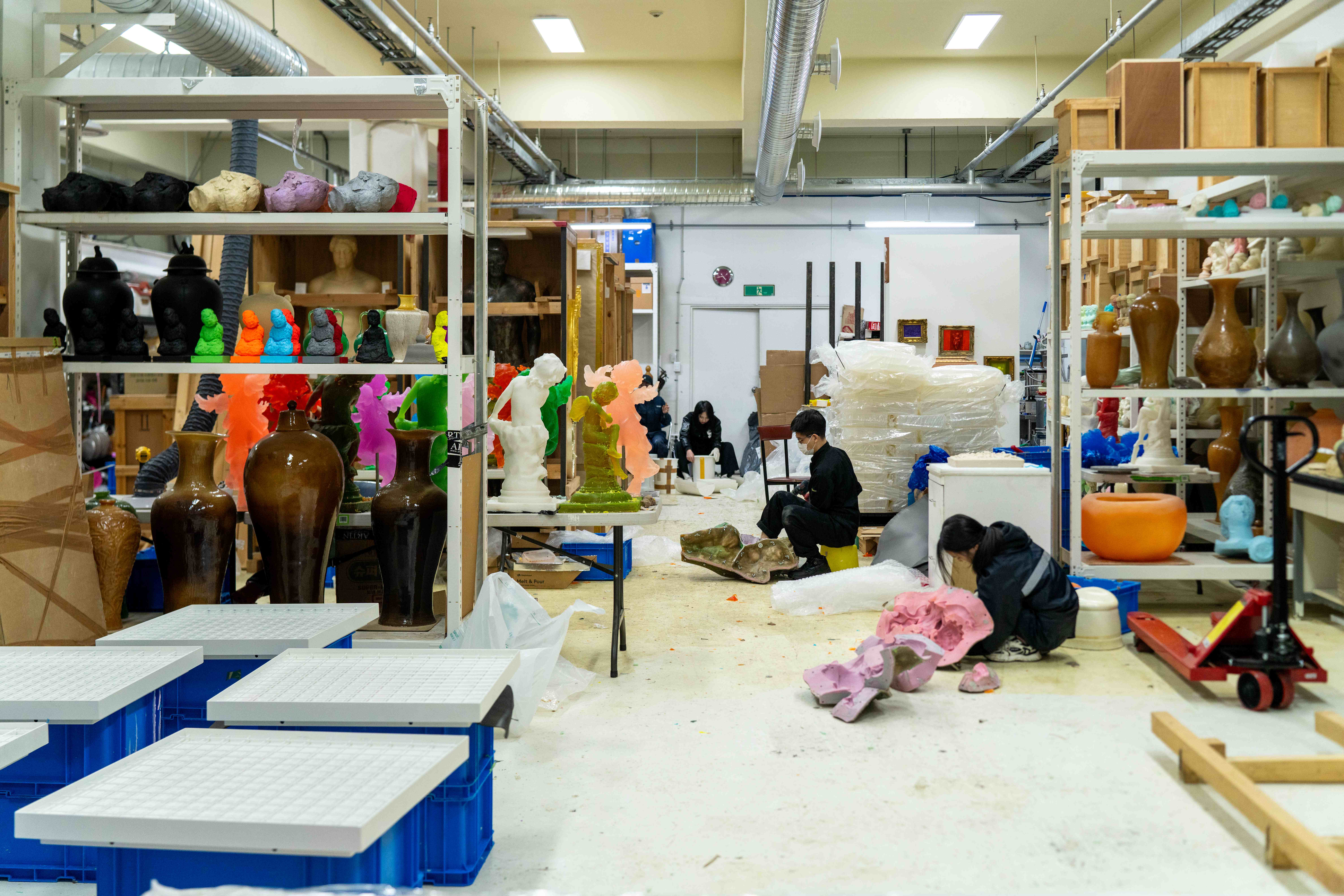 Meekyoung Shin in Studio, Courtesy of the artist. Photograph © Sonongji
Palmer: You began your artistic career in the 1990s when you studied your BFA and MFA in Sculpture at Seoul National University, before moving to London in ’95 to study at the Slade. As such, your education has spanned both Eastern and Western traditions and practices. How did this diversity of training shape your understanding and approach to artistic creation and history – particularly considering the subject matter you draw upon to create your sculptures?
Shin: My education in Korea and Britain shaped my practice in very different but complementary ways. In Korea, the emphasis was more strongly placed on technical skill and discipline. In Britain, I encountered an approach that focused much more on context, ideas and the questions surrounding an artwork. Looking back, that combination was extremely important. I already had a strong technical foundation, and in London I began to think about how that skill could function conceptually rather than simply as a means of making. I usually chose familiar cultural forms rather than new or unusual objects. I worked with Buddhist figures, Greco-Roman sculpture and later with conventional Western decorative forms. I was never particularly interested in inventing a new image. I was more interested in what happens when something already culturally coded and apparently familiar is displaced into another material or context. My concern has been less with novelty than with how something we think we already know can become unfamiliar again.
Palmer: What initially inspired you to work predominantly with soap for your sculptures? Do you find it more malleable and forgiving, or does its fragility result in frequent alterations to your original design?
Shin: What first attracted me to soap was its visual similarity to marble and its opposite cultural association. Marble represents permanence and durability, whereas soap is universally understood as something made to be used, worn down and eventually disappear. That shared expectation became very important to me. I wanted to work not only with soap’s physical properties, but also with the psychological associations already attached to it. In reality, soap can be surprisingly heavy and is not nearly as soft or fragile as people often imagine. Yet when viewers encounter a cultural object made from soap, they tend to assume that it is temporary and will soon vanish. I became interested in the tension this creates: an object resembling something historically valued and preserved yet made from a material culturally associated with disappearance. When I first came to London, I was also very conscious of being both similar to and different from the young artists around me. Making Western classical sculpture in soap became a way of articulating that condition.
Palmer: Much of your work considers themes of permanence, stability, cultural pejoratives and the passage of time. In particular, your Written in Soap: A Plinth Project 2012 explored the historical legacies preserved in these classical public monuments and the mutability of cultural history. Is there a resonance between your work and the recognition that, as Stuart Hall states, “those who cannot see themselves reflected in [National Heritage] cannot properly ‘belong’.”?
Shin: Stuart Hall’s ideas about heritage strongly resonate with my thinking. Public monuments do not simply preserve the past; they also reveal what a society chooses to remember, whom it chooses to represent and which histories it continues to endorse. What remains in public space, what is removed, and what is reinterpreted can all reflect the values of a particular moment. I have also never forgotten that I am an outsider in Britain. That position has always been important to my work, and in Written in Soap I wanted to make it visible. I was not speaking from within British political history but entering it from a certain distance. Sanford Levinson’s Written in Stone was a more immediate conceptual starting point for the project—hence the title Written in Soap. Levinson examines how monuments shift in meaning as societies change. I wanted to extend that question into the material itself, allowing meaning and physical existence to become unstable.
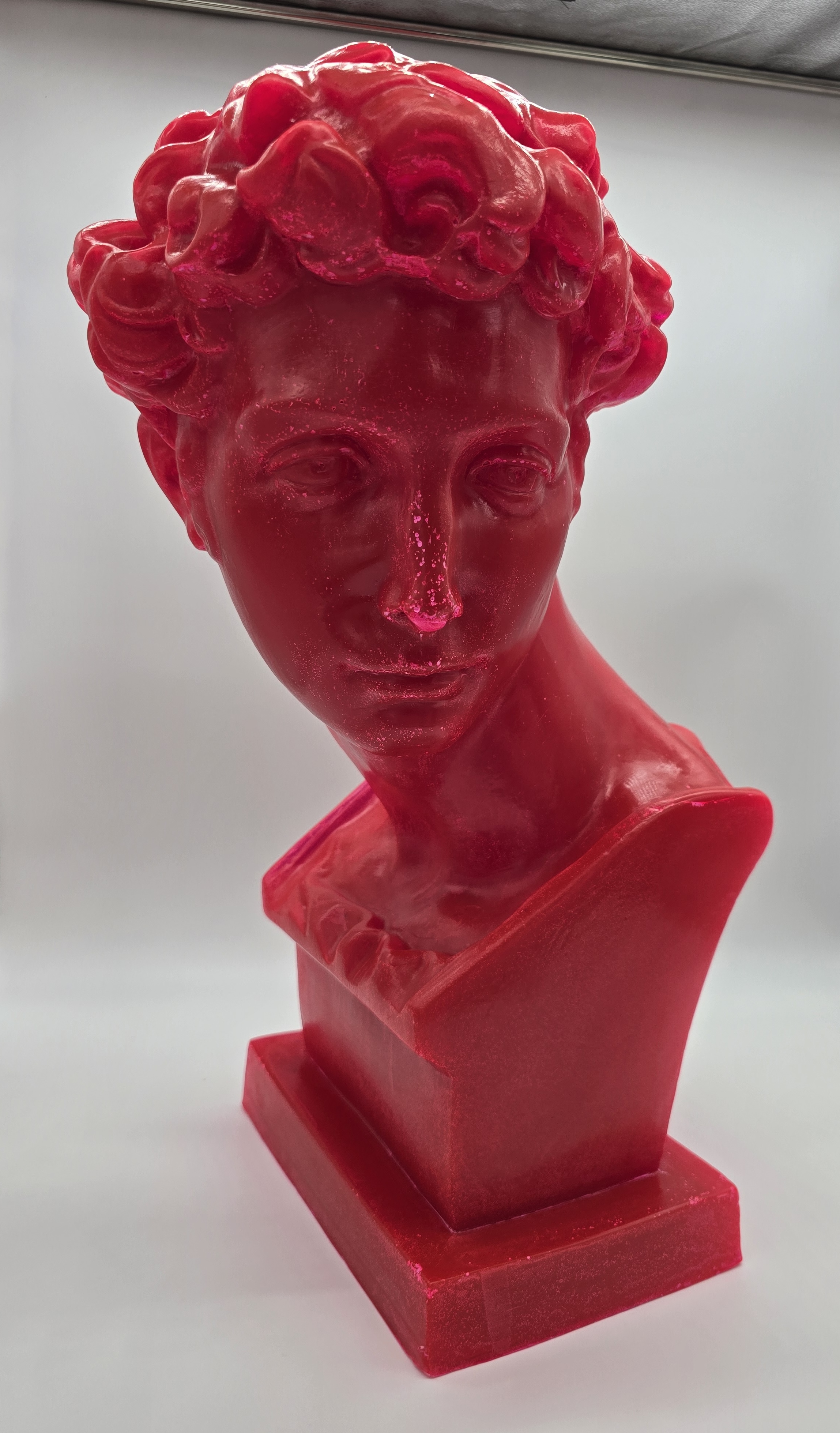 Meekyoung Shin, TPJL 04, 2026, soap, 33 x 35 x 58cm.
Palmer: Korean Classic: In Use for ‘The Unclassified’ exhibition at the Korean Cultural Centre explores both these ideas of preservation and methods of interaction. Beginning beyond the gallery sphere, these sculptures immediately engage with public spaces and audiences. How did you plot the journey of these sculptures? Why were tactility and the immediacy of introducing these objects to the public fundamental to Korean Classic: In Use?
Shin: I am less interested in simply making an object than in what that object becomes. For me, a soap sculpture is not complete at the moment it is produced. It needs to pass through time, use and contact to accumulate experience. In that sense, I think of it almost as an artefact: an object does not become an artefact simply because it was made; it acquires that status through history. For Korean Classic: In Use, I chose plaster figures long used as teaching models in Korean art education. Although they originated in Western classical sculpture, they travelled through reproduction and education and became deeply familiar to generations of Korean students. In that sense, they have acquired a specifically Korean cultural memory. Bringing them back to the West becomes a kind of reverse translation. Before entering the gallery, the works pass through what I call a “live time,” during which touch and use gradually transform them. Only afterwards do they move from use into preservation.
Palmer: This latest commission is in collaboration with LUSH. Has your process of creation and construction differed when working with their products, rather than your own materials? As part of the project, these sculptures will be displayed in various LUSH stores across the country. Do you think the interaction and alterations to the sculptures will change radically being positioned in these high-traffic spaces?
Shin: Using LUSH soap added another layer to the project because the material already carried its own identity, formula and sensory qualities. For people familiar with LUSH products, I think the collaboration becomes materially visible: the sculpture is not only recognisable as my work but also carries a specific character. My earlier Toilet Project works were usually encountered in bathrooms, but the bathroom was never important simply as a site. What mattered most was that the sculpture could be touched and used as soap. In the LUSH stores, the context becomes commercial rather than private, but the basic principle remains the same: the work is activated through contact, repetition and use. I do not think the nature of the transformation changes fundamentally. What may change is its intensity. In a busy retail environment, many more people can encounter the work within a shorter period of time; therefore, the physical alteration may become faster, denser and more visibly dynamic.
Palmer: ‘The Unclassified’ at the Korean Cultural Centre is presented to coincide with the British Museum’s upcoming ‘Korea’ exhibition. Presenting the private collection of Lee Kun-hee, this exhibition endeavours to reconsider the role of the cultural institution as a purveyor of knowledge, re-evaluating what historical and cultural narratives are given space to speak. Do you believe it is the responsibility of the museum, as well as the artist, to ensure that these historical traditions, practices, mythologies, etc. are preserved? What more can be done in the future to provide alternative ways of considering cultural heritage?
Shin: I would not say that artists necessarily have a responsibility to preserve cultural heritage. Museums and artists operate differently, and I think that distinction is important. Museums may have a responsibility to conserve, research and contextualise objects, while artists can approach inherited forms more freely. In my own work, I have been less interested in preservation in a conventional sense than in creating conditions in which cultural heritage can be seen again from a contemporary perspective. I often take historical or familiar forms and place them in another material, another location or another system of use. Through that shift, their meanings become less fixed and more open to reinterpretation. For me, heritage does not carry only one permanent meaning. It changes with time, place and the people who encounter it. Art can therefore create alternative relationships with heritage—not simply by protecting it, but by translating, relocating, questioning and reactivating it in the present.
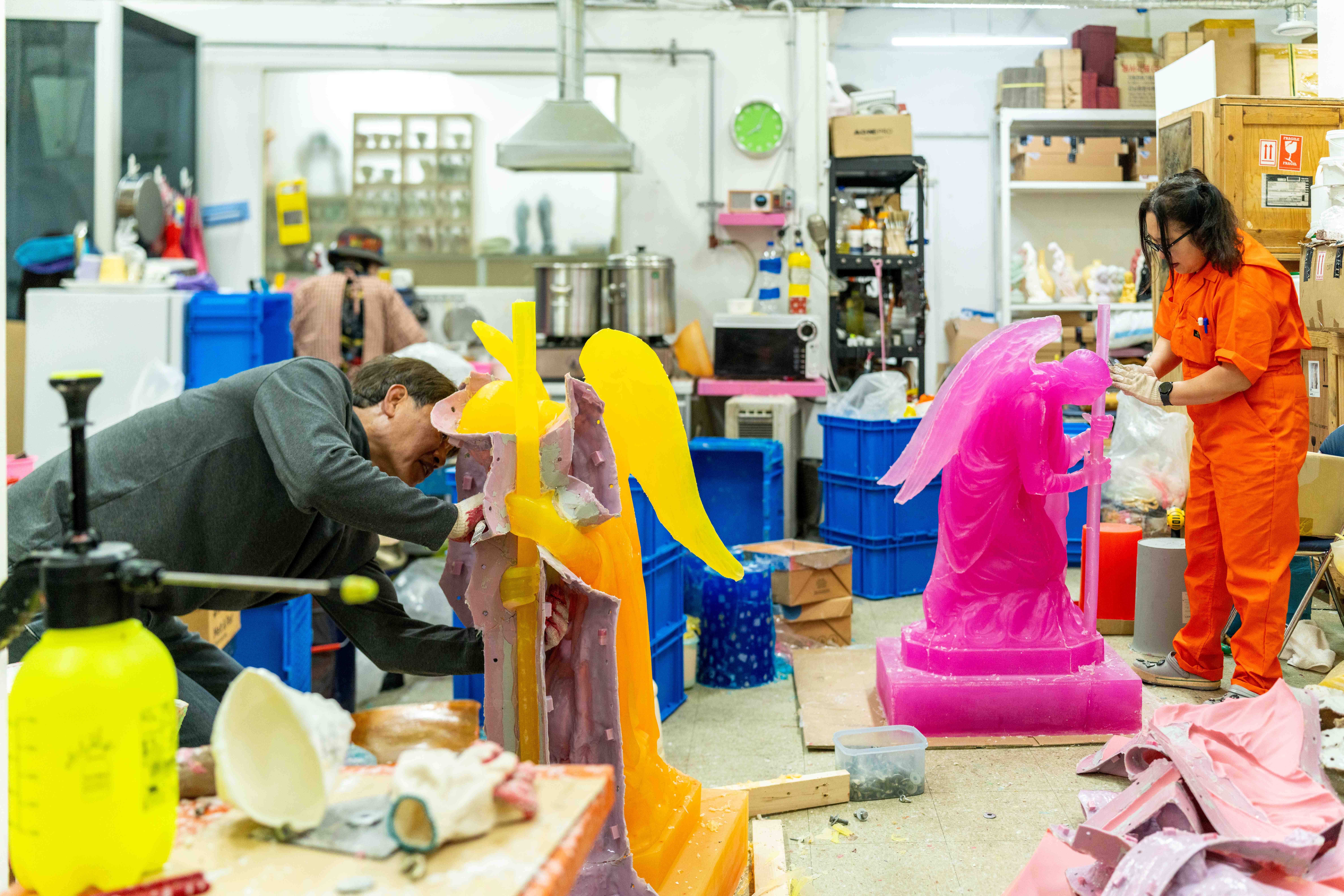 Meekyoung Shin in Studio, Courtesy of the artist. Photograph © Sonongji
Palmer: After ‘The Unclassified’ at the Korean Cultural Centre, what happens to these sculptures from the Korean Classic: In Use series? Do you let them erode and decay until they no longer exist, or do you preserve them as they are in their final ‘exhibition displayed’ form? What comes next for you after the completion of this exhibition – what further projects, exhibitions, showcases, etc. do you have on the horizon?
Shin: My work is not intended to disappear completely. I am more interested in the threshold between persistence and disappearance, and in the point at which an object moves from one state into another. During its “live time,” the soap sculpture functions as soap. Through contact with people, it is touched, used and physically altered. Once that period ends and the work moves into a gallery or back to the studio, its function changes. It is no longer used as soap. In a sense, its time and function become suspended. The object moves from use into preservation, almost as if it has become an artefact. I do not continue the process until nothing remains; I preserve the traces of a particular period of use.
Following The Unclassified, my solo exhibition in Korea, Becoming Stone: From the Remains, will present ceramic works developed from fragments and remains that became the starting point of a long-term investigation. The material is very different from soap, but the underlying question continues: How does something become identified as one thing or another, and how material, form and meaning shift between states?
My thanks go to Meekyoung Shin for her considered answers and for taking the time to speak with me, and to the team at the Korean Cultural Centre UK for facilitating and hosting ‘The Unclassified’.
‘The Unclassified’ runs between September 25 – December 31, 2026, at the Korean Cultural Centre UK, London.

Grace Palmer
Grace Palmer, an art historian and writer, specializes in the history of contemporary art and 1960s New York performance art. She contributes to Whitehot Magazine and is currently located in London, England.
view all articles from this author