Whitehot Magazine
October 2026
"The Best Art In The World"
"The Best Art In The World"
October 2026
The Paintings of Beate Wheeler at Heather Gaudio Fine Art
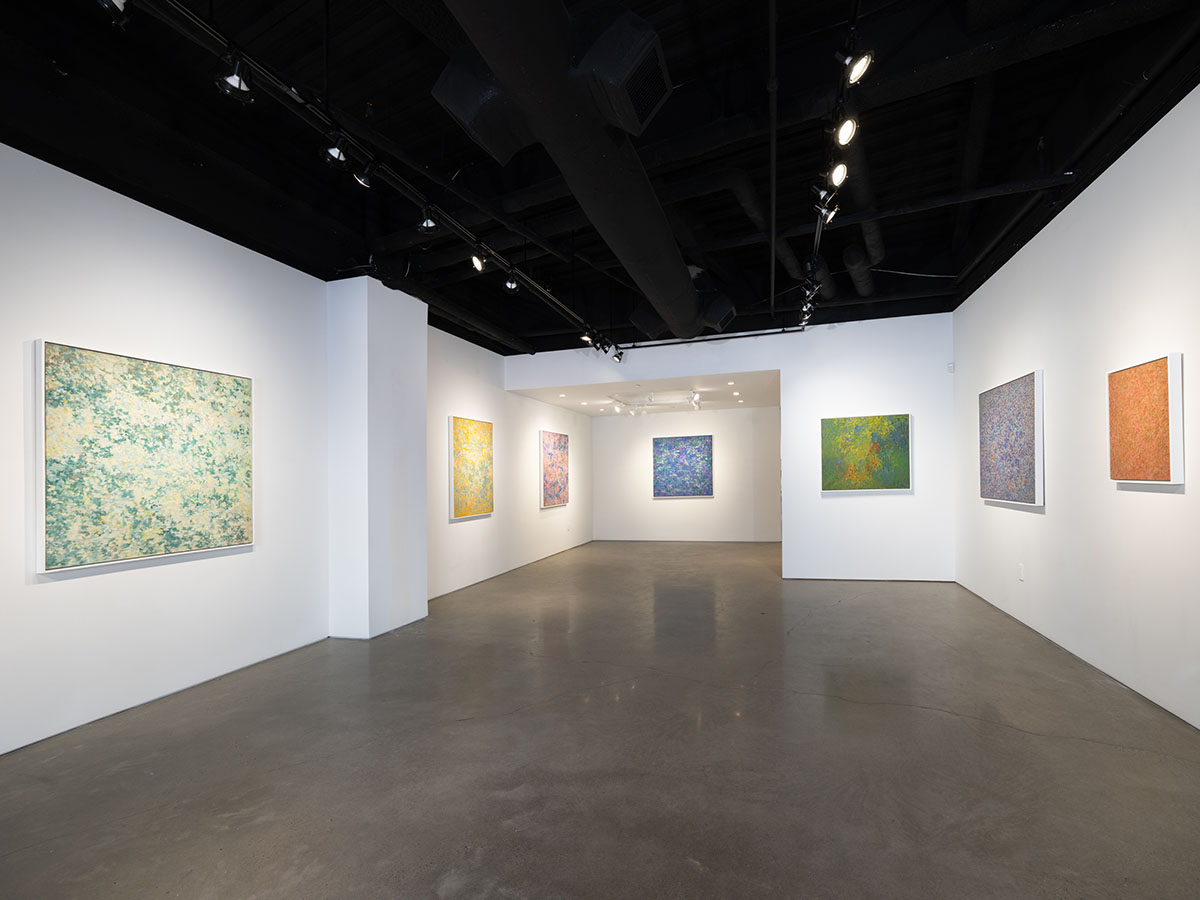 The Paintings of Beate Wheeler. January 31 – March 7, 2026. Heather Gaudio Fine Art, in partnership with Moss Galleries. Photo courtesy of Heather Gaudio Fine Art,©️ Jason Mandella
CLARE GEMIMA March 2026
Paintings of Beate Wheeler brought together fifteen works that spanned the 1960s through the 1990s. The exhibition, presented at Heather Gaudio Fine Art in partnership with Moss Galleries, reintroduced Beate Wheeler (1932–2017) as a painter whose fiercely introspective approach to abstraction developed alongside the artistic networks of mid-century New York (1945–1965).
Born into a Jewish family in Breslau, Germany (now Wrocław, Poland), Wheeler fled from the Nazis with her family in 1938 and immigrated to the United States. She studied painting at Syracuse University before completing an MFA at the University of California, Berkeley, where she worked under the Abstract Expressionist Milton Resnick. By the late 1950s she had relocated to New York and became a founding member of March Gallery (1958–1960), one of the cooperative artist-run spaces that defined the East Village’s 10th Street scene. Offering an alternative to the more conservative commercial galleries of Midtown, March Gallery fostered experimentation among the likes of Patricia Passlof, Elaine de Kooning, Robert Beauchamp, Lois Dodd, Alex Katz, and sculptor Mark di Suvero. Although Wheeler worked in close proximity to this mega-community of artists, she remained reluctant to aggressively promote her own work.
 Beate Wheeler. Untitled (BW-5236), 1950s/60s. Oil on canvas. 36 x 40 in. Photo courtesy of Heather Gaudio Fine Art,©️ Jason Mandella
In Untitled (BW-5236), a work dating from the late 1950s into the early 1960s, Wheeler builds her surfaces through intricate lattices of oil brushstrokes where pigment seems to pulse outward from multiple points — almost like petals slowy unfurling in bloom. Tonal accents flicker and distribute attention across the canvas so that no single area dominates. The result is a lush chromatic thicket where individual marks dissolve into one another, recalling something like an extreme close-up of one of Monet’s Water Lilies (Nymphéas).
At first glance her marks appear spontaneous in execution, but after awhile seem carefully and compositionally intentional. The strokes interlock into a dense surface that resist any singular focal point, though complimentary and constrasting hues that Wheeler felt compelled to play with blatantly flash. Even at an early stage she avoided the theatrics often associated with Abstract Expressionism, instead allowing the intensity of her paintings to emerge through quiet orchestrations of pigment.
 Beate Wheeler. Untitled (BW-5221), 1970s. Oil on canvas. 50 x 50 x 1 1/4 in. Photo courtesy of Heather Gaudio Fine Art,©️ Jason Mandella
The brushwork in Untitled (BW-5221) from the 1970s tightly interlaces into a restless network of scribbles that generate subtle shifts of light. Layers of pigment gather gradually and produce passages where small strokes in peach, black, grey, blue, and ochre hover just shy of the surface.
Working with a precise command of tonal relationships, Wheeler made incremental adjustments in color that, in this particular example, began to evoke something like a bed of poppies—perhaps roses—suggested by the pieces chromatic warmth and the rhythmic clustering of marks. Never settling for representation, the painting remains suspended somwhere between abstraction and natural sensation: kaleidoscopic, slightly disorienting, and charged with a rich undercoat of a botanical, near-devilish red.
 Beate Wheeler. Untitled (BW-5229), 1972. Oil on canvas. 48 x 42 x 1 1/4 in. Photo courtesy of Heather Gaudio Fine Art,©️ Jason Mandella
In Untitled (BW-5229), 1972, contrasts sharpen as broader gestures appear alongside Wheeler’s familiar clusters of smaller marks. Areas push forward and fall back across the picture plane as scattered marks gather into something more collectively consuming, like a vast forest fire gaining steady momentum. Some areas thicken while others remain open, allowing cooler tones—lilacs, lavenders, and baby blues—to emerge from the opposite end of the spectrum.
Paintings of Beate Wheeler revealed an artist whose approach to abstraction was grounded in patience, observation, and chromatic sensitivity. The exhibition ultimately positions Wheeler not simply as a peripheral participant in the history of Abstract Expressionism, but as a painter whose sustained investigation of color and mark-making expands our understanding of how abstraction evolved in the decades following the movement’s emergence.
WH

Clare Gemima
view all articles from this author