
Whitehot Magazine
October 2026
"The Best Art In The World"
"The Best Art In The World"
October 2026
10 to see at Art Genéve 2026
By CAMILLE MORENO February 5th, 2026
Art Genève, now in its 14th iteration, feels less like a trade fair and more like a human-scaled salon. You won’t get lost in a tent that’s too big for its own good, and you just might run into someone you know. Having held its exhibitor number at around 80 for years, it favors intimacy over mega fair frenzy. It also balances galleries with museums, foundations, and art schools, creating a rare equilibrium between market and institution. Swiss presence anchors the modern and contemporary program, with the Prix Mobilière spotlighting a young artist each year since 1996.
Special sections expand the format: Sur-Mesure for large-scale works, Music for sound and performance, Art Publishers for slower looking, and Conferences for critical debate. Compact and curated, Art Genève proves that bigger isn’t better. We visited the fair and selected 10 artworks worth writing home about.
 Ida Tursic and Wilfred Mille, Partie de Chasse, 2024 at Galerie Pietro Spartà
Bright and symbolic, Partie de Chasse (hunting party) carries a sordid array of references. First we have the 1983 French graphic novel The Hunting Party by Pierre Christin and Enki Bilal, in which aging Communist bloc leaders convene under the guise of a hunt. The hunt becomes a metaphor for power, nostalgia, and the waning influence of the Soviet order: a ritualized performance where violence, hierarchy, and decay coexist, albeit uneasily.
Tursic and Mille recirculate these images, but their work activates the viewer as a complicit bystander, cultivating a queasy feeling of implication. By looking, we are participating in histories of domination. The title also references colonial hunting traditions, where European elites would stage hunts as both sport and opportunity to flaunt imperial superiority; mastery over land, animals, and colonized people. The ritual not only legitimizes violence but also celebrates and aestheticizes it into a sick subcategory of leisure, complete with its own etiquette, dress code, and hierarchal structure.
The work recalls colonial spectacle, yes, but it is very much situated in the current day. We, as viewers, are asked to reckon with the ethical weight of witnessing, of circulating, and of consuming stories of authority, violence, and empire: something that is so timely it’s scary.
 Philippe Cramer, Aeturnus Eternise III: Left twist, 2025, at his own booth
A marble sculpture alludes to infinite continuity, compromised utility, and the elegance of unmistakable authorship. Cramer’s manipulation of marble situates the piece in dialogue with a lineage of modernist formalism, from Brancusi’s reductive purity to Donald Judd’s spatial interventions, but still challenges the tradition.
The Möbius-inspired curve enforces both intimacy and distance, allowing two people to occupy the space simultaneously without feeling entirely seen by each other: a clever but slightly disquieting play on private versus public experience.
This tension extends conceptually into ideas of eternity suggested by the twist, which contrasts with the temporal constraints of human use. The work is eternal in form but ephemeral in occupation; it is a vessel for interaction that cannot fully satisfy every expectation. In this sense, it becomes a meditation on the friction between art’s idealized permanence and the corporeal reality of human bodies.
Cramer’s work seems to interrogate the idea that art and design can coexist without compromise. But as it has previously been staged as seating inside of an exhibition, that does not mean that it doesn’t have a place. Its power comes from this balance, inviting us to reflect on the age-old question: does life mimic art, or vs. versa?
 Condition d’usage, 2026 at Fondation d’Art Teo Jakob
Stepping into the booth is like leaving Palexpo behind for a dreamy funland. The installation envelops you in a world that feels lived-in and uncanny. The objects seem to carry traces of their own histories and quirks, like personalities lingering in the spaces they inhabit. Tables, mirrors, and sculptural furnishings interact with paintings and contemporary interventions, creating a rhythm that feels comfy, familiar, and quietly uncanny.
Historic pieces by Meret Oppenheim and Man Ray converse with contemporary provocations by Maurizio Cattelan, Ai Weiwei, and Jason Dodge, creating an easy mix of past and present, art and utility, humor, and reverence. It feels less like an exhibition and more like a style ecosystem. It is a space that transcends the fair: immersive, transportive, and lightly surreal, it reminds you that the art of living is inseparable from the life of art.
 Yoan Mudry, Do not expect too much, 2025, Colourful Shipwreck, 2025, Sponge Puddle, 2025, Stan, 2025, Prix Mobilière Nominee
While Yoan Mudry did not win this year’s prize, his work was perhaps the most successful example of post-internet art I have ever seen. Starting from an investigation into image saturation and narrative overload, his work immerses contemporary subjects into a flow of visual signals, competing storylines, and fragmented meanings.
Working across painting, sculpture, performance, video, and installation, Mudry combines images and texts from the internet, comics, cartoons, and art history. These sources collide within one visual field, creating layered surfaces where multiple times, stories, and meanings coexist.
By piling up and remixing elements, Mudry exposes how meaning becomes unstable in a world where the balance between input and output has broken down. His works offer a network of partial signals and visual noise. In this way, his practice can be read as a “theory-in-form,” showing how contemporary perception is shaped by repetition, circulation, and information overload.
 Duke Riley, Voir la mer, 2025 at Galerie Georges-Philippe & Nathalie Vallois
A fragile and powerful wall sculpture of objects captures the paradox of the ocean: vast, self-regulating, yet overrun by human activity, its surface crisscrossed by tens of thousands of commercial vessels and inundated with refuse. Reminiscent of Hemingway’s The Old Man and the Sea, the work stages a quiet confrontation between human (often excessive) perseverance and the whale, a living embodiment of nature’s vast, indifferent power.
Built from ordinary, discarded objects, including tampon cartridges, combs, seashells, synthetic nails, and pipe stems, the work forms a delicate, undulating landscape. Part collage, part mosaic, it captures the most definitive component of ancient mosaic technique: andamento. With no direct English translation, andamento can be described as the flow or gesture of the mosaic lines and is fundamental to framing subjects as it expands from the center outwards.
The materials themselves evoke intimacy and ecology, lamenting human presence and consumption, clearly exposing our own complicity. Folk-art motifs of flags, miniature vessels, and maritime symbols weave historical reference with poetic intervention, framing heroism as an undeniable reciprocity with the sea. The work offers both call and caution: it is both beautiful and horrifying at the same time.
 Kate MccGwire, Nuzzle, 2024 at Les filles du calvaire
This quietly unsettling sculpture is made of layered, meticulously arranged goose feathers beneath a large antique glass dome. At first, it appears delicate and ethereal, but its restrained, seemingly unending form (the neck never quite resolving into a head) hints at a latent vitality, like a creature in stasis yet brimming with energy. The dense, scalloped feathers press against the dome, creating a sense of compressed life and resonant claustrophobia.
The work inhabits Freud’s uncanny: familiar yet strange, beautiful yet anxious. The dome both protects and confines, heightening the tension between life and containment. By elevating molted feathers, often overlooked or dismissed, MccGwire interrogates beauty, abjection, and material value, inviting viewers to navigate attraction, unease, and the ethical attention demanded by art.
 Susanne Wellm, Corridor, 2025 at Taste Contemporary
First and foremost, having a gallery called TASTE carries an ironic tension: is it a claim to refined curatorial confidence, or a nod to quality as subjective? Like Wellm’s work, the reference is both playful and piercing, prompting reflection on aesthetic authority.
Corridor is a woven photograph blending found imagery: family albums, movie stills, and original captures — into a landscape between memory and imagination. Each interlaced strip breaks time into micro-moments, producing a subtle rhythm of presence and absence, of attention and lapse. The weave renders familiar moments uncanny, allowing fiction and fact, private and public, ephemeral and permanent, to coexist.
By transforming time into material, Wellm asks viewers to slow down, read history in layers, and reflect on the labor of perception. The work meditates on memory, temporality, and the provisional nature of taste, highlighting the delicate balance between observation and meaning.
 Tim Casari, Présence de l’artiste souhaitée, 2024-25 at HEAD
Constructed from wood, screws, and costume and standing just larger than life at 200 cm, the figure evokes a storybook character. Theatrical yet wounded, its first impression condenses sadness and despair into a tangible form much like Vincent Paronnaud's tragic interpretation of the Pinocchio story. The artist describes the figure as something fabricated the way one builds a shelter or a house: structures that are meant to be inhabited.
Its scale suggests both protection and threat; it is big enough to dominate a room yet fragile enough to feel temporary. The puppet becomes an architecture for sadness: a shelter built from narrative, in which despair is held. The work proposes storytelling as observation and staging: a way of allowing imagined bodies to carry the weight of experience in place of the artist.
 Noémie Ninot, 22 Loggerstraat Zaandam, 1503KD at École des Arts Décoratifs-PSL
@noemieninot

Dolls operate at the fault line between care and threat. Engineered as objects of attachment, they simulate life without possessing it, producing what Freud termed the uncanny: something at once intimate and estranged. Horror icons such as Chucky radicalize this tension by weaponizing childhood itself, converting a figure of comfort into an agent of betrayal. The doll thus becomes a carrier of cultural anxiety, staging the collapse of trust between appearance and function.
Noémie Ninot mobilizes this instability through a strategy of generational substitution. Drawing on the notion of cellular exchange between mother and child beyond gestation, her work stages the artist, her mother, and her grandmother with hyperrealistic masks that exchange their faces. Identity is displaced into lineage; the subject becomes a relay rather than a singular body. Composed like Dutch genre paintings, these scenes perform domesticity while exposing it as a site of transmission—of habits, affects, and constraints.
The sculptural triptych of busts in a cradle extends this logic into form. Standardized and doll-like, they crystallize filiation as an apparatus: a system that reproduces bodies and roles through visual repetition. Here, the doll is not a toy but a diagram—of inheritance, of the female condition, and of the unease embedded in care itself.
 Monica Bonvicini, Fleurs du Mal (big bubble), 2022 at Galerie Peter Kilchmann
Across her career, Bonvicini interrogates dominance, desire, constraint, and freedom, making her work intellectually provocative and physically immersive. This work offers an ironic reading of Marcel Duchamp’s 1914 Bottle Rack, emphasizing its Freudian and erotic undertones. By adding anthropomorphic forms to the empty spikes, she humorously evokes frustrated masculinity, linking droopy, floppy forms to dying flowers, molluscs, or the performative “fake balls” hung from trucks. Different editions—light pink or clear glass—play with associations of flesh, power, and fragility.
Her installations often demand viewer engagement, collapsing the distance between audience and artwork. In her 2022–23 solo show I do You at Berlin’s Neue Nationalgalerie, she reconfigured Mies van der Rohe’s modernist architecture to explore power, gender, and spatial experience.
There are at least five distinct versions of the work, and it seems to thrive in the wild of art fairs. Its iterations have made the rounds like a well‑traveled celebrity, popping up at Art Basel Miami 2019, Miart 2022, and Art Basel Miami 2023. WM
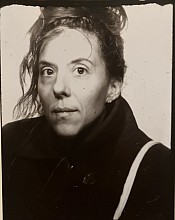
Camille Moreno
Camille Moreno is a Costa Rican-American writer based in Berlin. Her writing investigates how art operates within social structures, foregrounding accessibility and the everyday as sites of critical and imaginative potential. She has written for cultural publications in Germany, the United States, and the United Kingdom.
view all articles from this author



