Whitehot Magazine
October 2026
"The Best Art In The World"
"The Best Art In The World"
October 2026
Self-Presenting at the American Folk Art Museum
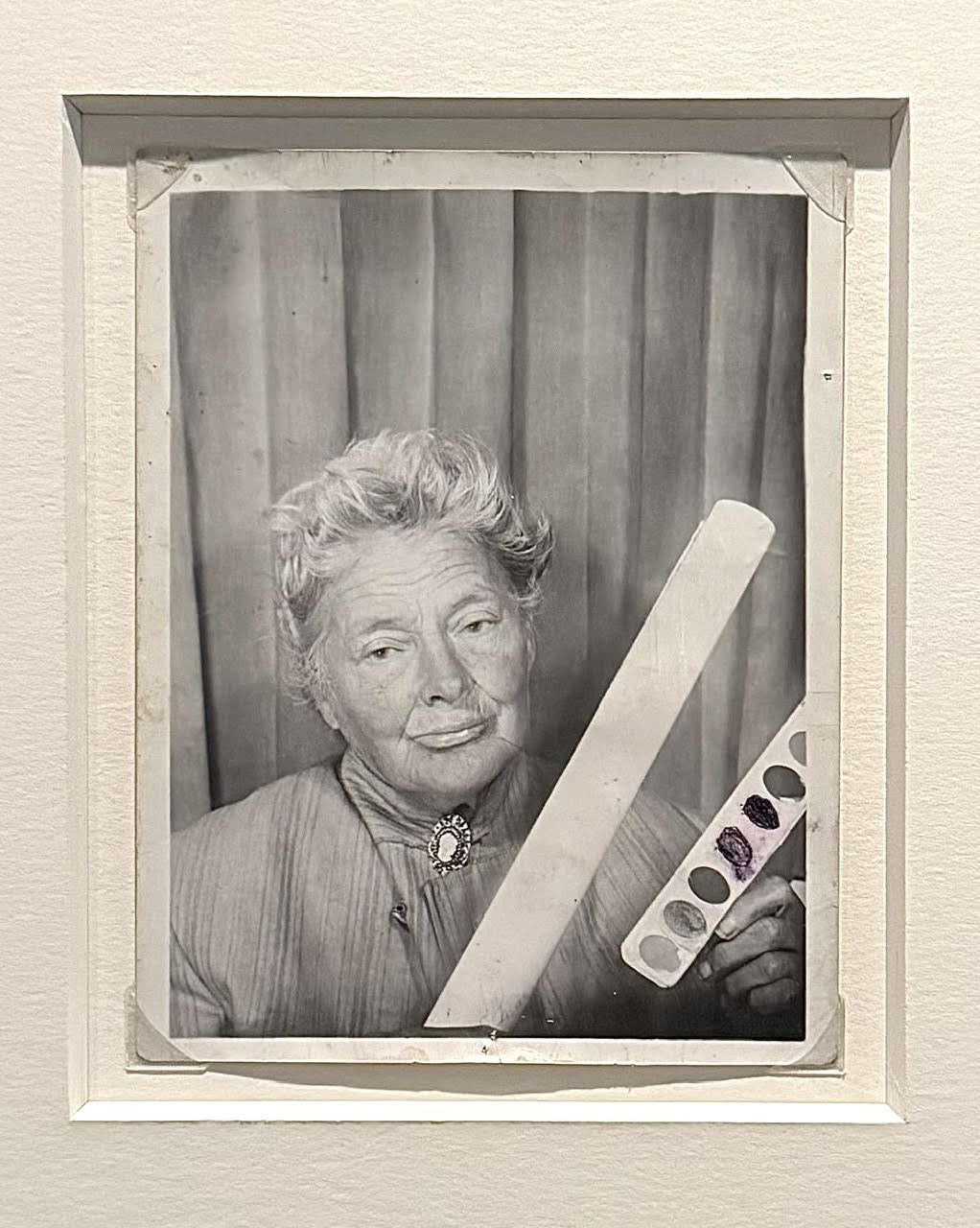 Lee Godie (self-portrait) n.d., photo-booth photograph.
By JOHN DRURY August 20th, 2026
The current exhibition, Self-Made: A Century of Inventing Artists, at the American Folk Art Museum highlights the power of the individual to have themselves heard - to find recognition, regardless of the position that society has relegated for them - whether that be simply assigned, it is propagated or maliciously fostered. Left with lemons, those intuitively creative and thus powerful, make lemonade. This presented potpourri of ingenious and truly unique makers increasingly receiving long overdue and deserved museum recognition, took the issue into their own hands to create intuitively potent works of art – to reveal that which is no longer ignorable in fine art; be that indifference originally the result lazy oversight, purposeful exclusion, racism, sexism or class warfare.
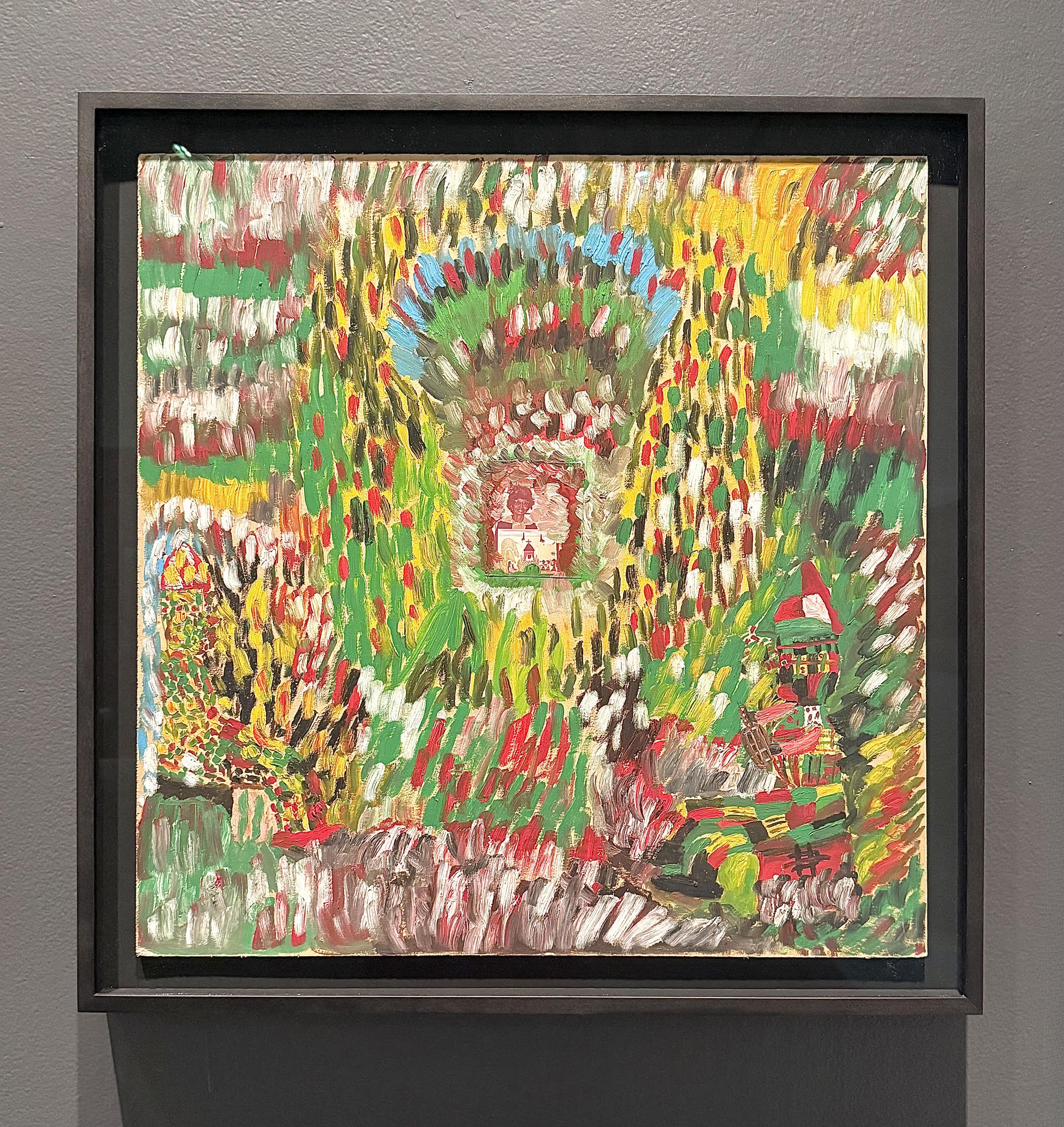 Clementine Hunter (untitled) 1975, oil on board with photograph.
There are masterworks included here at the American Folk Art Museum. I think particularly of the Clementine Hunter painting, incorporating a photograph of the artist peering from the painting’s near, dead-center; a kaleidoscopic and dense tangle of expressionistic brushstrokes, a sort of frenzied mark-making from which the painter’s image emerges from chaos in insistence and personal pride. Painted in 1975, the timeless, yet 50-year-old work is as fresh and relevant to today’s embraced abstraction (now however the result fear of cancellation for perhaps unsavory content), as the day it was painted. Born to enslaved parents, Clementine (1887 or 1888-1988) would pick up the abandoned paint and brushes that another artist had left behind at Louisiana’s Melrose Plantation in Natchitoches Parish; where she was raised and the site, later turned location of artist residencies.
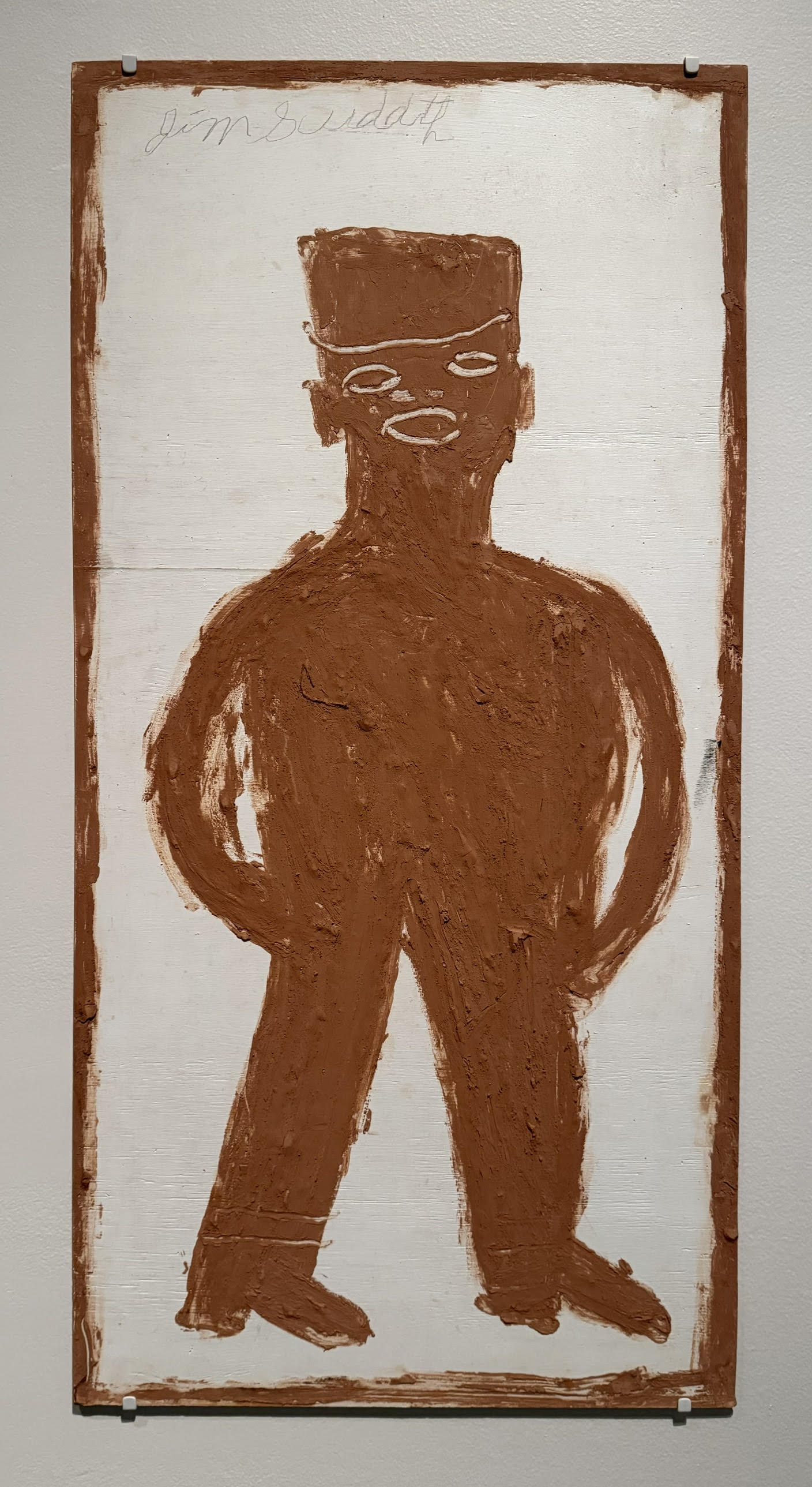 Jimmy Lee Sudduth (self-portrait) 1980’s, earth pigments, syrup and house paint on plywood.
Following suit then, and a perfect example the “of and by any means necessary” philosophical standing, the artist Jimmy Lee Sudduth (1910-2007) painted with mud. Georgia-based, the artist claimed he could find 30 tints of it, within easy walking distance of his small rural home. His homemade painting concoction was fortified (hardened) with Coca-Cola and the stout mix prepared in a 5-gallon bucket. It was applied by hand…finger-painting. Value and image might be manipulated by the addition of coffee grounds, for example, and a handful of fresh grass clippings rubbed into the surface would allow frugal coloring. Included here is a bold depiction of the artist himself, front and center. There is the artist, and the artist only; self, simply “enough”.
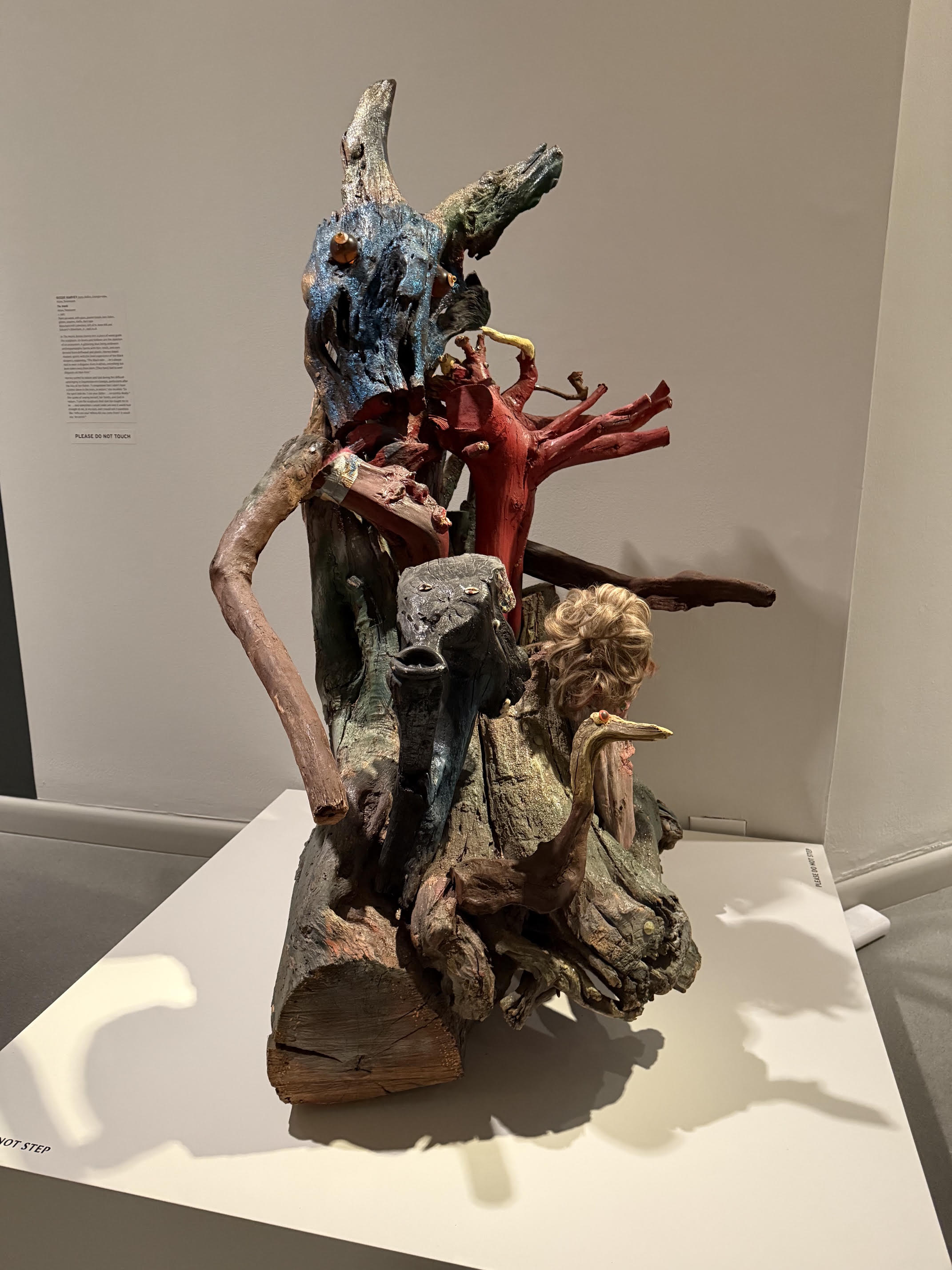 Bessie Harvey (The World) c. 1987, paint on wood with glass, beads, hair, fabric, glitter, sequins, shells, duct tape.
Bessie Harvey’s contribution to the exhibition alone, makes the trip to the museum worth the trip. Her “The World” is a girthy tangle of creatures imagined of the painted limbs and knots of driftwood - additionally adorned with hair, glass, fabric, sequins and shells. Anthropomorphic forms, substitute the Black diaspora - those silenced - herself, family and God, represented in masked spirits.
Without housing, street artist Lee Godie (1908-1994) wandered the streets of Chicago. While calling herself a French Impressionist, Godie had in fact likely never left Chicago and could often be found on the steps of the Arts Institute of Chicago, where faculty and students would buy her work, before a disgruntled school president would eventually shoo her away. Amongst my own favorites of her output are the photo booth portraits revealing a self-assured and assumed personality; the black and white images, often capturing the artist with prop in hand and colored by hand with ballpoint pen. Here, Lee poses holding a paint set, image enforcing her claimed life’s position as artist.
Like Godie, artist Mary T. Smith (1904-1995) also worked outdoors, embellishing her Mississippi plot of land with crude, ax-cut and painted, sheet-metal and wooden panels that would bring her eventual international fame; though sadly, dying penniless. Included here as part of the Self-Made exhibition, is a portrait painted on chip board – its mottled and textured composite surface, beneath the sparse (yet bold-stroked) application of paint adding to its ruddy allure and activated surface detail. Though deaf, Mary would communicate with the silent world about her, in exclamations of self and worship.
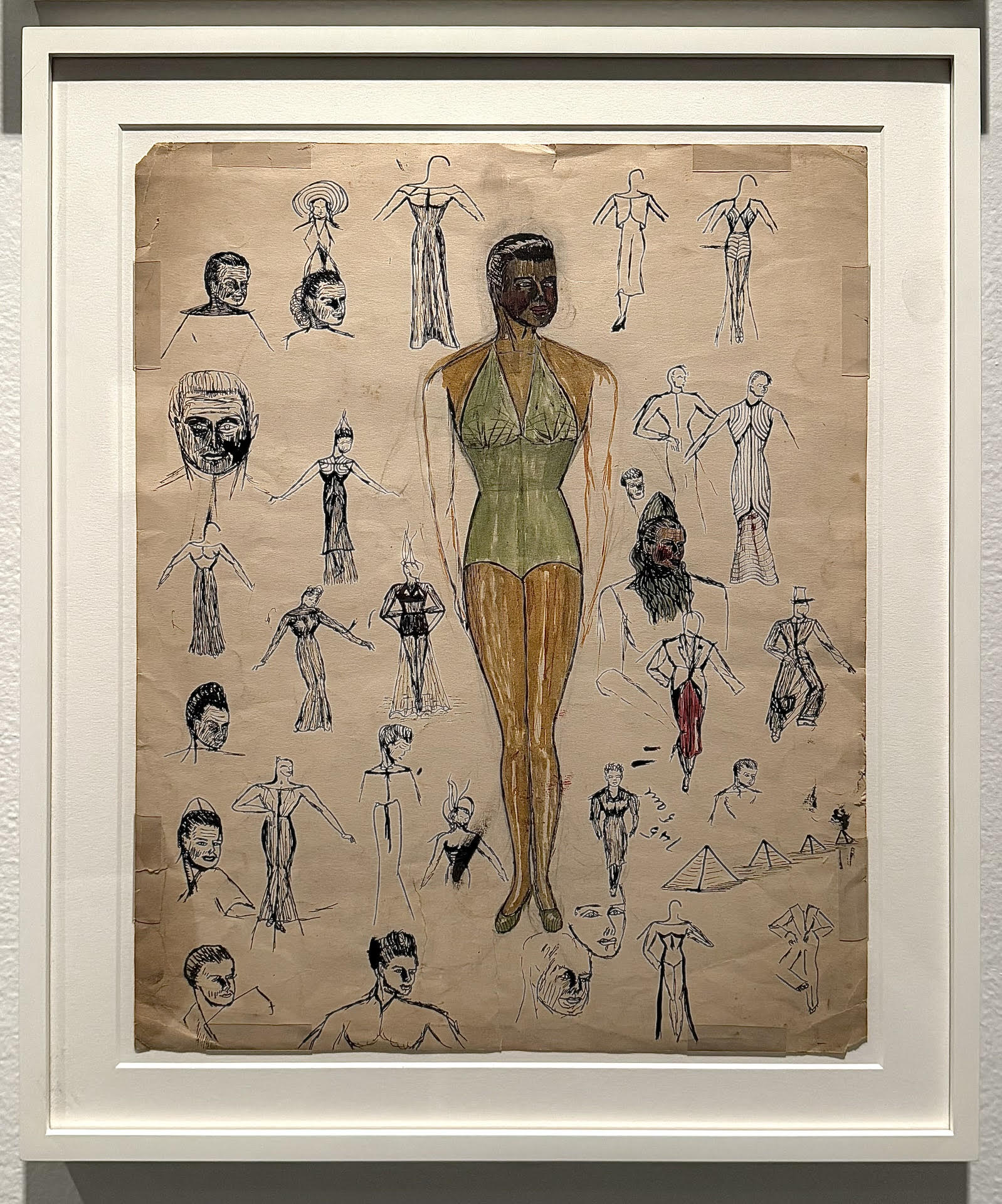 Eddie Owen’s Martin (ST. EOM; untitled) 1935-1957, watercolor and pen on paper.
And like the others included, who were nearly all born in the first decade of the twentieth century, self-proclaimed spiritual guru and leader Eddie Owens Martin (St. EOM, 1908-1986) was also Southern, despite a two-decade stint in New York City spent hustling, as a sex-worker, cross-dresser and fortune teller. The included pair of works, drawings, were made during that period when he was living in the city (1935-1957; Martin hitchhiked to NYC from Georgia, at 14 years of age). In one, a central figure is surrounded by lavishly clothed others, to challenge even the most outrageous creations of today’s designers; in celebration the extravagant, the flamboyant, the proud “other”. Owen’s was certainly eccentric, a creative trailblazer, and a flaming and self-proclaimed visitor to our conservative ways. Suffering a high fever in 1935, Owens received his first of many subsequent visions from a futuristic, gender-fluid being commanding he change his ways, name and life-path. And that he joins a new religion, Pasaquayanism. A subsequent visit from this extraterrestrial being persuaded him to return to Georgia, and his then recently deceased mother’s property. The now converted Pasaquayan dedicated the rest of his life to building a seven-acre art environment combining African, pre-Columbian Mexican and Native American symbols and motifs. Listed on the National Register of Historic Places, St. EOM’s Pasaquan is lauded as one of the most important visionary art environments in America.
The pendulum (like St. Eom!), it swings – and with the fickle winds altering our concerns it seems, with each election cycle, the group of one-of-a-kind artists included here at the AFAM, persist – in works of a very high quality and in the face of party-line, culture, beliefs or persuasion - to inform us that it is in embraced self, autonomy, that the truly one-of-a-kind creator resides.

John Drury
John Drury is a multi-media artist, published author, independent curator and instructor. Drury holds a Bachelor of Fine Art degree from the Columbus College of Art and Design and a Master of Fine Art degree in sculpture (1985; including a minor in painting), from Ohio State University. John is the father of two young adults, and is living in NYC since 1989. He has received the prestigious Louis Comfort Tiffany Foundation Award. John is a contributing editor of Glass Magazine, with published texts appearing in Raw Vision, Neus Glass and Maggot Brain magazines, in addition those appearing online, at ArtNet and Whitehot. He has written texts for artist monographs published by Black Dog, Damiani and the Museum of Glass.
John Drury is on Instagram, at johndrury.studio and can be contacted, at simplefolktoo@hotmail.com
view all articles from this author