Whitehot Magazine
October 2026
"The Best Art In The World"
"The Best Art In The World"
October 2026
Directism: a framework for understanding art that privileges unmediated encounter
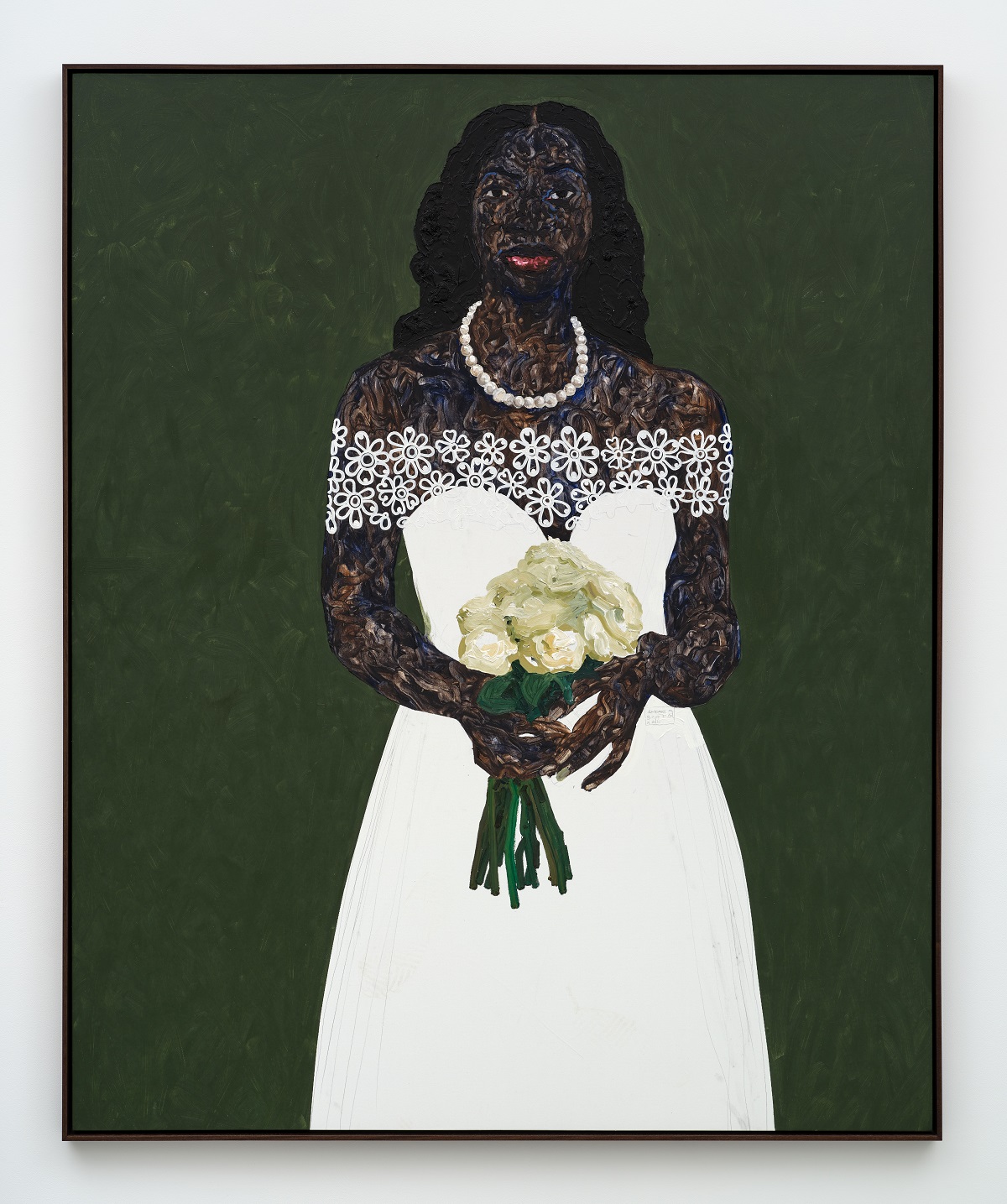 Amoako Boafo, Bouquet of White Roses ( 2025), courtesy of Roberts Projects, Los Angeles
By RICHARD ALLEN MAY III March 11th, 2026
Stand in front of a Kehinde Wiley portrait and the subject locks eyes with you. No looking away, no aesthetic distance. Look at Amoako Boafo's finger-painted portraits—the artist's literal prints visible on canvas, refusing mediation between hand, paint, and viewer. Scroll through your phone and compressed meaning is everywhere: emojis distilling complex emotions into glyphs, memes saying in three words what essays required paragraphs. Visit Marcus Guillory's exhibition and bold typography demands you read, understand, respond—no curatorial explanation needed.
Something has shifted in how art communicates. Enter Directism: a framework for understanding art that privileges unmediated encounter, compressed meaning, and strategic visibility over contemplation, elaboration, and passive observation.
This isn't simply about text-based art or figures that stare back. Directism names a fundamental reorientation in how artists address audiences, rooted in Black cultural practices of "keeping it real" and amplified by digital communication's demand for immediacy. It's art that gets "all up in yo grill"—intentionally, strategically, with full awareness of when directness is power and when opacity is protection.
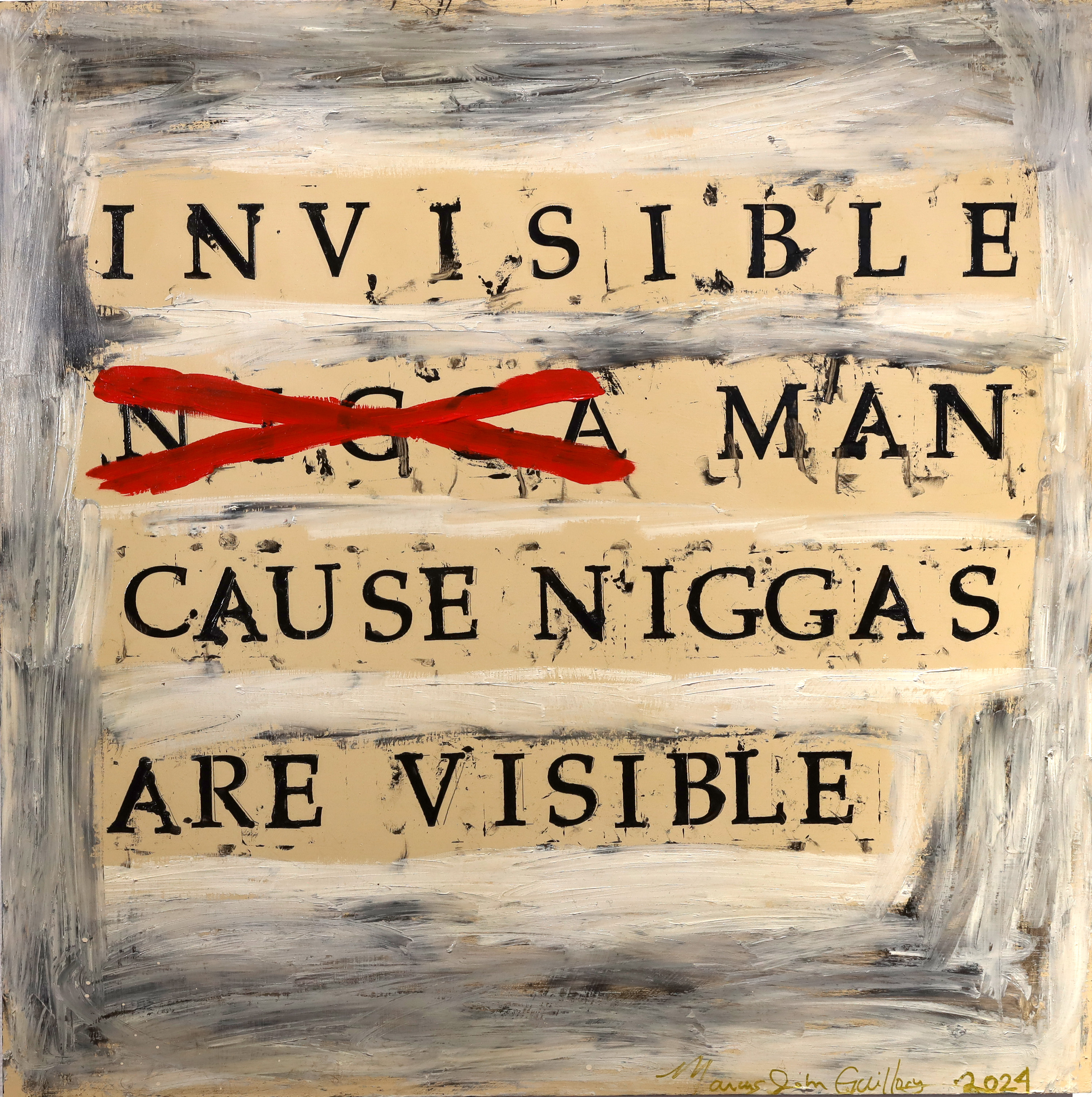 Marcus John Guillory, Ralph Ellison's Ghost (2024)
The Invisibility Paradox
Ralph Ellison's Invisible Man (1952) opens with a foundational claim: "I am invisible, understand, simply because people refuse to see me... they see only my surroundings, themselves or figments of their imagination—indeed anything and everything except me."
Ellison's narrator names the central wound—invisibility not as absence but as imposition, a refusal by others to see. But he also poses an impossible question that haunts Black artists across generations: How do you disappear when you are already invisible?
Directism emerges as a critical lens for confronting exactly that wound. It reveals how Black artists and musicians across more than a century have refused invisibility through direct address, unmediated encounter, and aesthetic confrontation. Where Ellison's narrator discovers that invisibility is imposed by others' refusal to see, Directism shows how artists have answered that refusal—getting "all up in yo grill" with undeniable presence.
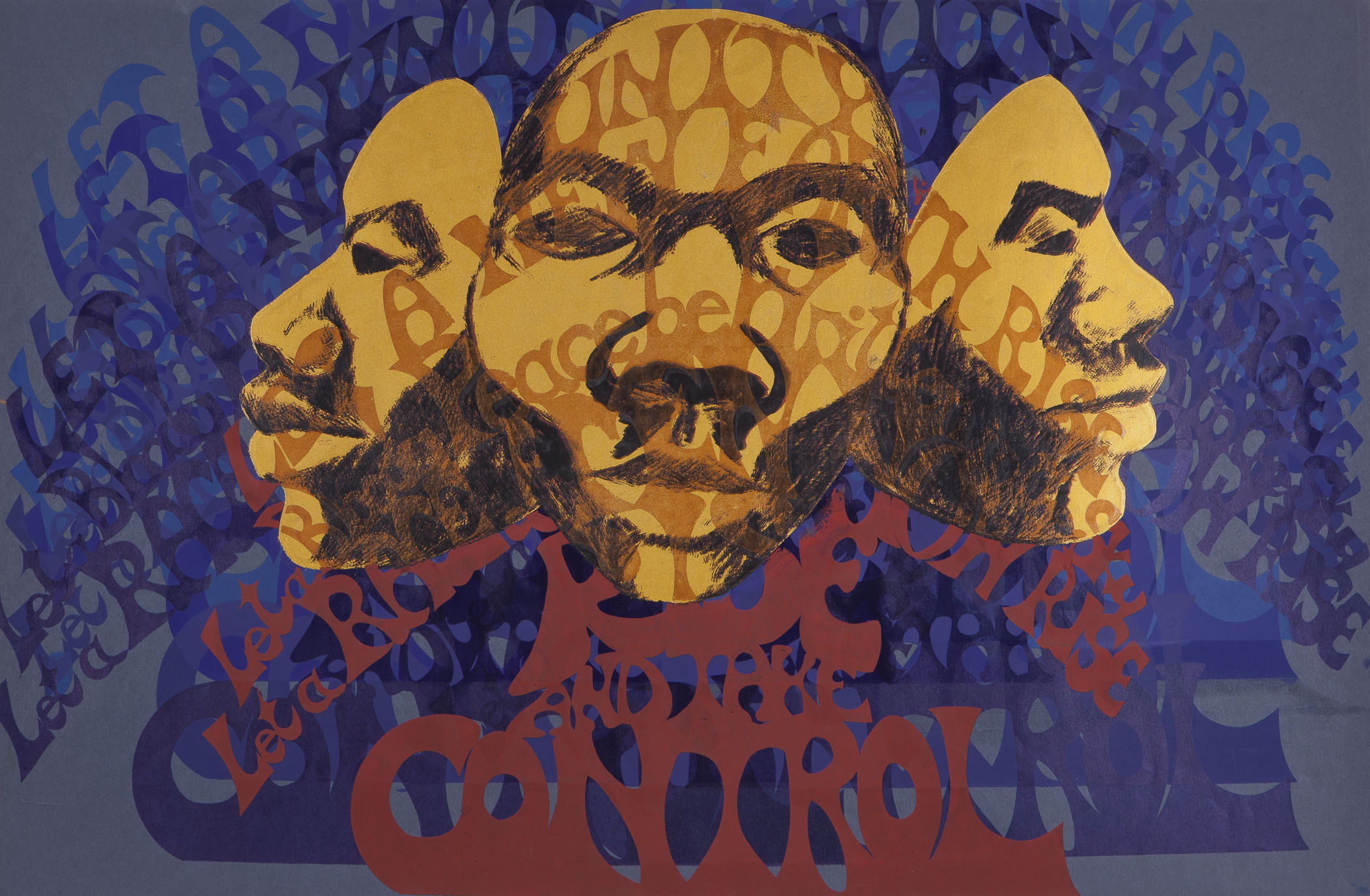 Barbara Jones-Hogu American, 1938 - 2017 Printed by Barbara Jones-Hogu American, 1938 - 2017 Rise and Take Control 1971 Screenprint on heavy purple-colored wove paper Sheet: 23 × 35 in. (58.4 × 88.9 cm) Framed: 31 × 42 3/4 in. (78.7 × 108.6 cm) Object credit line: The David and Alfred Smart Museum of Art, The University of Chicago; Purchase, Paul and Miriam Kirkley Fund for Acquisitions and The James M. Wells Curatorial Discretion Acquisition Fund Image credit line: Photograph ©2026 courtesy of The David and Alfred Smart Museum of Art, The University of Chicago
A Genealogy of Direct Address
Russian Constructivists pioneered text as confrontation. El Lissitzky and Alexander Rodchenko created visual statements that functioned as ideological billboards—typography assaulting viewers with the same force as imagery. Barbara Kruger appropriated this strategy decades later: "I shop therefore I am." "Your body is a battleground." Her work speaks with billboard directness, eliminating protective distance between artwork and audience.
Graffiti art extended this into public space without permission. Basquiat's SAMO© manifestos, Lee Quiñones' politicized subway cars, Rammellzee's linguistic warfare, Lady Pink's feminist territorial claims—all understood direct address as visibility itself. Shepard Fairey's "OBEY" campaign demonstrated directness through saturation: a single word, endlessly repeated until unavoidable.
But something else was happening simultaneously: AFRICOBRA.
AFRICOBRA's Revolutionary Directness
In 1968, Black artists in Chicago formed the African Commune of Bad Relevant Artists. Their manifesto outlined Directism's principles decades before digital culture caught up:
Frontal Images: Subjects looking directly at viewers with strength and dignity. Not compositional preference but philosophical commitment—images "inspired by the awesome images of African Sculpture, which presents strength, directness and dignity."
Written Statements: Text incorporated onto the picture plane with billboard clarity.
Programmatic Art: Work that teaches, preaches, offers solutions with the visual impact of billboards.
"Shine": The luster of Black lifestyles made visible.
AFRICOBRA answered Ellison's impossible question—How do you disappear when you are already invisible?—by refusing disappearance altogether. Wadsworth Jarrell's Black Prince stares with unflinching presence. Barbara Jones-Hogu's Rise and Take Control speaks its message in letters you can't ignore. This was art for confrontation, not contemplation.
The Dramatics understood this in 1971 with "Whatcha See Is Whatcha Get," staking transparency as integrity. Edwin Starr deepened that demand with 'Contact' (1978), and the hook line is in the chorus, eye to eye contact. These weren't just soul anthems; they were aesthetic manifestos hiding in plain sight.
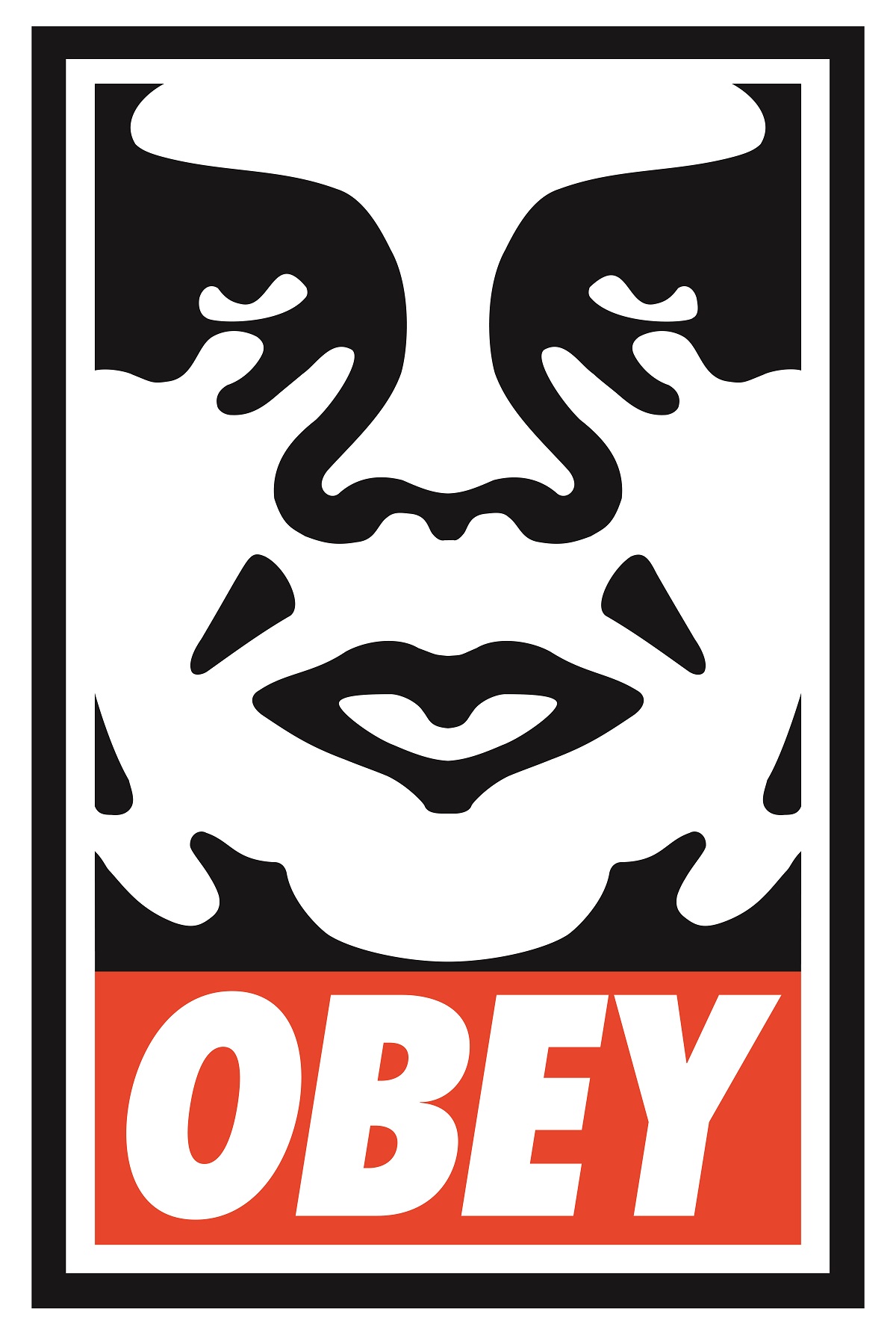 Shepard Fairey, Obey, courtesy of the artist and Obey
Directism on the Wall
Los Angeles muralist Noni Olabisi's 1996 To Protect and Serve demonstrates AFRICOBRA's frontal address at monumental scale. It depicts Black Panther Party members who don't recede, don't look away, don't invite comfortable distance. They demand reckoning.
When Los Angeles attempted suppression, Olabisi made resistance the work's statement: "This mural commemorates the Black Panther Party... dedicated to all political prisoners, as well as those who lost their lives fighting for truth, justice and freedom. The spirit of these brothers and sisters cannot and will not die. ALL POWER TO THE PEOPLE!"
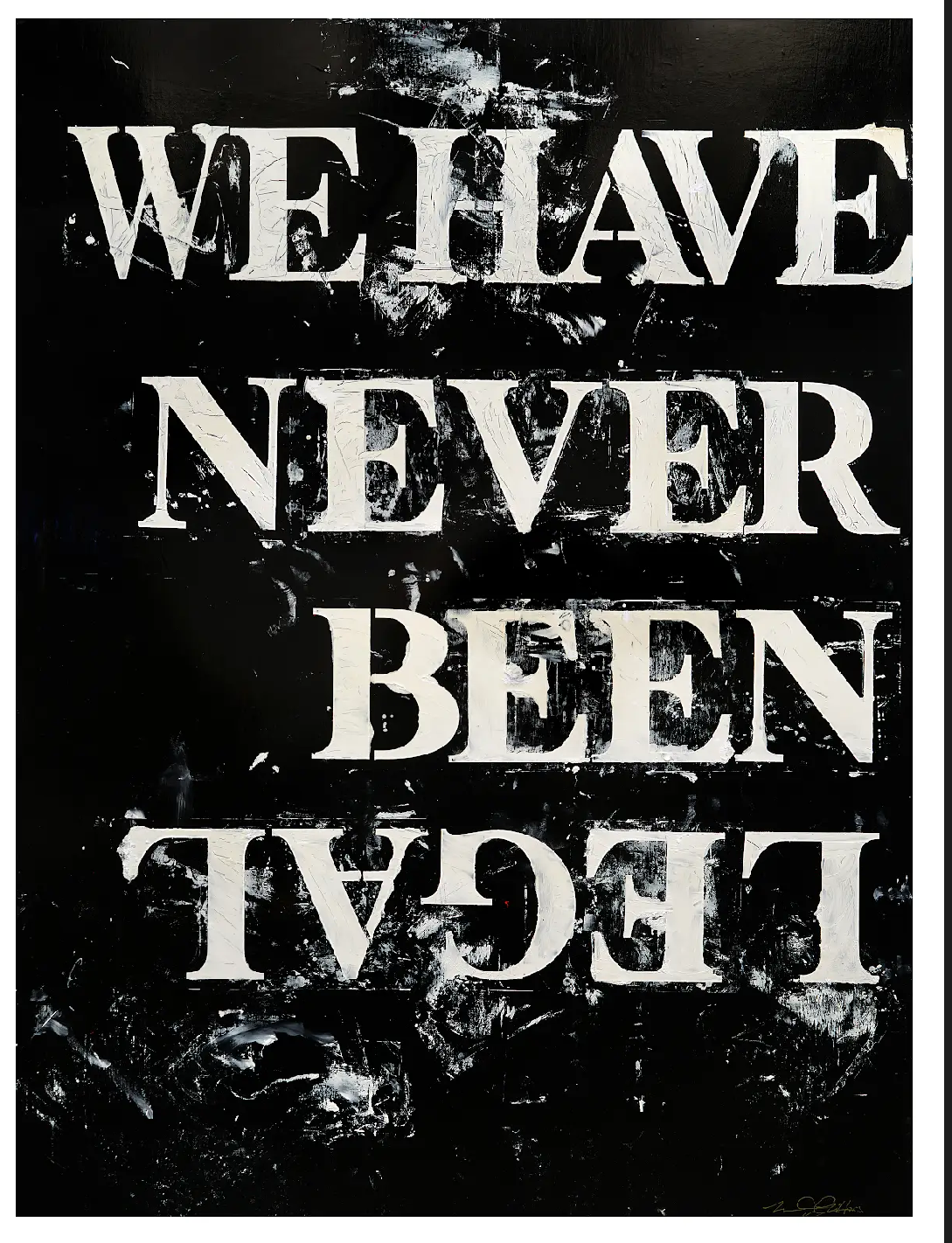 Marcus John Guillory, Never Been Legal
Marcus John Guillory: Typography as Political Medium
Marcus Guillory's practice makes Directism's contemporary stakes visible. One work confronts viewers with brutal clarity: INVISIBLE MAN—words fractured, interrupted by defiant red cross-out, the slur replaced, the phrase rebuilt to declare, "CAUSE NIGGAS ARE VISIBLE." Raw, scraped, layered with erasure and assertion, it addresses Ellison's existential dilemma directly. The answer: You don't disappear. You refuse invisibility. You overwrite erasure. You insist on visibility so aggressively it cannot be ignored.
A multidisciplinary Black artist with two decades writing for film and television, Guillory creates what he calls "flashes of stories, images, beliefs and behaviors"—compressed narratives speaking through typography itself. Working with oil sticks on paper and wood panels, he creates smudged, tactile surfaces layered with lettering that evokes urgency and taboo.
His practice explores "the human necessity to be understood clearly and succinctly"—Directism's driving principle as artistic mission. His art employs speech acts using typography, pragmatics, and aesthetics to make what is said and unsaid equally resonant. Parentheticals serve as counterpoint—visual code-switching where multiple meanings exist simultaneously depending on the reader's position.
Guillory operates within Wittgenstein's "language-games": meaning emerges from use within specific cultural contexts. When he deploys Black vernacular—"real talk," "straight up," "no cap"—he creates texts simultaneously transparent and layered. To insiders, the work speaks with unmediated directness. To outsiders, the same words require translation, remain strategically illegible.
Like the Dramatics' declaration and Starr's demand for contact, Guillory refuses protective distance between artwork and audience. His code-switching creates work simultaneously transparent to insiders and opaque to outsiders—Wittgenstein's language-game theory in Black aesthetic practice.
In an art world dominated by digital mediation, Guillory returns us to language's fundamental materiality—its weight, texture, physical presence. His paintings function as archaeological sites where personal narrative and collective memory intersect. His urgent inscription reveals typography as the most political of mediums, capable of violence and liberation, concealment and revelation.
Directness as Strategy
Directism recognizes that directness is strategic, not universal.
Contemporary Black artists navigate impossible terrain between imposed invisibility and hypervisibility—being seen only as stereotype, symbol, threat. The navigation requires knowing when to confront, when to code-switch, when to withdraw, when to be "all up in yo grill" and when to ghost.
The question haunts this navigation: How do you disappear when you are already invisible? This paradox reveals Directism's deepest insight—strategic withdrawal requires first establishing presence. You cannot choose invisibility when invisibility has been imposed. David Hammons strategically withdrew from the art world, understanding invisibility can be refusal—but only after establishing himself as undeniable. Simone Leigh creates dignified opacity—revealing enough to demand attention, withholding enough to maintain mystery—but her opacity is chosen, not imposed.
Wiley's portraits lock onto viewers with frontal confrontation. Boafo's finger-painted technique leaves literal prints on canvas—evidence of Black hands creating Black subjects who stare back, refusing erasure. Jordan Casteel's subjects control their visibility, determining encounter's terms. Glenn Ligon's text-based paintings start legible but become obscured—even direct statements can refuse easy access.
This navigation—between visibility and invisibility, transparency and opacity, confrontation and retreat—is what Directism maps. The choice to disappear becomes powerful only after you've forced the world to see you first.
Why Now
Directism matters now because we're living through a crisis of mediation. Every image filtered through algorithms. Every statement passing through institutional gatekeepers. Every encounter recorded, archived, surveilled.
Black artists have always understood this. Code-switching isn't new—it's survival strategy across centuries. The ability to speak one way to your community, another to power, to be simultaneously visible and protected: ancestral knowledge.
What's new is how digital culture made these strategies visible to everyone. Texting taught compression. Emoji taught symbolic efficiency. Memes taught that meaning multiplies through repetition and variation. Code-switching online became universal practice.
Directism names this moment when Black cultural strategies of direct address meet digital culture's demand for immediacy, creating art that speaks with unprecedented compression and sophistication.
Lower Frequencies
At Invisible Man's end, Ellison's narrator poses a question: "Who knows but that, on the lower frequencies, I speak for you?"
This is Directism's open question. These strategies emerge from Black artists navigating anti-Black invisibility—the specific condition of racial violence. The question of how you disappear when already invisible belongs first and fundamentally to Black experience—born from systematic erasure and exhausting hypervisibility. But might these innovations speak on "lower frequencies" to anyone navigating visibility's complex politics?
The framework doesn't universalize Black experience. It recognizes these strategies come from somewhere specific, born of particular violence and resistance. But it suggests what Black artists pioneered—out of necessity, survival, refusal to be rendered invisible—might illuminate something broader about communication, power, and visibility in our contemporary moment.
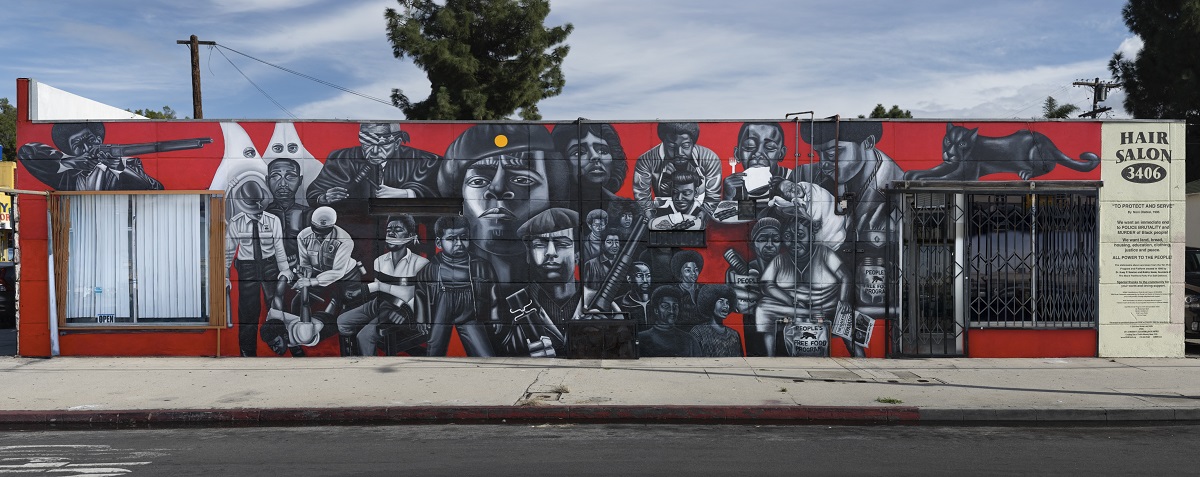 Noni Olabisi, "To Protect and Serve," 1995, Acrylic, 12 x 40 ft., 11th Ave. at Jefferson Blvd. Photo credit: Social and Public Art Resource Center (SPARC), The Great Walls Unlimited: Neighborhood Pride Mural Program, 1988-2002, Courtesy of Laband Art Gallery, Copyright held by the Estate of Noni Olabisi.
The Stakes
Directism connects AFRICOBRA's 1968 revolutionary directness to John Wilson's 1952 Incident Mural that refused to let lynching be covered up, to Olabisi's 1996 insistence that Black Panther history remain visible, to today's digital natives creating with texting's economy and emoji's precision. It explains why the direct gaze dominates contemporary portraiture—from Wiley's regal subjects to Boafo's finger-painted insistence on unmediated presence.
Most importantly, it recognizes Black artists aren't just making work about visibility—they're inventing new grammars of communication, new strategies for navigating impossible terrain, new ways of saying everything while protecting what matters most.
This art "ain't jivin'." It's "not perpetratin'." It's "representin'"—when it chooses, how it chooses, to whom it chooses. It understands that directness is power, that opacity is refuge, that the ability to control your visibility is freedom.
That's Directism. That's the framework. That's what we need to see what's right in front of us—if we're willing to look directly back.
Richard Allen May III
Richard Allen May III is a 2025 Andy Warhol Foundation Arts Writers Grant recipient, independent curator, and educator at CSU Fullerton, CSU San Bernardino, ArtCenter College of Design, and Bowie State University, where he teaches art history. He has been a contributing writer for Artillery for over eight years and wrote the foreword to AFRICOBRA: Experimental Art Toward a School of Thought (Duke University Press, 2020).
A project supported by the Andy Warhol Foundation Arts Writers Grant.
view all articles from this author