Whitehot Magazine
October 2026
"The Best Art In The World"
"The Best Art In The World"
October 2026
Digital/AI/VR Art: Selfhood as a Responsive Environment
 Luhan Rong, A Frame from In the Eyes of the others, VR art.
BY SERENA HANZHI WANG Mar 19th, 2026
here is a particular kind of exhaustion produced by contemporary systems. Not just physical exhaustion, but perceptual exhaustion. Too many prompts. Too many predictions. Too many interfaces trying to anticipate desire before desire has even had the chance to clarify itself. AI arrives inside this condition as both promise and pressure: a tool meant to reduce friction, but just as often one that adds another layer of suggestion, surveillance, and managed choice.
Luhan Rong, a computer artist and designer trained in industrial design at Pratt and later in interactive systems at NYU’s ITP, works right at that threshold where assistance starts to blur into control. Across digital/VR works, AI-assisted platforms, and responsive systems, her projects keep circling the same tension: how a person is guided through an environment, how attention is directed, and how much of the self gets reorganized once a system begins watching back.
Her digital/VR work In the Eyes of Others is the clearest entry point. Developed in Unreal Engine, the project is structured around a series of memories and the tension between external opinion and inner thought. Players move through scenes by way of gaze interaction, off-screen audio, and decision points that challenge their perceptions and values. Rong’s project page is very direct about the mechanics: interaction time and key presses are recorded, and those inputs alter dialogue, time cycle, room transformation, and scene progression. The work is personal in origin, but it does not unfold like confession. It unfolds like a responsive system that keeps adjusting the atmosphere around you.
What stays with me is not an abstract claim about identity, but the way the environments carry pressure. One scene has the washed-out calm of a domestic interior: sheer curtains, open sky, a laptop on a desk, the kind of space that reads at first as safe, tidy, almost neutral. Then a subtitle cuts across that quiet with a line of control: “You are not leaving this room…”. Another image moves in the opposite direction, into a dark vaulted interior lit by an ornate chandelier, where the ceiling itself feels heavy enough to press downward. The work understands that judgment does not always arrive as argument. Sometimes it arrives as atmosphere first. Sometimes the room changes before you do.
That is where the VR format starts to matter. In the Eyes of Others does not use immersion as a shortcut to intensity. It uses immersion to make familiar spaces unstable. Gaze becomes a way of moving the story forward, but also a way of making the viewer complicit in their own pacing. Off-screen audio matters for the same reason. It keeps the source of pressure slightly displaced, as though authority were always nearby without fully coming into view. The result is less a meditation on selfhood in the abstract than a staged encounter with environments that watch, respond, and slowly tighten around the player.
 Luhan Rong, A Frame from In the Eyes of the others, VR art.
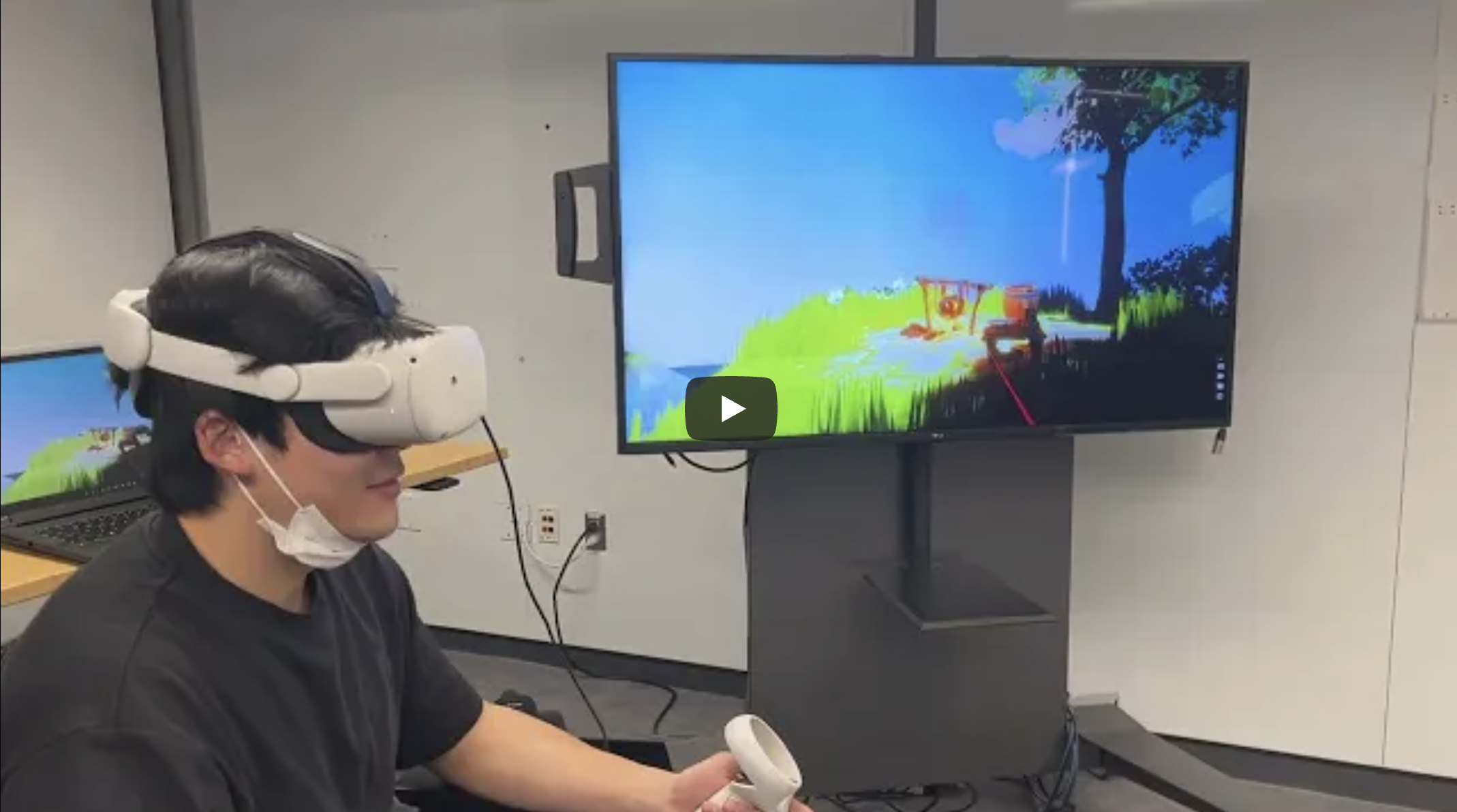 Audience Expericing Luhan Rong's work
That concern with guided perception carries directly into Roomly, her AI-powered interior platform for young renters and homeowners working with smaller spaces and tighter budgets. Users scan a room, receive personalized suggestions, and move through furniture options that include both new and pre-owned pieces. The project speaks very directly to a contemporary desire to make spatial judgment easier to live with. People want atmosphere to come with prompts. They want placement to feel previewable. They want uncertainty broken into manageable choices. Roomly sits inside that mood. It turns space into a sequence of decisions and, in doing so, makes visible how much contemporary seeing now depends on assistance.
That logic is not foreign to the art world. Exhibition culture already runs on mock-up, staging, previsualization, and the fantasy that a work can be known before it is installed. Roomly does not invent that impulse. It just places it in plain view. It belongs to a broader appetite for structures that help people decide what belongs where, how a room should read, how an object should sit, how taste can be made more navigable. Still, the old difficulty remains. Spatial judgment is never only a matter of optimization. It also depends on instinct, awkwardness, mood, and the occasional wrong placement that ends up reading best.
Her VR work With Soul shifts this sensibility into a softer register. Developed in Unreal Engine, the piece takes the form of a VR escape experience in which the participant enters a dry, lifeless crystal ball and gradually brings it back to life through interaction. The language around the work leans toward childhood, peace, and serenity, but what stays with me is something more structural than therapeutic. The environment only opens through participation. Feeling is not presented as private. It is built through movement, contact, and response.
That matters because it shows how consistently Rong thinks through environment as something active. In With Soul, interaction does not simply trigger an effect. It restores atmosphere. It alters the conditions of the world. The project uses a points system built through Unreal blueprints so that player behavior shifts both environment and plot. That detail says a lot. Even in a work organized around calm, Rong is still building systems that register action and return it in altered form. The world listens. Then it changes.
 Luhan Rong, A Frame from With Soul, VR art.
HERCS, her AI-powered fitness project, is where that logic becomes more overtly disciplinary. Developed in 2023, it pairs the eBell motion-detecting attachment with a mobile platform that tracks movement and load in real time, recognizes exercises, and generates responsive feedback. Rong’s role included mobile and web product design and user research, with interviews conducted across twelve weightlifters at different levels of experience. The familiar contemporary demand is all here: the body rendered measurable, correctable, continuously legible to a system.
What keeps the project from collapsing into pure optimization rhetoric is restraint. The issue was never how to produce more feedback. The issue was how much feedback a person could absorb before assistance turned into noise. HERCS later received two Red Dot recognitions in 2025, and the award makes sense. Not because the project performs intelligence loudly, but because the loop holds. Sensor, interface, and response all move in the same register.
Across these works, Rong’s real subject is not AI alone. It is the softer coercion of mediated experience. The way a system guides attention. The way it produces self-consciousness. The way it teaches a person where to look, what to notice, how to decide. In the Eyes of Others turns selfhood into a responsive environment. Roomly turns spatial uncertainty into prompted judgment. With Soul turns emotional restoration into an interactive world. HERCS turns bodily effort into a monitored feedback loop. Different formats, same pressure.

Serena Hanzhi Wang
Serena Hanzhi Wang (b. 2000) is an award-winning art proposal writer, multimedia artist, and curator based in New York City. Her work spans essays, exhibitions, and installation Art—often orbiting themes of desire and technological subjectivity. She studied at the School of Visual Arts’ Visual & Critical Studies Department under the mentorship of philosophers and art historians. Her work has appeared in Whitehot Magazine, Cultbytes, SICKY Mag, Aint–Bad, Artron, Art.China, Millennium Film Workshop, Accent Sisters, MAFF.tv, and others.
view all articles from this author