Whitehot Magazine
October 2026
"The Best Art In The World"
"The Best Art In The World"
October 2026
Focus Art Fair Spotlight - Legibility of Gaze
By RAIN CHAN June 29th, 2026
Focus Art Fair this May gathered a concentration of emerging Asian galleries in one room, from Korea to Singapore to India. But the encounter that stayed with me wasn't about Asia so much as about how Asian-ness survives being looked at in New York, and it played out between two local spaces showing diaspora artists: YveYANG Gallery and Art in General.
Both booths work inside the "Asian contemporary art" framing the fair invites, and both are caught in the same tension: not simply what Asian-ness is, but how much of it to make legible, and to whom. YveYANG (Alec Dai, Siyu Chen, James Chuang) and Art in General (Helena Tan, Simon Liu, Akira Ikezoe, Covey Gong) circle that problem from opposite ends. Two works set the poles.
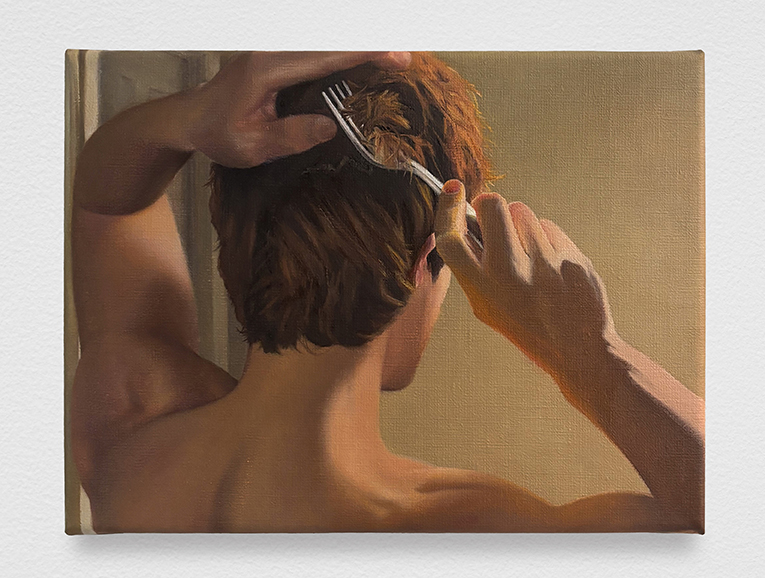
James Chuang, Dinglehopper, 2026, Oil on Linen, 9”x12” Courtesy of YveYANG
James Chuang, who is self-taught, shows paintings of male body parts in intimate close-up: beautifully detailed, warm, and anatomically wrong. The foreshortening doesn't read as a near-miss but as a different grammar: an arm tapering too fast, an elbow swollen against the torso. What looks at first like untrained error opens, on a second pass, onto a system. Chuang builds space the way ink painting does — planes stacked rather than receding, no single vanishing point to organize the body, the figure laid out across the surface instead of projected into depth. I'd argue the Asian-ness here is not the subject but a technics of seeing: a sidestep around the roughly six-hundred-year perspectival apparatus that begins in the Renaissance, and around the art-school lineage that transmits it. The work can't be consumed as identity, because its difference lives in the perception, not the theme. The gaze that comes hunting for a recognizable Asia finds instead a structure it can't quite resolve.
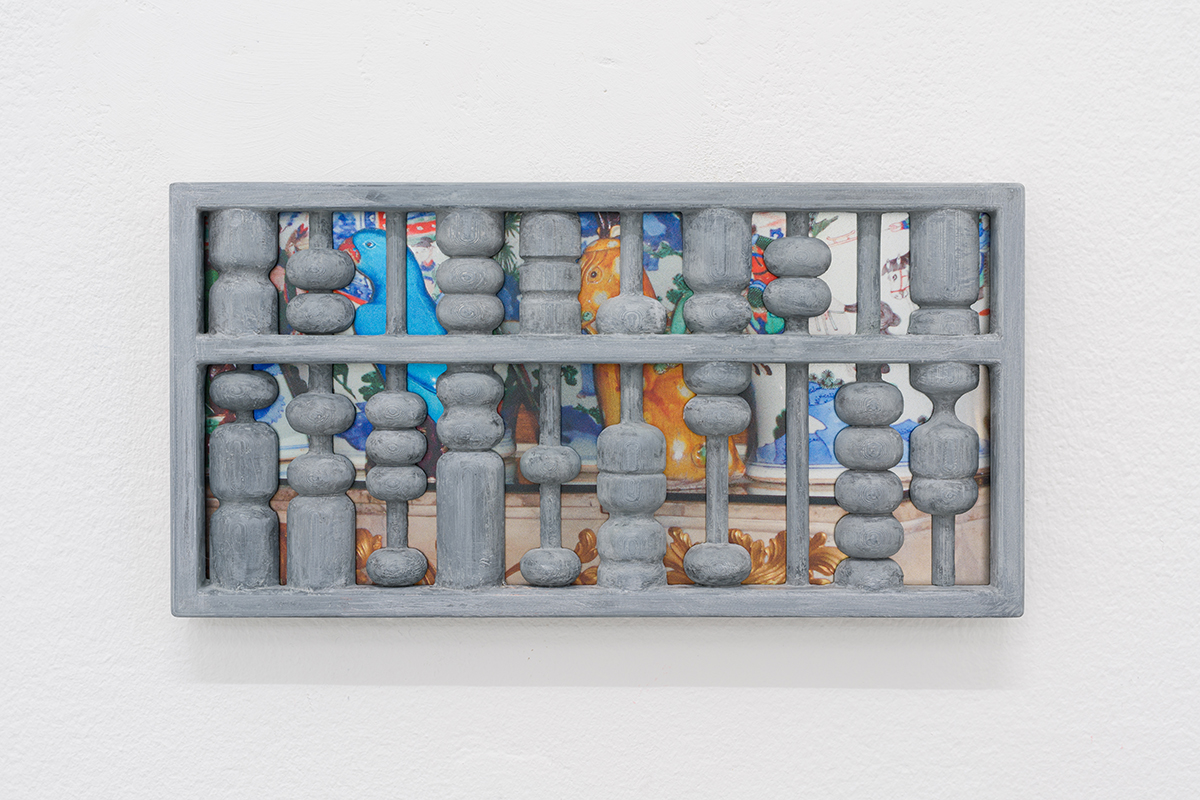
Helena Tan, Reel Fantasy, 2024, Image Courtesy of Ashley Berlin
Helena Tan's Brimming and Reel Fantasy refuses the same gaze from the other side: not through perception but in apparatus. Abacus beads hang suspended over an image of the Porcelain Cabinet at Charlottenburg Palace in Berlin, that eighteenth-century European fever-dream of East Asia rendered in chinoiserie. The rods of the abacus fall across the picture like the bars of a cell, caging the very image of "the Orient" the Western collector once assembled for display. If Chuang buries difference inside the act of looking, Tan puts the act of looking itself on trial: the God's-eye view of the European cabinet, the impulse to arrange Asia into a vitrine. Looking out through the bars of the category, the work asks what it would mean for Asia to look back.
So these aren't, in the end, opposite poles of supply and refusal. They're two refusals: one located in how a body is seen, the other in how a culture is displayed. The opposite pole, the one neither booth occupies, is the easy one, and it's the pole the fair's own banner tilts toward: to be shown as "Asian contemporary art" in New York is to be read by an audience with an appetite for legible difference, and a great deal of work made under that banner obliges, handing the gaze exactly the recognizable Asia it arrived for. The category does the naming in advance. What Chuang and Tan share is the refusal to be named on schedule: and that refusal, more than any shared geography, is what makes the two booths the most coherent argument at the fair.
Which leaves the question Focus Fair poses sincerely: how Asian is Asian enough, and who gets to decide?
Rain Chan
Rain Chan (b. 1994, Hong Kong) is an architect, artist, exhibition designer and educator based in New York. Rain has served as assistant professor in art and design at universities across Hong Kong and New York, And is currently serving as the Editor in Chief of September. His exhibition design and fabrication work has been shown in MoMA, SculptureCenter, Cooper Hewitt Museum, Denver Museum of Art and National Building Museum.
view all articles from this author