Whitehot Magazine
October 2026
"The Best Art In The World"
"The Best Art In The World"
October 2026
Art as a Means to Love
By CAMILLE MORENO September 29, 2026
Andy Warhol said that the most embarrassing thing we can do is die. I would one-up him and say that far more humiliating is falling in love.
Falling in love is a temporary surrender of self-possession: you are no longer entirely in charge of your own constitution. Another person, for whatever reason, is able to reorganize your attention. Their interests become interesting. You learn things simply because they matter to them. Your sense of what is important shifts, and you see your own world order is nothing more than an arbitrary assemblage of your own experiences, rearranged into a set of values. That is humiliating.
But there is something useful in the humiliation. It exposes how much of what we consider important is only important because it is important to us. We build our values from the things we have encountered, the people we know (and love), and the histories we have inherited, then tend to treat those values as self-evidently universal. Falling in love makes that illusion harder to maintain, and staying in love means living with the consequences.
In her essay commissioned for the seventeenth edition of Vienna’s curated by festival, Ariana Reines asks what happens when love ceases to be something through which a life — or a society — is organized. Twenty-four participating galleries address LOVE through desire and eroticism, friendship and care, identity and language, bodily relations, loss, memory, posthumous intervention, and social connection.
We have so many words for the mechanics of attachment: chemistry, compatibility, affection, connection, care — while “love” itself can be so triggering or downright cringeworthy. It is an embarrassingly earnest word reserved for worthy adversaries, ancestors, children — even favorite colors — but not for the general public and less so for society at large. Reines describes this problem as one of orientation: we have become adept at explaining, categorizing, and managing our attachments, but have lost sight of love as a force that changes what we pay attention to, what we value, and how we proceed from there.
For Reines, attention itself is love. To love something is, in part, to (learn how to) see it. To love someone is also to become attached to a life whose disappearance you cannot prevent. This is particularly evident with animals and pets: we invite them into our lives knowing that, by the terms of the deal, they will probably exit before us. Our knowledge doesn’t make the attachment less strong — if anything it may augment it.
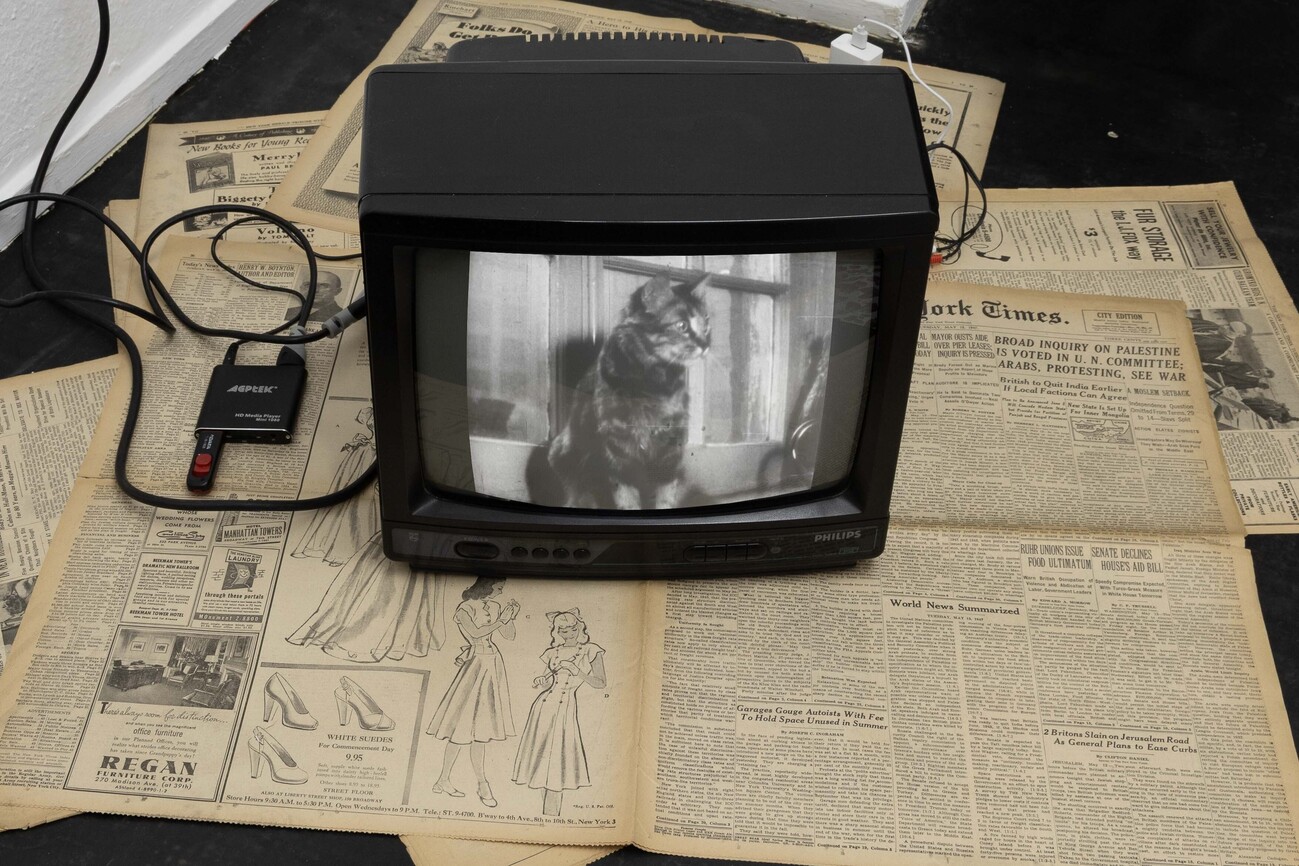
Shore Gallery, BABYBU NEVER DIE Installation View, Photo courtesy of the gallery
For Shore Gallery’s exhibition BABYBU NEVER DIE, curator Amalia Ulman’s text begins from this heartbreaking bargain. “To love an animal is to admit defeat and welcome heartbreak with open arms,” she writes, recalling the adoption of her service dog. Ulman’s exhibition brings together works about animal companionship and loss, but also the relationship between attention and time. Zoë Lund’s photographs of pet rats, Deren and Hackenschmied’s film The Private Life of a Cat, Judith Hopf’s sleeping horses, and works by Gretchen Lawrence, Margaret Tashkova, Libby Rothfeld, Bruno Zhu, Jennifer Moon, and Laub portray animals as subjects of sustained attention rather than objects of use.
Clocks and references to permanence run throughout, pointing to the temporality of caring for another creature: days measured by feeding, walking, waiting, and watching, alongside the knowledge that the relationship has a certain end. Ulman’s interest lies in the desire to create a life around something that cannot stay.
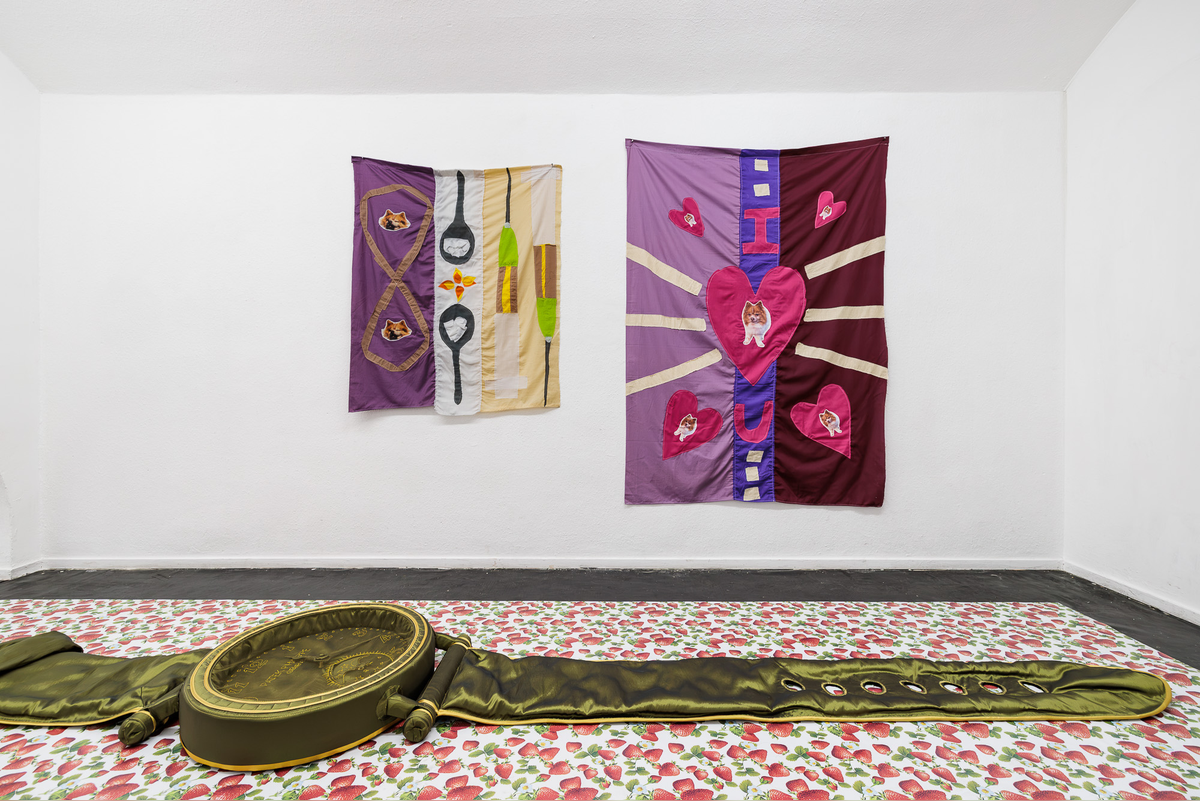
Shore Gallery, BABYBU NEVER DIE Installation View, Photo courtesy of the gallery
At Galerie Thoman, After Love also turns to encounters we continue to have with someone who is, for whatever reason, no longer there. The exhibition resists the neatness of “post-love,” a term that makes the end of a relationship sound like a clean break, and a new (age) category into which everything can be filed. Love persists in rooms, objects, habits, and memories. What transpired is over, but it lingers. Like in Eternal Sunshine of the Spotless Mind, the hardest part is how to confront what remains when we cannot, or do not want to, forget.
At FELIX GAUDLITZ, Jason Dodge gives the problem a title that goes on and on, buffering like unclaimed love that’s all dressed up with nowhere to go: What can I do now with this great useless machine of my love? It has no wholesome work to do. The exhibition comprises works by Florence Jung, Lydia Ourahmane, Rosemary Mayer, Iman Issa, Christine Dahlerup, Tanja Widmann, and James Richards, among others.
Where do you spend love currency when there’s nobody to give it to, and seemingly nothing to be had? What happens to all that energy of attachment when there is still something to hold onto, but nothing to hold it together? Dodge’s accompanying text invokes Alice Notley’s The Prophet, where a sponge can be an animal that resembles a plant, or a moist, bad-smelling thing inside the kitchen sink waiting to be chucked. “Many things,” Notley writes, “are often misleading, transformed, or elsewhere.”
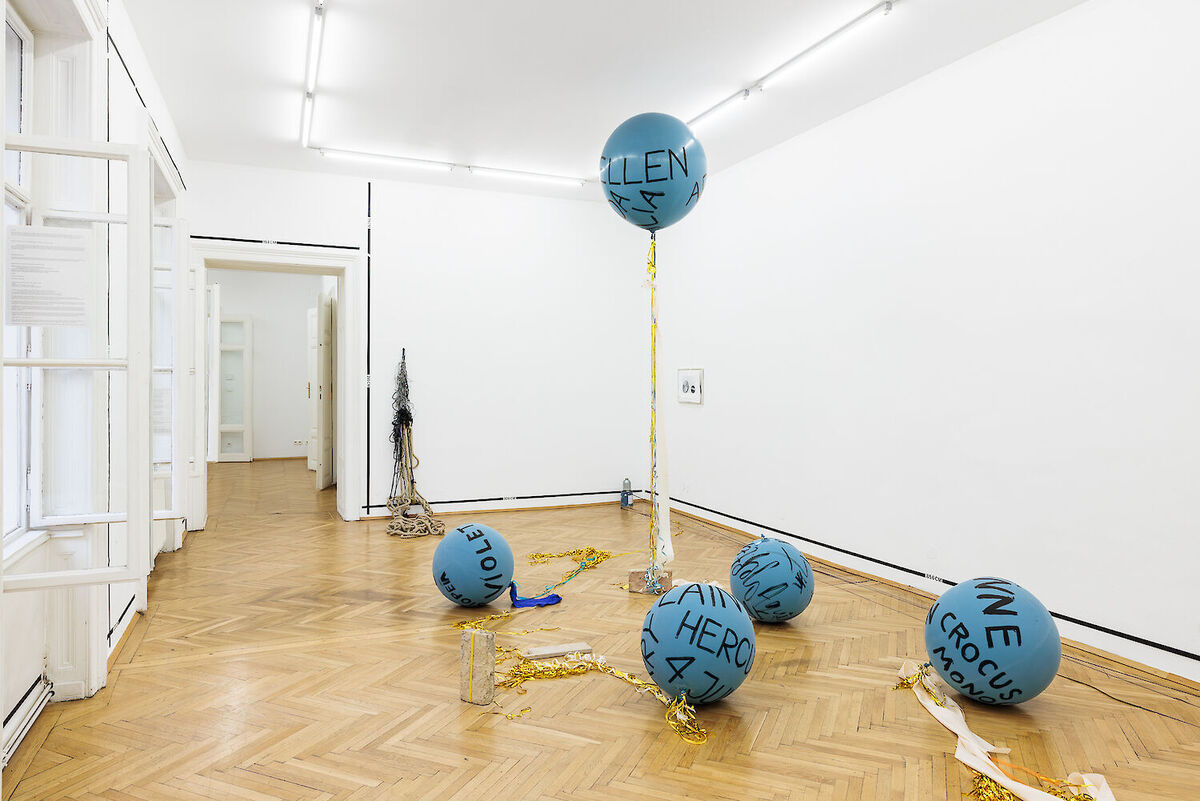
Rosemary Mayer, Estate of Rosemary Mayer, Connections (Vienna), 1978/2026, balloons, helium, marker, ribbons, silk, string, metallic streamers, dimensions variable, at FELIX GAUDLITZ, Photo courtesy of the gallery
Dodge extends this instability to the question of who makes an artwork. In his curatorial statement, he describes ancestry as something that might be expressed through translation: a work not entirely made by one artist, but produced through a “binding dust” indifferent to who did what. Like a poem translated by multiple people, the artwork becomes a collective undertaking, its meaning shaped by more than a single author. Love, in this account, loosens the boundaries between people and their contributions.
Collectivity finds another expression at Meyer*Kainer, where curator Andreas Reiter’s five-room exhibition brings together vibrant, playful works that unfold from one room into the next and up the stairs. The collective dimension of art-making is highlighted by Emily Kame Kngwarreye’s small wall piece. The Australian Aboriginal painter’s work emerged from a cultural context where artistic practice is considered a shared community activity bound to collective knowledge, as opposed to the Western ideal of a self-contained individual genius who conducts work more or less privately. Upstairs, Isa Schieche’s Kiss Flute makes collective encounter more literal: a carved wooden head whistles when kissed and blown into. The work requires another person to activate it, and affection becomes an action with a delightful and unexpected result.
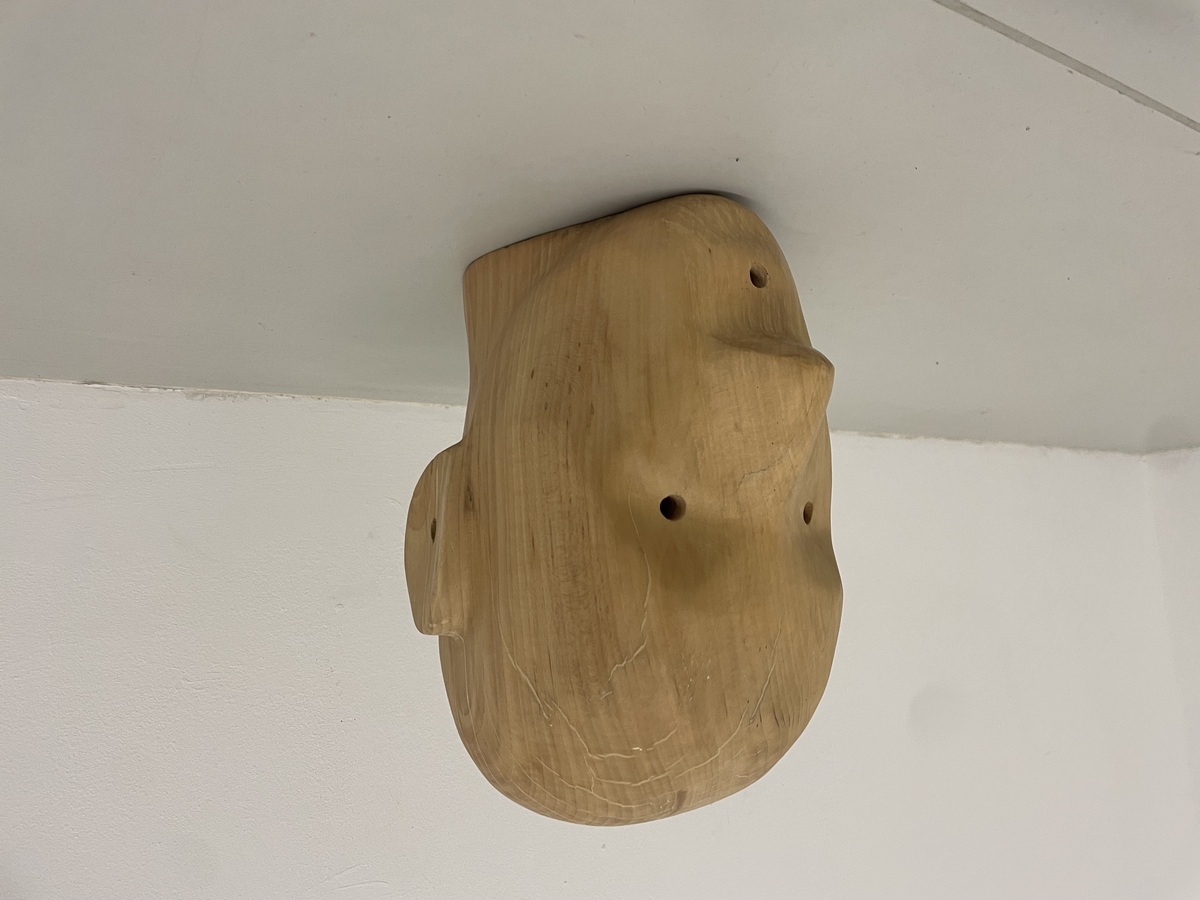
Isa Schieche, Kiss Flute, 2020, at Meyer*Kainer, photo by Camille Moreno
At Galerie Martin Janda, Jan Mot presents Ian Wilson’s There is a discussion (1972), a work consisting, almost impossibly, of the words “There is a discussion” and Wilson’s signature. Wilson spent decades turning conversation into an artistic medium. From discussions about time to oral communication, the known and unknown, and the absolute, the artwork offers little to look at. What it proposes instead is a situation that only comes into being when people speak together. Like Schieche’s flute, it depends on participation, though the exchange it asks for is verbal rather than physical.
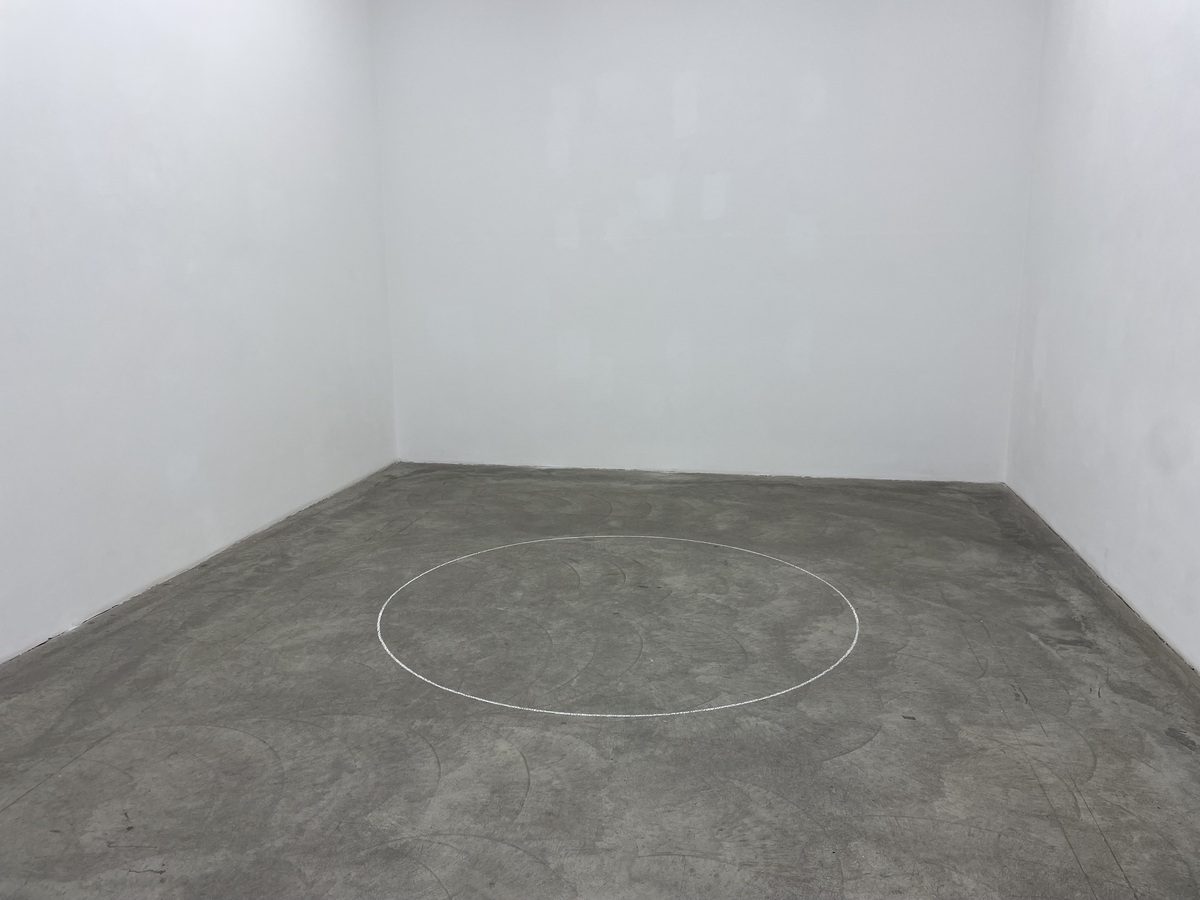
Ian Wilson, Chalk Circle on the Floor, 1968, Galerie Martin Janda, photo by Camille Moreno
Across these exhibitions, love shows us how much of what we value can be rearranged through encounter. We are not always the authors or even the keepers of what matters to us, nor can we decide what will outlast us. What and whom we love will eventually exceed our possession. There is something deflating in the loss of agency, but relief in recognizing its limits. But attention does not have to become attachment to alter what enters our field of concern. Art does not ask us to love what we see, but it can help us learn to look at what we might otherwise fail to understand, or choose not to see in the first place.
curated by is on view from September 11 to October 17, 2026
Info here
Camille Moreno
Camille Moreno is a Costa Rican-American writer based in Berlin. Her writing investigates how art operates within social structures, foregrounding accessibility and the everyday as sites of critical and imaginative potential. She has written for cultural publications in Germany, the United States, and the United Kingdom.
view all articles from this author