Whitehot Magazine
October 2026
"The Best Art In The World"
"The Best Art In The World"
October 2026
APPLE FACE and the Return of Surrealism
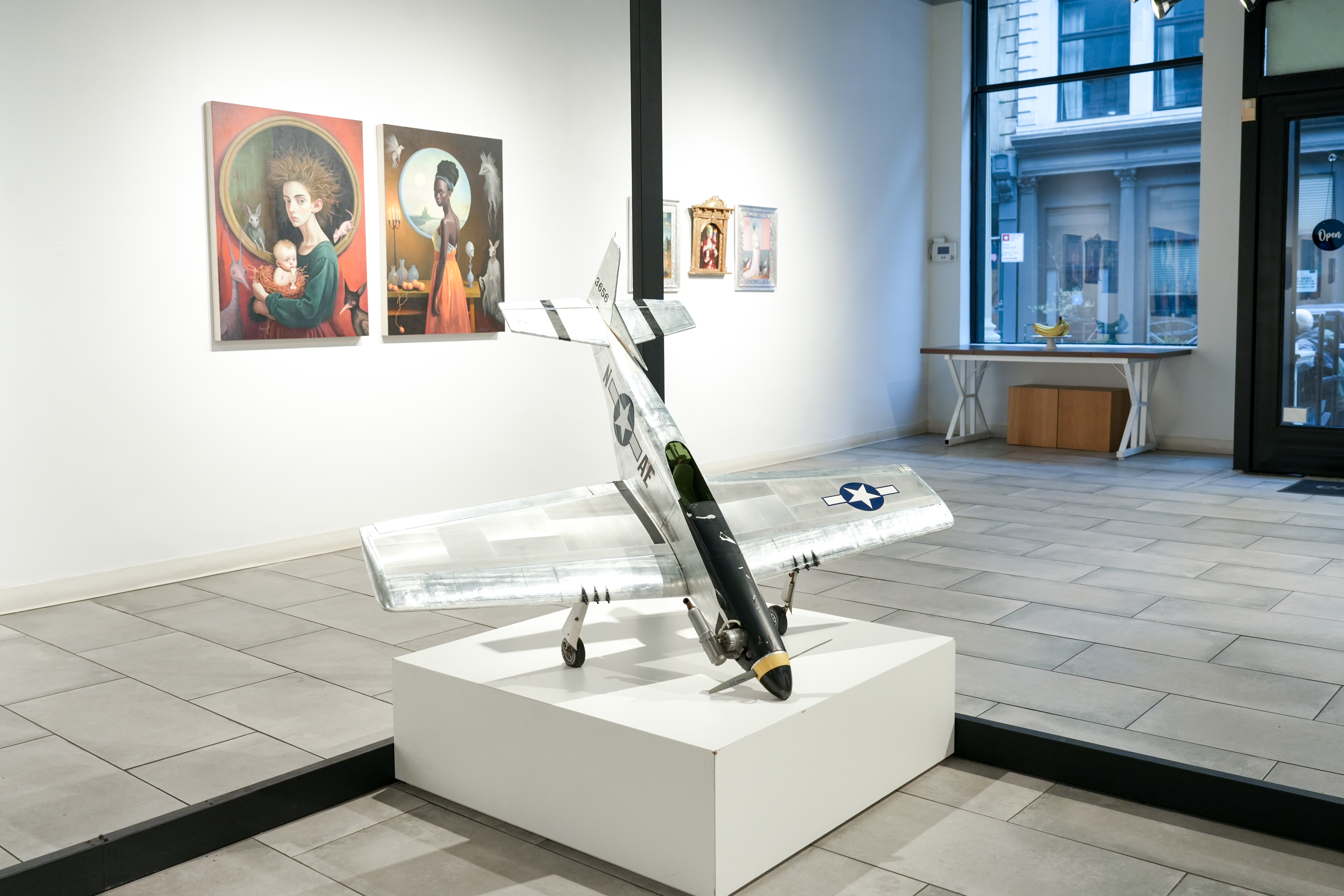 Installation view of APPLE FACE. Photo by Nadiya Papina. Courtesy of the artists and Mriya Gallery.
BY SERENA HANZHI WANG May 15th, 2026
It feels like just a few years ago AI-generated images still made obvious mistakes: hands with too many fingers, faces caught in the uncanny valley, rooms obeying no real architectural logic. But even then, those images felt strangely familiar to me, like they belonged to a part of the human psyche we were never supposed to reach. Now the technology has become smoother, more convincing, almost invisible. But that feeling never disappeared.
And it’s no longer limited to entertainment either. AI images are only the micro version of how surreal contemporary life has started to feel. Elections unfold through algorithmic outrage. War arrives first through screens, then by mouth, and only after that does opinion become truth. I keep wondering what people from a hundred years ago, or a hundred years from now, would think about this moment. Would it feel unreal? Surreal?
This is why Surrealism feels worth revisiting now. The movement once tried to visualize dreams, desire, and the unconscious, the hidden layers of human psychology. Today, that distance between reality and perception no longer exists only inside the mind. It has spilled into everyday life itself. What we see, remember, believe, and fear is constantly filtered through systems we barely understand.
APPLE FACE, exhibited at Mriya Gallery in Tribeca, treats Surrealism as something unfinished, still mutating alongside technology, media, and contemporary perception. Inspired by René Magritte’s The Son of Man, the exhibition brings together works that move between intimacy and alienation, absurdity and sincerity. Bodies blur, symbols mutate, and familiar objects begin to feel emotionally charged in unexpected ways.
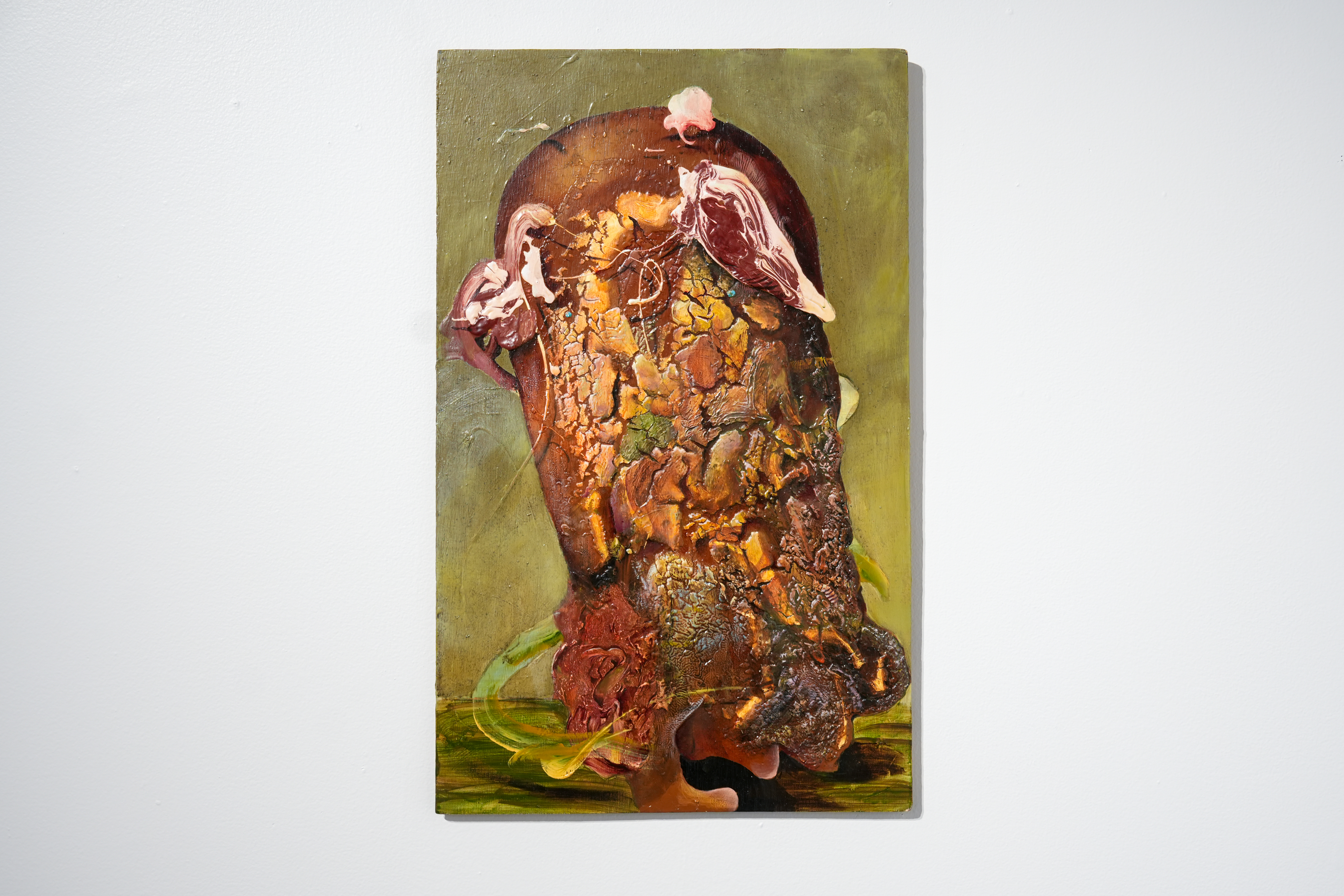 Lain Andrews, Golem I.
One of the exhibition’s strongest paintings, by Iain Andrews, Golem I depicts a bodily form caught somewhere between formation and collapse. Near the center of the composition, a shape resembling a hand briefly pushes through the surface before dissolving back into the surrounding paint. Thick layers of cracked pigment spread across the canvas in bruised reds, rusts, and heavy browns, giving the work a dense, almost overheated physicality. The muted green background creates an uneasy contrast against the warmer tones, making the entire surface feel slightly contaminated, almost chemical. Small areas of pale pink interrupt the darker mass like traces of something still soft beneath the hardened exterior.
The painting never fully settles into a recognizable image. At certain moments it resembles flesh, then landscape, then something almost geological. Looking at it feels strangely similar to watching an image struggle to render itself, where forms continuously emerge and disappear before the eye can fully settle. Andrews slows down recognition itself, allowing the work to hover in an unresolved state.
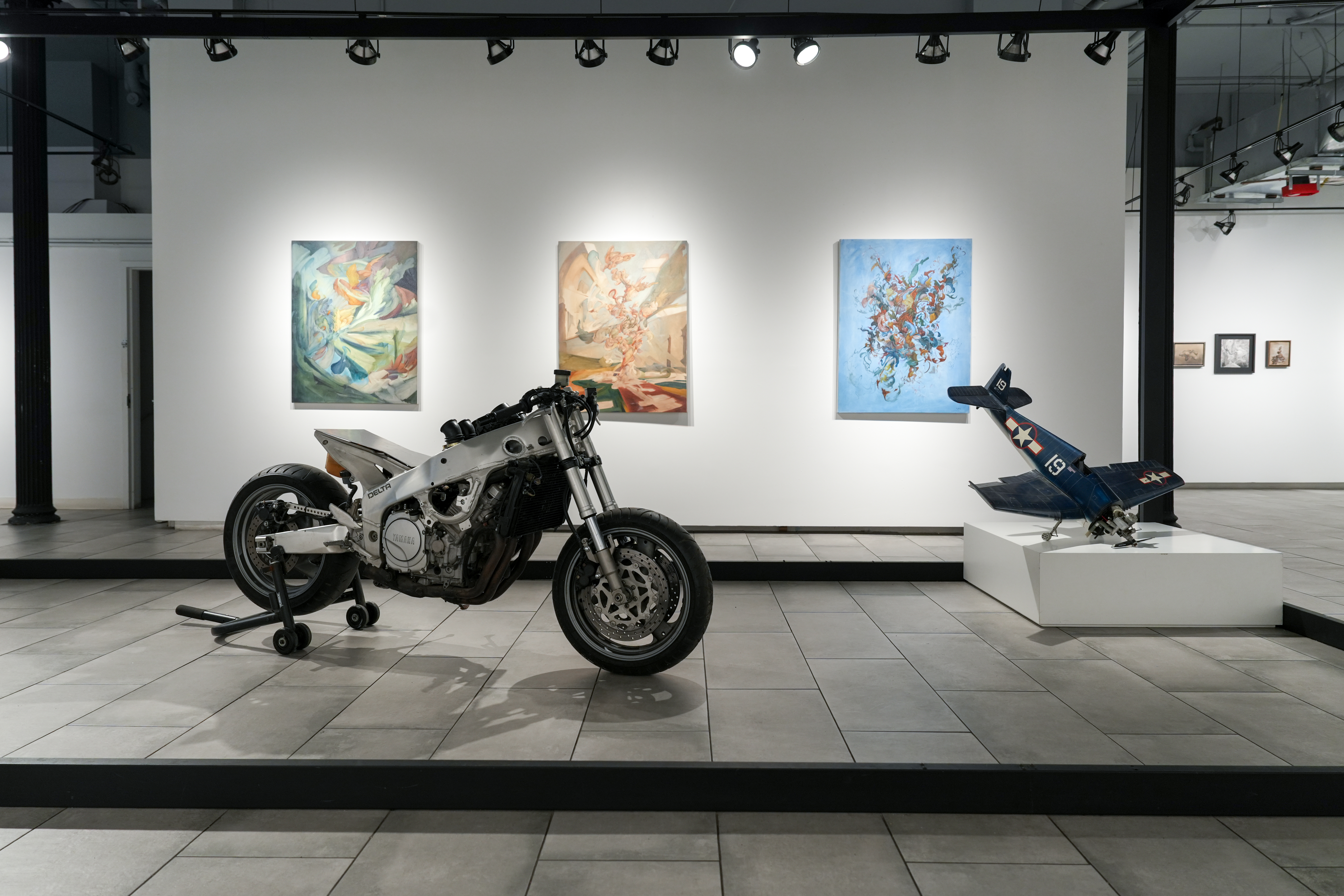 Kevin Draper, Dancing Planes and Delta (motocycle). Photo by Nadiya Papina. Courtesy of the artists and Mriya Gallery.
Kevin Draper’s sculptural aircraft introduces a different kind of surrealism into the exhibition. Unlike the painting works, its imagery is immediately recognizable: a silver military plane positioned almost ceremonially within the gallery. Yet the familiarity of the object quickly becomes unstable. Removed from its original function, the aircraft begins to feel strangely theatrical, suspended somewhere between weapon, toy, and cinematic prop.
The aluminum surface gives the aircraft a strange lightness. Its missiles and insignias remain intact, though at this scale they begin to resemble details from a toy model rather than an actual machine of war. Standing in the gallery, the sculpture felt caught somewhere between military technology and childhood fantasy, like the kind of object built from imagination before one fully understands what it represents. I kept thinking about Thomas Hirschhorn’s Fake it, fake it — till you make it (2023), and the strange way contemporary violence is often experienced first through simulation, spectacle, and constructed images before it registers as reality.
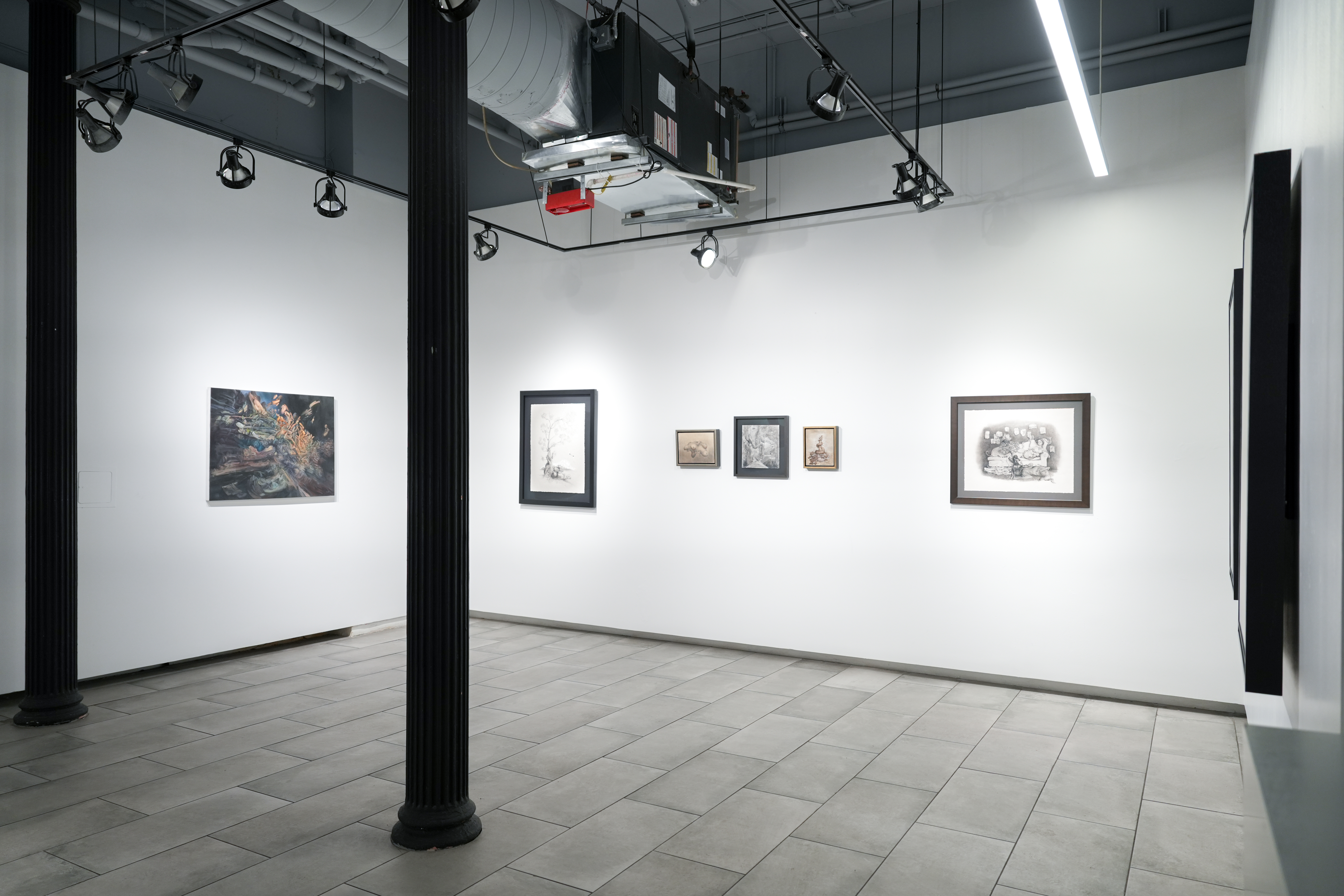 Installation view of Miguel Bonilla's work. Photo by Nadiya Papina. Courtesy of the artists and Mriya Gallery.
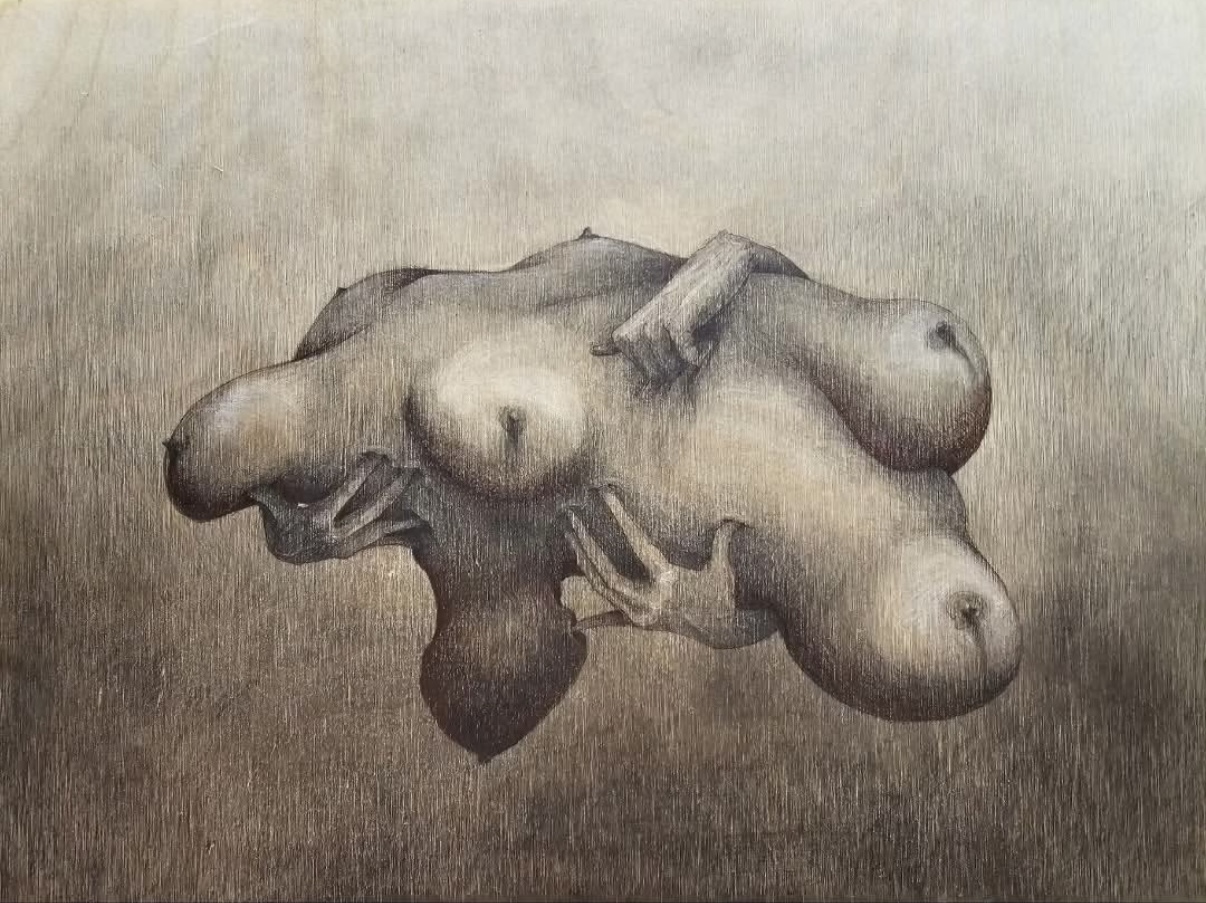 Miguel Bonilla, You Have to Understand.
Some of the exhibition’s quieter moments appear in Miguel Bonilla’s graphite drawings, which approach surrealism through subtle distortion rather than spectacle. In one work, tree branches twist into bodily forms, their surfaces interrupted by scattered eyes that seem to emerge naturally from the landscape. The drawing moves with the loose logic of a dream, where anatomy and environment quietly exchange roles without explanation.
Another drawing depicts a floating mass of flesh-like forms suspended against an empty background. Limbs partially emerge before folding back into the body, making it difficult to tell where one figure ends and another begins. Rendered in soft graphite tones, the work feels strangely delicate despite its unsettling imagery. Rather than dramatizing transformation, Bonilla allows it to unfold slowly, almost tenderly.
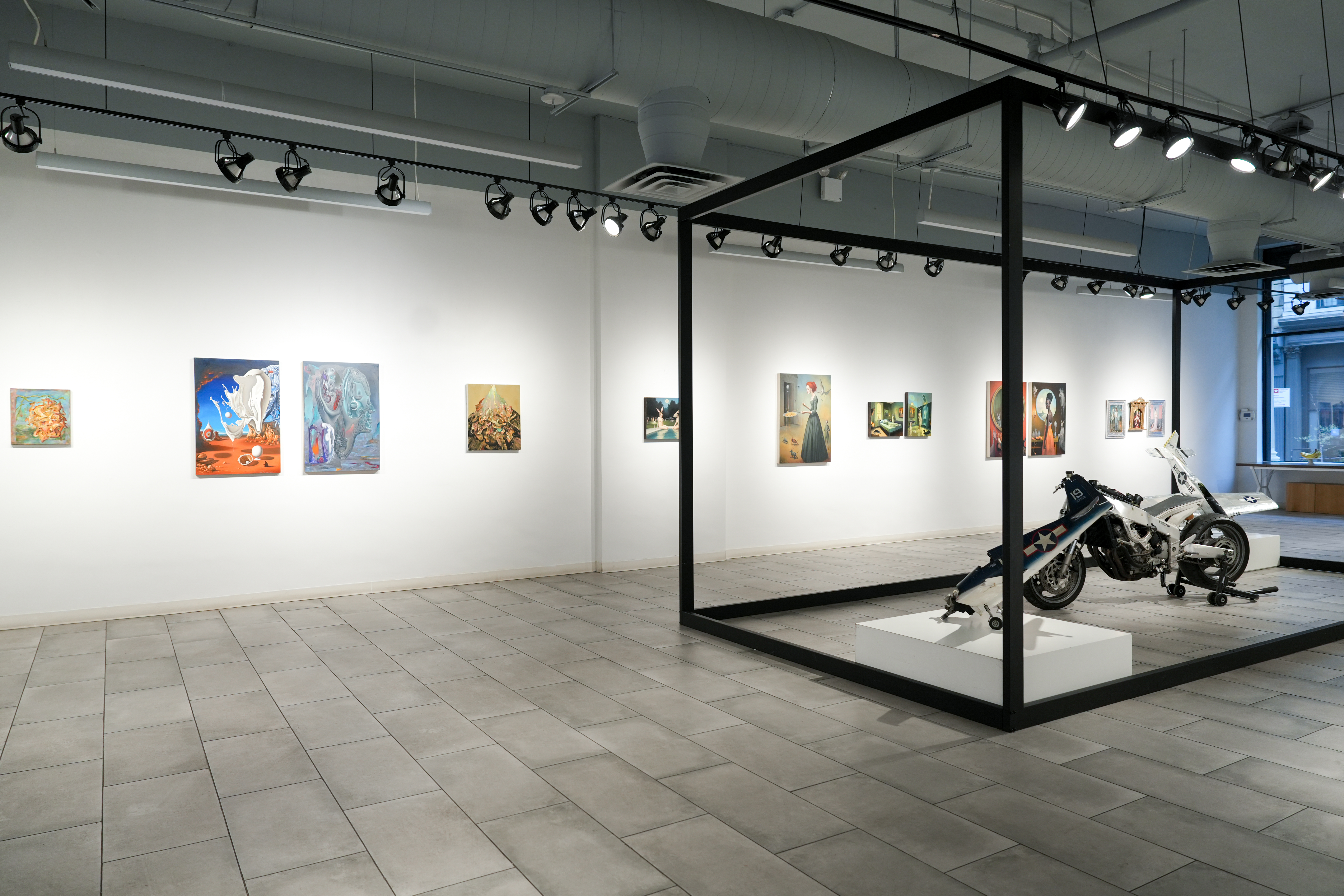 Installation view of APPLE FACE. Photo by Nadiya Papina. Courtesy of the artists and Mriya Gallery.
Other works in the exhibition deepen this atmosphere in quieter ways. Francesco Cipollone’s paintings move with a tidal momentum, where bodies, landscapes, and organic forms continuously fold into one another. Jacques de Beaufort brings a more mystical energy to the exhibition, drawing from surrealism, science fiction, and esoteric imagery to create scenes that feel suspended between hallucination and ritual. Meanwhile, Kevin Kuenster’s paintings introduce moments of dark absurdity, filling his strange psychological worlds with hybrid creatures, theatrical figures, and traces of humor that never fully soften the underlying sense of estrangement.
APPLE FACE never fully resolves into a single mood or interpretation. Some works feel intimate, others grotesque, melancholic, or strangely funny. Together, they suggest that surrealism was never simply about dreams or fantasy. It was always about the instability hidden beneath ordinary life. Looking at these works now, that instability no longer feels distant. It feels familiar.

Serena Hanzhi Wang
Serena Hanzhi Wang (b. 2000) is an award-winning art proposal writer, multimedia artist, and curator based in New York City. Her work spans essays, exhibitions, and installation Art—often orbiting themes of desire and technological subjectivity. She studied at the School of Visual Arts’ Visual & Critical Studies Department under the mentorship of philosophers and art historians. Her work has appeared in Whitehot Magazine, Cultbytes, SICKY Mag, Aint–Bad, Artron, Art.China, Millennium Film Workshop, Accent Sisters, MAFF.tv, and others.
view all articles from this author