Whitehot Magazine
October 2026
"The Best Art In The World"
"The Best Art In The World"
October 2026
Sara Anstis: Pastels at Olney Gleason
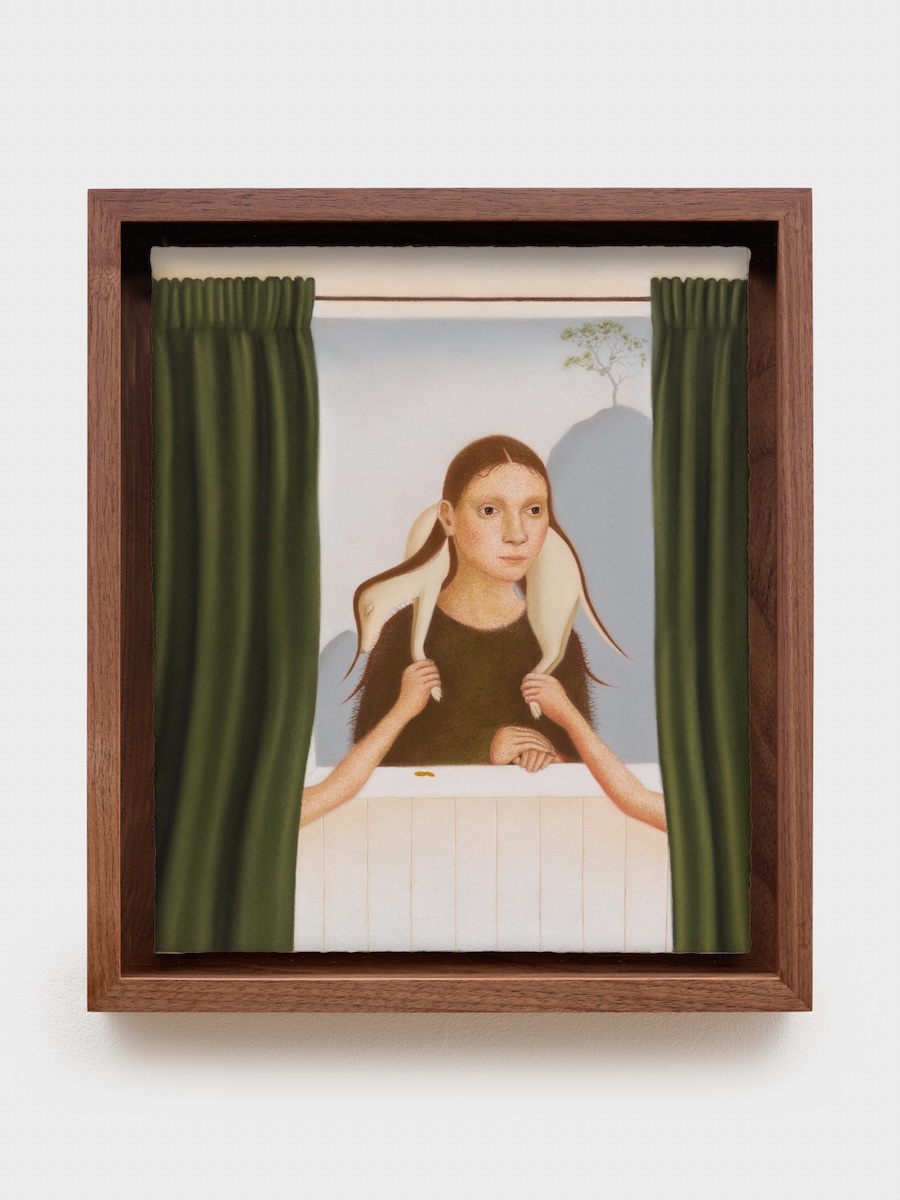 Sara Anstis, The Milkman, 2026, pastel on paper, courtesy of Olney Gleason
By ESME GRAHAM, October 15, 2026
Pastels, Sara Anstis' enigmatic exhibition at Olney Gleason in New York, showcases twenty-eight small pastel drawings rife with art historical references. The images have bodily contortion pulled from medieval illuminated manuscripts, echoes of Flemish and Italian Renaissance landscapes and portraiture, and the dreamlike tableaus of Surrealism. The Milkman, for example, evokes Leonardo Da Vinci’s Lady with an Ermine. In it, a woman sits in front of a window, resting her hands atop the sill. Beyond the window is a hazy mountain topped with a single tree. Two sets of arms reach from behind a curtain and wrap a slender white mammalian creature around the woman’s neck. The animal, like in Da Vinci’s image, acts as an adornment. However, it is not an inanimate fur pelt, nor is it being treated like a live animal, rather its function hovers in some interstitial space. Further disquieting is the realization that the viewer is on the same side of the windowsill as the curtains; the woman is thus outside the window, gazing placidly in.
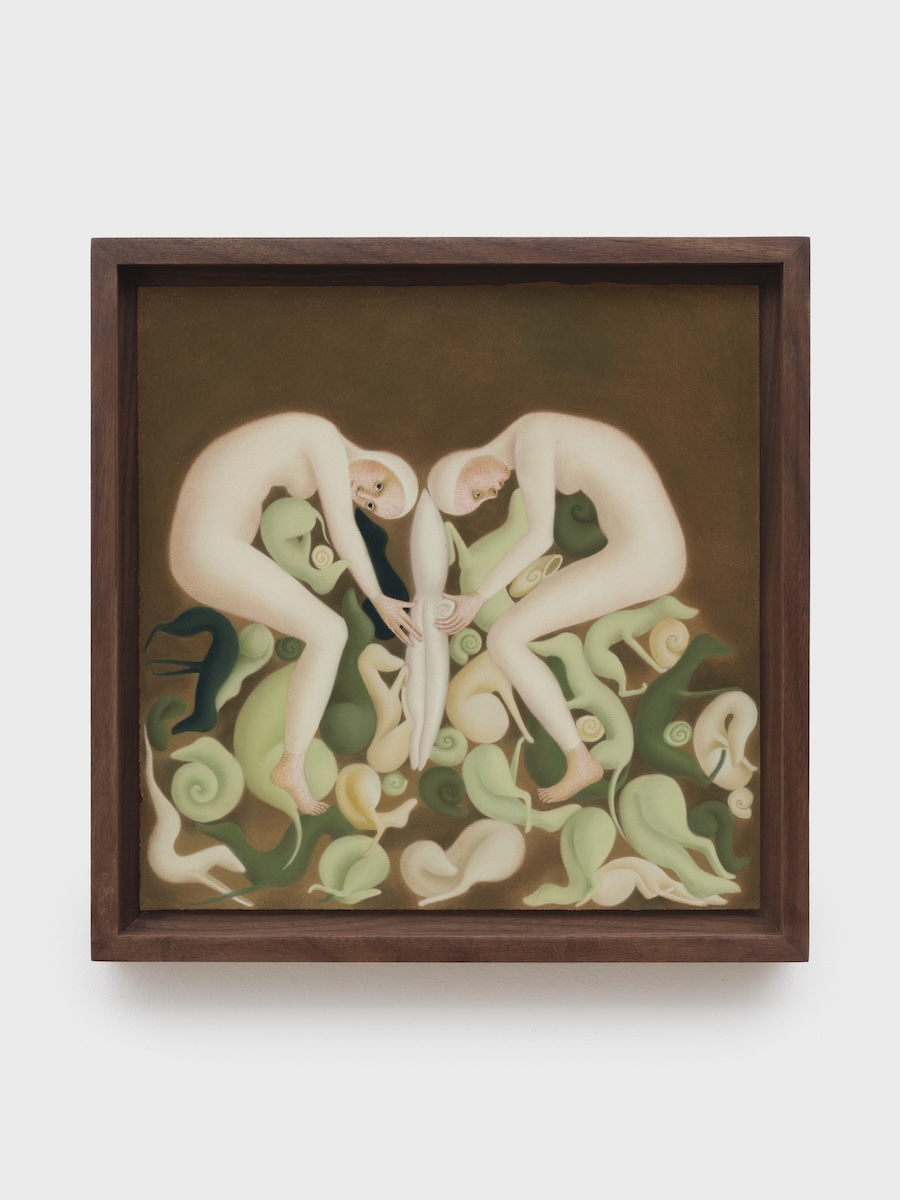 Sara Anstis, The Botanists, 2026, pastel on paper, courtesy of Olney Gleason
In Death Bed, one of the most striking images in the exhibition, Anstis again subverts oft-depicted art historical subject matter. It depicts three women: the central figure, wearing a white cloak, is embraced by a nude woman who curves her head down deferentially. The cloaked woman holds the head of a third figure, loosely wrapped in blue fabric, who lies on a table before them. Because of Anstis' use of pastel, the skin of all the women is slightly grainy, as if half-remembered or seen through static. This grouping is perhaps an all-female reworking of the Catholic trinity: the cloaked figure as the Father, holds her Son, with the Holy Spirit at her shoulder. This interpretation is complicated by the fact that the “Son” is clothed in the same blue as typically clothes the Virgin Mary, thus connecting her to this image. In this interpretation, we are reminded that Mary, defined as the mother of Christ, was herself a human child first.
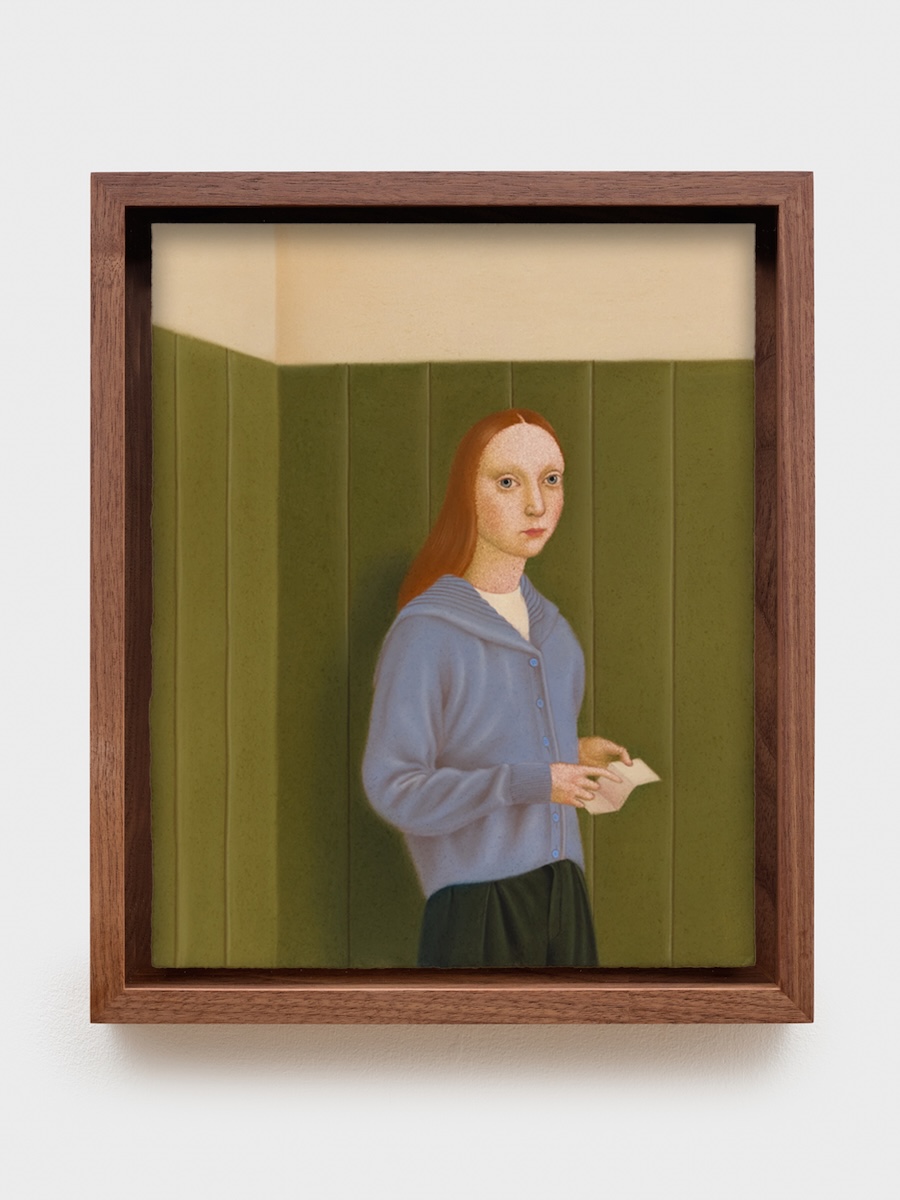 Sara Anstis, The Note, 2026, pastel on paper, courtesy of Olney Gleason
Throughout the exhibition, Anstis alludes winkingly to art historical precedent, pairing her subjects with snail-like creatures reminiscent of medieval marginalia or placing them in front of the thin trees of Raphael. Despite this, she incorporates emblems of modernity throughout—a sleeping bag, a tent, an umbrella—that jolt the images out of their historical precedents. Indeed, in The Note, a red-haired woman stands in front of a wood-paneled wall, wearing a buttoned blue cardigan. She holds a piece of paper folded so that no text is discernable. Equally opaque is her expression; she looks back at the viewer with large eyes set far apart like those of a deer. While Anstis includes modern objects, nothing grounds the compositions in any exact time or place. The result is a series of images out of time, familiar yet removed from our reality. Despite her sustained engagement with tradition, in Pastels Anstis has captured a contemporary ennui. In this exhibition, there is a dueling sense of intimacy and remove: we see the women’s private moments but are denied insight into their interiority.
Sara Anstis
Pastels
September 10–October 24, 2026

Esme Graham
Esme Graham is a writer and critic based in New York. She began writing while receiving her master's degree in art history from the University of Chicago. Her specific focus is on modern and contemporary art.
view all articles from this author