Whitehot Magazine
November 2026
"The Best Art In The World"
"The Best Art In The World"
November 2026
Sam Anderson: Heartbreak Bar at Derosia
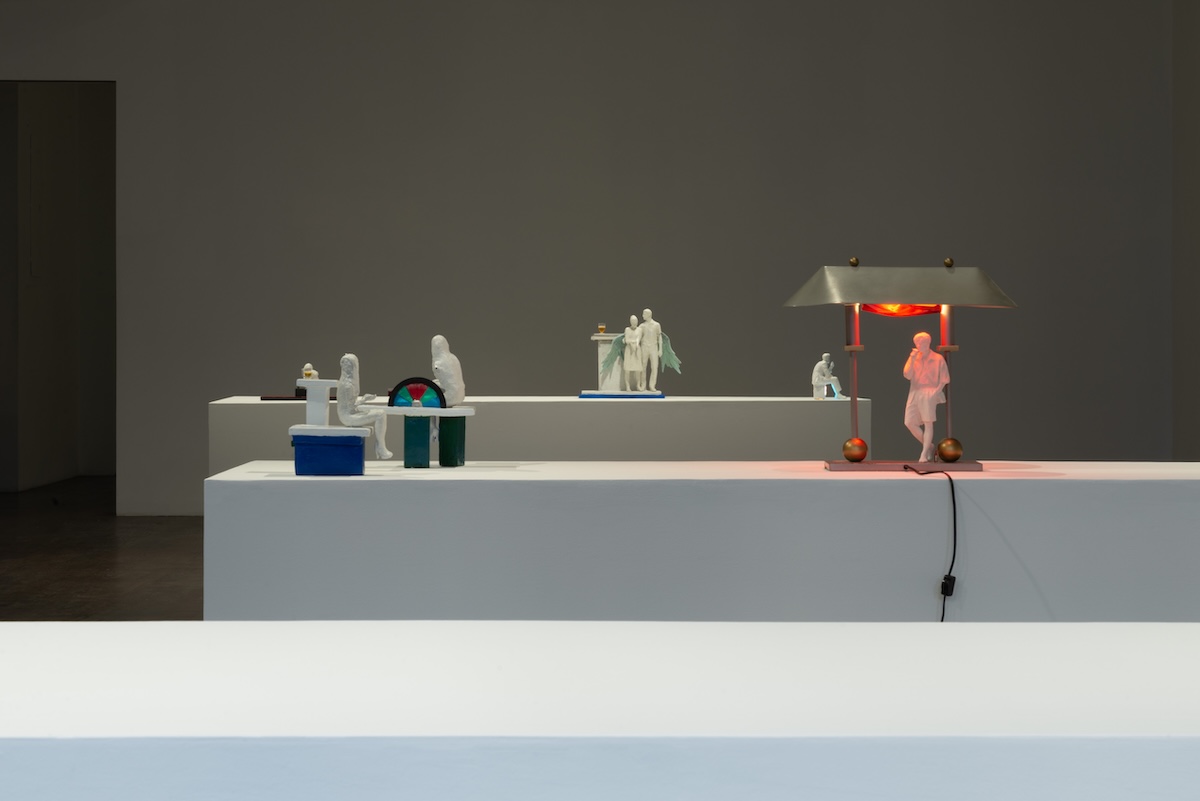 Image courtesy of the artist and Derosia, NYC
By ESME GRAHAM, November 6, 2026
Visiting Heartbreak Bar—Sam Anderson’s solo exhibition at Derosia—in the evening feels like an immersive experience. The second-floor gallery peers out onto Grand Street, and the noises of rush-hour traffic and after-work chatter outside can be heard over the dim buzzing of the lights inside. This ambience contributes to the feeling that the visitor has been transported into a bar that, long-forgotten, has simply continued operating. In the main gallery, three long pedestals stretch across the room, displaying small scenes rendered in plaster, wood, resin, acrylic, and other materials. The mysterious—potentially ominous—bright green drinks, soft red and blue lighting, and painted bars contrast the monochrome human figures, which, made from plaster, are all ghostly white. Indeed, like apparitions, they seem tethered to their designated spaces, destined to lurk behind bars or sit at lonely tables. The word "haunt" takes on a double meaning in Heartbreak Bar, as the gallery transforms into an oft-frequented locale populated by spectral figures.
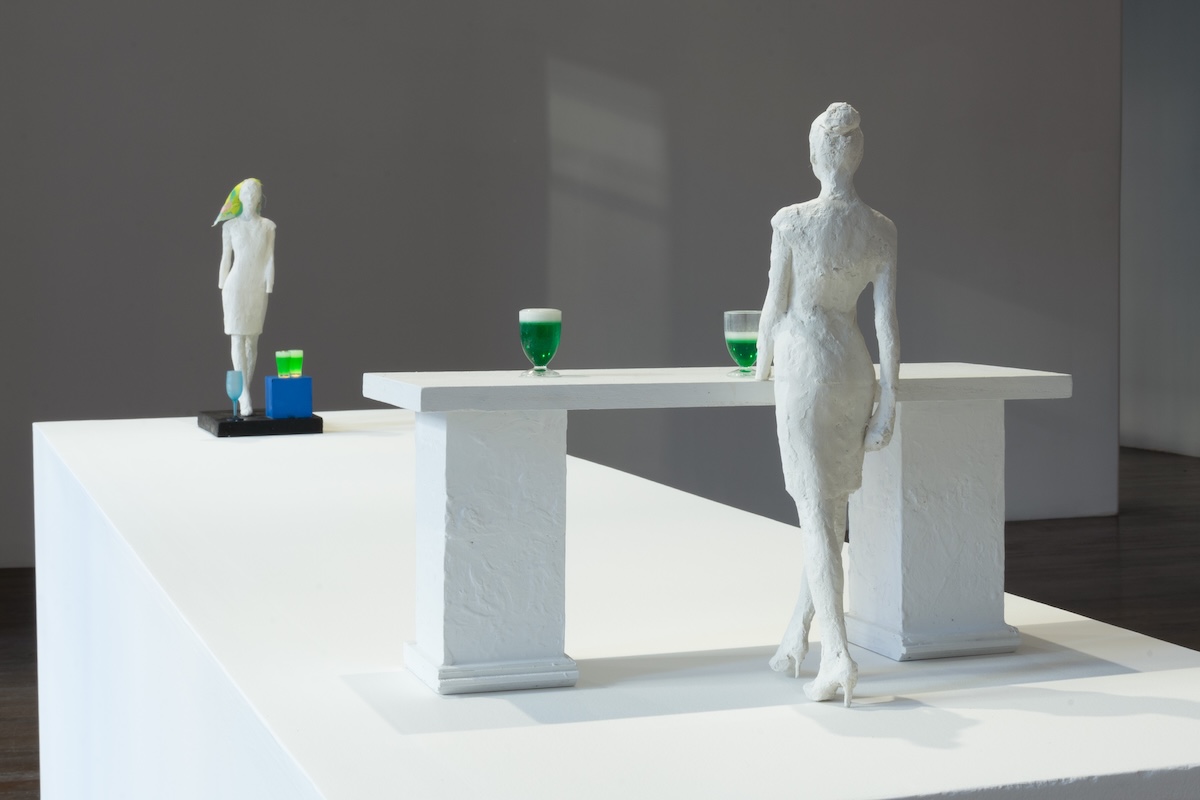 Image courtesy of the artist and Derosia, NYC
Anderson’s figures are simultaneously vague and specific. Their facial features and plaster bodies are blurred, but their psychic conditions are clear. In Heartbreak Bar and Michele Outside, female figures squat by low tables. Despite their similar postures, the subtlety of Anderson’s sculpting reveals profoundly different psychological states. In Heartbreak Bar, the woman’s head is slumped between her outstretched arms. She stares limply into her lap, isolating herself from any potential interaction. In Michele Outside, on the other hand, the woman takes a long drag from her cigarette, conveying resignation rather than despair. It is through these subtleties that characters and narratives begin to emerge. While the condition of heartbreak may be universal in Anderson’s exhibition, she deftly captures its myriad manifestations.
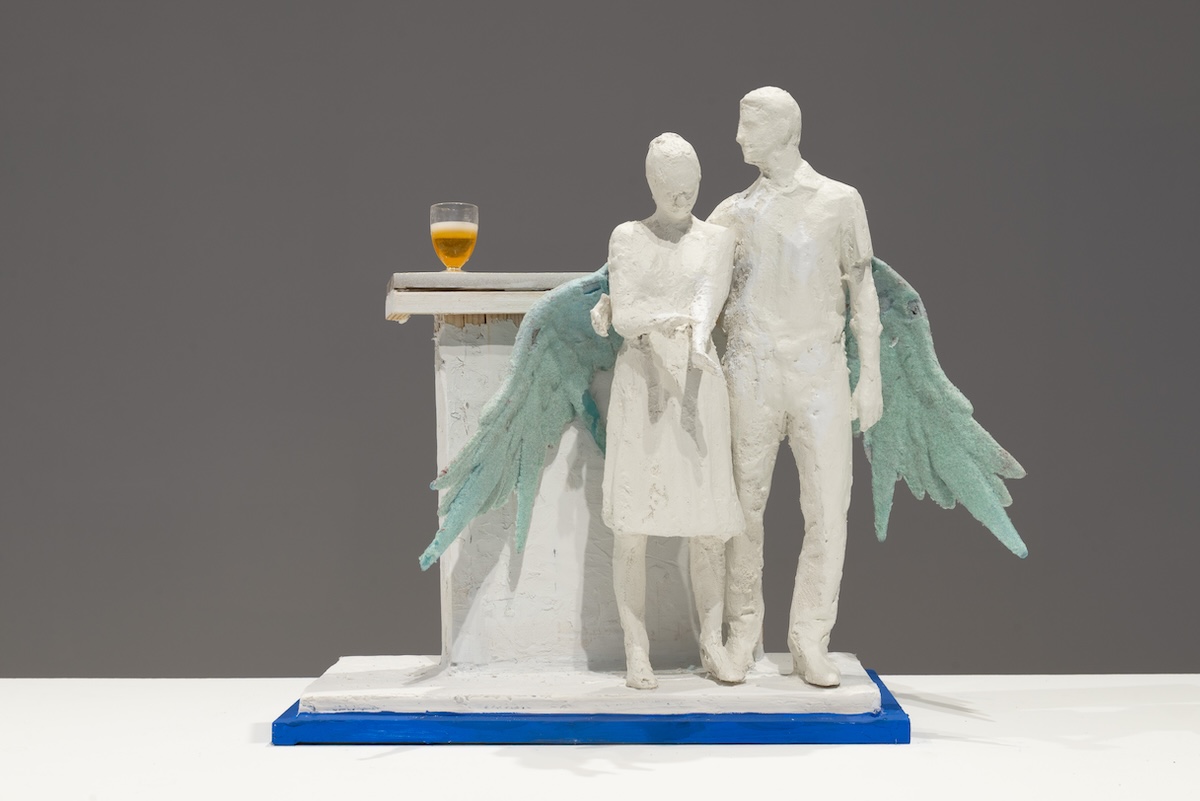 Image courtesy of the artist and Derosia, NYC
Angel of Loneliness is the only instance in which people appear together. In this sculpture, a man wraps his arm around the woman beside him, while a pair of angel wings coated in light blue-green foam encircles them. Standing directly behind the pair, it is revealed that a wing is affixed to each of their backs, uniting them in a wide, feathered embrace. In this bar full of ghosts—perhaps a purgatory—it seems the only way to escape this aimless wandering is through companionship. While the wings promise a transcendence of their lonely environment, the figures, though angelic, are not completely enlightened. Indeed, the man casts a backwards glance at his half-drunk beer resting on the table, suggesting that perhaps there is still comfort to be found in these human vices.
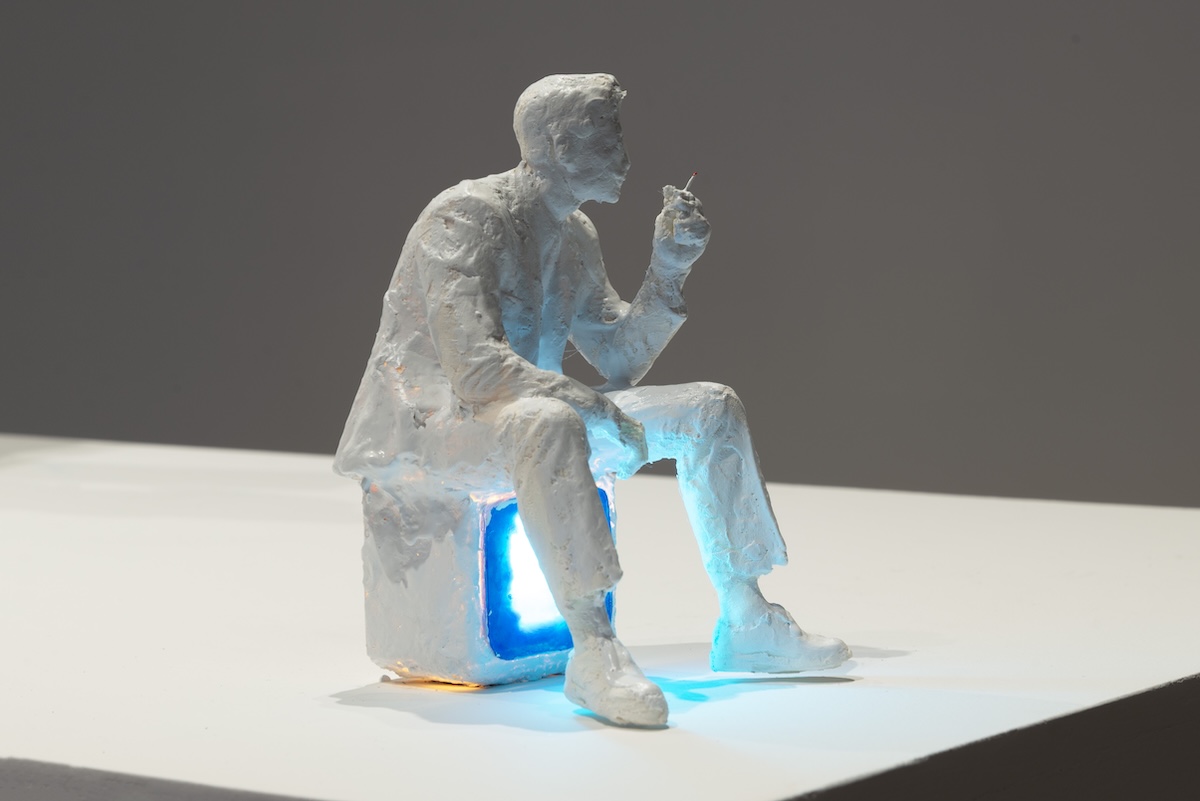 Image courtesy of the artist and Derosia, NYC
Anderson’s exhibition transports the visitor backwards in time: In Miss Lonelyhearts (named for Nathanael West’s novella), a suited man sits on a television whose screen emits glowing blue light. The title’s reference to Depression-era literature, paired with the vintage suit and the cathode ray tube television, places him, alongside his drinking companions, in a bygone era. Even the location of the bar as a destination for solitude seems retro. In the contemporary moment in which loneliness manifests as complete social isolation, Anderson’s exhibition depicts a time in which even when we were alone, we were alone together.
Sam Anderson
Heartbreak Bar
October 16–November 28, 2026

Esme Graham
Esme Graham is a writer and critic based in New York. She began writing while receiving her master's degree in art history from the University of Chicago. Her specific focus is on modern and contemporary art.
view all articles from this author