Whitehot Magazine
August 2026
"The Best Art In The World"
"The Best Art In The World"
August 2026
Alterity and animality in "Cavalas": a performance by Alana Falcão and Ana Brandão - Dance - Brazil
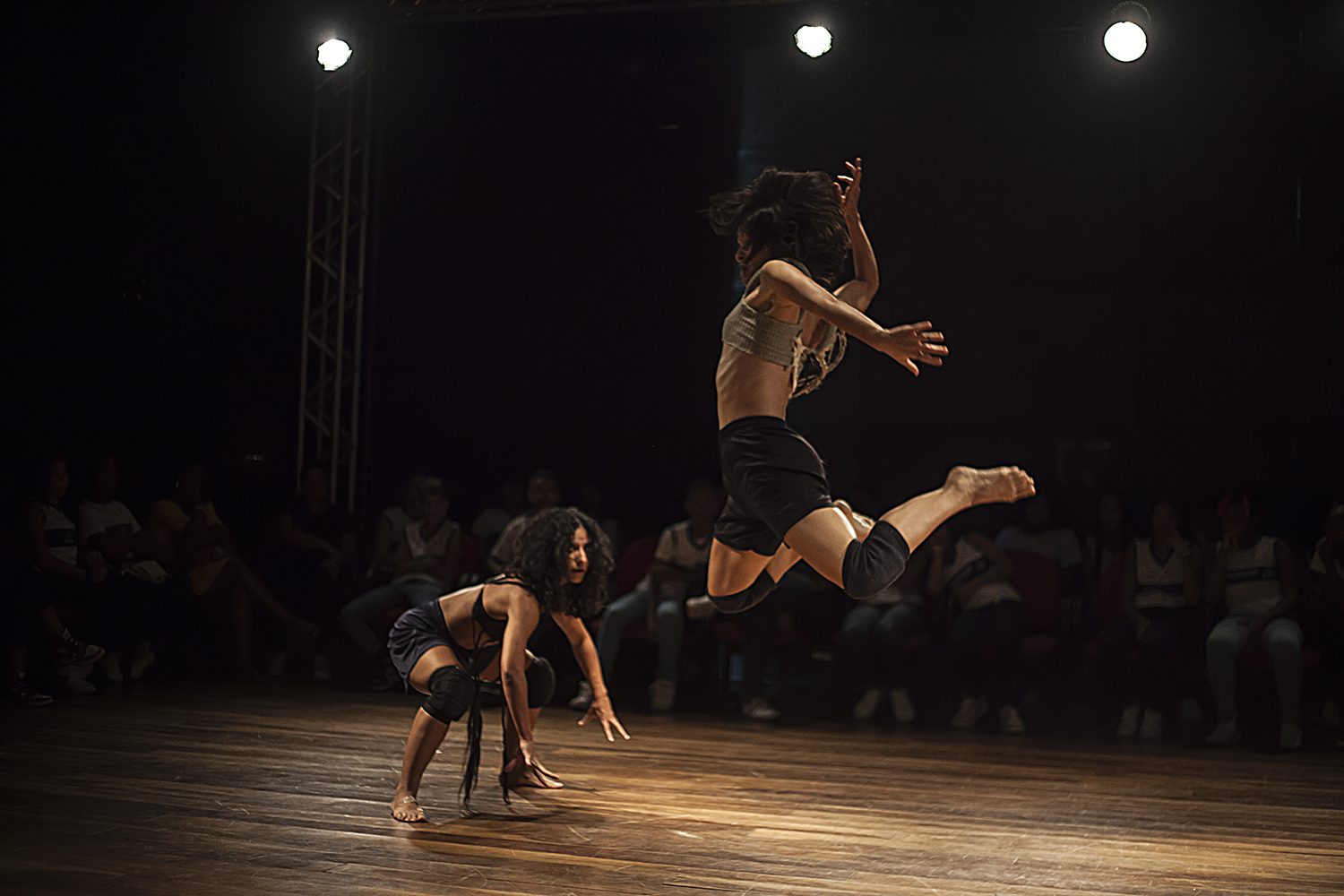
Alana Falcão and Ana Brandão in Cavalas, Salvador, 2023. Photo: Cristiane Fernandes.
By Flávio Rocha de Deus December 29th, 2025
There are performances that not only move us but also expand our sensibility to think new ideas about old ones. For me, Cavalas, a piece conceived and performed by the Brazilian dancers Ana Brandão and Alana Falcão, is one of them. It is a work of extensive touring across the national territory, which I saw at the Sala do Coro of TCA in Salvador in October 2024 and which was recently presented at the 28th International Dance Festival of Recife (October 2025). Through movement, it thinks, reacts, and confronts the contemporary urgencies and agencies that shape how our era thinks and acts upon fundamental issues such as animality, tension, sensibility, violence, and life.
Yuldashev, a little-known and rarely remembered philosopher, in his contribution to Foundations of Aesthetics (1978), conceived dance as “bodily intonation accessible to visual perception.” For him, “the object of representation in dance is life and human feelings translated into gestures, poses, and movements.” In other words, what music achieves through “sonorous intonations,” dance achieves through the body’s “plastic intonations.” Thus, dance imposes a human order on movement, transforming it into style and configuring it as language.
In this universe where dancers land meaning through the physical rhythm of their bodies, Cavalas celebrates precisely that power. Through movement, the performers compel the audience to confront perceptions of human experience that also reflect the critical interior of the artists themselves, whether regarding the humanity within our animality or the common animality underlying our social arrangements.
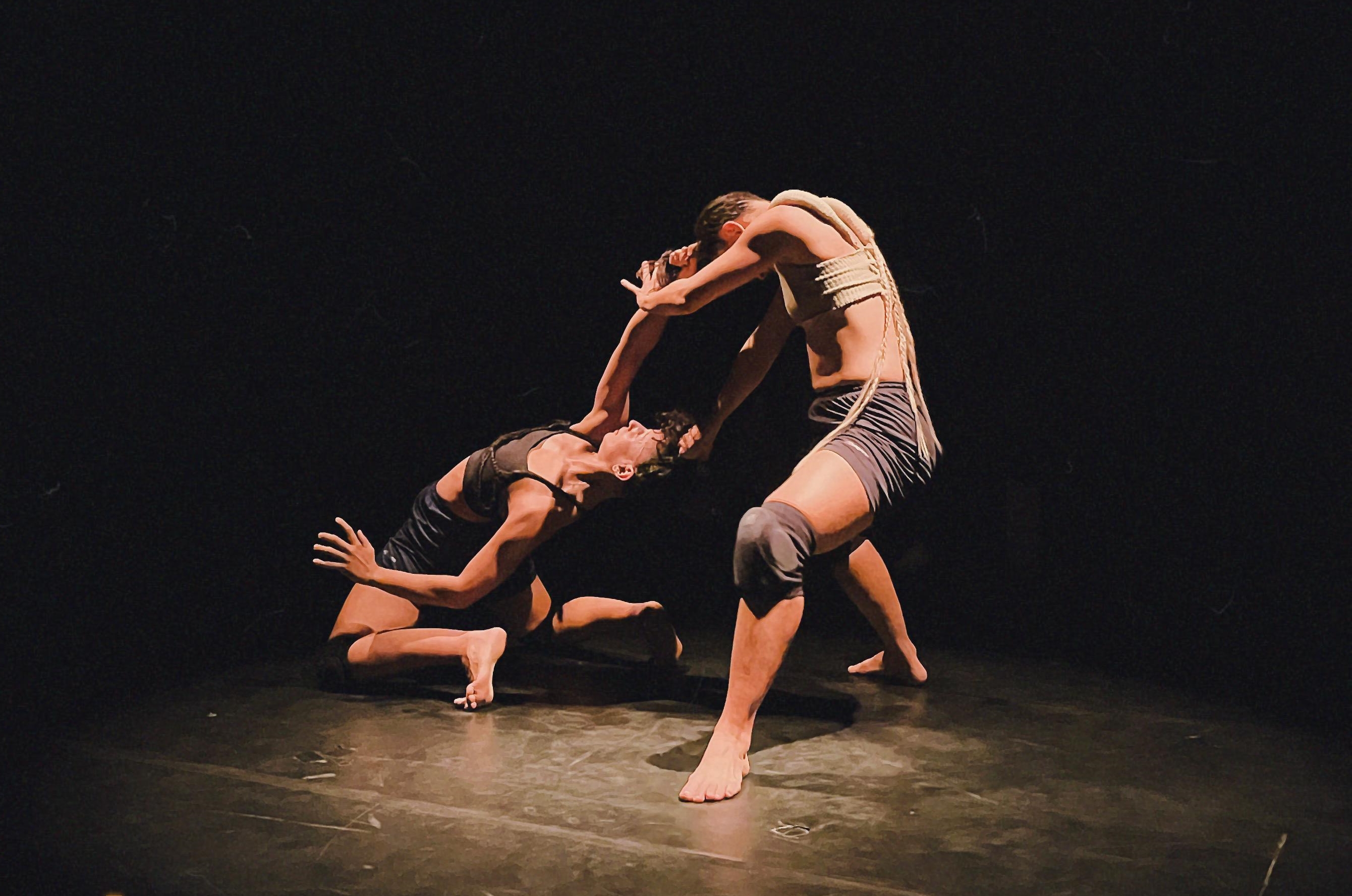
Cavalas by Alana Falcão and Ana Brandão, 28th International Dance Festival of Recife, 2025.
Theatre Hermilo Borba Filho, Recife, Pernambuco, Brazil. Photo: Yaya Cavendish.
Premiered in October 2023 at Junta – International Dance Festival in the city of Teresina, Cavalas has since toured several regions of Brazil, including São Paulo, Pernambuco, Ceará, Paraná, and Bahia. The performance weaves, with remarkable sophistication, a choreography of dichotomies that dissolve into one another. On stage, the dancers oscillate between the disciplined and the untamed, the mythical and the human, the animal and the civic, terror and beauty, evoking images that shift between simulations of a mare’s trot and visual metaphors of female experience.
Even within a contemporary spectrum where communication, clarity, and conceptual coherence seem to have been abandoned by many of today’s performance artists, Cavalas honors the purpose of its art. Without any reductive didacticism, it constructs a piece in which the movements of the performers’ bodies unmistakably express the human meanings they seek to evoke. Through the rhythm of their intertwined bodies, Falcão and Brandão animate sensations that communicate narratives such as: the rupture of circular cadences in search of new paths; the discovery of a solidary unity in an “other” who recognizes herself; the conflict of walking alongside an equal who is nonetheless different; the preservation of a singular identity that resists both the process of self-discovery and the recognition of the other. In this performance, even the visible outline of the dancers’ spines beneath their skin seems to convey meaning.
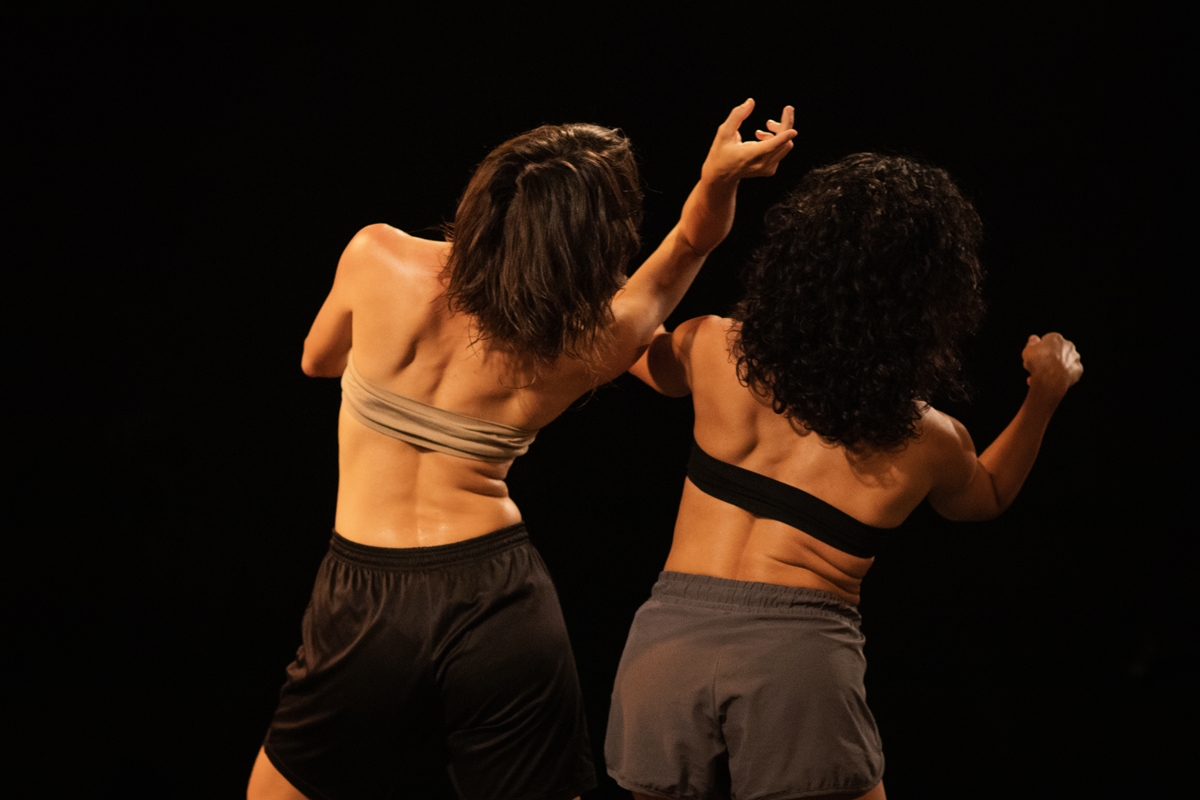
Alana Falcão and Ana Brandão in Cavalas, 2023. Photo: Lucas Mello Nogueira.
In one of the choreography’s moments, Ana and Alana move in circles, panting like animals about to take flight. Their tense, damp bodies strike the floor with force, and the sound of their steps echoes like heartbeats. At one point, one of them falls, and the other hesitates between the impulse to flee and the gesture of care. A minimal yet symbolic, powerful, and meaningful choreography, where the struggle between solidarity and survival becomes visible. The dim lighting and audible breathing turn the scene into a territory of vulnerability and potency, where animality ceases to be metaphor and becomes presence.
According to the dancers, the short story “Things We Lost in the Fire”, by Argentine writer Mariana Enriquez, was a major inspiration for the creation of the performance. In this story, Enriquez recounts the tale of women who were set on fire by their partners and who, beyond carrying the marks of the flames, face the brutal indifference of the surrounding society, one that not only ignores their denunciations but easily welcomes the supposed innocence of the aggressors. The discomfort and horror of the story are constructed both through the vivid images of burned bodies and the systematic apathy of those who refuse to understand what such wounds reveal.
Within this narrative, where the true terror lies in the impotence before an inescapable fate, emerge the “Burning Women”, a group that decides, by their own will, to throw themselves into the fire for a few seconds. As Brazilian literary scholars Maria Albuquerque and Isis Irineu explain in their article “Basta de nos queimar!” (Revista Abusões, 2023), throwing themselves into the fire becomes, for these women, a strategy of survival and resistance, since the burns and deformities prevent further violence, including sexual assault. The expressions “burned monster” and “crazy Argentine women,” initially used to disqualify them, are thus re-signified by the victims themselves, who transform them into symbols of strength and autonomy.
Both the dancers and the women in Enriquez’s story engage in symbolic processes of self-sufficiency through the appropriation of animality and monstrosity. Just as the women of the story reclaim their bodies by embracing the monstrosity that external contexts have inflicted upon them, in Cavalas, Alana and Ana embrace the animality of a recurrently pejorative term, “a cavala” (Portuguese slang for a “mare-like” or “brutish” woman), and transform it, through the synchronized movement of their bodies, into a source of strength, beauty, and inspiration.
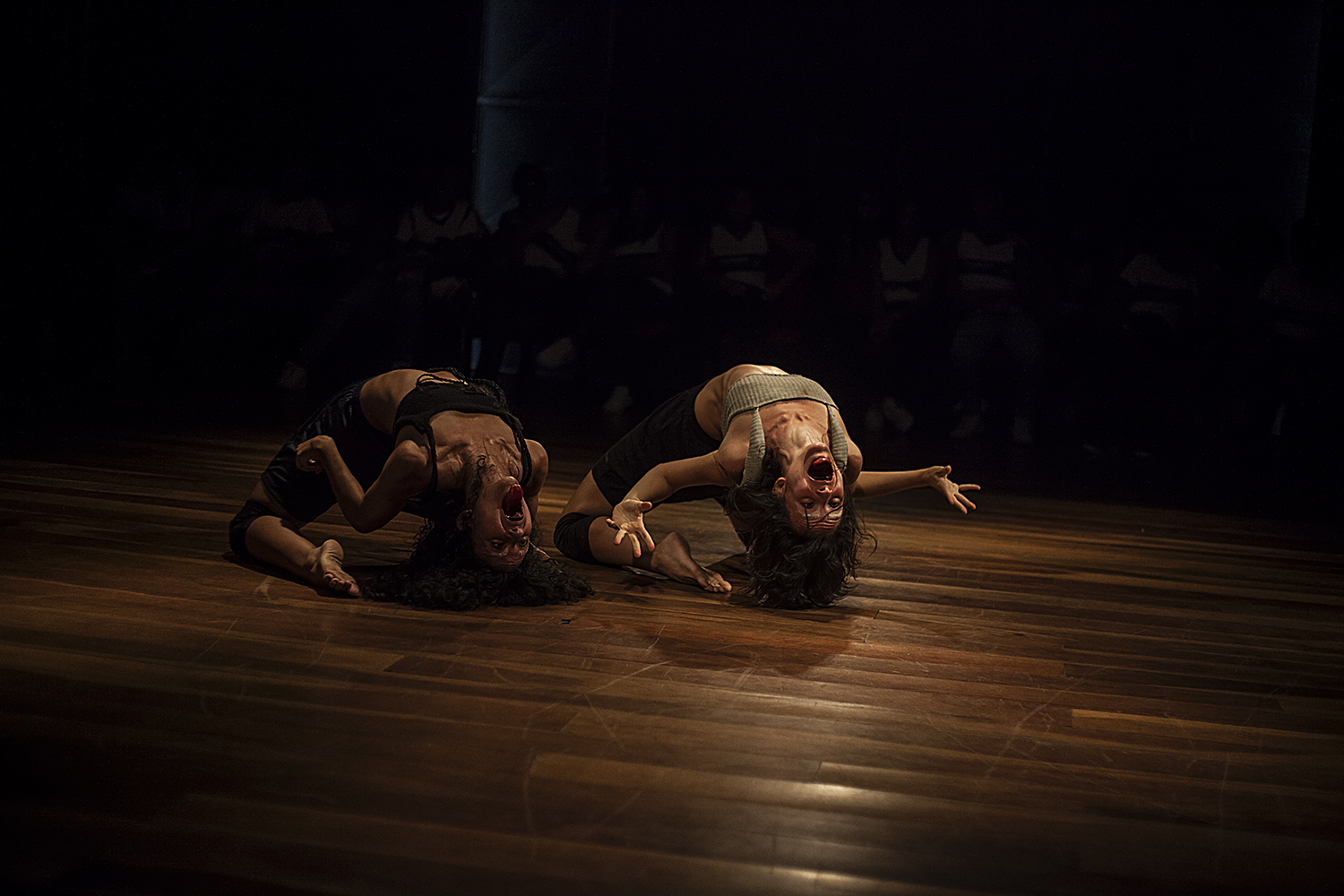
Alana Falcão and Ana Brandão in Cavalas, Salvador, 2023. Photo: Cristiane Fernandes.
As we can see through the conceptual definitions of Martha Nussbaum in Not for Profit (2010) and Cláudio Zanini in his entry “Monster” in the Digital Dictionary of the Fictional Uncanny, there is an ontological equivalence between these identifications: the monster and the animal. Both animality and monstrosity operate as symbolic mechanisms of dehumanization. By attributing to certain bodies, women, Black people, Indigenous peoples, traits deemed animalistic or monstrous, Western culture consolidates hierarchies that define who fully belongs to humanity and who inhabits its edges. The figure of the “Other” is born from this gesture: the deviation necessary for the norm to recognize itself as center.
In this context, though in different yet convergent ways, animality and monstrosity are mechanisms that construct the figure of the “Other”, an identity projected onto certain groups to keep them at the margins of the dominant norm. But in both Enriquez’s story and Falcão and Brandão’s performance, monstrosity is not an end, it is a beginning. In Cavalas and in Things We Lost in the Fire, animality and monstrosity become catalysts of empathy and transformation. By challenging traditional standards of beauty and embracing what has been labeled grotesque, both the dancers and Enriquez’s characters invite the audience to revisit their own prejudices about the feminine and about the body that embodies it.
It is no exaggeration to say that Cavalas creates a rare space of collective reflection, aesthetic excellence, and communicability through dance. Here, the dancers’ bodies are not merely expressive, they are territories, open fields for exploring pain and resistance, trauma and affection. A silent theater where violence and forgiveness, piercing pain and the infinite capacity for care, coexist.
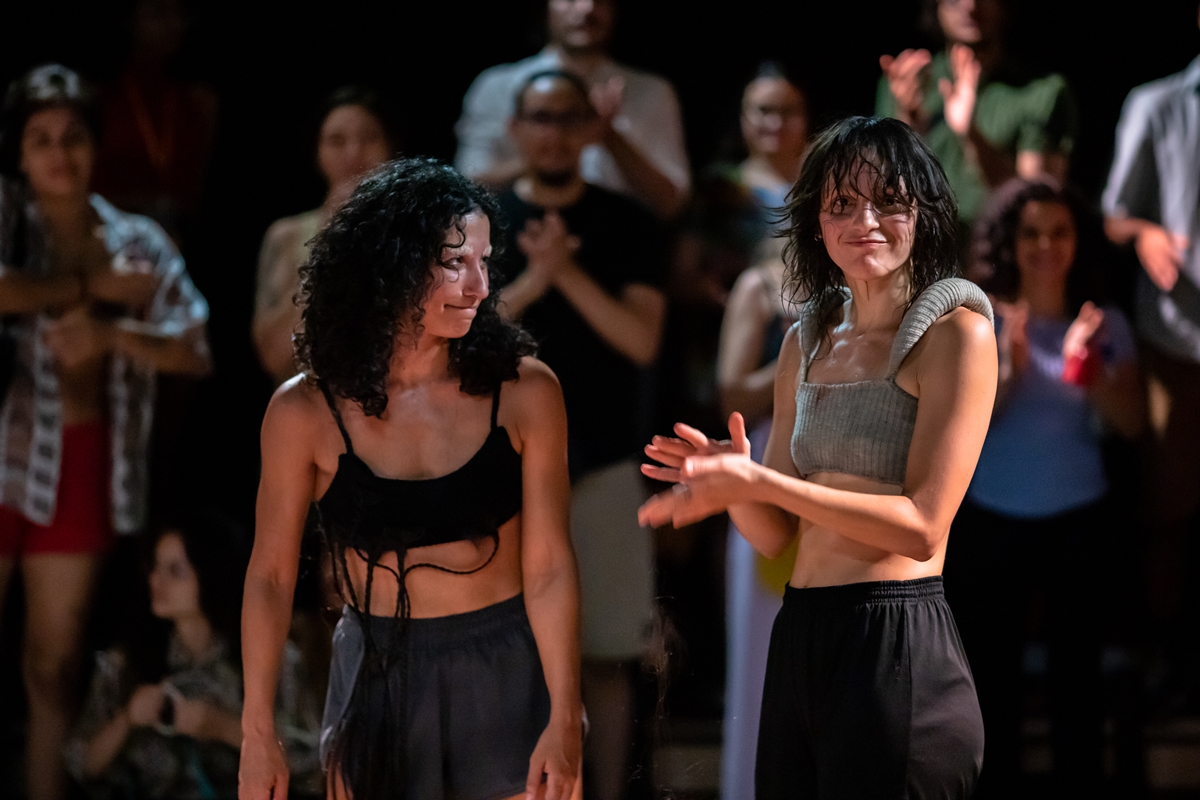
Alana Falcão and Ana Brandão at JUNTA – International Festival of Dance and Contemporaneity, Teresina, 2023. Photo: Caio Silva.
Cavalas - Dance Performance (2023-Present)
Direction, conception and dance: Alana Falcão and Ana Brandão
Dramaturgy: Lais Machado
Lighting design: Diego Gonçalves
Scenography: Bernardo de Oliveira
Costume design: Marlan Cotrim
Sound design: Paulo Pitta
Flávio Rocha de Deus
Flávio Rocha de Deus is a Brazilian philosopher, professor, and art critic. He holds a Master’s degree in Contemporary Philosophy and is currently a Ph.D. candidate in Aesthetics and Philosophy of Art at the Federal University of Ouro Preto (Brazil). Member of the Brazilian Association of Art Critics, he is also the author of the acronym fradde.art; writes essays and art criticism for national and international platforms and publications.
view all articles from this author