Whitehot Magazine
October 2026
"The Best Art In The World"
"The Best Art In The World"
October 2026
Illwoo Yunseo Park at the Asian & American Art Foundation in Chelsea
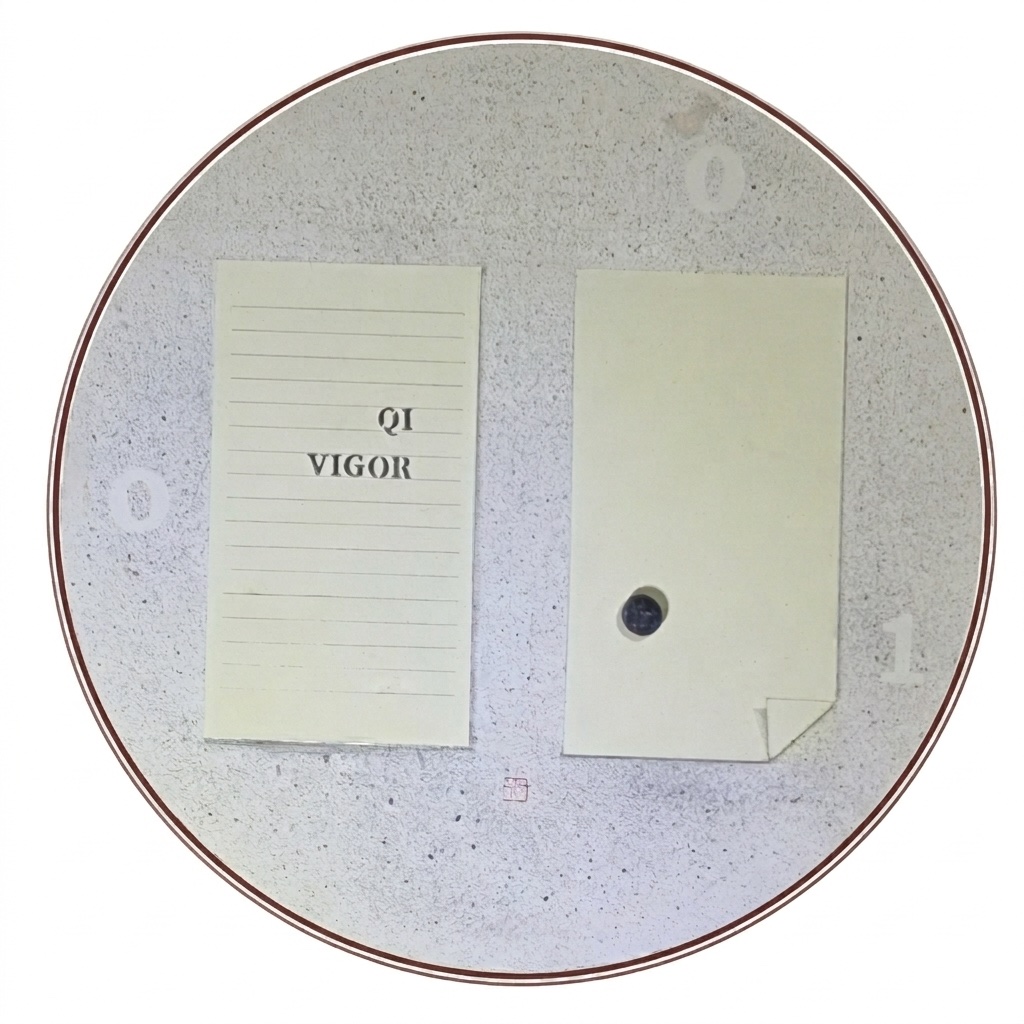
Jin Gong Myo Yu series, ink on Hanji paper, acrylic on canvas, 15¾ inches in diameter.
By RICHARD VINE July 10th, 2026
Comprising some 30 works from 2025-26, Jin-Gong-Myo-Yu: True Emptiness, Wondrous Presence evinced veteran Korean artist Illwoo Yunseo Park’s mastery of a technique—trompe-l’oeil painting—rarely practiced in his native land. Among a handful of precedents are the “waterdrop” paintings of Kim Tschang-yeul (1929-2021) and the deceptively 3D “pipes” of the Nucleus series by Lee Seung-Jio (1941-1990), but there is no Korean school of sheer illusionism comparable to those that flourished in 17th-century Holland and later in France and the United States. The reason for this difference lies in the cultural incongruity between the visual literalism of Park’s method and the spiritualism that his show title invokes.
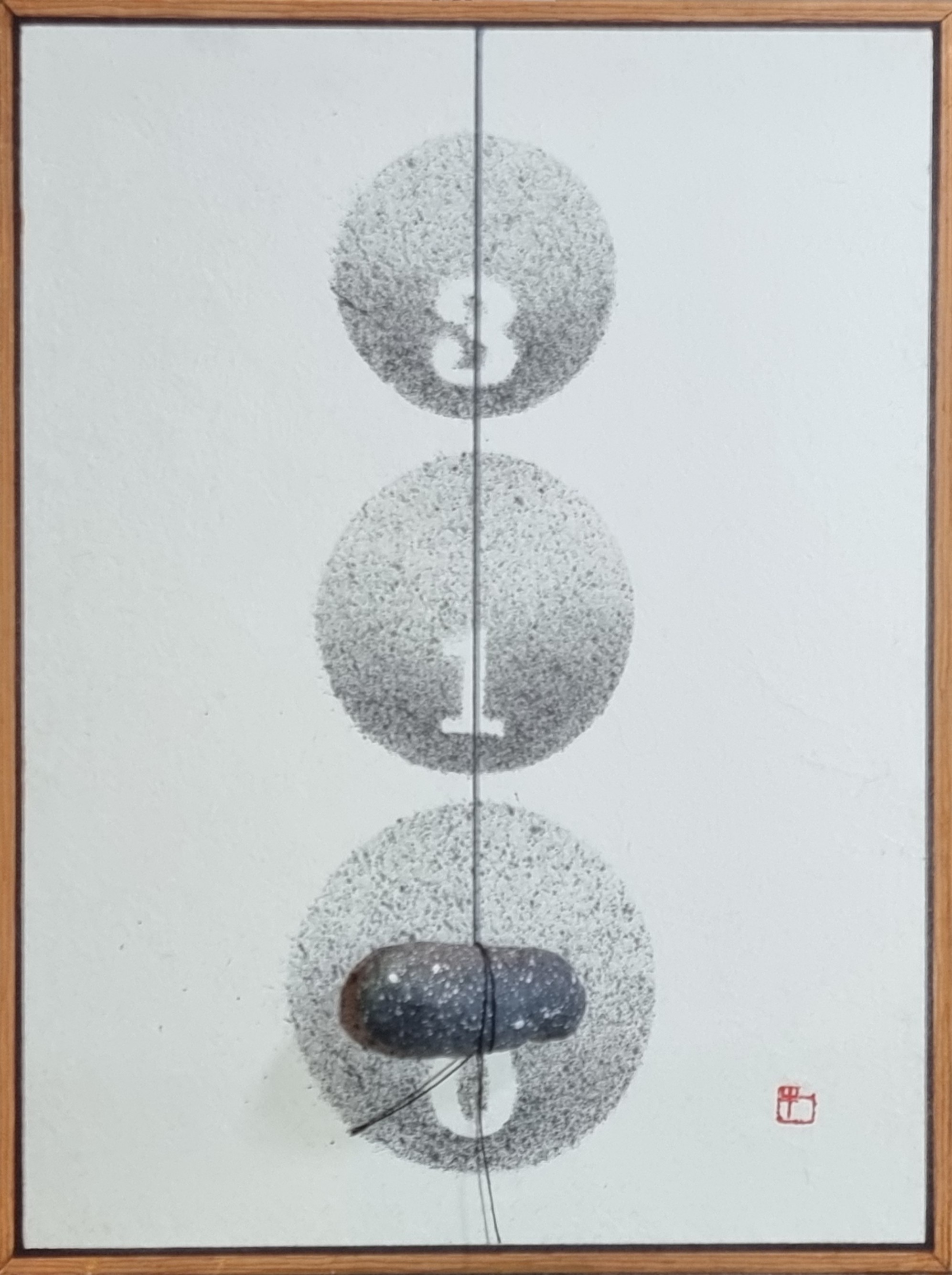 Jin Gong Myo Yu series, ink on Hanji paper, 12 ½ by 10 ½ inches.
Many of the small-scale paintings—done in ink on traditional Hanji paper or acrylic on canvas—feature what looks like a stone hanging by a thread against a speckled grayish background that, in some cases, is punctuated by one or more disk forms. In other compositions, a central circle encompasses sheets of paper, sometimes with a corner folded up, sometimes held in place by a stone. “VIGOR” is inscribed one such sheet; “QI VIGOR” (referring to the mystical energy qi) reads another. The numbers 0, 1, and 3 hover here and there. Overall, the implications seem cosmic. Yet most of the components are unreal. The wooden frames tacked together with silvery nail heads showing, the vertical threads, the notebook pages, the surrounding margin between background and frame—all are depicted. The stones (except for one, just to mess with us) are actually wads of paper. Only the treads dangling beneath the fake stones are what they appear to be.
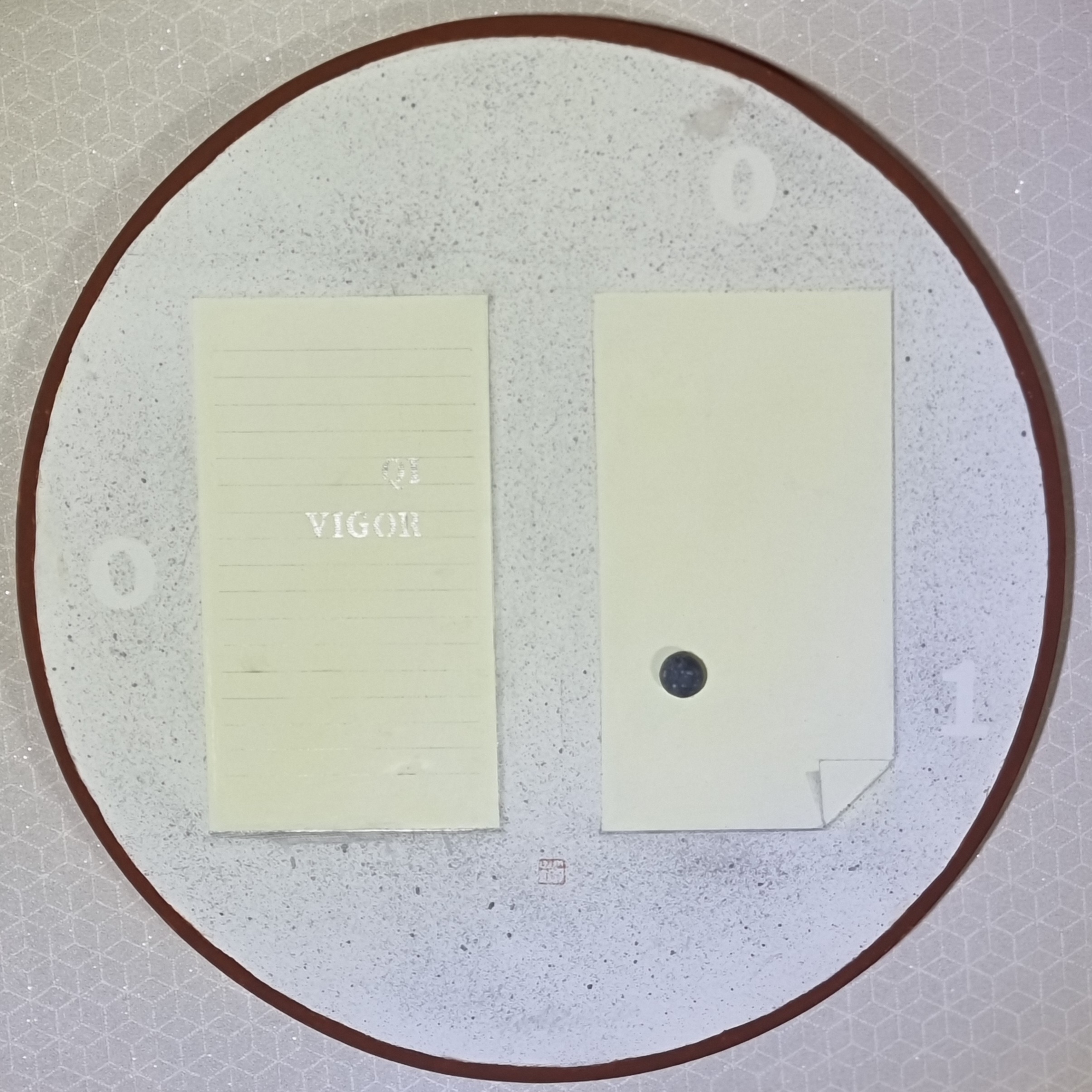 Jin Gong Myo Yu series, ink on Hanji paper, acrylic on canvas, 15¾ inches in diameter.
Park, a retired full professor from Mokpo National University, is explicit about what we should make of these perceptual tricks. His artist’s statement holds that uncertainty about what we are really seeing at any given moment should bring to mind the Eastern concept of an ultimate emptiness from which impressions of separate being, our own and those of the things around us, spring forth constantly, spoofing our consciousness and distracting us from the true oneness of all. The numbers, whose significance alters when they are variously combined (3 and 1 vs. 3 + 1 vs. 31, etc.), imply that all aspects of existence depend upon the ever-changing interrelationships of transient entities. “Emptiness does not signify nothingness or void in the nihilistic sense; rather, it is the fundamental state from which all possibilities arise. Form emerges from emptiness and ultimately returns to it.”
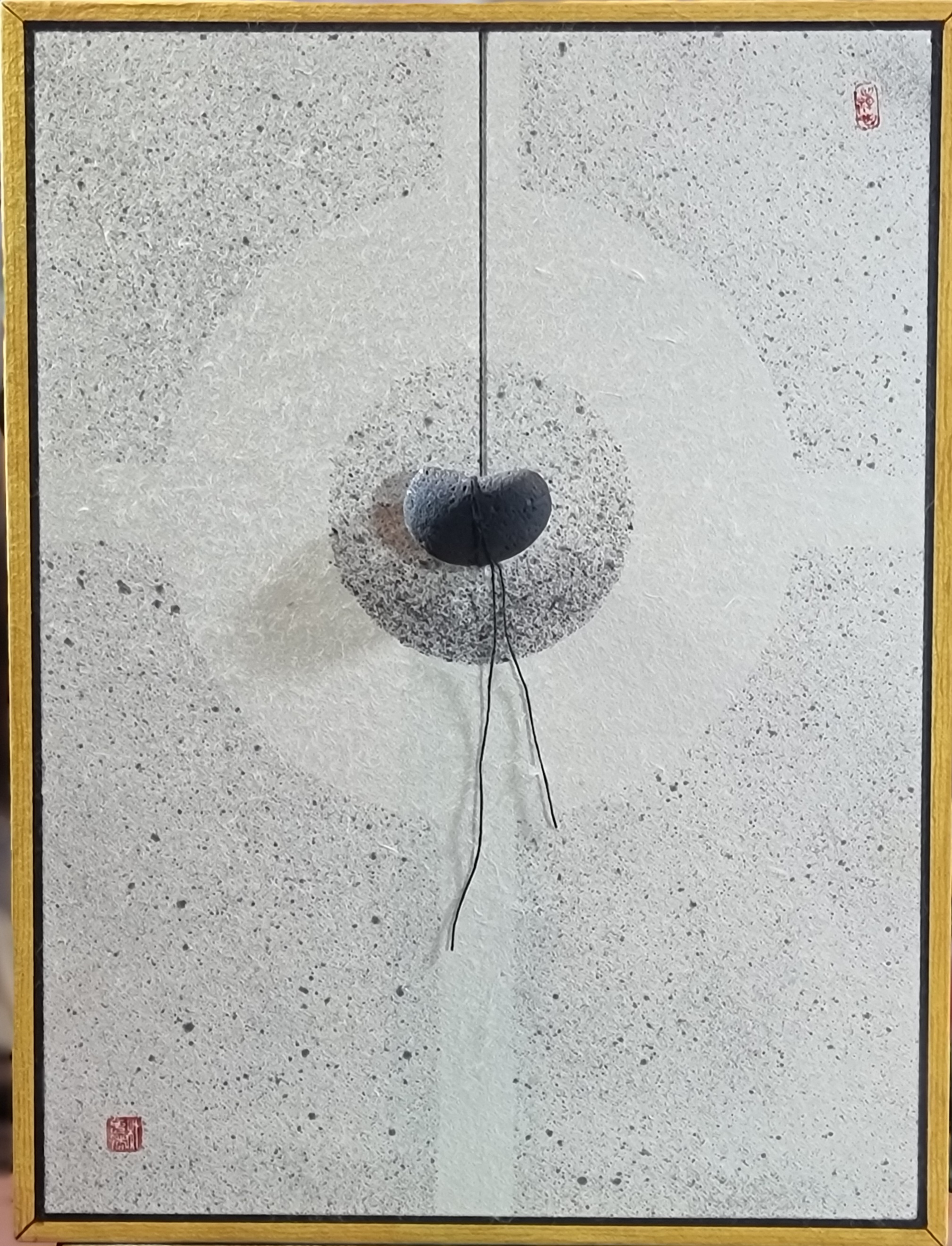 Jin Gong Myo Yu series, ink on Hanji paper, 12 ½ by 10 ½ inches.
This notion of a generative Void was introduced to Korea in the 4th century via a strain of Buddhism derived from the 2nd to 3rd-century teachings of the Indian philosopher-monk Acharya Nagarjuna, who espoused Madhyamaka, a “Middle Way” between nihilism (nothing truly exists) and essentialism (the world is composed of myriad fixed quiddities ). The idea is thus directly contrary to the impulse that drove Western painters like Samuel Dirksz van Hoogstraten, Jean-François de Le Motte, and William Harnett to “deceive the eye.” European and American trompe-l’oeil artists, heir to their own long, ever-evolving philosophical tradition regarding visual representation, participated in the era’s Enlightenment project—the birth of empiricism and the scientific method—deeply unlike the spiritual quest of Asian religious practice. These artists demonstrated how easily the senses could be fooled in order to direct viewers to the telescope, the microscope, the laboratory, and the rigorous processes of rational proof—not to the temple, not to contemplative solitude.
Thus Park‘s exhibition was a salutary reminder that mimesis (“imitation”), whether of Plato’s eternal Forms or Aristotle’s ordinary objects and scenes, can serve disparate ends, drawing antithetical worldviews from the same root observation. Reality, insofar we are able to know it, is constructed in our minds. What matters then, as Park’s exquisitely conceived and executed paintings attest, is how our minds function and draw conclusions—empirically and logically, or intuitively and poetically; scientifically or spiritually.
Ilwoo Yunseo Park’s solo exhibition Jin-Gong-Myo-Yu: True Emptiness, Wondrous Presence took place at the Asian & American Art Foundation, New York, June 1-15, 2026.

Richard Vine
Richard Vine is the former managing editor of Art in America and author of hundreds of critical articles, interviews, and reviews. His eight books include New China, New Art (2008) and Odd Nerdrum: Paintings, Sketches, and Drawings (2001), as well as the artworld crime novel SoHo Sins (2016). He has taught and lectured around the world, and curated exhibitions in Beijing, New Delhi, Hangzhou, Ho Chi Minh City and New York.
view all articles from this author