Whitehot Magazine
October 2026
"The Best Art In The World"
"The Best Art In The World"
October 2026
Banquet Against the Knife - Inner Feast 2025
 Inner Feast, August 8, 2025–August 12, 2025, at Accent Sisiter 89 5th Ave #702, NYC
BY SERENA HANZHI WANG Aug 30, 2025
I once stumbled across a detail about António Egas Moniz that I can’t shake. History remembers him as the Portuguese neurologist who invented the lobotomy, who even won a Nobel Prize for it in 1949. But I remember him differently: as a man who not only carved into the minds, but who also delighted in eating ortolan buntings—a dish so cruel it is now banned. Imagine it: a tiny bird force-fed until swollen, drowned in Armagnac, roasted, then swallowed whole, bones and all, under the cover of a napkin. Moniz’s appetite, like his science, was nothing short of predatory.
From his dinner table to his operating table, cruelty and “cure” became indistinguishable. He severed nerves and called it repair. He swallowed life and called it a feast. Women, especially, bore the brunt of his knife—60% of lobotomy patients in the U.S. were female, in Ontario nearly three-quarters. Violence masqueraded as medicine; domination masqueraded as healing.
And yet—with that anecdote in mind—when I stepped into Accent Sister on a warm August evening in 2025, I found myself at a radically different kind of banquet. Inner Feast became, for me, an answer to Moniz’s legacy. Where his tables were marked by cruelty and erasure, this table was set for tenderness and presence. Where his work enforced silence, this gathering invited dialogue. The exhibition’s thesis is clear: healing does not come from cutting or consuming, but emerges through femininity, food, ritual, and the quiet rhythms of presence—repair instead of erasure, communion instead of domination.
 Installation shot of Annie Yuan Zhuang's ǒu duàn sī lián (2023)
Inner Feast, a week-long group exhibition curated by four amazing girls (Luman Jiang, Jinyi Freya Xu, Yvonne Yitian Xu, and Shuhan Zhang). The show’s conceptual menu draws from Freud’s id–ego–superego model, promising a journey toward “inner healing through symbols, dreamscapes, and intuitive visual languages”.
In place of hors d’oeuvres and cocktails, they are served art as psychic nourishment, each work a dish to be “digested” emotionally. As I moved through the space, I felt like a curious diner sampler but for the subconscious—the atmosphere equal parts intimate dinner party and collective therapy session. Each of the seven female artists offers a distinct flavor of feeling: together, their works form a multi-course meal of identity, memory, and oneiric imagination.
 Chloe Yu Chen, Untitled, 2020, Ceramics, glaze
➊
Chloe Yu Chen’s installation assembles cultural fragments in a surreal table setting, blending the domestic and the uncanny. Her piece is a dinner for two, set under the glow of a Tiffany-style lamp, a scene that feels both intimate and slightly eerie. On each plate rests a ceramic breast—pinkish, perfectly round, glassy—positioned over a plate with printed braids motif as though femininity itself has been portioned and served. Chloe's gentle surrealism invites me to laugh, and leaves a slightly bitter aftertaste as I digest its obvious message on how women’s bodies and cultural heritage are consumed in everyday life. This installation piece is a fitting ‘appetizer’ for Inner Feast, locating us at the uncertain border between comfort and discomfort, self-deconstration and collective stereotype.
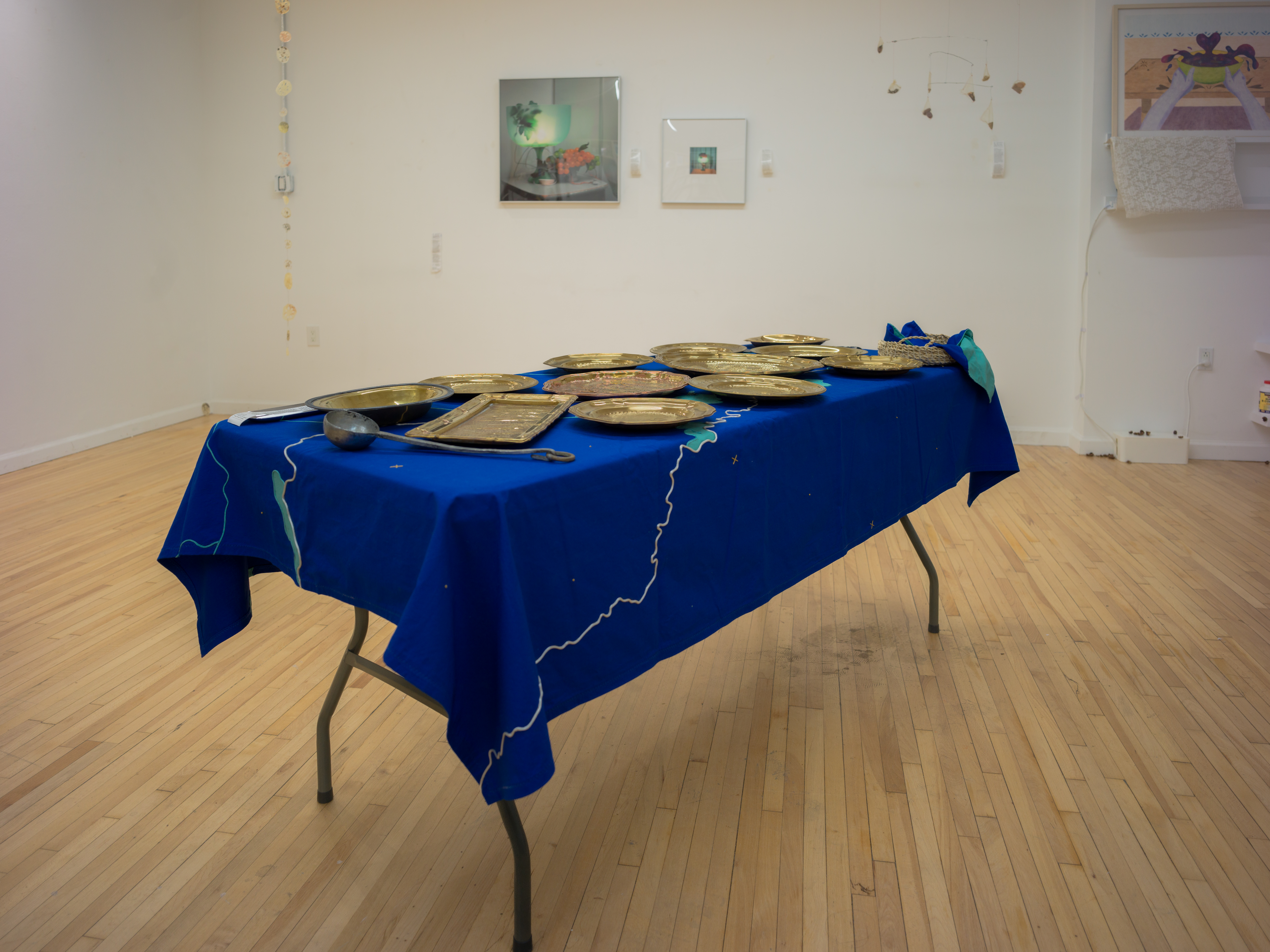 Zahra’a Nasralla, Sofreh Supperclub, 2024, Copper Alloy (Sufr رفص )
➋
Zahra’a Nasralla’s Sofreh Supperclub (2024) lays out many Middle Eastern brass plates on a blue tablecloth embroidered with maps. The artist is trying to blend food, culture, and memory in a single work. The fabric art—the tablecloth—outlines geographic regions sewn in thread, referencing Zahra’s Mesopotamian heritage. Arranged on top are hand-crafted copper-alloy plates and trays, each unique with ornate engravings in Arabic calligraphy. They look like the kind of wares you might find in a Baghdad market. But under gallery lights in downtown NYC, they take on new weight, carrying meanings beyond their original use.
At the opening, the plates were filled with dates. I saw some people get so fascinated by dates as a raw ingredient, I guess humans are so used to processed food at this point. However, on most days of Inner Feast, though, the setup is quite haunting: a communal dining table with no diners served, just empty, big plates. As a second-generation Iraqi-American project, I think Zahra is trying to ask us to fill the vessels with our narratives, to question our belonging through acts of sharing. In doing so, she really taps into a deep well of diasporic politics. The work carries a quiet warmth—a sense of welcome—but also a loneliness at its core.

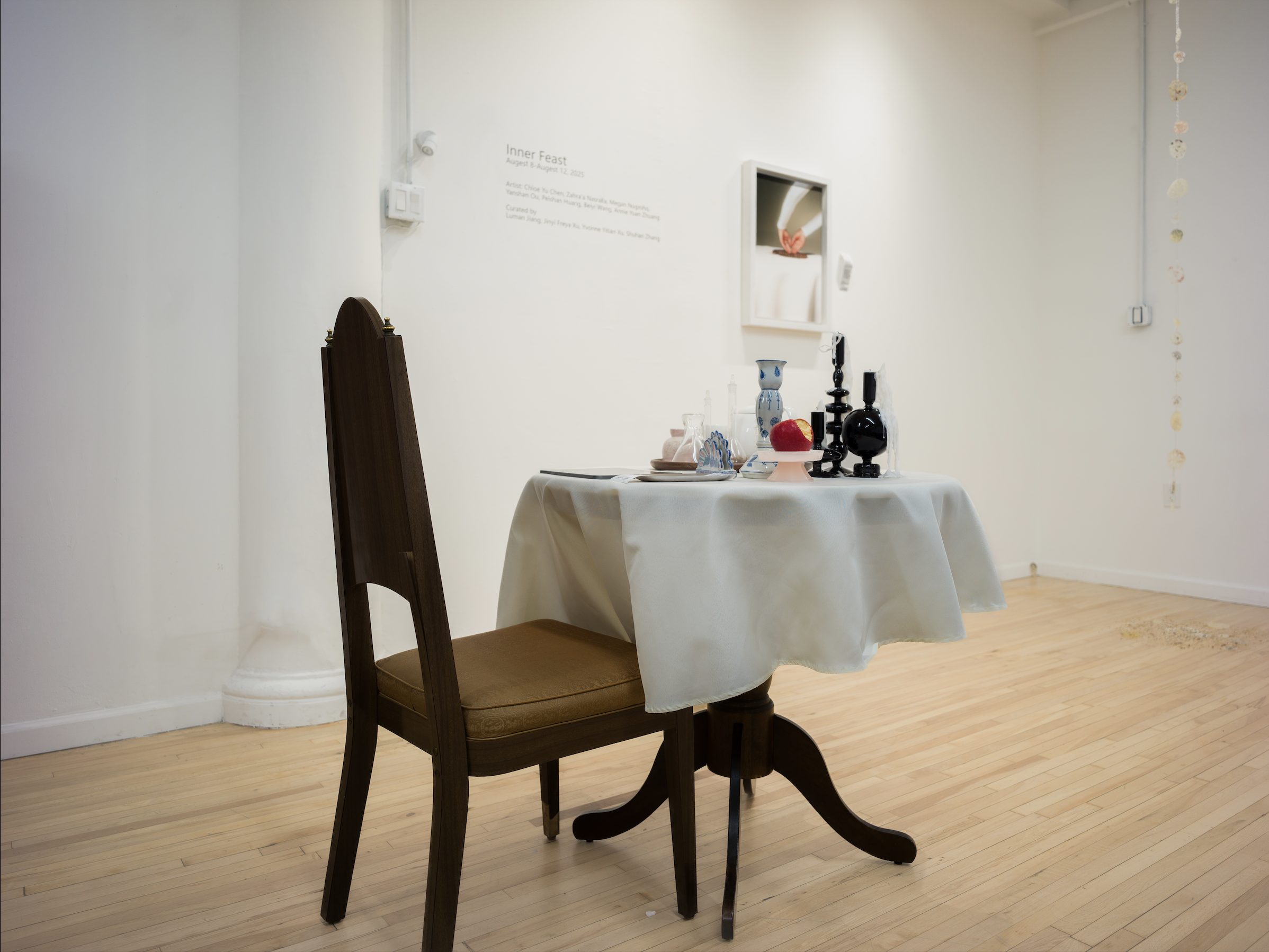
 Installation shots includes works from Megan Nugroho, Yanshan Ou and Peishan Huang etc.
➌
Megan Nugroho, a painter born and raised in Indonesia, drew me into another unique Asian woman’s inner-experience. Her colored-pencil drawing From Me to You (2020) hangs on the wall like an unguarded thought. She calls it a mental landscape between intimacy and wildness, and looking at it feels like slipping into the first-person view of a private diary — not in words but in colored strokes. The texture is delicate, layered in pencil and pastel with a hazy softness, yet every line lands with the precision of someone who knows exactly what they’re confessing.
➍
Yanshan Ou takes the idea of a “toast to the subconscious” almost literally. The installation work CIN CIN (2021) made me struck by its sensory charge—the full-bodied sound of crystal, the whirl of red wine, the slow-motion play of liquid and light. The toast becomes ceremonious, a ritual that activates all five senses.
➎
Peishan Huang’s works look, at first glance, like the kind of Y2K-era home décor prints you’d find in a dollar store—dusky palettes, fuzzy abstractions, the sort of thing meant to fade quietly into the background of a suburban living room. That effect isn’t accidental. Huang leans into AI-generated image tools to arrive at this kitsch aesthetic, intentionally courting banality to see what happens when “evidence” of objects is filtered through both machine and memory. Her series Evidence of Objects #1 and #2 (2024) presents two archival inkjet prints: the big one (45×45 cm) shows a glowing green goblet-shaped lamp, tangled wires snake down the table, brushing against a glossy bunch of artificial grapes in neon green. Next to it, the tiny one (15×15 cm) is in a similar theme, but it’s just a lamp and looks like a woman's beautiful leg.
 Beiyi Wang, 2023, Today I had meeting with apple, stone and matsutake
➏
Beiyi Wang’s work Today I had meeting with apple, stone and matsutake (2023) creating a ritual of sensory transformation. Finally we see a live element to the feast. The work, with its enigmatic title, is both performance and video installation, wholly mesmerizing. In a dimly lit corner of the gallery, Wang sits at a small table covered with a white cloth, across from—an apple, a stone, and a matsutake mushroom. These three ordinary objects are arranged as if they were not her dinner, but dinner companions. Also dressed in white, she slowly lights two candles and proceeds to “meet” with the objects—gazing at them, touching them, even seeming to converse in silence. The scene is slightly absurd, yet venerated.
Beiyi says she’s interested in “ritualized installations and bodily experiments,” allowing “psychic energy to undergo a quiet transformation through subtle but profound sensory interventions.” The apple’s crisp red skin, the stone’s cold grey weight, the matsutake’s organic curve and pungent scent: each seems to represent a different aspect of the self (perhaps the id, ego, and superego seated at the dinner table?). I could not help but project emotions onto them—the defensiveness of the hard stone, the temptation of the apple, the fragile wisdom of the mushroom.
By the end of the performance, when deliberately bites into the apple, I felt a release, as if a spell had been broken. Beiyi Wang’s work is perhaps the most literal embodiment of Inner Feast’s core idea: art as a meal, to be sensed and absorbed. It gave me a quiet sense of purification. In the silence after the performance ended, I realized I had been holding my breath. This work nourishes the part of us that longs for ritual and meaning in the everyday acts of eating, meeting, and feeling.


 Annie Yuan Zhuang's work
➐
Annie Yuan Zhuang’s three works are probably my favorite in the whole exhibition. ǒu duàn sī lián (2023) hangs down from the ceiling: a series of translucent discs suspended by almost invisible threads. These discs are cross-sections of lotus root, cast in glossy epoxy resin. Inside each resin slice I can see embedded organic matter: tiny seeds, grains of rice, flecks of saffron, sesame, dried osmanthus petals—an entire set of Asian spices and botanicals sealed inside like amber. A projector casts a faint image over them (at this moment I saw the silhouette of a lotus root against a blue sky, drifting like a Déjà vu). The title ǒu duàn sī lián comes from a Chinese idiom: even when the lotus root is broken, its fibers remain connected, a metaphor for relationships or memories that persist even when separated. This meaning runs through the piece: each resin slice is independent, but the threads and the visual image of the fibrous holes connect them, forming a gentle vertical continuum.
Her second piece, Five Spices (2021), arranges common spices (cinnamon, bay leaves, chili peppers, etc.) with wire and mesh, releasing a faint blended aroma in the gallery that made me stop immediately—is that the smell of nostalgia, or just cumin? The third piece, on a plinth nearby, is her ongoing project Everything I Own - that you probably do, too (2025)—a collection of tiny everyday remnants (a chestnut shell, expired multivitamin tablets ground into powder, dust and ashes), carefully arranged and sealed, It reminds us that even the smallest discarded things carry the DNA of experience.
Zhuang’s works speak in the language of the subconscious: the effect is poetic and uncanny. I felt as if I too were suspended, hovering between past and present, self and other—those invisible threads tying us to our former selves, and to each other, even as time keeps breaking apart.
■
As I stepped back onto 5th Ave, the neon of New York’s night life buzzing around me, I noticed a lingering sensation in my gut (or was it my heart?): a feeling of warmth, fullness, and slightly surreal wonder. It was as if the subconscious “banquet” I’d just engaged with had indeed fed some part of me that had been empty. And I thought again of Moniz—his knife, his bird, his appetite for cruelty masked as cure. Inner Feast is everything his table was not. My mind buzzes with rich aftertastes of images and ideas that I suspect will continue to digest within me for a long time to come. Let's continue to ask: What does it mean to nourish—ourselves, each other—in an age of overstimulation and broken identities?

Serena Hanzhi Wang
Serena Hanzhi Wang (b. 2000) is an award-winning art proposal writer, multimedia artist, and curator based in New York City. Her work spans essays, exhibitions, and installation Art—often orbiting themes of desire and technological subjectivity. She studied at the School of Visual Arts’ Visual & Critical Studies Department under the mentorship of philosophers and art historians. Her work has appeared in Whitehot Magazine, Cultbytes, SICKY Mag, Aint–Bad, Artron, Art.China, Millennium Film Workshop, Accent Sisters, MAFF.tv, and others.
view all articles from this author