Whitehot Magazine
October 2026
"The Best Art In The World"
"The Best Art In The World"
October 2026
After Language Withdraws
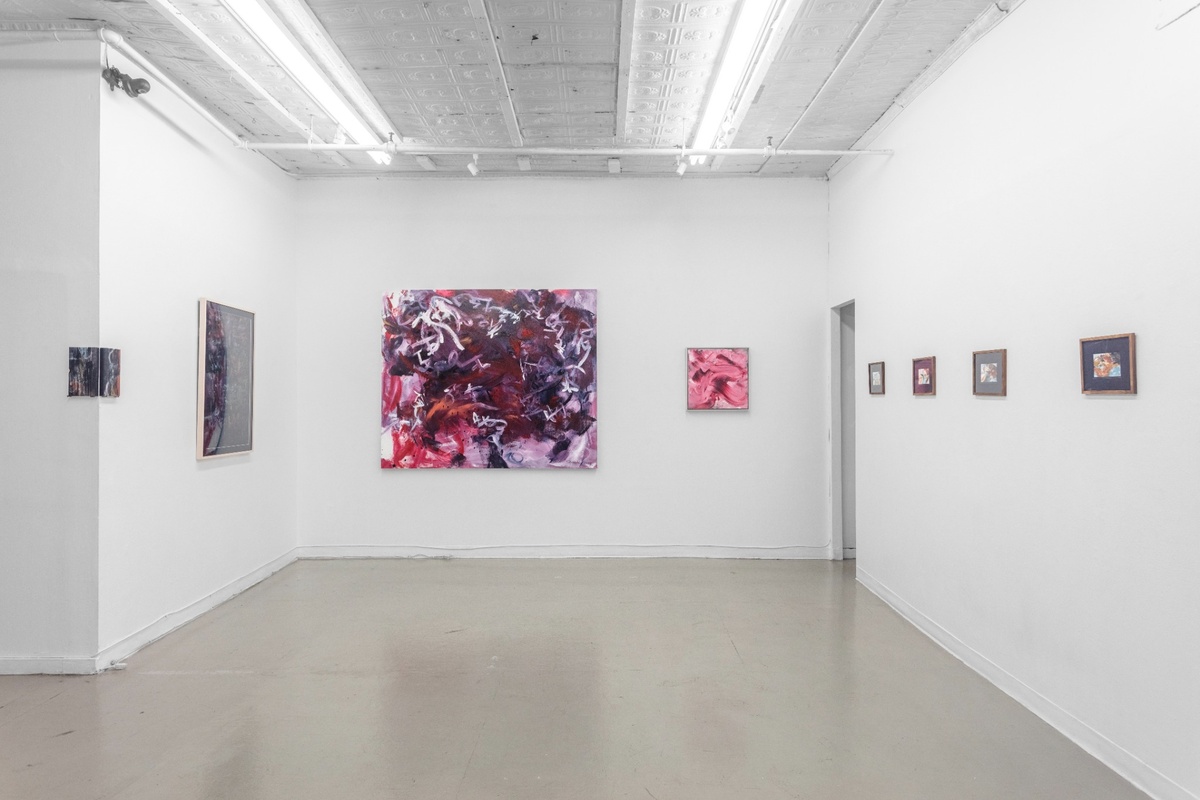 Installation view of The Line That Forgot Its Name. Courtesy of the artist and Gallery 456.
By SHUHAN ZHANG June 20th, 2026
“Today, art is burdened by an excess of interpretation.”
When Susan Sontag wrote these words in Against Interpretation, she was resisting modern culture’s persistent pursuit of meaning. Looking is often understood as an act of decoding; we approach artworks through analysis, classification, and interpretation, as though their value ultimately resides in a conclusion waiting to be extracted. Yet before The Line That Forgot Its Name, Fanyu Lin’s solo exhibition curated by Xumeng Zhang and presented at Gallery 456 in New York, this mode of viewing quickly begins to falter.
Bringing together works produced between 2021 and 2026, the exhibition unfolds through a body of marks that seem perpetually on the verge of becoming language. Writing appears everywhere, yet remains stubbornly unreadable. White inscriptions scattered across the surface hover between legibility and illegibility, while expansive brushstrokes retain the speed, pressure, and rhythm of handwriting without ever fully returning to the structures of text. Viewers instinctively search for meaning, only to encounter repeated interruptions in the act of reading. The question, then, is not what these marks signify, but why they persist in a state prior to signification itself.
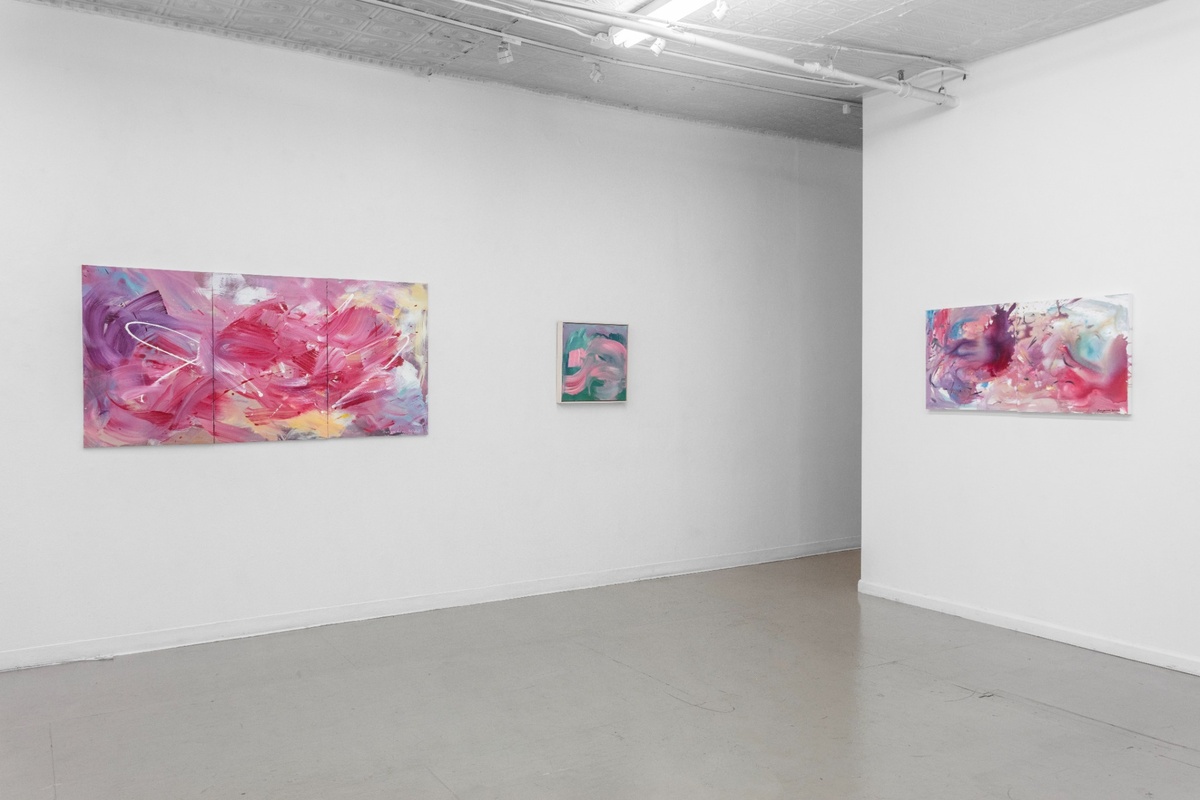 Installation view of The Line That Forgot Its Name. Courtesy of the artist and Gallery 456.
This suspended condition lies at the heart of the exhibition. Rather than treating abstraction as a departure from language, Zhang’s curatorial framework proposes the line itself as a resilient trace, one that carries both the memory of writing and the bodily weight embedded in painterly gesture. Across works spanning five years, the exhibition follows how repeated inscription, layering, and extension gradually loosen language from its original semantic function, allowing form to acquire its own rhythm and structure. In this sense, The Line That Forgot Its Name is less concerned with the disappearance of writing than with the conditions under which the line continues to exist after language begins to withdraw.
For Lin, writing has never functioned merely as a vehicle for language. Within the Chinese tradition, calligraphy is equally a bodily practice, shaped by breath, rhythm, pressure, and movement. It is through the body that writing comes into being. Consequently, when Lin repeatedly writes, overwrites, and extends these traces across the surface, her concern is not how language communicates meaning, but how the line continues to exist once meaning begins to loosen. Language gradually withdraws, yet the trace remains.
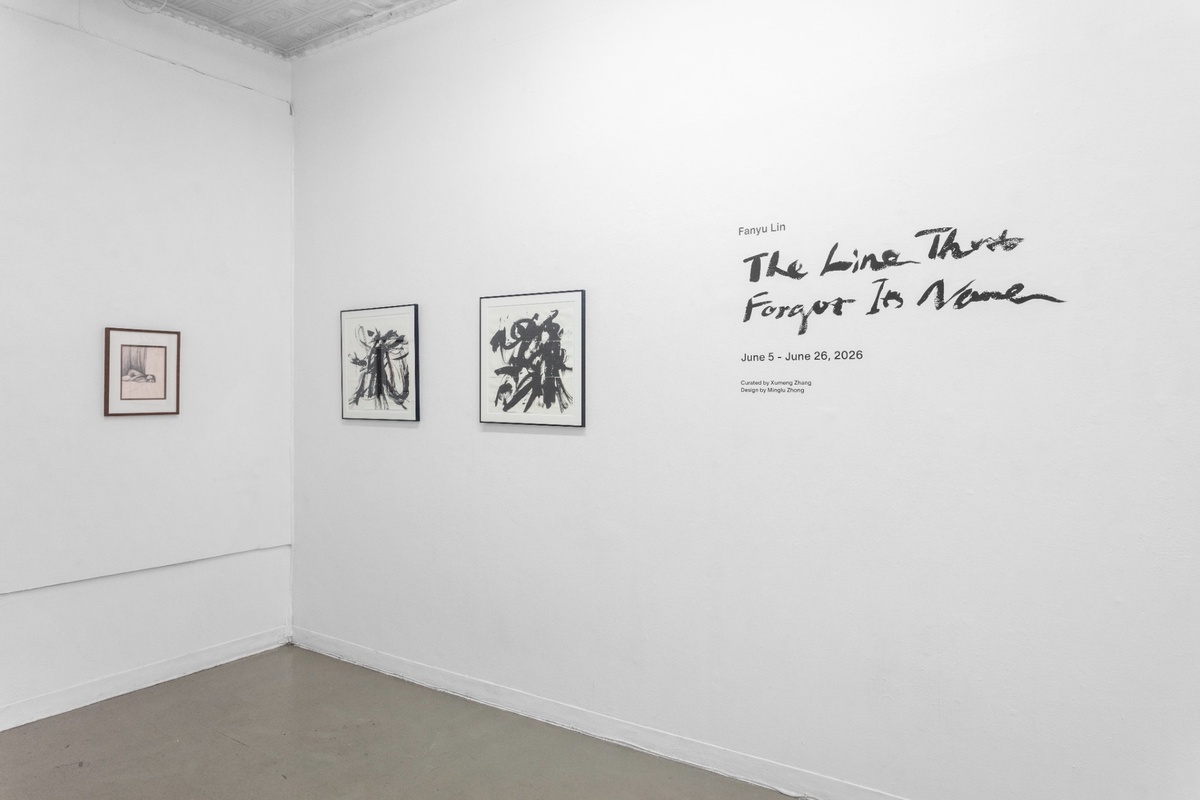 Installation view of The Line That Forgot Its Name. Courtesy of the artist and Gallery 456.
I’ll Protect Her From You offers perhaps the most concentrated articulation of this transformation. A dense accumulation of black brushstrokes gathers at the center of the composition, producing a structure of inward collapse, like an emotional gravity field from which there is no escape. Around it, white marks proliferate across the surface. Although they retain the speed, pressure, and directional force of handwriting, they no longer form coherent language. What confronts the viewer is not a text awaiting interpretation, but a perceptual condition compressed, layered, and reorganized through gesture. Emotion is never narrated directly; instead, it emerges through spatial relationships, rhythmic movement, and variations in visual density.
This attention to the trace recalls Emmanuel Levinas’s reflections on the concept of the trace. For Levinas, a trace is not the thing itself, but evidence of a passage that has already occurred. It never fully presents itself, yet continually points toward something that has departed. Lin’s lines operate in much the same way. They do not explain or declare. They simply preserve the evidence of a body having passed through. Each act of writing, covering, and repetition settles into the surface, transforming painting into a site where gesture, duration, and memory accumulate together.
By contrast, The Embrace series reveals a more delicate and intimate dimension of her practice. These small-scale works on paper do not depict a complete scene of embrace; rather, bodily relationships are dispersed into flowing color, fragmented contours, and intertwining lines. In In Praise of Shadows, Jun’ichirō Tanizaki writes that beauty resides not within objects themselves, but within the shadows and ambiguities that surround them. The same could be said of The Embrace. What matters most is not the body that becomes visible, but the body that remains unfinished, emerging, or on the verge of disappearance. Viewing thus ceases to be an act of identifying an object and becomes an encounter with a relationship still in the process of formation.
If the experience of art therapy has left a lasting imprint on Lin’s practice, it may lie in this trust in the non-linguistic. Within therapeutic contexts, expression does not always arrive through words. Many emotions remain unnamed and resistant to precise description, yet they can nevertheless find temporary form through gesture, trace, and material presence. Lin’s paintings do not seek to explain these experiences; they create a space in which they may linger. Painting therefore becomes not the representation of meaning, but the condition from which meaning has yet to emerge.
When language gradually loses its capacity to name the world, can the body still perceive it? When words relinquish their responsibility to explain, can the line become another mode of knowing? The Line That Forgot Its Name does not offer definitive answers. Instead, it reminds us that beyond language there remains another structure of experience, slower, quieter, and more elusive. Perhaps those lines that have forgotten their names continue to grow precisely there.

Shuhan Zhang
Shuhan Zhang is a curator and writer based in New York. Her work focuses on contemporary art, digital culture, and the politics of exhibition-making.
view all articles from this author