Whitehot Magazine
October 2026
"The Best Art In The World"
"The Best Art In The World"
October 2026
Monira Al Qadiri’s Aesthetic Riddle at Central Park
By RAPHY SARKISSIAN | July 17, 2026
In the shadow of the Plaza Hotel, the city's Gilded Age limestone meets the arboreal weight of Central Park. At this threshold stands a seventeen-foot apparition of a human head, its visage eclipsed by a towering scarab. This sculpture, Monira Al Qadiri's First Sun, arrests the onlooker through its formal duplicity, contrasting human features coated in a deep, static purple with the shifting, chromatic transformation of the insect’s back. This iridescence fluctuates with the intensity of daylight as much as with the observer's moving point of view. Often displaying a single hue or several tones across its surface at once, the insect's shifting colors re-enact the natural pearlescence of beetle shells, echoing the mythological beauty once ascribed to the creature. By grafting the carapace of a scarab onto a colossal human head, the sculpture stakes out unfamiliar ground among its neighbors: the gilded militarism of Augustus Saint-Gaudens' Sherman Monument (1903) and the classical femininity of Karl Bitter's Pomona (1916) stand just steps away. In ancient Egyptian mythology, the scarab was sacred to Khepri, god of the rising sun, resurrection, and transformation. First Sun therefore enacts an allegory, recasting the sunrise as a generative force of aesthetic revisionism.
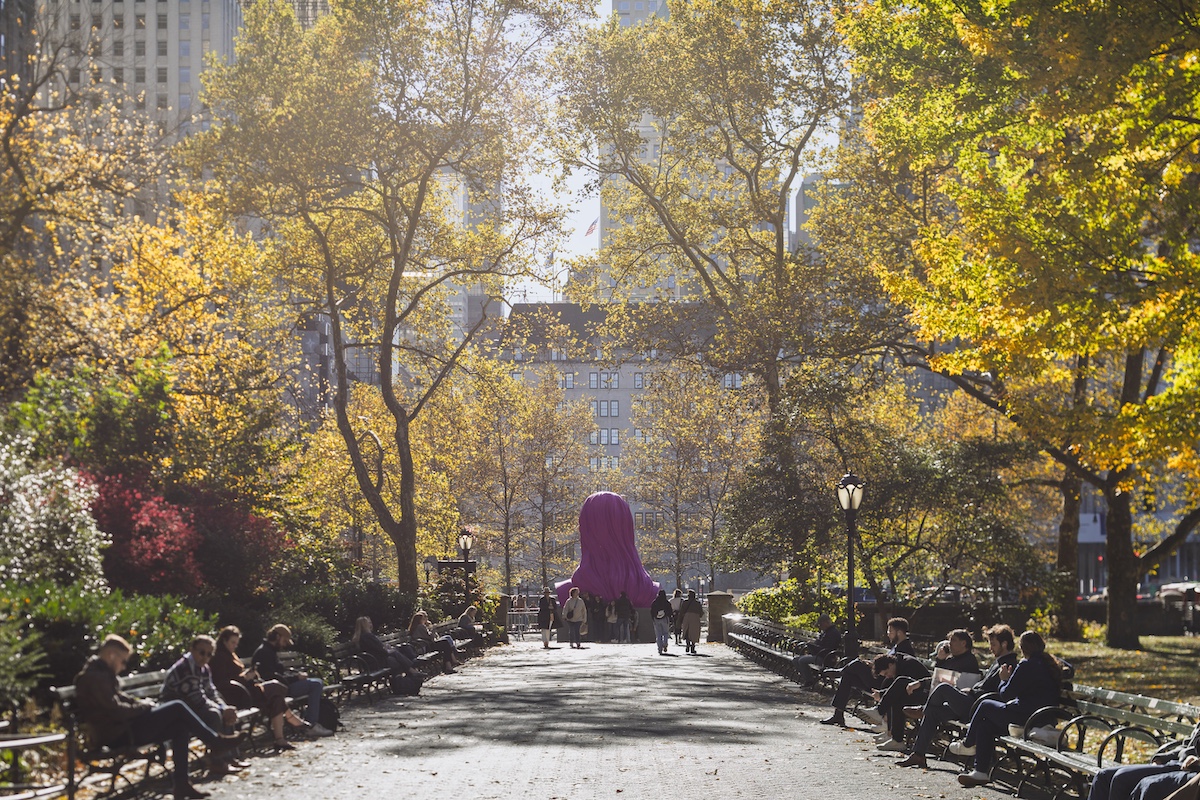
Monira Al Qadiri, First Sun, 2025. Cast aluminum, steel, automotive paint; patinated brass pedestal, 197 by 118 by 118 inches. Courtesy of the artist. Photo: Nicholas Knight. Courtesy of Public Art Fund, NY.
The work's power lies in its material and formal dissonance: its immense scale, its slick surfaces, and the stylized modeling of hair depicted behind a shut, featureless head. Coated in automotive and Glasurit paints, the bust holds a deep purple while the scarab's presence discloses pink, purple, blue, and green as light varies and the passerby's vantage point shifts. A few blocks north, the neoclassical facade of the Edmond J. Safra Synagogue on 63rd Street bears monumental bronze gates depicting the Tree of Life. Walking southwest from there toward this partly lustrous monument, one moves between diametrically opposite mythologies of regeneration: one ancient and sacred, the other industrial and synthetic. Farther south, Joan Miró's primal and whimsical Moonbird (1966) at the 58th Street plaza of the Solow Building belongs to the surrealist movement Miró himself helped pioneer, with its biomorphic form as commanding today as when it first appeared. Yet Al Qadiri shifts the medium from classic bronze to the synthetic materials of what she terms petro-culture, her surfaces' coloration displacing traditional metal's fixed patina. First Sun thus remains eerily futuristic, an object that demands to be read within the context of Al Qadiri's ongoing interrogation of the petroleum industry's extraction from the natural world.
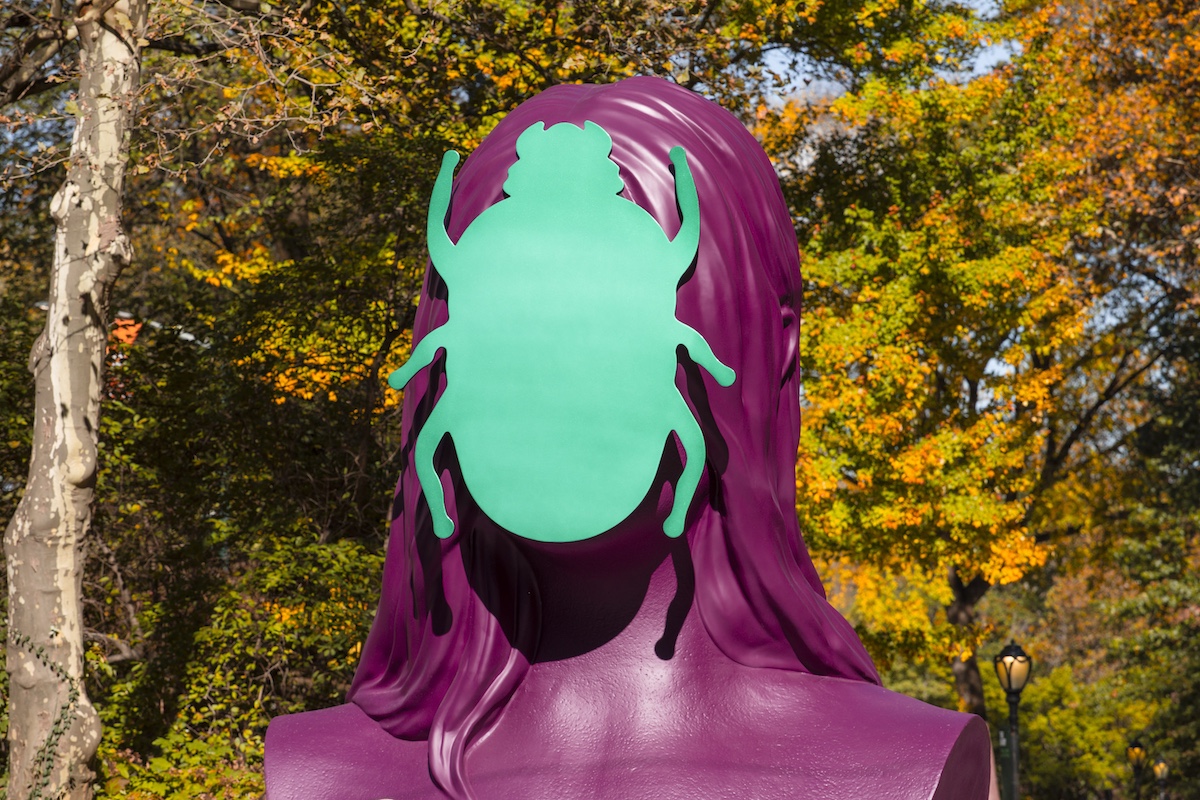
Monira Al Qadiri, First Sun, 2025. Cast aluminum, steel, automotive paint; patinated brass pedestal, 197 by 118 by 118 inches. Courtesy of the artist. Photo: Nicholas Knight. Courtesy of Public Art Fund, NY.
While First Sun arrives as a counter-monument in space, Al Qadiri's trajectory suggests it is equally a counter-monument in time, bypassing the traditional logic of permanence, heroism, and national memory. Having witnessed the 1991 Gulf War in Kuwait, with its oil wells set ablaze and its skies darkened, she later spent a decade in Tokyo completing a dissertation titled "The Aesthetics of Sadness in the Middle East." This body of thought informs First Sun, her translation of the Gulf's petroleum history into cast aluminum and steel. Finished in petroleum-derived automotive paint, the surface evokes the 1970s, the decade when Gulf oil wealth first asserted itself as a global power. Yet the immediate catalyst of the sculpture was a visit to the Tomb of Pharaoh Ramses I in Egypt, where she encountered a painting of the scarab-faced god Khepri. The sculptor later recast this discovery in metal and paint as a critique of petro-culture and its ecological cost. On the southeast corner of Central Park, the scarab enacts an uncanny opulence of chromatic trickery. Its murky grey plinth rises as a proscenium, staging the chromatic event above. Echoing Khepri's daily ascent from beneath the earth, this figure emerges from its industrial base, as if to restage an ancient myth in terms of the ecological hazards of our time.
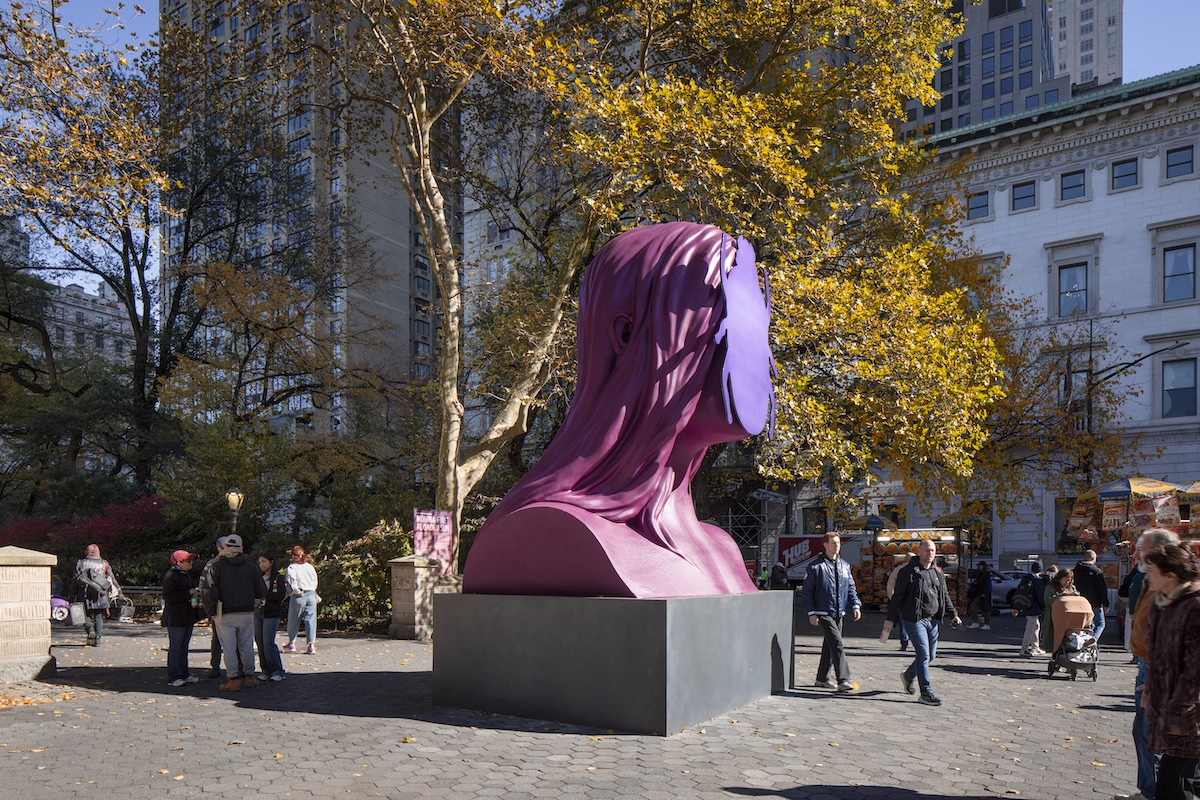
Monira Al Qadiri, First Sun, 2025. Cast aluminum, steel, automotive paint; patinated brass pedestal, 197 by 118 by 118 inches. Courtesy of the artist. Photo: Nicholas Knight. Courtesy of Public Art Fund, NY.
As one stands between the sculpture and its curatorial text, the industrially finished surface presses questions of humanity's estrangement from the natural world, while the monumental form demands a rethinking of social identity. Here, the windswept hair recalls Botticelli's The Birth of Venus, where Zephyrus and Aura intertwine as twin currents of wind and breeze. In Al Qadiri's figure, these dual winds appear to fuse into a single, androgynous form. Whereas Jeff Koons attaches his mirrored gazing balls to classical figures as instruments of direct reflexivity, Al Qadiri loads her sculpture with Egyptian mythology and a career-long insistence on the artificiality of gender. Indeed, the sculpture's enigmatic, color-shifting surface operates as a physical residue of this preoccupation, rendering metallic iridescence as a mirror for the unstable constructs of identity within our late capitalist system.
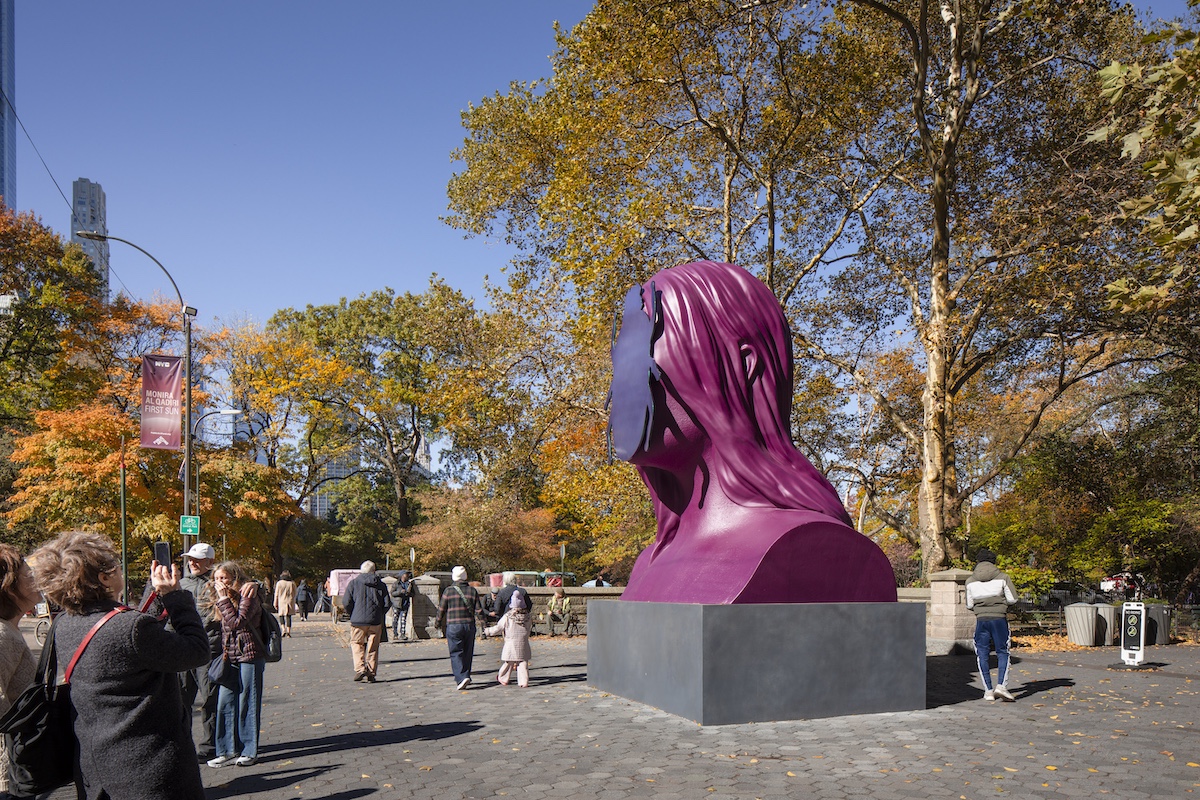
Monira Al Qadiri, First Sun, 2025. Cast aluminum, steel, automotive paint; patinated brass pedestal, 197 by 118 by 118 inches. Courtesy of the artist. Photo: Nicholas Knight. Courtesy of Public Art Fund, NY.
Rather than standing alone, the work enters a live and heavily contested dialogue with other monumental public works recently exhibited in Manhattan. Wangechi Mutu and Lee Bul have each transformed the Met's Fifth Avenue facade niches in recent years, just as Simone Leigh's Brick House commanded the High Line in 2019. This sculpture shares the sentinel energy of Mutu's guardians and the radical fluidity of Lee Bul's forms across gender, ethnicity, and culture. It carries, too, the demanding, meditative presence found in Leigh's monumental bust. By obscuring the literal face, Al Qadiri joins these artists in working from within the tradition of New York's public monuments, simultaneously unsettling its terms, whether through Mutu and Leigh's postcolonial critique, or Lee Bul's radical techno-feminist forms. Standing in the open air, First Sun meets the daily traffic of pedestrians, actively participating as an assertive presence in the contemporary streetscape.
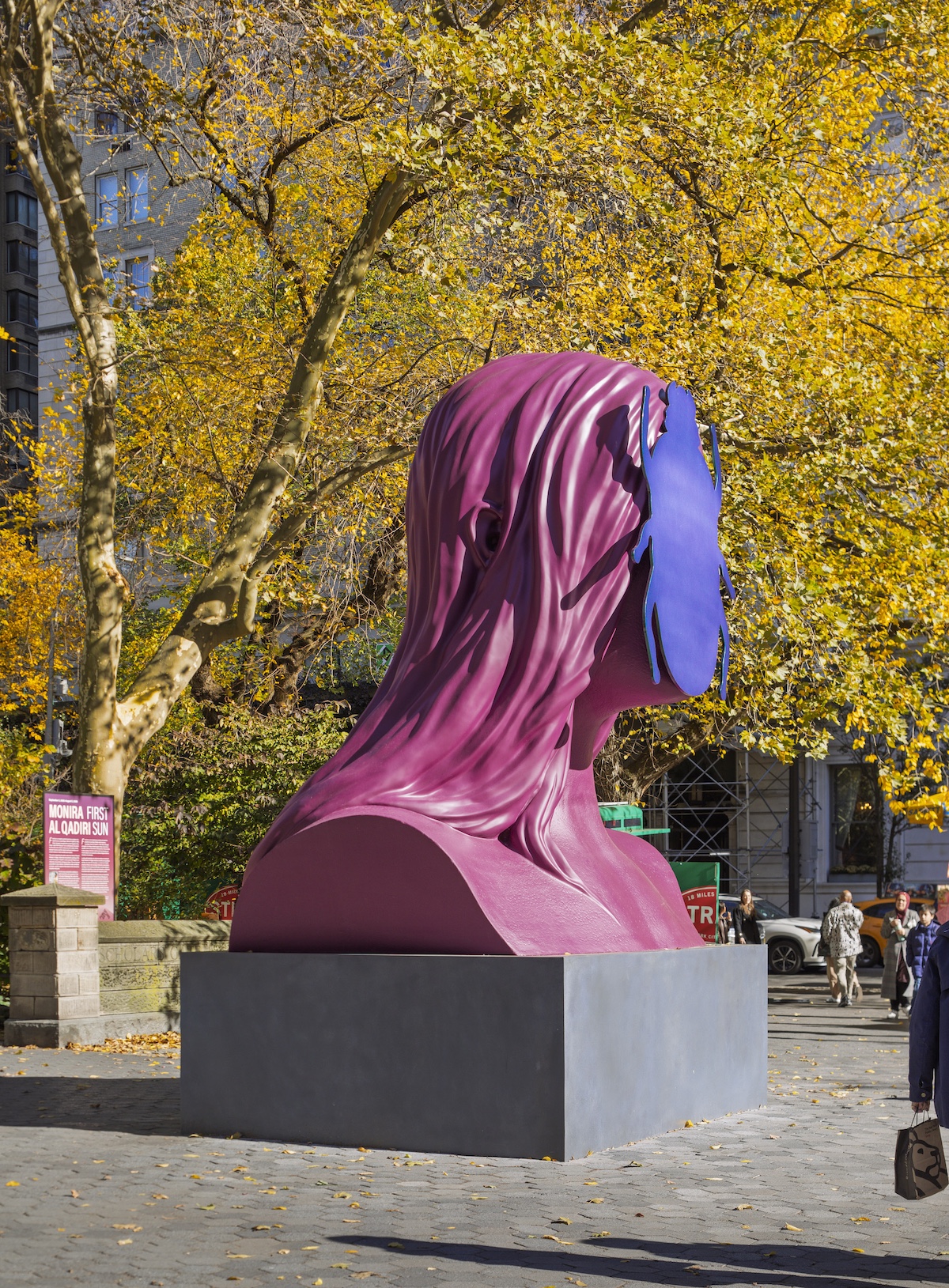
Monira Al Qadiri, First Sun, 2025. Cast aluminum, steel, automotive paint; patinated brass pedestal, 197 by 118 by 118 inches. Courtesy of the artist. Photo: Nicholas Knight. Courtesy of Public Art Fund, NY.
Confronting Al Qadiri's enigmatic head, one enters a dream state, crossing that threshold where mythology and surrealism overlap. In Egyptian legend, the scarab emerged spontaneously from the earth: self-created and parentless. Like that sacred symbol, this figure emerges as if from nowhere, suspended in the quiet hour before waking. Here, amid monuments that speak to a bygone century, this specter of ancient lore insists on the present moment. The stylized physiognomy of the insect conveys the iconography of the sacred scarab, serving as an amulet central to the apotropaic tradition of ancient Egypt. Yet against petro-culture and planetary warming, the scarab stands as it always has: a seal, a shield, a protection against what exceeds human scale. In Monira Al Qadiri's First Sun, these forces converge into a chimera. With its shut face turned inward, the work posits the scarab as an emblem of a precarious kinship among species, demanding an ontological reckoning with humanity's place within our fragile ecosystem. WM
_________________________
Monira Al Qadiri: First Sun was curated by Public Art Fund Senior Curator Melanie Kress and Lassonde Art Trail Artistic Director and Chief Curator November Paynter. The project was co-commissioned by Public Art Fund and Lassonde Art Trail and presented at Doris C. Freedman Plaza, New York City, September 3, 2025 – August 2, 2026. The sculpture will be on view at Lassonde Art Trail, Toronto, ON, September 10, 2026 – September 2027.
Raphy Sarkissian
Raphy Sarkissian received his masters in studio arts from New York University and is currently affiliated with the School of Visual Arts in New York. His recent writings on art include essays for exhibition catalogues, monographs and reviews. He has written on Rachel Lee Hovnanian, Anish Kapoor, KAWS, David Novros, Sean Scully, Liliane Tomasko, Dan Walsh and Jonas Wood. He can be reached through his website www.raphysarkissian.com.
view all articles from this author