Whitehot Magazine
October 2026
"The Best Art In The World"
"The Best Art In The World"
October 2026
Critiquing body fascism: A conversation with Stephanie Mercedes about their show Inútil
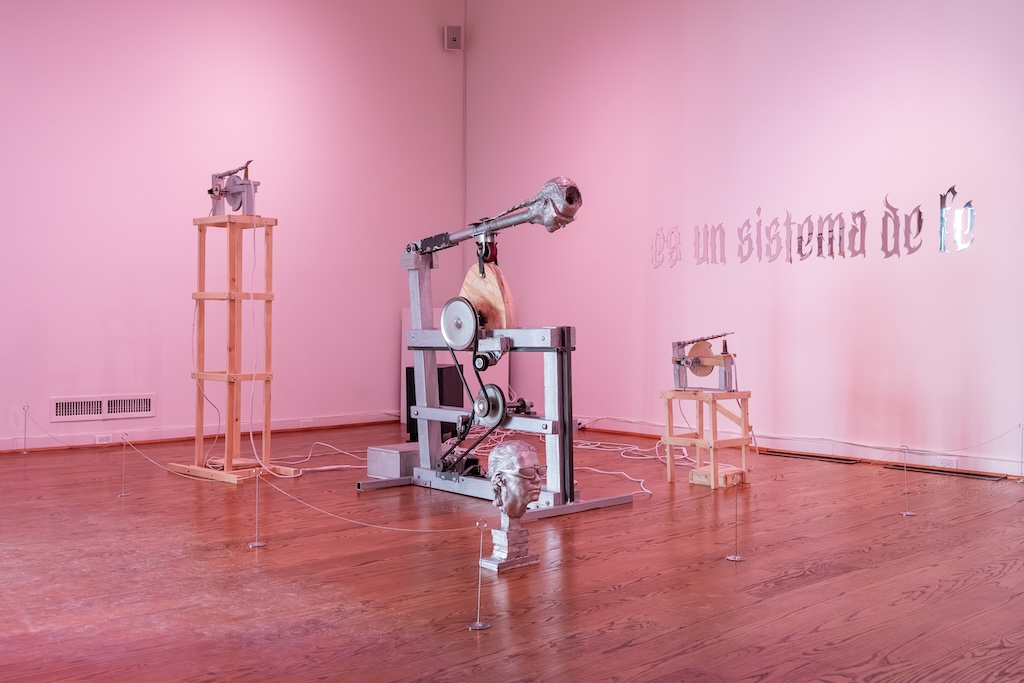 Photo of Inútil installation by Amir Pourmand.
BY EMMA CIESLIK April 9th, 2026
This past January 23rd, the Art Museum of the Americas opened Stephanie Mercedes’ show Inútil. In this multimedia, multisensory exhibition, Mercedes (they/she) pairs the sound of dripping wax and the echoes of a metal cast of the artist’s head made out of melted weapons crashing into bullets. The exhibition follows Mercedes’ previous memorial to murdered journalists at the OAS gardens in 2024. At the heart of the exhibitions are explorations of colonization, deconstruction, and liberation--through the bodies of the people facing down weapons that consolidate imperial power.
After the exhibition opened, I sat down with Mercedes to learn about the powers and potentials of melting weapons to create something new, something that can destroy the very thing--the ammunition--that give these weapons power.
Emma Cieslik: Would you mind introducing yourself however you feel comfortable?
Stephanie Mercedes: I am a queer Latina artist who’s based in Washington, DC, and currently living in between St. Louis and DC. I have a very anti-disciplinary practice, I work in metal casting. I melt down weapons. I also create experimental operas. I work a lot with sound. I love club music and techno and try to incorporate that into my work, and I also create a lot of kinetic installations.
Cieslik: There are several cast metal heads throughout the show--as your post on Instagram shared, these are casts of your own head. Why did you choose to recreate your own head with the metal of melted weapons?
Mercedes: My relationship with metal is primarily in the form of melted weapons, so for a long period of time, I have been melting down weapons and transforming them into sonic sculptures. I think that for this show, I wanted to think about what it means to be queer today. What does it mean to be in today’s version of the United States, and being a queer body, being a queer self, maybe even for the future of this country. I feel like the best way to try to do that is through my eyes, through the language of self-portraiture and through my body because I can speak about my own experience. It's also hard for institutions to erase artists working in self portraits because there is such a long art history of artists working in that medium.
I also think maybe on a subconscious level, a lot of my practice is very intensely physical. I am using my body with hammers, with different power tools, with furnaces to take a certain material and try to transform it. So I think that there was also an interest in maybe this fusion between all the different machines that I’m using, the materiality and myself as well. I often think about metal as a very queer and also very liberatory material because I feel like it has the capability to shapeshift. What other type of material do we know that can transform from a weapon, to a face, to a block, to maybe a weapon back to a space.
To cast my own head out of melted weapons over and over again, maybe is what it means to be queer in this version of the United States.
Cieslik: Absolutely, it’s one thing that really resonated with me seeing your show as a queer person and queer museum worker, so understanding and navigating that right now has been incredibly difficult to know the level of erasure and violence against queer bodies in museums and beyond.
Mercedes: Yes, I think that’s really true, and that’s why, throughout the show, I had my face being distorted, my face being squished, and being controlled by outside forces. In the back room, there is a sculpture where my braid is over my mouth. It is being silenced. When the braid is around my neck, I feel like it’s being strangled, and even in the power tool work, the braids will eventually wear away. My body is being used in a destructive way that I think is reflective of unfortunately queer erasure in this country.
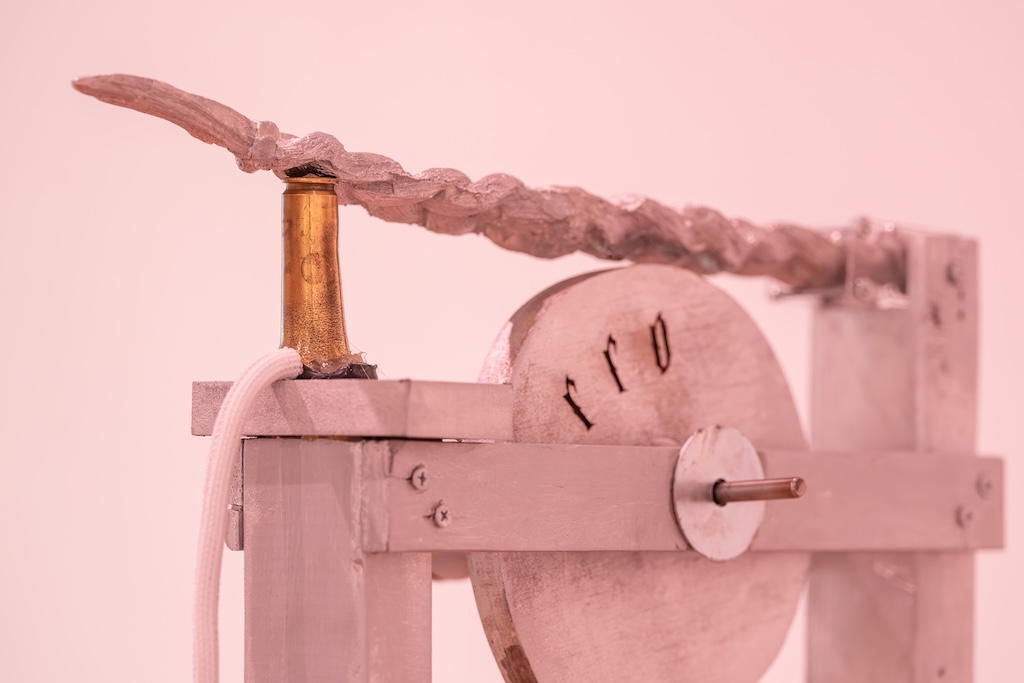 Photo of Inútil installation by Amir Pourmand.
Cieslik: I totally agree. What’s the significance and the inspiration behind this head-smashing metal collision that takes place in the gallery and the sound that results?
Mercedes: So the piece you’re talking about--es un sistema de fe, or “it’s a belief system”--is these kinds of experimental power hammers, which I have incorporated my body into. The original power hammers are actually called a cam hammer, and they’re based off of these drawings that da Vinci made. A lot of blacksmiths don’t like these kinds of power hammers because they’re so mechanically involved, but they’re really wild machines within themselves that normally go a lot faster and are intensely destructive, much more than the ones that are in the show. I just felt drawn to these machines.
I was working on an installation, which is up at the Walters Museum right now, which is hundreds of bullets which have been hammered into bells. The piece is called We Were Treated Like Numbers Rather Than Stars, I was with my assistant, and we’re both queer, and it was just this very interesting experience, where we were talking about what it means for both of us to be existing right now and to be these queer bodies. But at the same time, we were honestly just hammering the shit out of everything because that was a very raw process of turning these bullets into bells. I think at one moment, he ripped the leg off of a table and started using that, so there was this intense physicality to it.
He has a power hammer that was in the same space as us, so we were constantly in dialogue with this machine, and I just loved the pure, brutal force of it. I think in some ways I identified a lot with the potential of the machine, so that was really the inspiration behind it. I fell in love with it as a source of power, maybe there was an identification with it as well. So I came up with this crazy idea of creating these power hammers with my body parts and having them kind of hammer bullets into bells. In the installation, it’s my head which is a hammer and also my trenzas, or my braids.
I really wanted the machines themselves to be composing music because in my work, I’m always thinking about how we can queer sound. How can the sound of a hammer, the sound of quenching, the sound of a bullet melting be considered musical? So I have contact microphones on all of the machines. There’s two things happening. There is the sound of the machines themselves just creating music, and then I also an audio to MIDI-trigger, which is happening, so there’s certain files or sounds which are getting triggered when those machines are playing. For instance, the really tall sculpture is the kick that my friend DJ Kell helped me with, and the short one is more a strange bubbly synth sound that my friend Alex Braden helped me with, and the middle sculpture is just truly like the raw sound of the machine itself, so I wanted to feel like machines are creating their own music, and they really are. There’s no soundtrack. It only works if the machines are working.
Cieslik: Absolutely, that was one of my favorite parts, especially as an autistic person. Multi-sensory exhibitions are critical, and I feel like they bring our bodies as visitors into participation with the work you have on display.
Mercedes: I think that’s really interesting, and something else that happened is that in the beginning, I was trying--each machine is essentially controlled by a separate Arduino, and I was trying to synchronize them perfectly in the beginning. It felt like the sculpture didn’t want to do that, so what ended up happening is that the composition is different every time because it slowly changes throughout the course of the show, so sometimes I don’t even know what’s going to happen next, but I feel it’s really intriguing to watch other people experience it because it’s very intensely physical. I love working with all of the mediums, as many mediums as I can and senses I can engage, which feels very satisfying to me.
I feel like there’s a lot of anticipation in the work that viewers have expressed to me, and also maybe a feeling of my body on the line. They feel like their body is being engaged in a very specific way.
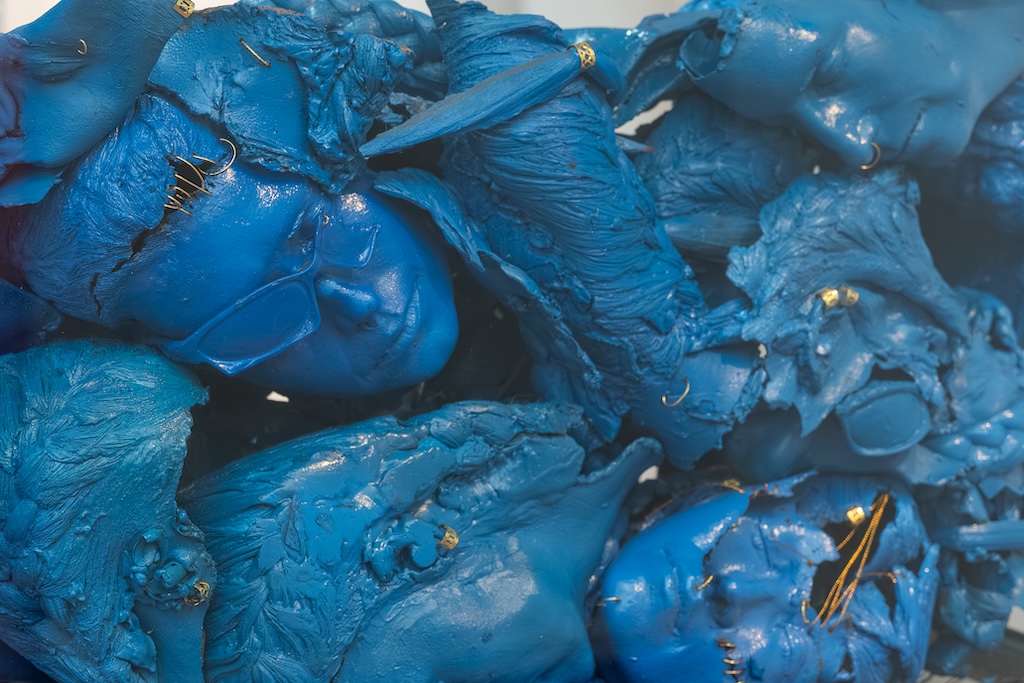 Photo of Inútil installation by Amir Pourmand.
Cieslik: One thing that really stood out to me was how your art reckoned with the ways in which queer bodies are destroyed in this system. I remember the top of your metal cast being broken out from violent contact. How do you see that destruction as timely, and what is the importance of visualizing and bringing attention to the destruction of queer bodies?
Mercedes: To be honest, I have no option as a queer human. I feel like it’s just a reflection of what it means to be alive today, and I feel like as an artist, I’m making more about things that feel urgent, things that feel extremely relevant. It’s interesting because the work, which is to the left of the power hammers, “yo soy martillo, mi cuerpo, polvo de armas” is made from the residue of creating the power hammer sculptures. When I’m angle-grinding metal, it creates a lot of dust. There was a certain point when I realized the residue from the work felt like a new work in itself.
My psychoanalyst actually had a very interesting interpretation of the work. What she said is that throughout the whole show, I am creating these different versions of my head and destroying them over and over again or different parts of my body, turning them into these power tools or just straight up manipulating them as a way to kind of regain agency over a possible future that I think may happen. I think hopefully by reperforming a potentially traumatic moment over and over again, I am also regaining control of how my own (queer) body is treated.
Cieslik: I totally agree. I saw this piece, and at the same time with reclaiming agency, I think about a level of reducing and mechanizing the body, essentializing people to their utilitarian productivity and functionality within a system of labor and militancy.
Mercedes: Yes, what I really love most about the Power Hammers is how they relate to Juan Downey’s pieces [showcased in this exhibition alongside Mercedes’ work and in the AMA permanent collection], the mechanical aspect of it, like the pulleys are serving a purpose. It’s very practical, which is very strange as an artist. Normally, you’re not engaging with the practical or the useful. I think thinking about the idea of a body within a machine within society is obviously something that feels a little fascist. I know a lot of people’s interpretation of the big hammer was that it's a metaphor for the cyclical everyday, that people are forced to endure. I thought that was quite interesting too.
Cieslik: I totally agree, and that raises one of my other questions. In your post, you mention how the machine and sculpture literally destroyed itself multiple times before it became functional? How is that destruction part of the art that you create? And how in being efficient is it causing damage to your form itself?
Mercedes: Yes, I think that it was a really long journey to on a very material level create the actual work because I was trying to take a very useful object and put something in it like my head, which is a very organic object. That was incredibly difficult, and I also went through a lot of different phases. Normally, the RPM [revolutions per minute] is really fast, and originally I wanted it to create techno beads, so it was going to be going like 1,000 rpm which is way faster than it’s going now. I thought it was actually very conceptually interesting, but the machine--I think this is the 10th version of it.
A lot of the other ones like I would turn it on and it would go for 5 seconds and then everything would explode in my studio, and it would destroy itself. I think the idea of a machine that’s in the process of self-destruction is really interesting. Unfortunately, it’s not very suitable for a museum show. They were not interested in that and that would have been probably really dangerous, but I think it was an interesting part of making the work itself that the machine had to be destroyed many times before it could have this longer life.
Cieslik: Absolutely, I feel like that ephemeral piece is really interesting and important.
Mercedes: Yes, I have a background in performance art, and I create all these experimental operas, so I think the reason why I love the power hammers is that they feel very performative. So I think the way that I was creating them was also engaging with ideas of ephemerality and performance.
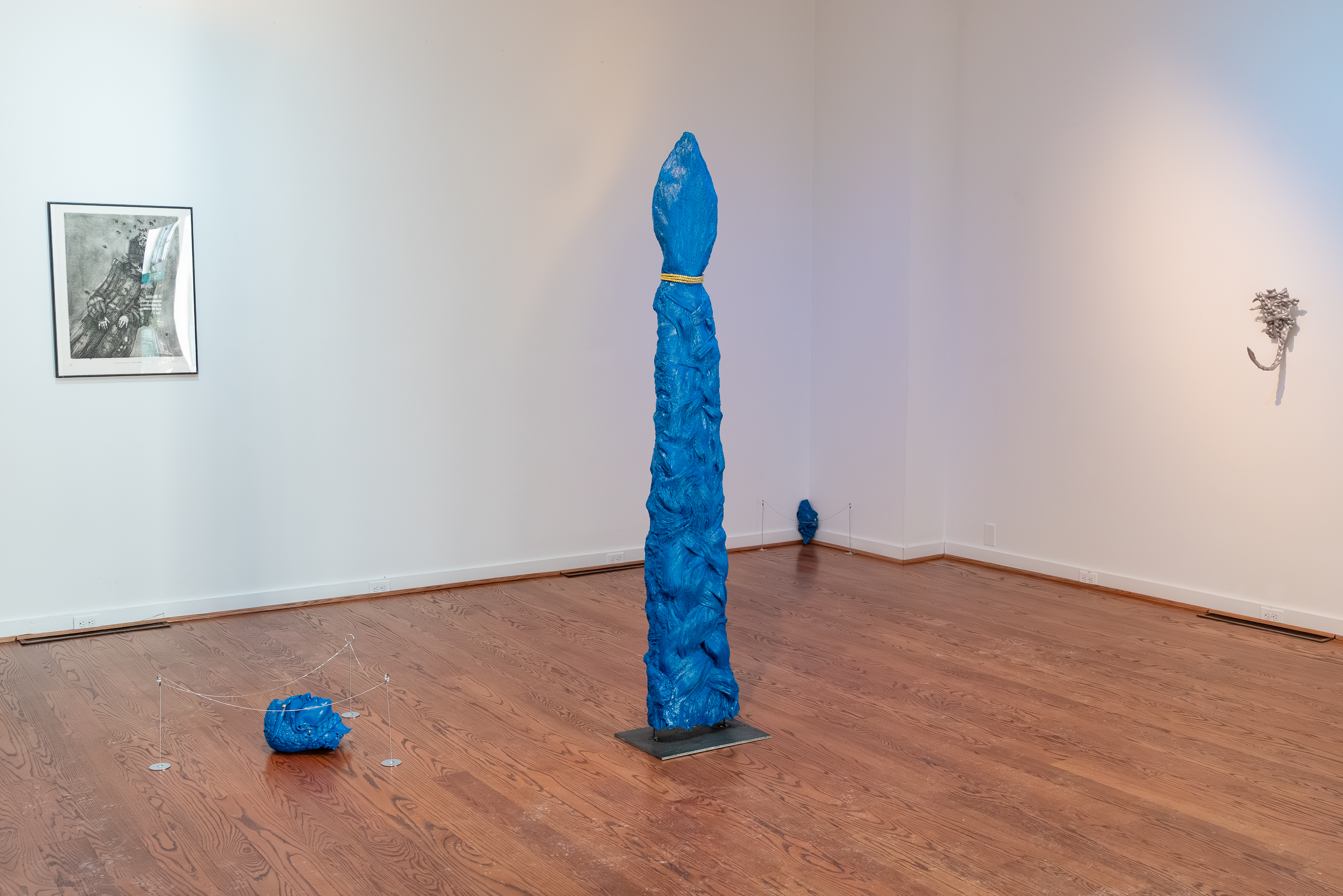 Photo of Inútil installation by Amir Pourmand.
Cieslik: Yes, and one of the things I love about the AMA is just how close it is to the National Mall and to the White House. What was the importance of creating and displaying these works so close to the epicenter of bigoted rot, especially surrounding queer bodies and identities?
Mercedes: I think that it just contextualizes the show in a very different way, and it made it very clear. There is a piece in the show which is called It’s Not a Belief System or an Idea. It’s like a huge trenza, a huge braid that is blue, and I feel like that piece is really in dialogue with the Washington Monument that you can see from where the piece is installed because the Washington Monument is very phallic. Trenzas or braids can also be really phallic, but hopefully this kind of huge, massive braid is more of a monument to what I wish this country represented rather than what the Washington Monument currently represents.
I looked at the permanent collection before I even started making any of the work, so I picked out all of this work I was interested it and then started to have dialogue with the work by amazing artists like Jose Luis Cuevas, who is one of the Mexican artists, and Juan Downey, who is a Chilean artist, and it wasn’t until we installed the show, and I was really looking at the pieces again, that I realized a lot of the works that I picked were either made right before or during dictatorship. For Cuevas it was during Mexico’s so called guerra sucia.
Cieslik: Yes, and something that’s coming up for me in our conversation is the idea of body fascism, or how the ways in which we present our gender and our bodies [and how they are controlled] are sometimes intertwined in fascist systems of control. How is that control and regulation and policing, especially of queer bodies, a throughline in your show?
Mercedes: I couldn’t agree more. I think that there is a lot of policing and control of queer bodies, and I think that through the process of trying to manipulate my own body, altar my face, and really have it on a very physical level, morph, in a lot of different ways, is an attempt to try to regain agency in the conversation--to think about my body as something that can be a source of shapeshifting. For me, I always think about material as a space of liberation in terms of gender and actually this summer, I’m creating a bigender opera with the Walters Museum, which is called Velvet Rage, and I will be using the power hammers in the techno section of that.
I am always trying to think about how I can think about liberation of gender on a material level, but I love this idea of fascism in relation to the control of the body because I think that’s very true, especially when it comes to creating binaries and systems of gender. A huge portion of the sculptures are blue, and I liked the idea of the blue because I feel like it felt very queer and otherworldly and not related to anything we think of in terms of gender. There are no bodies which are blue on this earth.
Cieslik: I totally agree, and just like you were saying, that dichotomy between the beautiful, tall blue braid and the Washington Monument becomes even more glaring when your work is surrounded by white marble monuments.
My last question is that you mentioned es un systema de fe [“it’s a belief system”]. What belief system are you referring to, and what faith is it connoting?
Mercedes: I think it’s really open within this work of art. I feel like I was trying to think about multiple belief systems because we’re living in a country right now where folks who are thinking about Second Amendment rights and that’s a belief system. But at the same time, I wanted that piece to also kind of reference club culture and queer club culture. That’s also a belief system, even the way in which I’ve created my own practice where I’m destroying these weapons and trying to create these different strange kinetic sculptures that are destroying themselves over and over again. I have to have belief in my own work in order to continue.
Inútil will run through April 19, 2026.
Mercedes’ opera Velvet Rage will run on the following dates:
Act 1: May 31st, 7 PM, Power Plant Live, Baltimore, MD
Act 2: June 27th, 1-4 PM Walters Museum, Baltimore, MD

Emma Cieslik
Emma Cieslik (she/her) is a queer, disabled and neurodivergent museum professional and writer based in Washington, DC. She is also a queer religious scholar interested in the intersections of religion, gender, sexuality, and material culture, especially focused on queer religious identity and accessible histories. Her previous writing has appeared in The Art Newspaper, ArtUK, Archer Magazine, Religion & Politics, The Revealer, Nursing Clio, Killing the Buddha, Museum Next, Religion Dispatches, and Teen Vogue
view all articles from this author