Whitehot Magazine
August 2026
"The Best Art In The World"
"The Best Art In The World"
August 2026
Eva Petric Talks with Whitehot About "Bird of Hope For Peace"
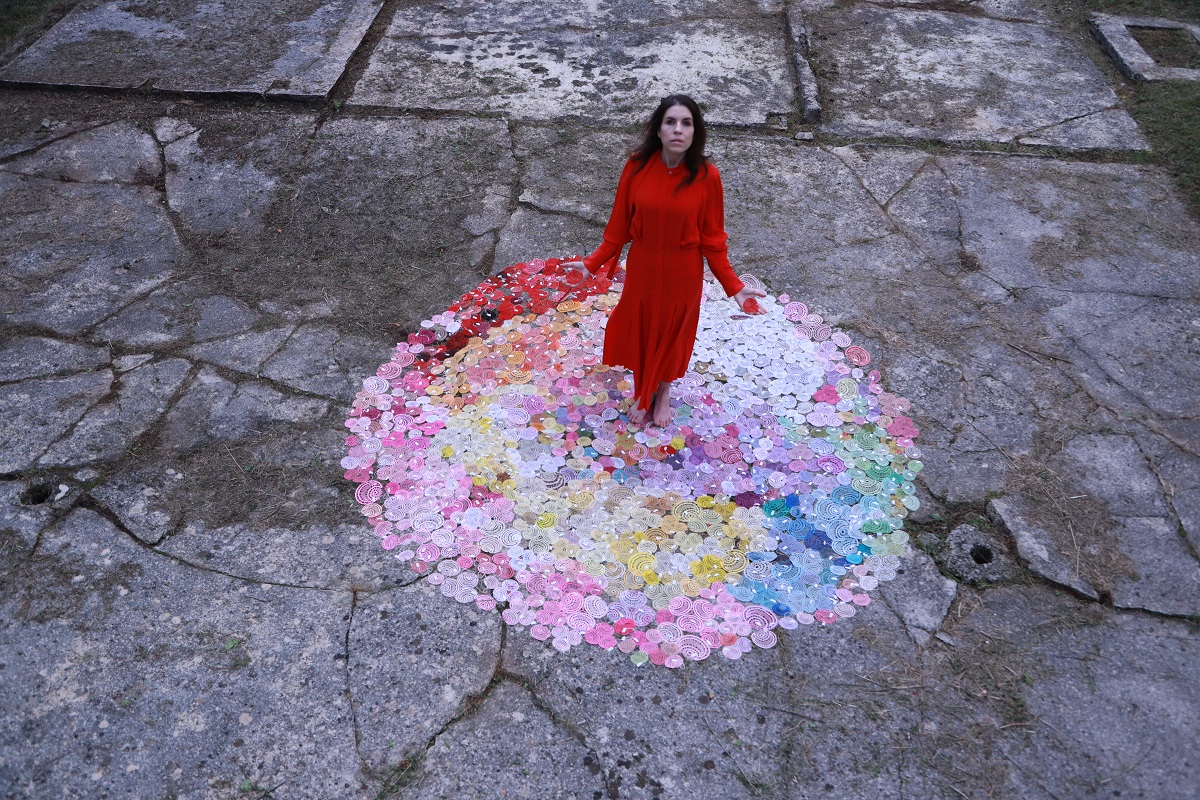 Eva Petric, Bird of Hope for Peace, from a performance
By NOAH BECKER April 1st, 2026
What does it mean for you to present Bird of Hope for Peace in New York City, near the United Nations and within such an international cultural context?
Presenting the “Bird of Hope” in New York City marks a return to a place that shaped me during my high school years. Today, however, I return as an artist carrying a global message. New York is the ultimate melting pot, built by people who arrived with dreams of creating something new. Within this multicultural fabric, the “Bird of Hope” becomes a connective symbol. Many immigrants came here in search of peace, and I believe that the hope for peace is the original shared vision that continues to hold this city together.
By placing this bird into a public space - as the Narthex Gallery of St.Peter’s is - near the United Nations (which is not a public space opened to all), I both honor and challenge New York’s global role, demonstrating that even among so many cultures, hope remains a universal language. New York City stands at the crossroads of the world, and there is no better place to amplify a call for peace. Having the “Bird of Hope” present within this international dialogue reminds us that although our backgrounds differ, our aspiration for a harmonious future is shared.
Bringing the “Bird of Hope” to New York therefore gives voice to a silent hope that unites us all. Its presence near the United Nations reinforces the urgency of this message. It is a call for unity in a city that never stops—an invitation to pause and reflect on the peace we must build together.
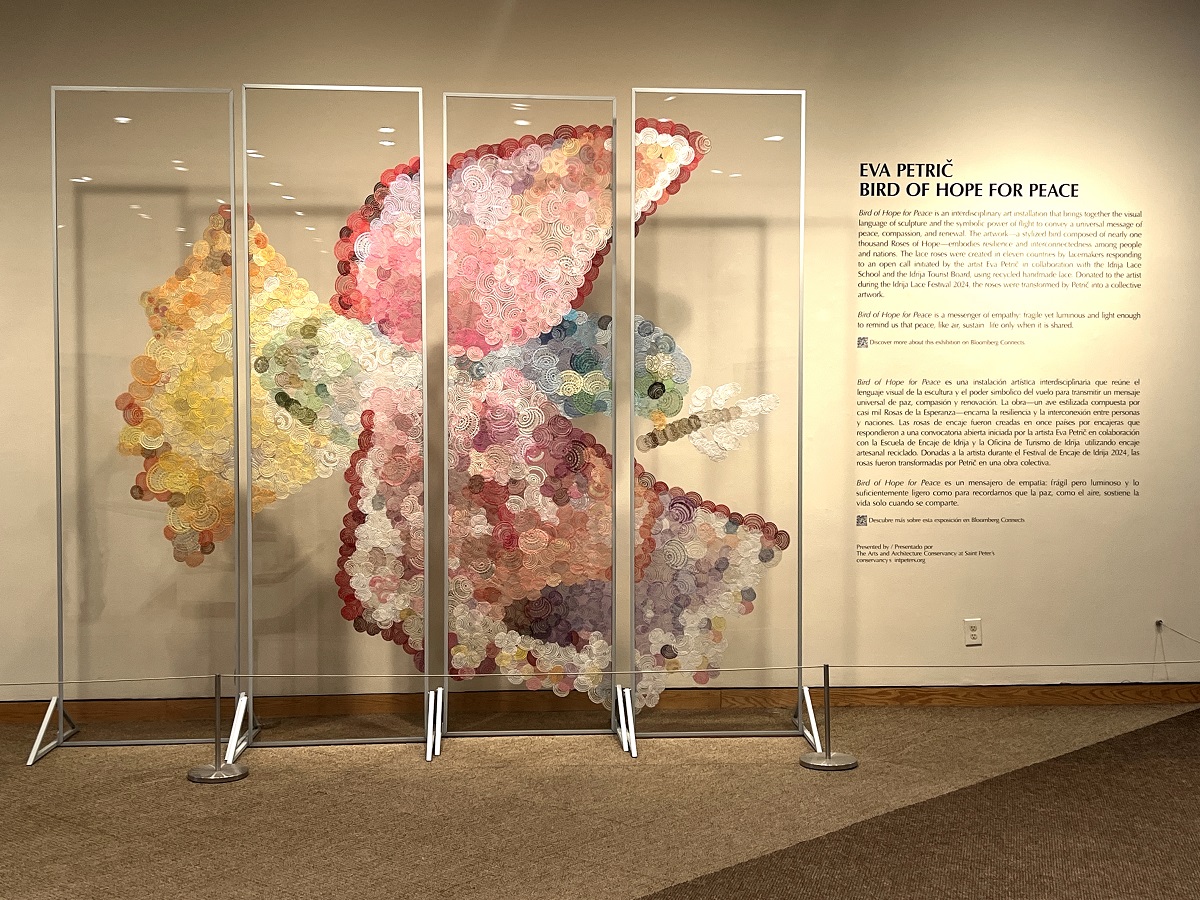 Eva Petric, Bird of Hope for Peace
How did the history of the former forced labor camp at the Ljubelj / Loibl Pass shape the concept behind this work?
The history of the former forced labor camp at the Ljubelj / Loibl Pass deeply shaped the ethical foundation of this work. It is a stark reminder of human cruelty, where prisoners were forced to pierce through a mountain in a desperate struggle for survival. Creating the “Bird of Hope” in response to such a place means acknowledging that darkness and light often exist within the same landscape. The bird symbolizes the resilience of the human spirit—the belief that even from the depths of suffering, the desire for freedom and peace can still take flight.
A crucial element of this work is that the bird is composed of nearly one thousand small lace elements shaped like tiny roses of hope. They were created in response to my open call organized together with the Insittute for culture from Idrija, the origin of Idrija lace, and people from eleven different countries contributed their handmade pieces. Each rose arrived with a small tag bearing a number and the name of the person who made it.
This detail became deeply meaningful to me. The presence of both names and numbers reminded me that throughout history, and particularly in places like forced labor camps, people were often reduced to numbers. The project therefore became a quiet insistence that human beings must never be treated merely as statistics. Every small rose represents an individual gesture, a personal story, and a human presence. Together they form a collective body of hope.
During the performance at the site, I wore a red dress. For me, the color did not symbolize blood or ego, but life itself—a vibrant act of resistance against the cold stone landscape and the memory of suffering embedded there.
Interestingly, the project did not originally begin as a bird. It started as a circle—the fourth in a series of ritual forms—symbolizing something youthful, cyclical, and spring-like. However, during a performance in harsh weather, as I hurriedly gathered the lace pieces to protect them from a sudden storm, a bird-like shape unexpectedly appeared. In that moment I realized that the symbol should no longer remain enclosed within a circle. The dove of peace had to be released—it had to take flight.
The “Bird of Hope” thus transforms a site of historical suffering into a space of remembrance and reconciliation. Seen from above, it invites us to broaden our perspective, moving away from the dehumanizing logic of numbers toward a shared and compassionate understanding of humanity.
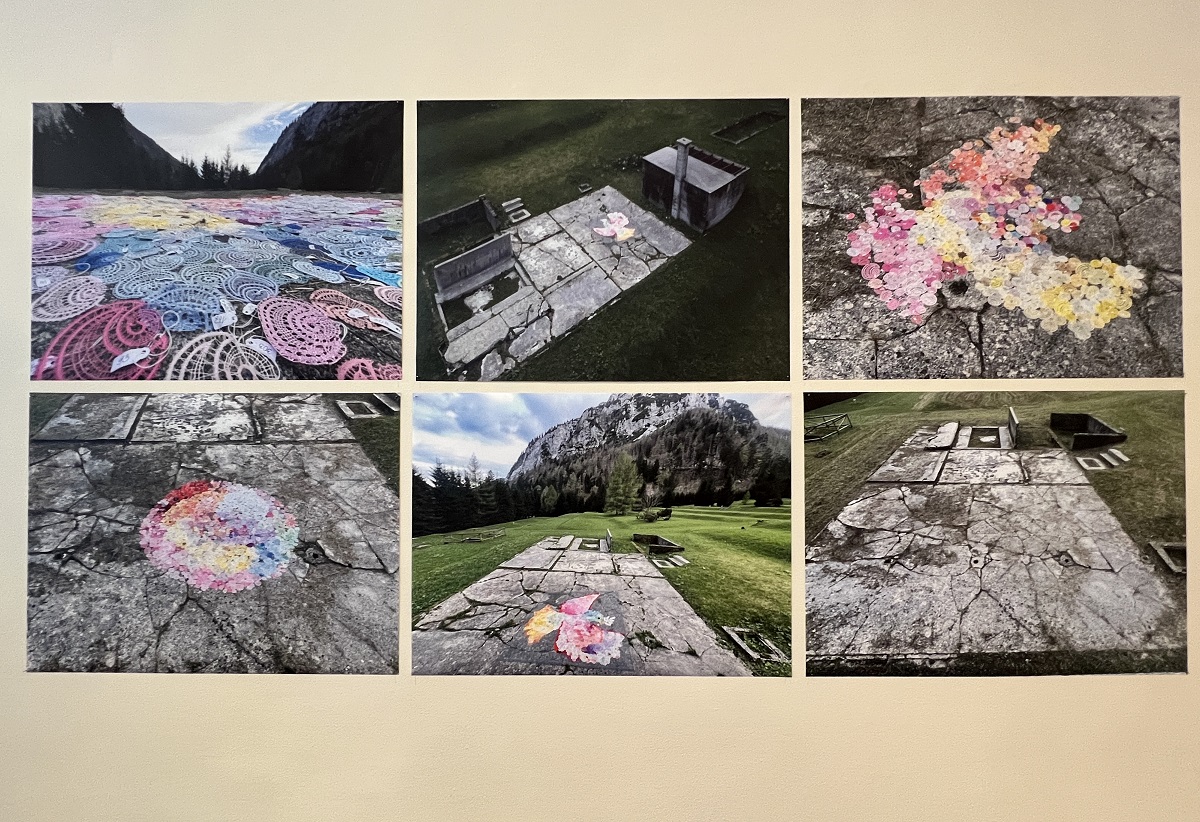 Eva Petric, Bird of Hope for Peace, performace photos
The project includes photographs documenting a performative action at the historical site. How does performance help you engage with memory and history in your practice?
"For me, performance is a way to bridge the gap between abstract history and lived experience. By physically being at the Ljubelj / Loibl Pass, my body becomes a medium through which the memory of the site is reactivated. It is not just about observing the past; it is about honoring the presence of those who suffered there. I think it is important to acknowledge physical presence at locations. These photographs document a silent dialogue – that was enabled by my physical presence at the site (also the hand made laces include manifestation of physical presence)- between the weight of the mountain and the fragility of the 'Bird of Hope,' showing that memory is not static—it is a living act of remembrance that we must constantly perform to keep the hope for peace alive."
 Eva Petric, Bird of Hope for Peace, performace photos
How did the architecture and atmosphere of the Narthex Gallery at Saint Peter’s Church influence the way you adapted the installation for this exhibition?
"The Narthex Gallery at Saint Peter’s Church is a space of transition—a threshold between the bustling energy of Manhattan and a sanctuary of reflection. Its modern, open architecture and the play of light deeply influenced how I positioned the installation. The 'Bird of Hope' needs air and light to 'fly,' and here, it interacts with the verticality of the space, mirroring a spiritual ascent. The atmosphere of the church, which has a long history of supporting jazz, arts, and human rights, provides a sacred resonance to the work, turning the exhibition into a meditative encounter with history and peace. For my project also the fact that this space is open to public, carries great importance."
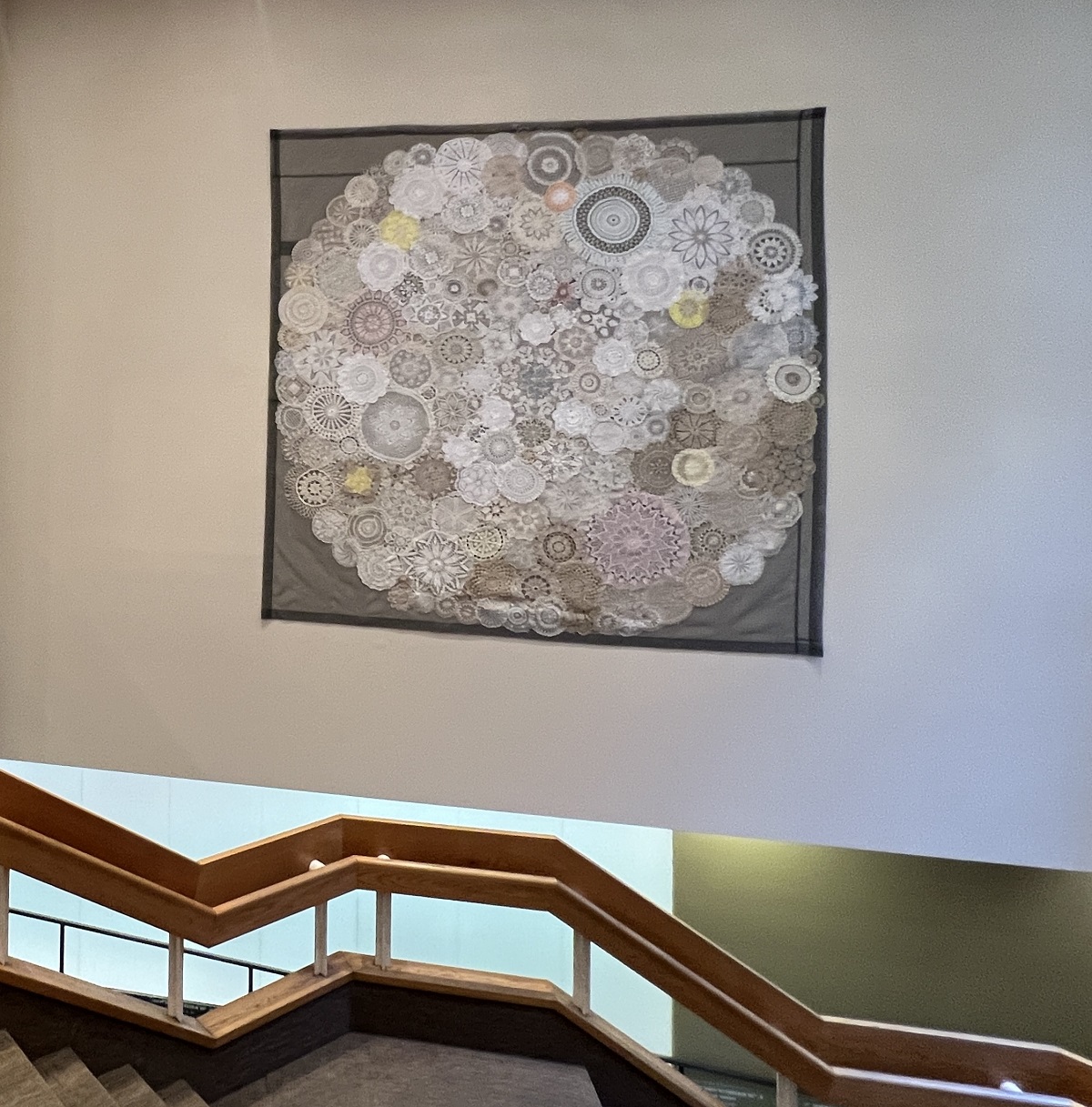 Eva Petric, World Embryo
Your work often connects personal memory with collective history. How did your childhood experiences in this mountain region inform the project?
"Growing up in the shadow of these mountains, the landscape was never just scenery to me—it was a silent witness. As a child, you feel the overwhelming scale of the Alps, but you also sense the layers of stories buried within them. This mountain region is a place of profound contrasts: the breathtaking beauty of nature versus the dark, heavy memories of the labor camp. My childhood experiences taught me that memory is etched into the earth. The 'Bird of Hope' was born from this duality—the need to take the heavy, cold stone of history and give it the wings of a bird, allowing it to rise above the peaks toward a horizon of peace."
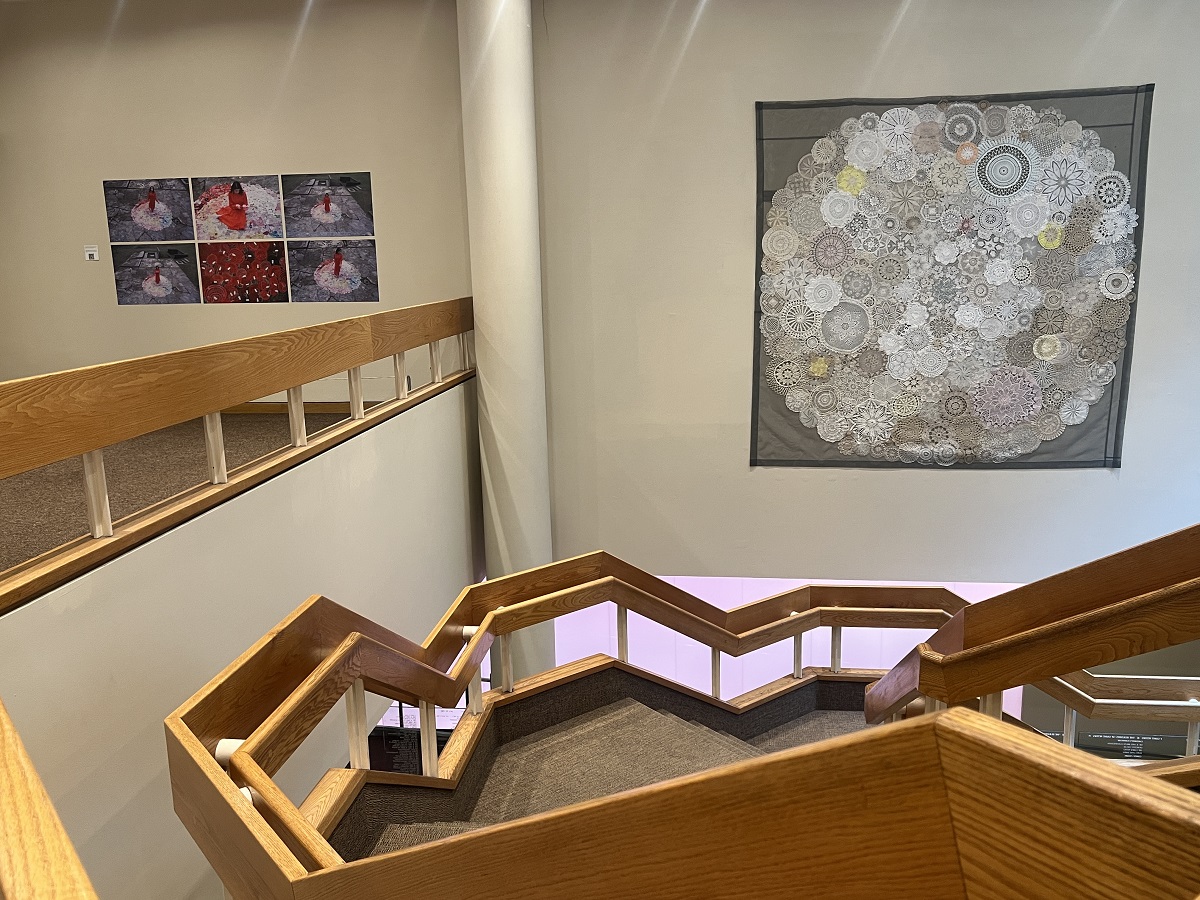 Eva Petric, World Embryo
In this exhibition you also reference your long-term project World Embryo. What ideas connect these two works?
This exhibition also references my long-term project World Embryo, which I had the honor of presenting at the United Nations in 2018 as One World – A World for All, at the Delegates Entrance of the UN Headquarters. Unlike the Bird of Hope, however, that installation was not situated in a space freely accessible to the general public. It was placed within the diplomatic environment of the UN, primarily experienced by delegates and officials. In contrast, the presentation of the Bird of Hope at St. Peter’s Art and Architectural Conservancy unfolds in a space open to everyone, allowing the message to reach a broader public directly.
Both projects are connected by a shared reflection on the genesis of life and the persistence of hope. World Embryo is crafted from recycled lace gathered from many parts of the world, carrying with it the traces of countless anonymous hands. These fragments are transformed into a single, fragile vessel of life—an image of humanity’s shared origin and interdependence.
If World Embryo represents the silent potential of peace, the Bird of Hope embodies its movement and realization. The embryo symbolizes the inner beginning—the delicate spark of life and possibility—while the bird represents that same energy taking flight into the collective history of the world.
Seen together, the two works form consecutive stages of the same journey. One is the seed; the other is the ascent. While World Embryo reflects on the fragile origin of life, the Bird of Hope expands this vision into the public sphere, reminding us that peace is not a finished state but a process that must continually grow, gather strength, and rise above the scars of the past.
 Names-numbers stickers, Eva Petric Bird of Hope for Peace
What kind of reflection or dialogue do you hope visitors will experience when encountering Bird of Hope for Peace?
"I hope visitors feel the energy of the colors and the weight of the names. I want them to realize that peace isn't just a political goal—it starts with how we perceive the 'other.' If we can stop seeing numbers and start seeing stories, the 'Bird of Hope' can truly soar. I want them to leave with more than just a memory of an image; I want them to leave with the hope that peace can become a reality."

Noah Becker
Noah Becker is an artist and the publisher and founding editor of Whitehot Magazine. He shows his paintings internationally at museums and galleries. Becker also plays jazz saxophone. Becker's writing has appeared in The Guardian, VICE, Garage, Art in America, Interview Magazine, Canadian Art and the Huffington Post. He has written texts for major artist monographs published by Rizzoli and Hatje Cantz. Becker directed the New York art documentary New York is Now (2010). Becker's new album of original music "Mode For Noah" was released in 2023.
Becker's 386 page hardcover book "20 Years of Noah Becker's Whitehot Magazine of Contemporary Art" drops Aug 8, 2025 globally on Anthem Press.
Noah Becker on Instagram / Noah Becker Paintings / Noah Becker Music / Email: noah@whitehotmagazine.com
view all articles from this author