Whitehot Magazine
October 2026
"The Best Art In The World"
"The Best Art In The World"
October 2026
Stan Squirewell’s The Weight of Grace at Claire Oliver Gallery: A House for the Past, A Place for the Present
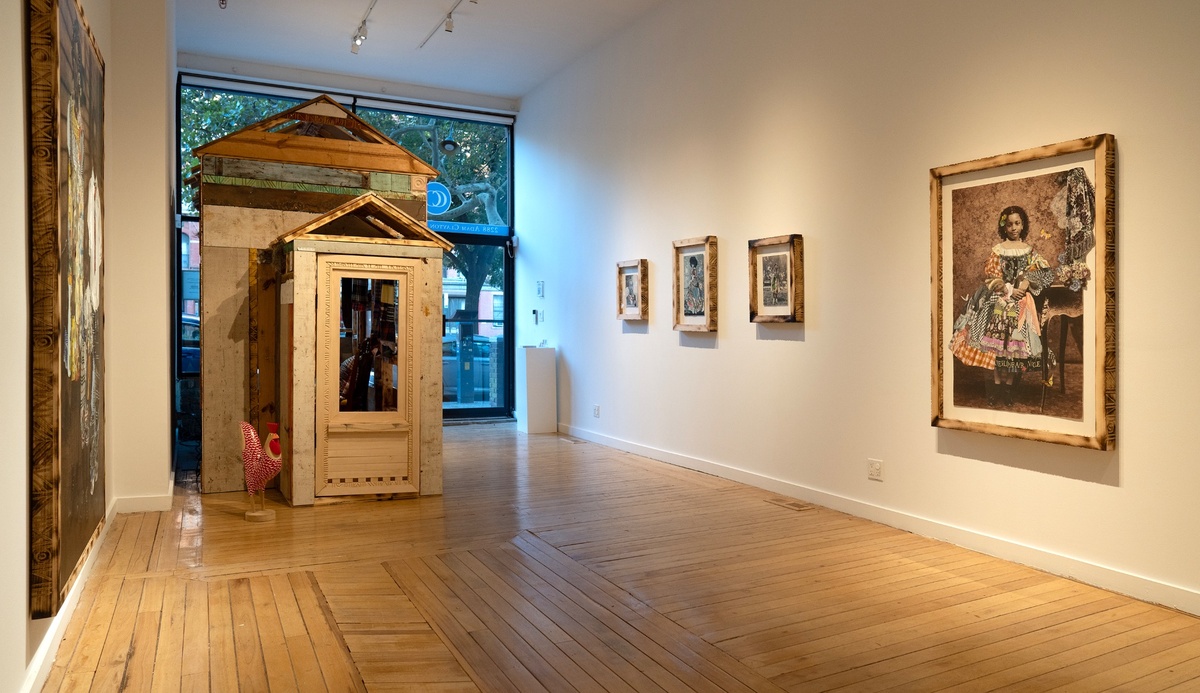 Installation view of Stan Squirewell’s The Weight of Grace at Claire Oliver Gallery, 2026. Courtesy of Claire Oliver Gallery.
By KUN SOK October 12th, 2026
When I rang the bell at Claire Oliver Gallery in Harlem, Claire Oliver opened the door. It felt like being invited into someone’s home. Immediately upon entering, I encountered another house: Stan Squirewell’s The House of Inheritance (2026). Inside were a television flickering with static, a glowing lamp, curtains, framed pictures, and magazines. Although installed in a gallery, it looked as though someone had been there moments before.
In The Weight of Grace, Squirewell gives figures from old photographs new clothing and settings, then extends this process into a space visitors can occupy. He works with both family photographs and anonymous images from the Smithsonian’s archives. The house gives this engagement with the past a specific family anchor: inside is his oldest ancestral photograph, depicting a Civil War veteran. Built from reclaimed wood, it takes the form of a shotgun house associated with Black domestic life in the American South. The installation places a family image within a space that present-day visitors can enter.
Before entering the house, I examined the portraits. Squirewell cuts photographs of patterned fabrics and collages them onto the figures, giving them new clothing and backgrounds. The paper follows their bodies with remarkable precision. At first glance, the works resemble restored black-and-white photographs with color added to clothing and accessories. Up close, however, overlaps and joins become apparent. The collages disclose their construction while creating clothes the subjects might plausibly have worn.
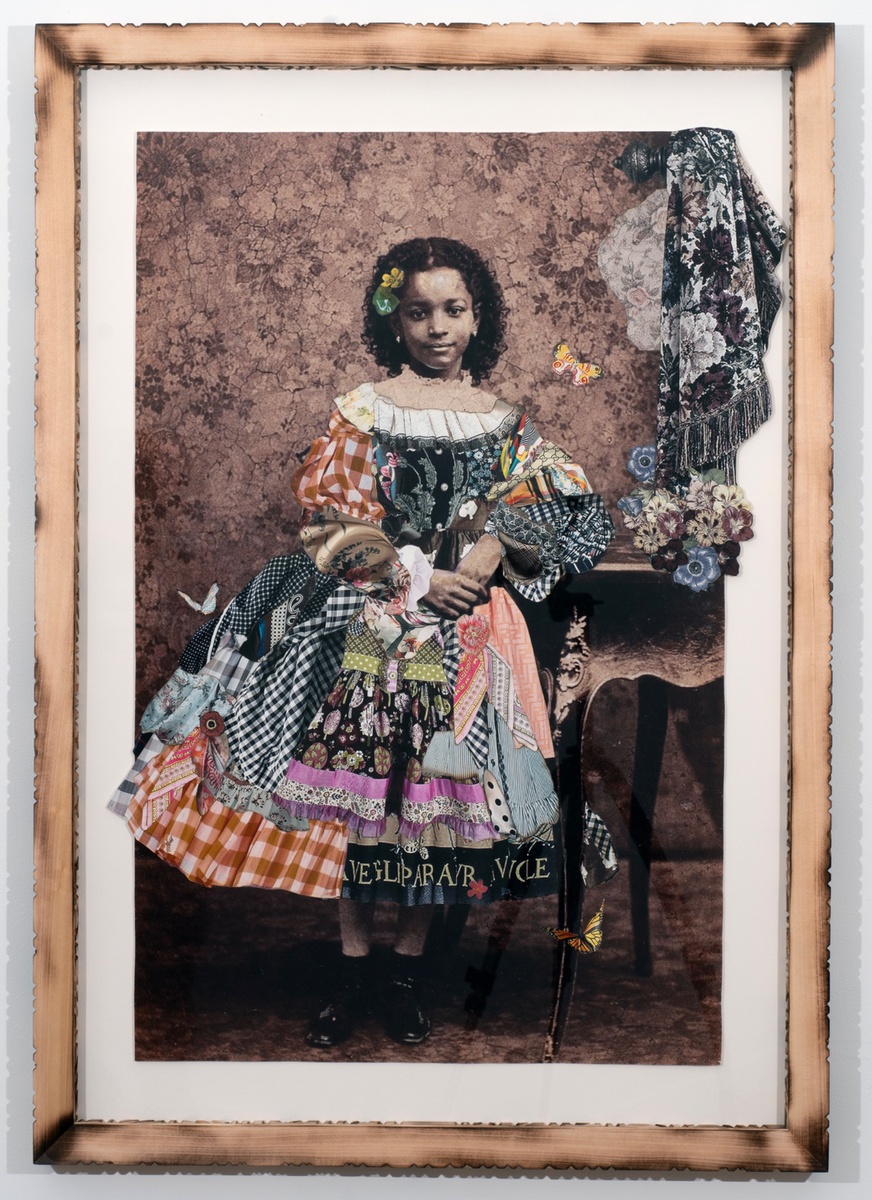 Stan Squirewell, Aquinnah, 2026, artist-printed photos collaged with paint and glitter in a hand carved shu shugi ban frame, 43.5 × 38 inches. Courtesy of Claire Oliver Gallery.
Yet the clothing does not bring every figure into the same moment. The girl in Aquinnah has a clear gaze and a faint smile. Her full skirt extends beyond the photographic background into the white margin. Its dimensionality made her seem to emerge from the photograph; I could imagine encountering her in Harlem today. In Jr. and Melody, the soft facial details and faded photographic textures caught my attention before the new clothing did. These figures still seemed to belong to old photographs. Contemporary patterns do not erase every trace of temporal distance.
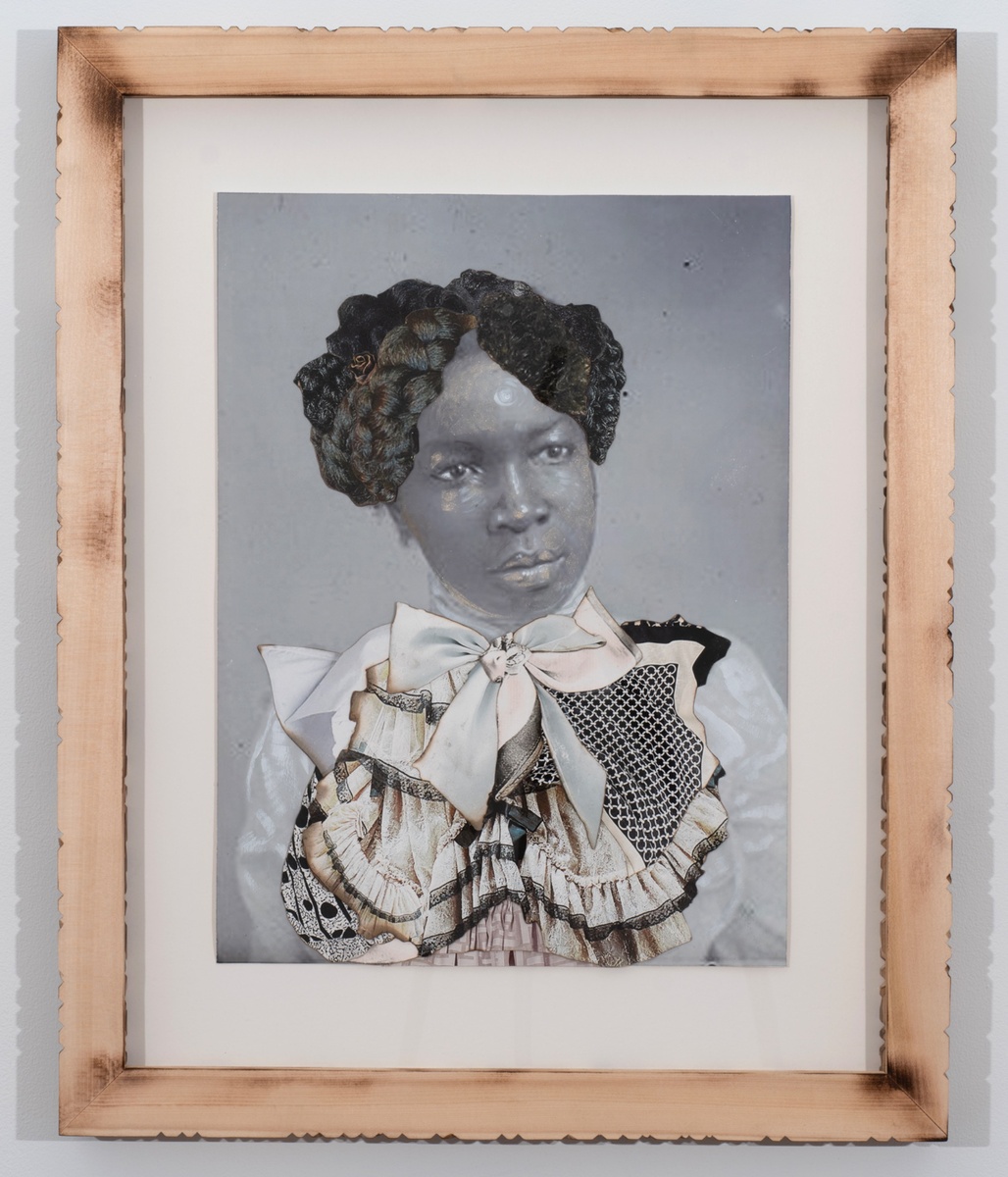 Stan Squirewell, Melody, 2026, artist-printed photos collaged with paint and glitter in a hand carved shu shugi ban frame, 33 × 26 inches. Courtesy of Claire Oliver Gallery.
The thick wooden frames bear marks of scorching. Their depth and scorched surfaces give each portrait a physical place, like a small dwelling. In Autumn at Nana’s II, two children sit before a doorway, their patterned clothes surrounded by collaged images of weathered boards. Fabric and wood meet in photographic form. In The House of Inheritance, those materials become curtains, cushions, and walls.
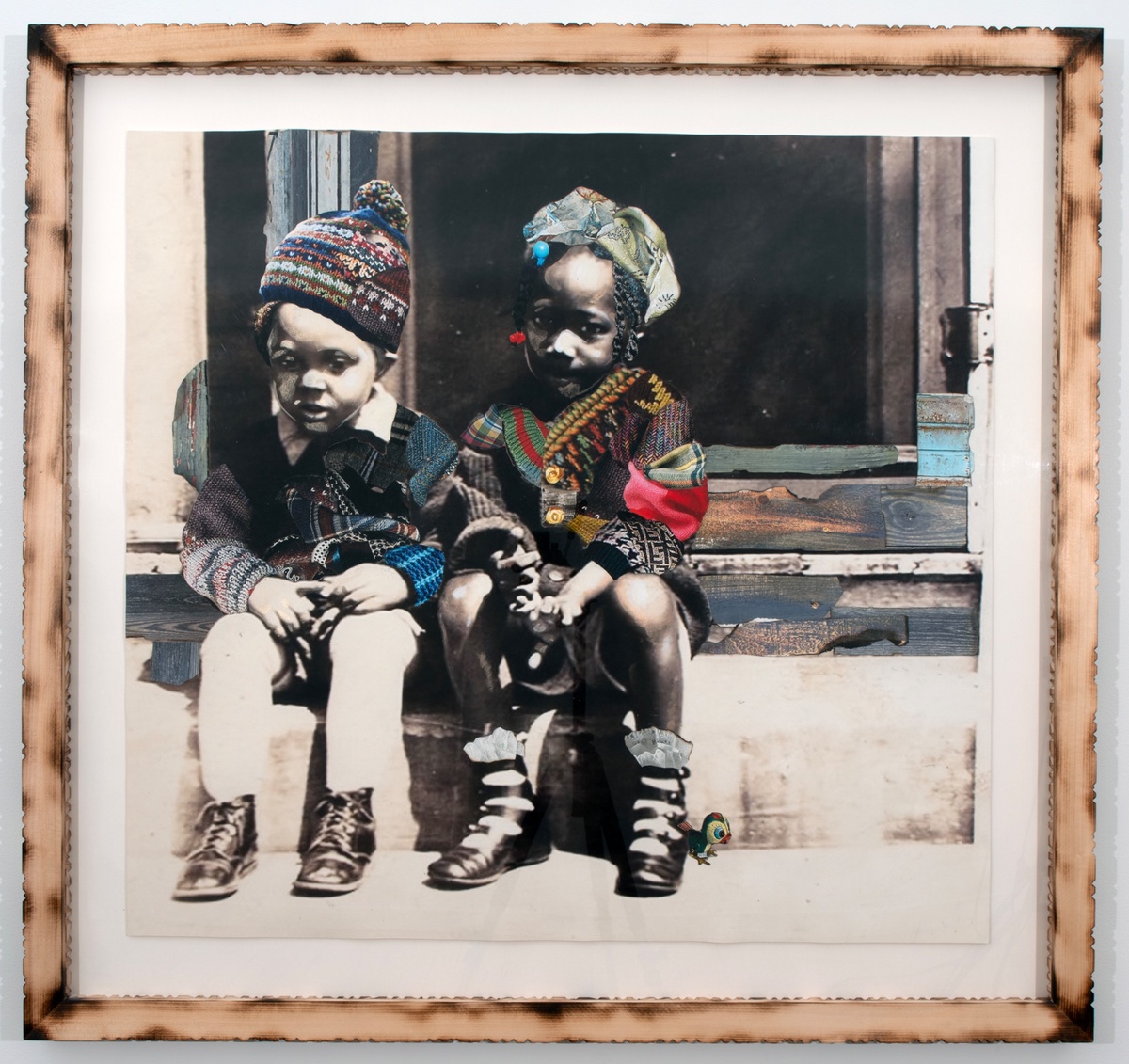 Stan Squirewell, Autumn at Nana’s II, 2026, artist-printed photos collaged with paint and glitter in a hand carved shu shugi ban frame, 51.5 × 48.5 inches. Courtesy of Claire Oliver Gallery.
After carefully studying all the portraits, I entered the house. Wooden walls surrounded me, and the television’s static became the sound of the room I occupied. For a moment, I felt as though I had become a figure in one of Squirewell’s portraits, wearing clothes assembled from fragments and standing within a background he had made. The portraits had changed how I saw the house.
Here, collage becomes a way of organizing space around a body. Disparate boards form walls, and patterned fabrics furnish the interior. Their differences remain visible: wood varies in color and texture, while exposed framing and gaps allow views of the gallery. The lamp and television suggest daily life without concealing the structure’s assembly. As in the portraits, visible joins coexist with a convincing whole.
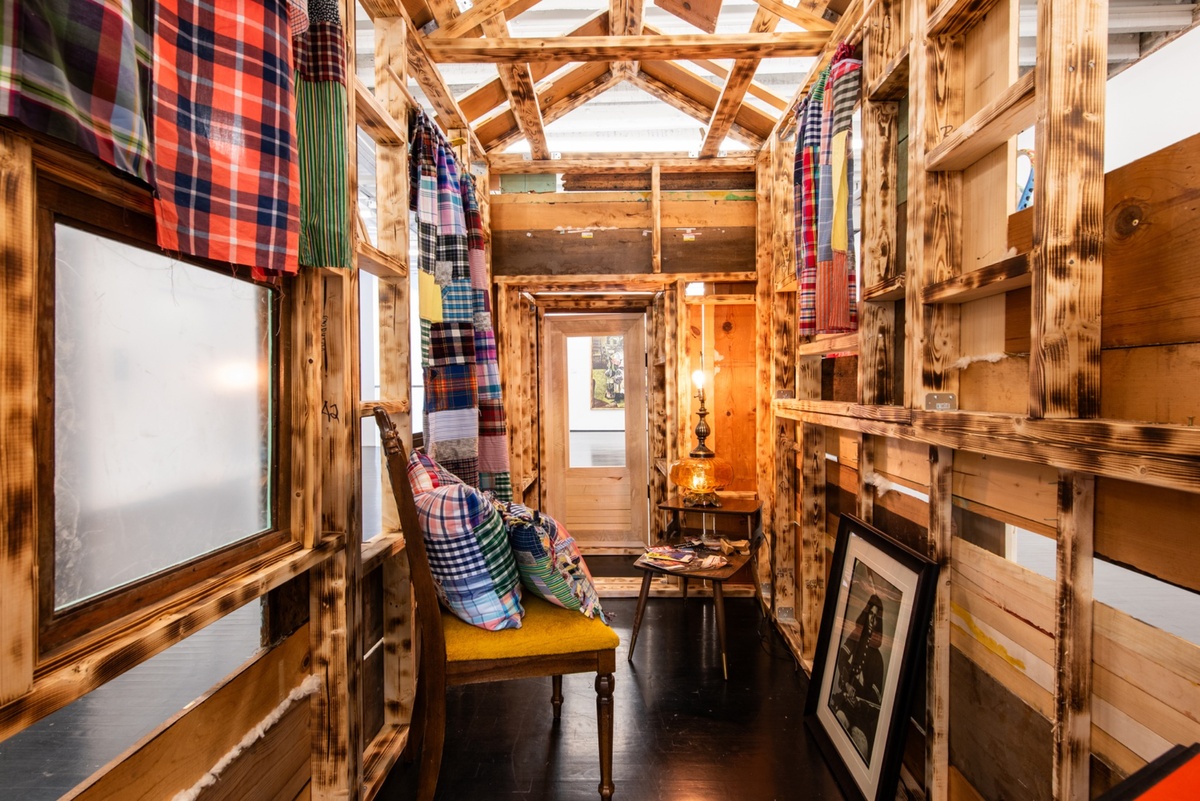 Detail of Stan Squirewell’s The House of Inheritance, 2026, mixed media, reclaimed and salvaged wood, 9 × 11 × 6 ft. Photo by Diane Deacon Street. Image courtesy of KMAC Contemporary Art Museum.
The house’s particular contribution is to make the viewer’s position part of this construction. A portrait offers clothing and surroundings to a photographed figure; the installation offers an environment to a living visitor. Its scale, sounds, and materials require more than visual inspection. They establish an inside from which the exhibition can be encountered differently. The ancestral photograph places a family presence within that space, while the visitor occupies it in the present.
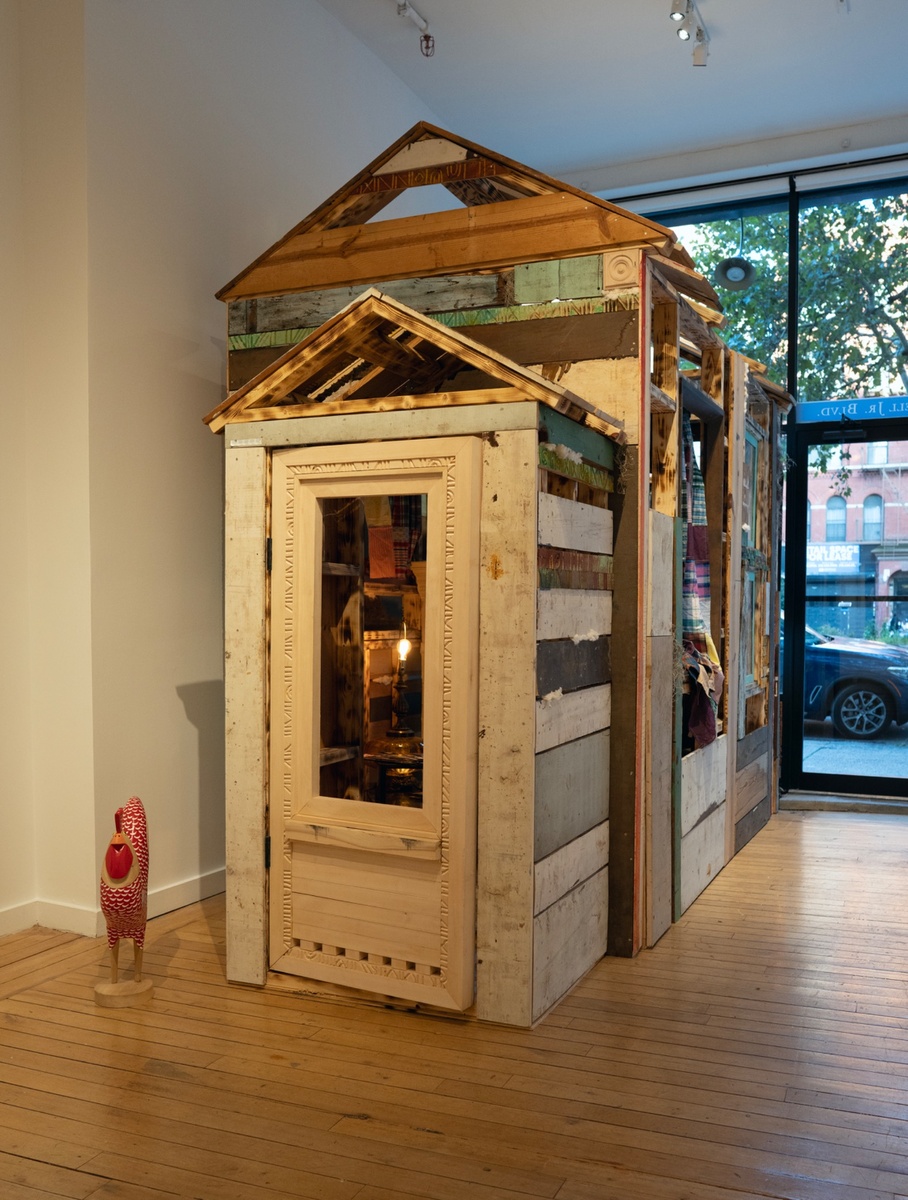 Stan Squirewell, The House of Inheritance, 2026, mixed media, reclaimed and salvaged wood, 9 × 11 × 6 ft. Installation view at Claire Oliver Gallery. Courtesy of Claire Oliver Gallery.
This encounter does not reveal how the photographed people lived. Familiar objects suggest domestic routines without explaining a particular biography. What the installation makes available is the portraits’ relationship between bodies and constructed surroundings. Patterns and joins first encountered as images become fabric and timber around the visitor.
The house’s achievement lies in this continuity. Entering it after studying the portraits turns a change of medium into a reconsideration of what has just been seen. The clothing, backgrounds, and frames acquire a spatial counterpart; the room gains meaning through the figures on the walls. This connection gives the installation more substance than the invitation to step inside alone.
The feeling of occupying the house stayed with me afterward. Yet the portraits retained their distinct faces and differing distances from the present. The Weight of Grace gains its force from that balance: it brings the viewer physically into a constructed setting while leaving the photographed figures’ temporal differences intact. Past images and present bodies share a place without becoming interchangeable.