Whitehot Magazine
October 2026
"The Best Art In The World"
"The Best Art In The World"
October 2026
1974/2026: Kishio Suga and the Slash Date
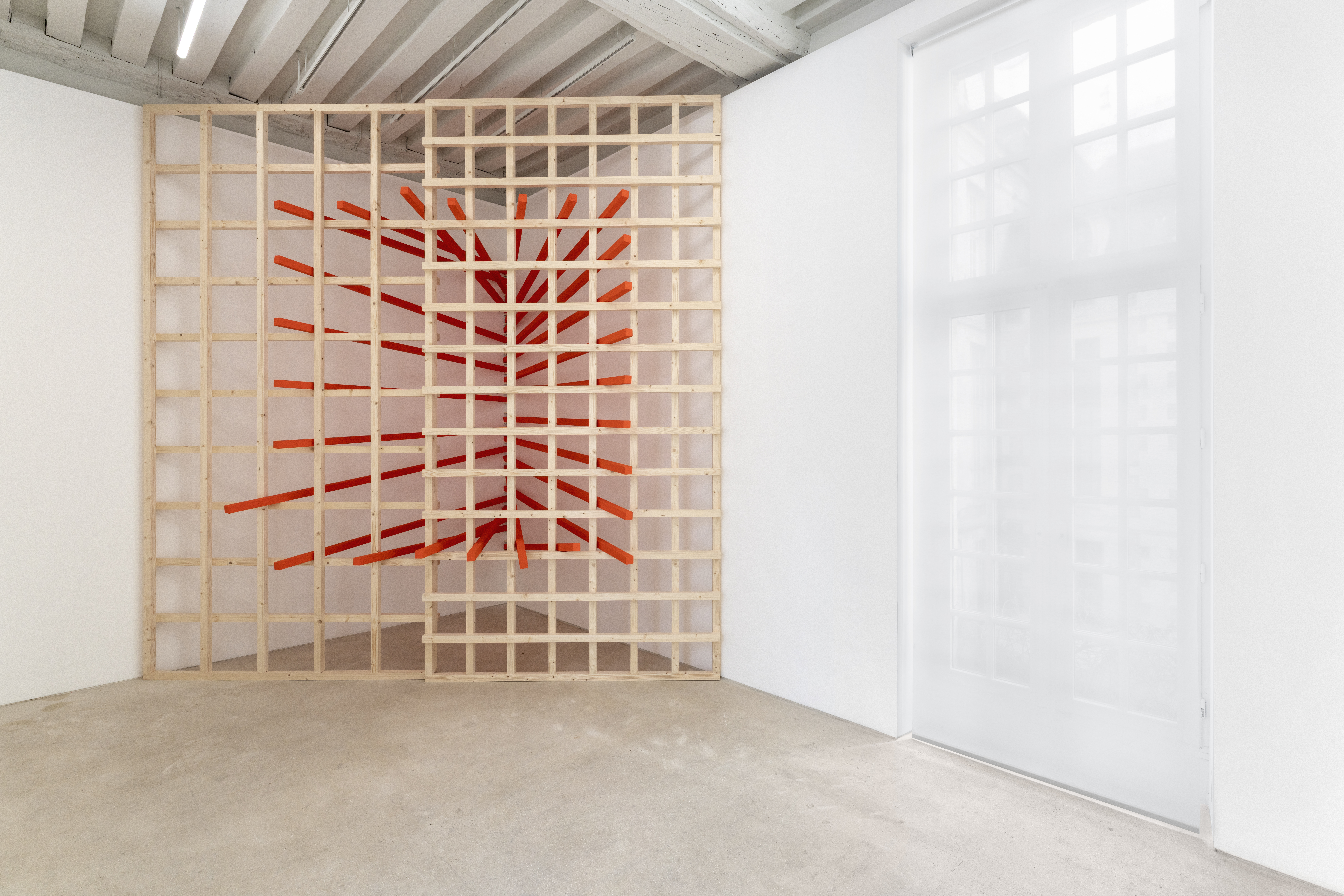 Kishio Suga, Boundary of Marginal Scenery, 1994/2026. Wood, paint, dimensions variable. Installation view, Mendes Wood DM, Paris, 2026. Courtesy of the artist and Mendes Wood DM, São Paulo, Brussels, Paris, New York.
BY LUMAN JIANG July 8th, 2026
A date split by a slash is a strange thing to find on a label. Walk through Kishio Suga's exhibition at Mendes Wood DM in Paris this spring and you find it on a wooden grid pierced by a burst of red bars, dated 1994/2026. Cross the Atlantic to the gallery's New York space and you find it again, on a different installation: 1982/2026. Take the train up to Dia Beacon, where Suga's long-term display opened in 2025, and the dates multiply: 1970/2025, 1971/2025, 1973/2025, 1974/2025. The slash appears as a technical detail, a notation a registrar might use. It may also be the most concise expression of Suga's method.
The work in Paris, Boundary of Marginal Scenery, was first conceived in 1994. What hangs in the gallery now is, and is not, that work. A timber lattice rises the full height of the room; through its grid, painted red bars angle outward, as if the wall had been struck from behind by something radiant. The configuration is specific to this room, this ceiling, these windows. It cannot have looked like this in 1994. The gallery's own text confirms what the slash already says: these installations, it notes, "do not replicate their original configurations but instead respond to the specific conditions of the exhibition space."
What is the status of an object that exists twice, decades apart, in two unrepeatable arrangements? Suga answered this in a 2017 interview with Mika Yoshitake, on the occasion of his first U.S. museum solo at Dia Chelsea. Dia had initially requested a past work; once Suga saw the space, he chose to make something new. "There is a profound difference," he told her, "between the conditions of something at rest versus something that is upright, even if it is the same object." Same object, different situation. A situation, Suga has written elsewhere, "is rooted in the breakdown of the already present system. It excludes all traits that can be imitated or duplicated." If the work cannot be duplicated, no single date can anchor it. If it nonetheless returns, a new date must register its return. The slash is what is left when those two demands meet.
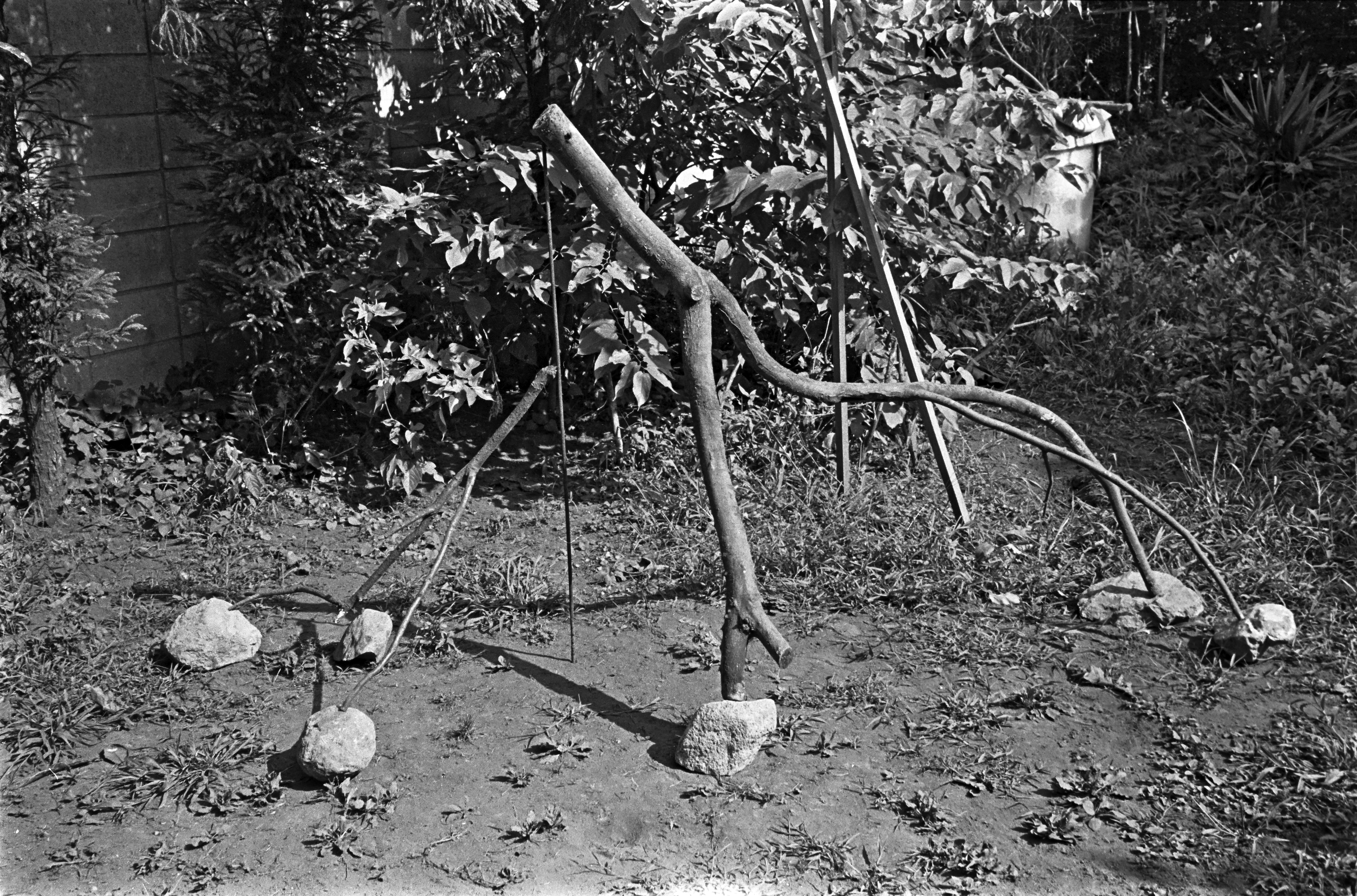 Kishio Suga, Branches of Critical Boundary, 1974. Branch, metal rod, stones, dimensions variable. Courtesy of the artist and Mendes Wood DM, São Paulo, Brussels, Paris, New York. Photo: Kishio Suga.
This logic also reorganizes how Suga's two-dimensional work behaves. The press release frames the show as two directions—works on paper and assemblages, installations—but the assemblages on the wall refuse the category they are placed in. Latent Branches (2015) is eighteen centimeters deep: a tree branch arches out from its wooden support, a stone weighing it down. Elements of Perimeter (1991) is nineteen centimeters of zinc-edged wood, more shallow vitrine than picture. The slash that splits the time of an installation has a spatial cousin: the surface that refuses to stay flat, the category that refuses to close.
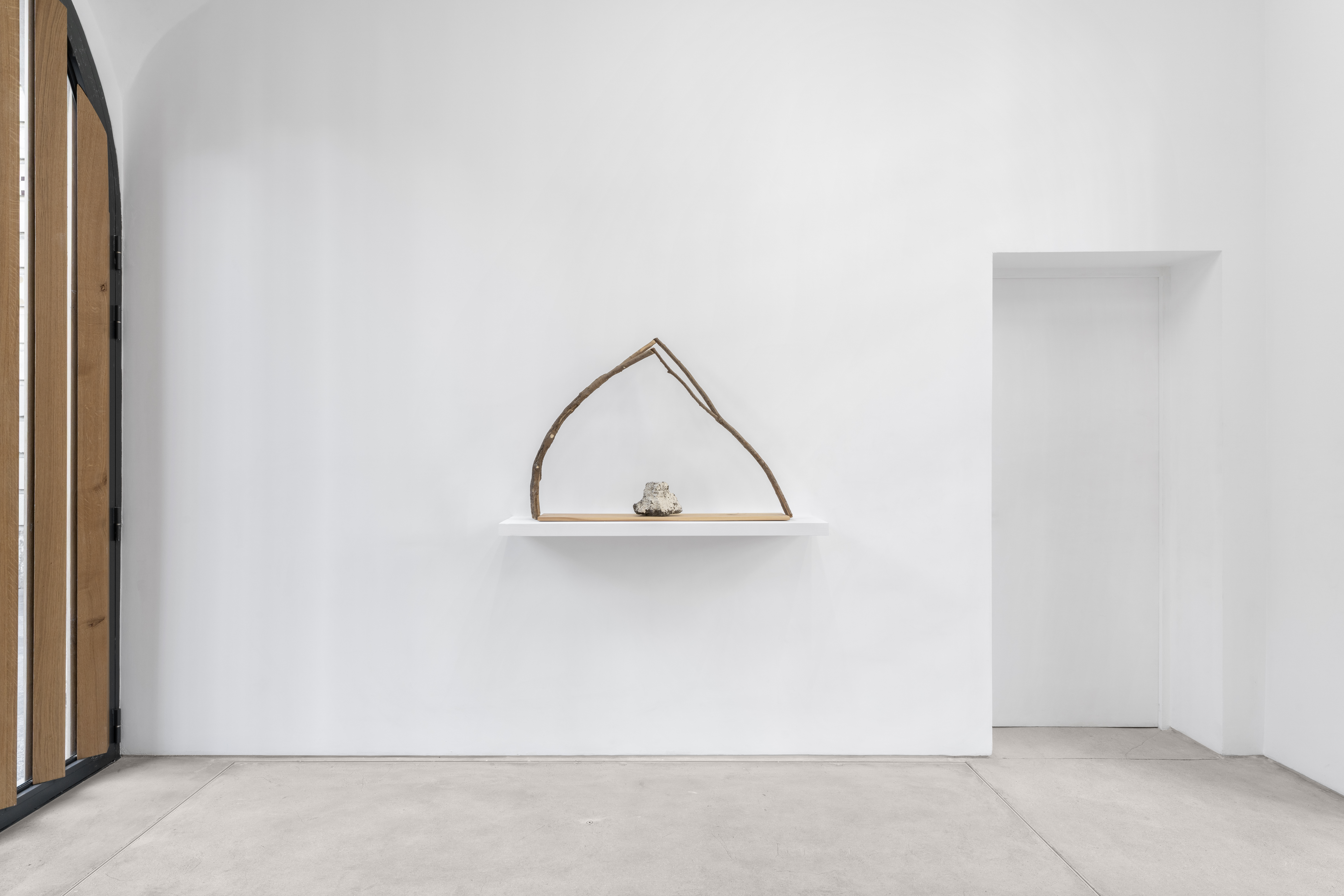 Kishio Suga, Latent Branches, 2015. Wood, branches, stone, 75.5 × 101 × 18 cm. Installation view, Mendes Wood DM, Paris, 2026. Courtesy of the artist and Mendes Wood DM, São Paulo, Brussels, Paris, New York.
It is here that the slash becomes more than a private notation. Suga has been generating slash dates for at least a decade; the 2017 interview already shows the method fully formed. What has changed is the scale at which it now operates. In 2025, Dia Beacon opened a long-term display of work from the 1960s to the 1990s; in 2026, Mendes Wood DM mounted dual exhibitions in Paris and New York, each with its own reconfigured installation. The work now sits in collections from Tate to Pompidou-Metz, from Dia to M+. Across this network, the slash is what allows Suga's situations to circulate without pretending to be fixed objects—holding the work together as one nameable thing while recording that no two instances of it are the same.
This is not a case of an artist being absorbed by an institutional system against the grain of his practice. Suga makes the slash himself—defends it in interviews, builds it into his method. What it makes visible is a quieter historical shift: Mono-ha's survival now depends not on escaping the institution but on finding a form that can stay unstable inside it. The movement that in the late 1960s sought to negate Western modernity from within has found, in the slash, a way to remain within the system of exhibition and collection without becoming one of its fixed objects. The compromise is honest. The slash neither pretends the work is unchanged nor pretends it is new. It writes "both" on the label, and lets the contradiction stand.
There is a temptation to read this as either betrayal or vindication, and it is neither. The slash is the form through which Suga lets historical distance remain visible while letting the work happen again. Boundary of Marginal Scenery will be reinstalled somewhere else, sometime else, and the right side of its slash will tick forward. Look long enough at "1994/2026," and you see what Mono-ha has become in our moment: not a movement that escaped the institution, but a practice that learned how to keep moving inside it. WM
Kishio Suga is on view at Mendes Wood DM, 25 Place des Vosges, Paris, through June 4, 2026, and at 47 Walker Street, New York, through May 23, 2026. Suga's long-term display at Dia Beacon opened in 2025.

Luman Jiang
Luman Jiang is an independent curator and writer based in New York. Her work engages contemporary art, curatorial practice, and cultural theory across Chinese and English.
view all articles from this author