Whitehot Magazine
October 2026
"The Best Art In The World"
"The Best Art In The World"
October 2026
Charles Dickson: Select Works, 1965–2026 at Parrasch Heijnen
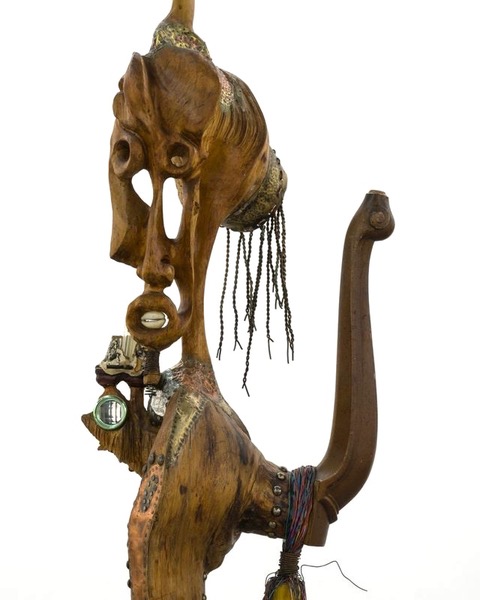 I Feel the Spirit (detail) 1980, mixed media, Photo courtesy Parrasch Heijnen
By GARY BREWER, Oct 28, 2026
There is a rich language in these sculptures that has been grown and cultivated in the soil of Los Angeles for decades. Charles Dickson’s work expresses ideas, feelings and memories through a vernacular of material and forms. They convey the history of this creative artist, whose work, like that of many others, was underrepresented for decades by a larger art world that often excluded artists of color. Thankfully for Dickson and for us, the clouds have parted, and the brilliance of this sculptor can be seen in the bright sunlight of a different day.
I first saw Dickson’s work at a solo show at the Charles Mingus Gallery in the Watts Towers Cultural Center where Dickson has been an artist in residence for years. It was a powerful experience to see sculptures by an artist whose work I was unfamiliar with that spoke of race, sex and the human spirit in such a complex and rich language of forms and signifiers. Black Power fists, references to African sculpture, bodies in chains, phalluses, vulvas, and carved figures of women exalted and held as divine.
His work is untethered to what the larger art world believed were the dominant cultural trends. Dickson lived and worked for years in a cavernous studio in Compton and made art that was personal but also expressed the political and social world he lived in. His art is always reaching for the spiritual, with an unrelenting drive that is animated by the pure light of creative joy.
This exhibition, Charles Dickson: Select Works, 1965-2026, at Parrasch Heijnen gallery brings to us a deep experience of the many materials and methods Dickson employs in his imaginative endeavor to capture the spiritual life of an artist and the world they live in. In the earliest work in the exhibition, Untitled, pen and watercolor on paper (1965), one can see the artists feeling for form. It is an image of his first girlfriend. Her nude body reclining, legs spread, the powerful forms of her legs and vulva rendered in the way only a sculptor sees. It is reminiscent of the work of artist Niki de Saint Phalle.
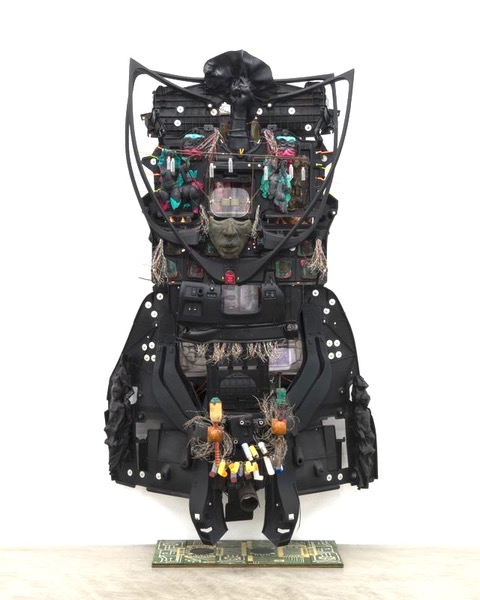 Inside Out, 2009, car parts, ABS plastic and mixed media, Photo courtesy Parrasch Heijnen
Inside Out (2009, mixed media), is a complex and powerful sculpture. It has the look of a pre-Columbian bas-relief in its initial impact. In it, a large sculpture of an African mask is surrounded symmetrically by myriad details. Each one is a symbol of some moment from the artist’s life—empty inhalers that Dickson needs for his asthma, small, sculpted figures from some earlier projects left in his studio, a Black Power fist—all these elements are masterfully composed within the lines and contours of the car parts that have been organized into this marvelous work. Dashboard, window frames, circuits and electrical wires all reassembled into a metaphor of this ancient modern relic of our contemporary world. Within, hidden from view unless one peeks through the assemblage, are alchemical photographs laminated in plastic. These were intentionally left on his studio floor for months. Walked on, soaked in rainwater leaking from his studio ceiling, covered in dust and affected in many other ways, they contain in matter the random moments in this artist’s life.
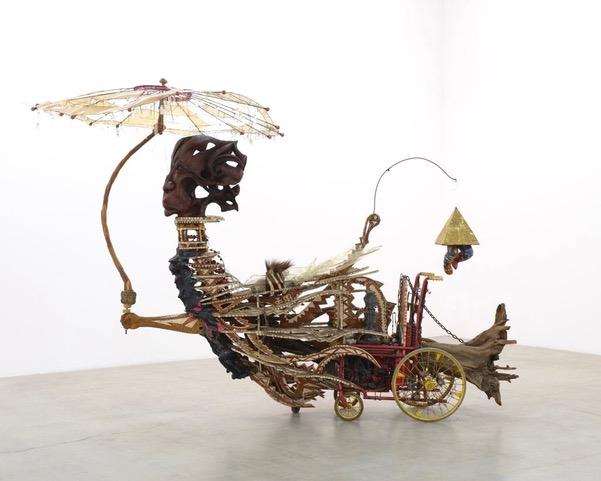
Bongo Mongo Mobilization of the Spirit, 1975, mixed media, Photo credit Parrash Heijnen
The marvelous chariot Bongo Mongo Mobilization of the Spirit (1975, mixed media) is the masterpiece in this exhibition. I first saw it in his studio. Surrounded by an avalanche of work cascading from the ceilings and leaning against the walls, the sculpture was enveloped in the rich history of his own mythic Merzbau. To see it now, clearly, in the elegant, spare installation that the gallery designed, is a joy. Each element of its complex construction can be discerned, the effect of this fanciful craft animating the space around it. It suggests a magnificent transport that could have carried Sun Ra through the streets of Harlem. Its free-form arrangement soars like a John Coltrane saxophone solo. Indeed, the artist has mentioned that music is a deep inspiration for the work he creates. Dickson told me that he first carved the head for this piece out of a rare piece of walnut burl. Later, a disabled friend who purchased a new wheelchair offered the artist his old one and asked that he create a sculpture from it. Dickson first used the wheelchair to create a Mask Cart to display and sell small masks at an art fair. Later, the two different works came together to create this wondrous spirit vehicle carrying the soul of the viewer into realms of freedom and joy.
Dickson spoke about his process, how he saves all the materials from the creation of a sculpture. When carving a piece of wood, he will save the sections cut away for future use. He collects the things he finds in the world at large that engage his imagination, seeing them as both potential for a future yet-to-be imagined piece and as a diaristic snapshot of his life, where he lived and his companions.
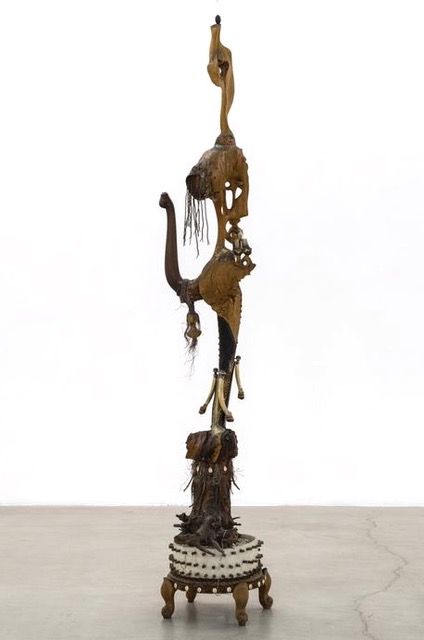 I Feel the Spirit, 1980, mixed media, Photo courtesy Parrasch Heijnen
In I Feel the Spirit (1980, mixed media), a totemic figure is festooned with constellations of objects, each area a small masterpiece of assemblage. Small shapes of copper, brass and leather are tacked to the surface with tiny nails. One can sense the sound of each tack gently being hammered into place, like a cobbler telling stories. A cluster of broken glass, a vial and bits of detritus, glued together in a little mound, speaks of his studio life; maybe these are sweepings, colorful remnants of carved and cut materials from his workspace. Bullet casings he found in and around his Compton studio when he first moved there in the 1970s, adorn the base. The sculpture is tall and slender with a carved wooden face that sits atop the exquisite passages of inspired improvisation. The sculpture’s lovely arm is from a chair leg he found in the street. It seamlessly and elegantly gives the overall form a more human-like presence. Each of the various elements—eye glass, cowrie shells, bones—add to the mythic aura of this piece. It has a presence that both speaks to his experience as an African American artist and embodies a link to his ancestral roots.
Dickson is a visual poet. He creates in eloquent and earthy forms and materials a poetry of his life as an artist and of the world we live in. His work is imbued with a spiritual presence that speaks directly to the soul.
Parrasch Heijnen
1326 S. Boyle Ave.
Los Angeles, CA

Gary Brewer
Gary Brewer is a painter, writer and curator working in Los Angeles. His articles have appeared in Hyperallergic, Art and Cake, and ART NOWLA.
Email: garywinstonbrewer@gmail.com
Website: http://www.garybrewerart.com
view all articles from this author