Whitehot Magazine
October 2026
"The Best Art In The World"
"The Best Art In The World"
October 2026
The 16th Gwangju Biennale
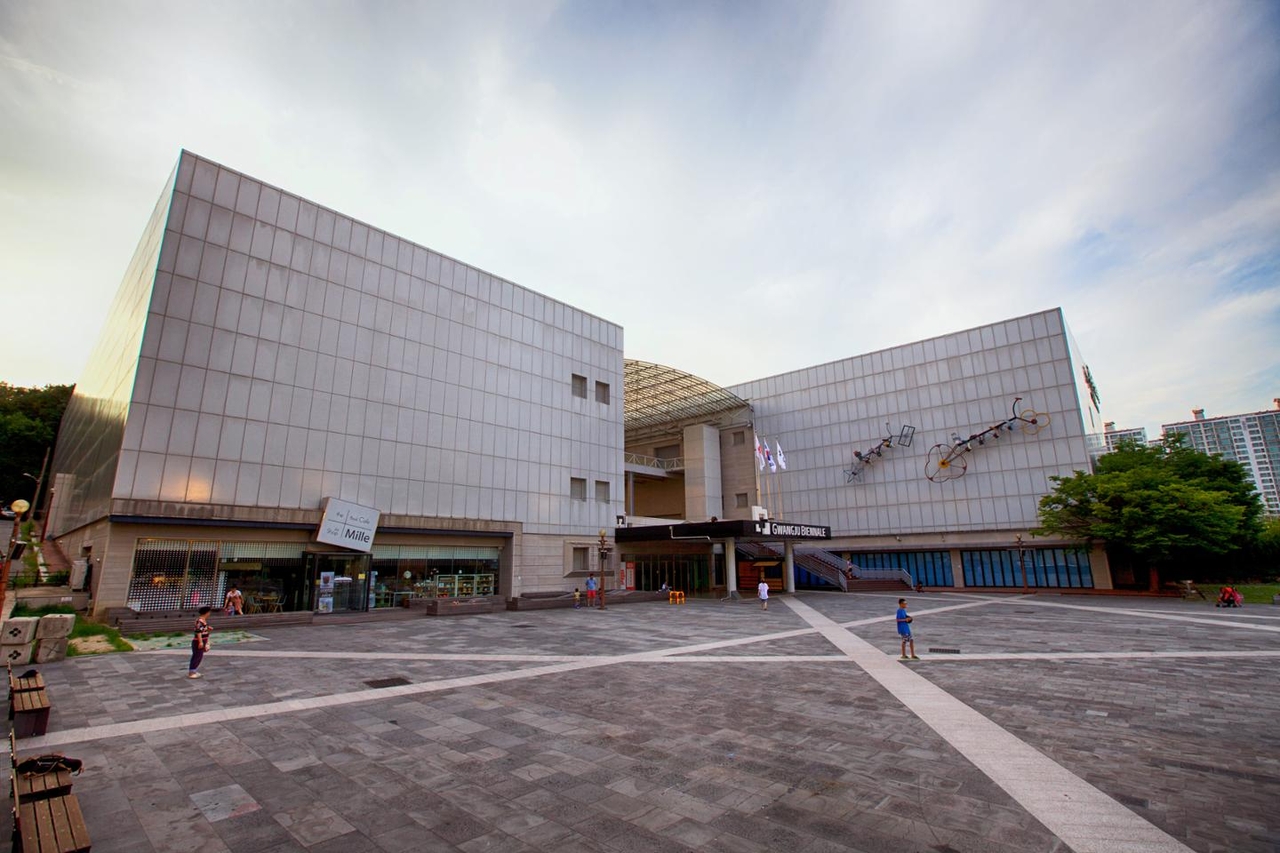 Gwangju NTMoFA
By DANIEL KOND October 12th, 2026
A name on a wall is not a courtesy. It is a fact you are willing to be seen with.
The 16th Gwangju Biennale opened. Theme, from Rilke, as the organisers have it: You Must Change Your Life. Thirty-six artists and curators, Chosun Ilbo reports, answered with a statement of their own: You Must Change Your Name. They were not being decorative. In June the poster had already changed it.
Taiwan's ministry of culture says the satellite show was proposed as the Taiwan Pavilion. Proposal decks, emails, an agreement dated 2 April, all with that name, posted on the ministry site. ARTnews has a second date: an agreement on 23 April using the same designation, and a confirmation on 2 April that the exhibition Instance Dungeons: Gray Zone would appear under that banner. The Gwangju Biennale Foundation says something else: a 12 January agreement with the National Taiwan Museum of Fine Arts, an institutional pavilion, not a national one, therefore NTMoFA on the paper. Two calendars, two contracts, one poster. In August the poster said NTMoFA. Taiwan was not on it.
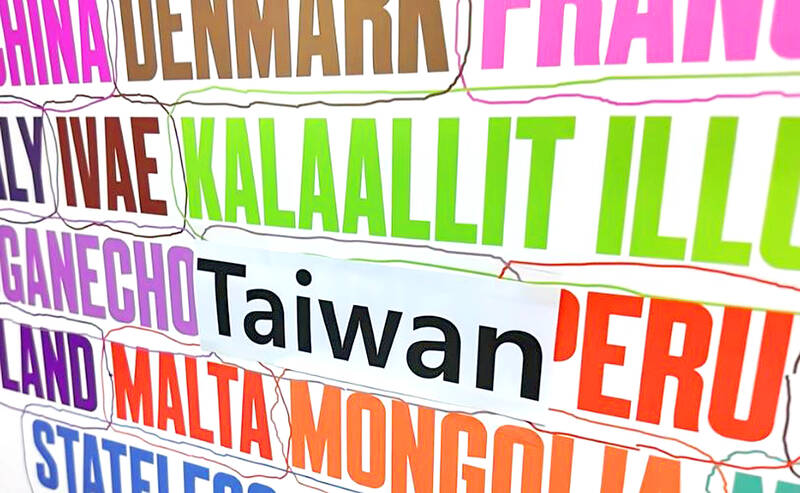 Taiwan sticker over NTMoFA
On 15 August the curator, Chen Xiang-Wen, and nine artists put the sentence on Instagram. The exhibition, they wrote, had been "unilaterally renamed 'NTMoFA', without the consent of the participating team, and brutally erased Taiwan from the poster." Not a caption. A charge: a threat to freedom of expression. Chosun counts ten artists and curators in that statement and describes it as political censorship, which is also what Taiwan's ministry called it, in a protest dated the same day. The Foundation, 19 August: it had not censored planning or content. "This matter does not concern the content of an exhibition or freedom of expression. It arises from an administrative difference concerning participant classification and naming conventions." A national pavilion, it said, requires a letter from an embassy or a ministry. South Korea does not recognise Taiwan. That is not a mood. That is the diplomatic register.
The ministry, ARTnews reports, learned of the NTMoFA listing in June, wrote through the Taipei Mission, and got no reply. It also says the Asia Culture Center, the host venue, refused the team entry from 18 August, and that the Foundation had floated a smaller room. Chen alleged pressure from larger forces. The Art Newspaper, 26 August, was careful: no evidence that Beijing or Seoul had ordered the first rename. At that hour mainland China was publicly quiet. Quiet is not proof of innocence. It is also not a confession. I will not supply one.
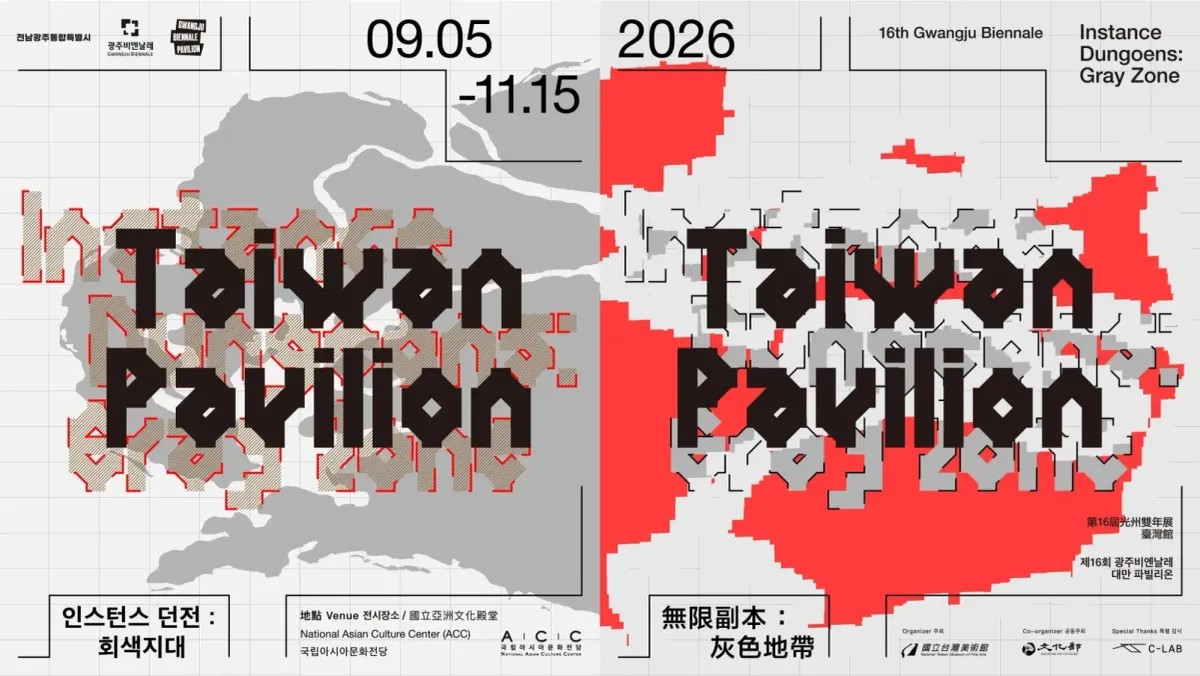 Taiwan pavillion visual
Then the Foundation moved. 25 August, a Tuesday: it told The Art Newspaper it had agreed with Taiwan's ministry and "officially approved the use of the name 'Taiwan Pavilion.'" A letter went to the museum. A request went to the Asia Culture Center, where Korean photographs had shown a cordon. The name returned to the wall. The paper is another matter. Korea JoongAng Daily quotes the Foundation still: the formal name in the agreement remains the museum's; how a participant presents itself in the hall is separate. Wall and letter, two truths in one building. Very expensive building. Very cheap paper.
China was no longer quiet. Thursday, 27 August, Ambassador Dai Bing met the mayor, Min Hyung-bae. (Asia Business Daily, alone among the desks I read, names the ambassador Xing Haiming. The others, citing MBC, name Dai. I am not averaging ambassadors.) Dai, via MBC, expressed regret and concern at what he called a national-pavilion name. Min, same reports, said political considerations should not affect the field of art. The next day Chinese curators and installers walked out of the Ha Jung-woong Museum of Art. Artists had not yet arrived. As of 31 August, Chosun writes this morning, work is still stopped. The Chinese Cultural Center sent a letter over the weekend asking that the Taiwan name be withdrawn. The Chinese pavilion's Friday opening is, in the Korean papers, uncertain. The Foundation told JoongAng the works already in the room have not been pulled. A room with objects and no installers is not an exhibition.
Today, the city of Gwangju apologised. Chosun has the sentence: we respect the One-China Principle in line with the government's diplomatic stance; the use of "Taiwan Pavilion" does not imply recognition of Taiwan as a sovereign state. The wall says Taiwan. The city says it does not mean it. This is what a name costs when the neighbour is larger than the museum.
I live in Tel Aviv. I put names on objects. A signature on a clasp is a small politics. A pavilion is a large one. Gwangju was founded in 1994 to remember 1980, when the city stood up and the army came in. ARTnews writes "upwards of 2,300" civilians killed; a coalition of Korean artists, quoted in the same outlet, says hundreds. The number is still argued in Korea. I will not import the rounder figure from a New York desk and call it history. The founding is enough. A biennale that began as a refusal to be quiet is now writing two captions for the same door.
Beijing's position is not a mystery. It does not recognise Taiwan. Most of the international order does not either. In sport, the island is Chinese Taipei, which is a bureaucratic bruise worn in public. Venice let Taiwan have a national pavilion from 1995 until 2003, ARTnews notes, then demoted it when Beijing arrived with one of its own. Gwangju is not inventing the squeeze. It is performing it, in real time, four days before the doors.
The Foundation's anonymous official, to Chosun: given China's sensitivity, accommodating Taiwan was challenging. That is the closest anyone in the building has come to saying the first rename was not only paperwork. It is still not a cable from Zhongnanhai. I will keep the gap. The gap is the story.
Saturday, the rooms open. Ho Tzu Nyen's title will still be on the banner. Somewhere in the Asia Culture Center a wall will say Taiwan, or it will not, depending which hour you arrive. Across town a Chinese installation may sit unfinished. A name is a material. You can sand it off a poster. You cannot sand it off a city that already said it, and then said it did not mean it.
I do not need a national pavilion. I need the word on the wall to match the thing in the room. If it does not, you are not looking at art. You are looking at a negotiation, hung.
SOURCES
The Art Newspaper, 26 August 2026, "Gwangju Biennale permits Taiwan Pavilion name after row"
ARTnews, "Gwangju Biennale Restores 'Taiwan Pavilion' Amid Censorship Claims"
ARTnews, "China Pulls Artists from Gwangju Biennale Over 'Taiwan Pavilion'"
Chosun Ilbo (English), Byun Hee-won, 1 September 2026, "Gwangju Biennale Caught in Taiwan-China Pavilion Name Dispute" (updated 10:14)
Korea JoongAng Daily, Ha Nam-hyun, "China halts Gwangju Biennale pavilion work over 'Taiwan Pavilion' name"
Taiwan News, 28 August 2026, "China pulls artists from Gwangju Biennale over 'Taiwan Pavilion' name" (citing MBC, Yonhap)
The Asia Business Daily, 28 and 30 August 2026 (names the ambassador Xing Haiming; other desks, citing MBC, name Dai Bing)
The Asia Business Daily, 30 August 2026, on artistic director Ho Tzu Nyen and the 5 September–15 November run (72 days)
Instagram statement, 15 August 2026, Chen Xiang-Wen and participating artists, as quoted by The Art Newspaper
Taiwan Ministry of Culture statements of 15 and 19 August 2026, as quoted by The Art Newspaper and ARTnews
Gwangju Biennale Foundation statements of 19 and 25 August 2026, as quoted above
Gwangju Metropolitan Government, 31 August 2026, as quoted by Chosun Ilbo
Artists' Solidarity Against Censorship, as quoted by ARTnews

Daniel Kond
Daniel Kond is a contemporary artist based in Tel Aviv. Trained as a jeweller at Carl Fabergé College and at ICA Moscow. Writes from the studio. Previously published in Time Out Russia (as Daniil Kondratev).
view all articles from this author